By
John Vandermosten, CFA
NASDAQ:SBPH
NASDAQ:ARWR
Spring Bank had a productive third quarter, providing new details about its STING agonist program which has shown the ability to stimulate interferon production and suppress tumor cell growth in pre-clinical models. While in-human trials are many years off, the initial data as recently presented are compelling. The company has also advanced its efforts with SB 9200, its dinucleotide immunomodulator, with new partner Arrowhead (NASDAQ:ARWR) in a combination trial that seeks a cure for HBV. Currently, the company is enrolling for its 2a trial and has reported third quarter results.
On October 28, 2016, Spring Bank Pharmaceuticals Inc. (NASDAQ:SBPH) filed its third quarter 10-Q generating a quarterly net loss of ($4.1) million for the three month period ending September 30, 2016. This compares to our estimate of a ($4.5) million loss. On a per share basis the loss was ($0.53) better than our estimate of ($0.58). No revenues were reported in the quarter, which is a decline from the $0.3 million received in 3Q:15 from an NIH grant which has since been exhausted.
Research and development expense was $2.7 million in the quarter, increasing from the prior year’s $2.1 million due to a rise in activity costs for the Phase 2a clinical trial for SB 9200. The increase also stemmed from higher personnel costs and a greater number of R&D personnel. The amount was slightly lower than our estimate of $2.9 million.
General and administrative costs were $1.5 million, flat sequentially and down slightly from the $1.6 million expended in 3Q:15. Lower severance offset by higher administrative personnel costs, a greater number of personnel and increased legal and liability insurance expenses were behind the change. Our G&A estimates were for expenditures of $1.6 million.
Other income consists of interest income and totaled $27,000 in the three-month period compared to $10,000 in the third quarter of 2015.
Spring Bank consumed $11.7 million in free cash flow for the first nine months of 2016 and $2.8 million for the quarter. The nine month use of free cash was up from the $6.3 million consumed in the same period in 2015. Net loss for the first nine months of the year was $15.0 million, and non-cash adjustment for stock-based compensation and issuance of stock for a license agreement reduced net cash used to the previously mentioned free cash flow of $11.7 million.
Cash balance declined sequentially from $19.6 million to $15.6 million with an operating burn of $2.8 million in the quarter.
Key Events
The company announced several key events during the quarter.
- Acceptance of abstract for STING Agonist program and poster presentation at the American Association for Cancer Research (AACR) Special Conference on Tumor Immunology and Immunotherapy. The conference took place from October 20 to 23. The abstracts highlight the potent immune-modulating and anti-tumor activities of SB 11285 in multiple in vitro systems. A summary of the poster detail is provided
here. The titles of the two posters being presented are:
-
Nucleotide Analogs as Novel STING Agonists for Immuno-oncology -
Novel dinucleotides that activate STING signaling for Immuno-oncology- A collaboration between Spring Bank and Arrowhead (NASDAQ: ARWR) for the development of chronic HBV treatment. Currently, Arrowhead is conducting its
MONARCH study, which is employing an RNAi-based therapy in conjunction with other therapeutic agents that can lead to a cure of HBV. The MONARCH study is a Phase 2b trial that is employing Arrowhead’s lead compound, ARC-520.
- Continuation of enrollment of patients in the
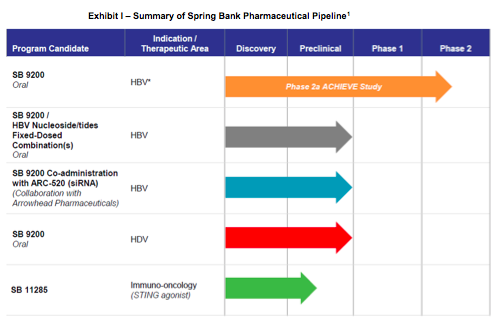
ACHIEVE trial which is expected to provide a readout in the first half of 2017. The first cohort (25 mg) is in process of enrolling in Canada and Korea. Hong Kong and Taiwan centers are expected to open in the next four to six weeks.
SB 9200
Using the SMNH technology, Spring Bank has developed SB 9200, which is designed to bind to RIG-I and NOD2, two cytosolic antiviral signaling proteins. SB 9200 is composed of two chemically modified nucleotides linked together. The compound is a prodrug that is rapidly absorbed and converted into its active moiety. It is taken up by the liver where it seeks out RIG-I and NOD2 and binds to them. The HBV virus is able to downregulate the natural antiviral functions of RIG-I and NOD2, thereby preventing the body’s natural immune defense from activating and killing the virus. When SB 9200 enters the cell, it restores interferon production by interacting with RIG-I and NOD2.
SB 9200 Use in Combination Therapy
As we mentioned in our initiation, the concurrent use of multiple therapies is believed necessary to clear HBV from the liver. This potentially includes an immunomodulator, a disease modifying agent and an antiviral suppressant. Many companies are working on combination therapies in disease modifying agents and antivirals and have publicly indicated the need for an immunomodulator in the treatment regimens in their studies. Interferon is the only approved immunomodulator therapy available, however, the side effects are difficult for patients to tolerate resulting in low compliance by study subjects and potential additional costs for a trial using this as part of the combination. Therefore, Spring Bank’s SB 9200 is a natural alternative given the promising data from the animal studies and the Phase 1 trial. Spring Bank has publicly stated a desire to study SB 9200 in CHB patients in combination use with other treatment modalities either currently marketed or in clinical development. On October 6, 2016, Spring Bank and Arrowhead Pharmaceuticals announced a collaboration to use SB 9200 in conjunction with Arrowhead’s ARC-520 in HBV therapy in its MONARCH trial.
The combination therapy will join SB 9200’s immunomodulatory features with the gene silencing qualities of ARC-520. A direct-acting antiviral will also be used, such as tenofovir or entecavir. If successful, the trial will show increased cure rates for HBV, with improved tolerability and shorter duration of treatment compared to standard therapy. The MONARCH trial is expected to be completed by first half 2019.
For a free copy of the full research report, please email scrinvestors@zacks.com with SBPH as the subject.
SUBSCRIBE TO ZACKS SMALL CAP RESEARCH to receive our articles and reports emailed directly to you each morning. Please visit our website for additional information on Zacks SCR and to view our disclaimer.