By Grant Zeng, CFA
OBB:SNGX
In our previous reports or articles on Soligenix (OBB:SNGX), we talked a lot about the company’s clinical programs. In this article, we will be focused on the company’s technology: the Innate Defense Regulator (IDR) Platform.
The IDR Platform Has Potential to Targets Multiple Indications
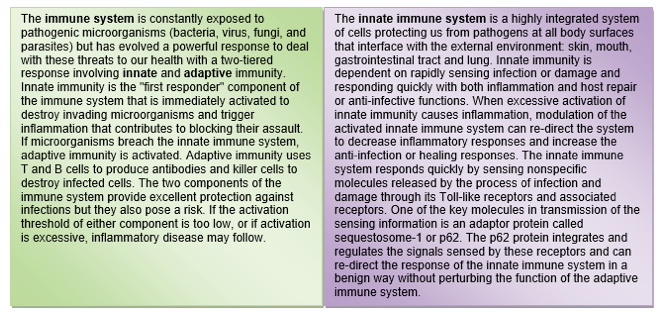
IDRs provide a novel approach to the control of infection and tissue damage via highly selective binding to an intracellular adaptor protein, sequestosome-1, also known as p62, which has a pivotal function in signal transduction during activation and control of the innate defense system. Sequestosome is a recently identified target for modulation of innate defenses and is expressed in most cell types.
IDRs have no direct antibiotic activity but modulate host responses, increasing survival after infections with a broad range of bacterial Gram-negative and Gram-positive pathogens including both antibiotic sensitive and resistant strains, as well as accelerating resolution of tissue damage following exposure to a variety of agents including bacterial pathogens, trauma and chemo- or radiation-therapy.
Since IDRs target the host (and not the pathogen), IDRs do not engender resistance and are active against resistant pathogens. In vitro data indicate that the endothelium plays a significant role in IDR activity and animal studies show that IDRs selectively promote monocyte and macrophage recruitment to disease sites and accelerate resolution of disease. Though IDR action depends on monocytes and macrophages, there is no dependence on either the adaptive immune system (e.g., T cells and B cells) or neutrophils. This suggests that IDRs may be effective in immunosuppressed patients. Moreover, p62 functions downstream of signaling receptors (TLRs, NODs) responsible for sensing both infection and tissue damage, which gives it a role in innate immune modulation relevant to a wide range of diseases from infection (pathogen sensing) to colitis and mucositis (damage sensing).
SGX942 Could be a Game Changer in the Treatment of Oral Mucositis
SGX942 is the lead IDR candidate for Soligenix, which is developing SGX942 to treat infections and tissue damages. SGX942 represents a novel and innovative approach to therapeutically modulating the immune system by targeting the innate immune system and has the potential to target multiple indications.
Soligenix acquired SGX942 (formerly IMX942) in December 2012 from Inimex Pharmaceuticals of Canada. Soligenix is developing SGX942 for the treatment of oral mucositis in head and neck cancer patients following chemo- or radiation therapy.
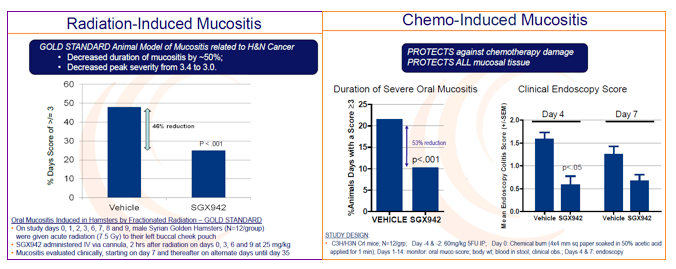
SGX942 is a fully synthetic, 5-amino acid peptide with high aqueous solubility and stability. Extensive in vivo preclinical studies have shown that SGX942 reduces tissue damage associated with chemotherapy, radiation, trauma and inflammation. Although SGX942 is not directly antimicrobial, it accelerates pathogen clearance and increases host survival in a broad spectrum of bacterial infections including Gram positive and negative bacteria, and both drug sensitive and resistant strains, by directly targeting the host innate immune system.
Extensive animal data set points to high potential for development of a broad spectrum of SGX942 products based on the following attributes:
- ameliorate injury;
- reduce inflammation;
- fight both antibiotic sensitive and resistant infections;
- complement antibiotics; and
- protect immune-compromised animals.
More specifically, SGX942 ameliorates tissue damage in models of chemotherapy- or radiation-induced mucositis as well as DSS-induced colitis and has shown accelerated healing in a murine model of skin infection and injury. SGX94 is not a growth factor and does not promote tumor growth or protect tumors against treatment in a breast cancer xenograft model using the MCF-7 cell line.
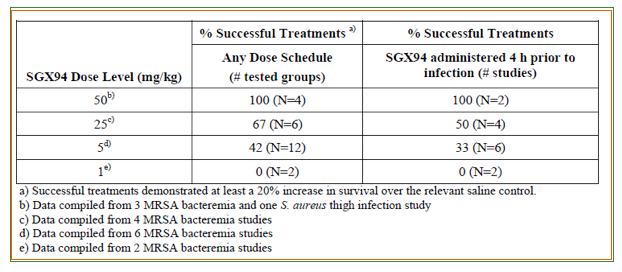
Studies in murine models of bacterial infection have shown activity against a broad range of pathogens including methicillin-resistant S. aureus (MRSA), K. pneumoniae, E.coli, P. aeruginosa, and B. pseudomallei. SGX94 enhances the activity of antibiotics administered at sub-optimal doses. Studies in a model of MRSA bacteremia indicate that SGX94 is effective both therapeutically and prophylactically. SGX94 is most effective when administered by IV injection and has a very short plasma half-life (~10 minutes). When administered prophylactically in the MRSA model, a single dose of SGX94 is protective when injected up to 5 days before bacterial challenge, indicating a prolonged pharmacodynamic effect despite rapid plasma clearance.
Inimex completed a double-blind, placebo-controlled Phase I clinical trial of SGX942 in 84 healthy volunteers with both single ascending dose and multiple ascending dose components. SGX942 showed a strong safety profile when administered IV over 7 days and was consistent with safety results seen in pre-clinical studies. Drug clearance in humans is rapid and similar to results seen in pre-clinical studies.
Development Status of SGX942
SNGX initiated a Phase II proof of concept (POC) study of SGX942 (NCT02013050) for the treatment of oral mucositis in head and neck cancer patients in December 2013.
This Phase II trial is a randomized, double-blind, dose-ranging, placebo-controlled trial, initially set to enroll approximately 75 subjects across three SGX942 dose groups (1.5 mg/kg, 3.0 mg/kg and 6.0 mg/kg) and placebo, focused on demonstrating the safety and biologic activity of SGX942 in patients with tumors of the mouth and oropharynx who often experience debilitating oral mucositis as a consequence of tumor treatment with chemoradiation therapy (CRT).
In early March 2015, Soligenix received a positive recommendation from the Data Review Committee (DRC) to continue the enrollment. Following DRC review of available data on the subjects enrolled in the trial, the committee recommended that enrollment include an additional 20 subjects randomized into either a single SGX942 dose group or the placebo group to allow for a more targeted assessment of the drug's potential effect and to inform final dose selection in this patient population.
The primary efficacy assessment is the comparison of the incidence and/or duration of both ulcerative and severe oral mucositis throughout the subjects' 7 week course of CRT and for an additional 4 weeks thereafter. Other key efficacy measures will assess patient reported outcomes, pharmacoeconomic parameters such as hospitalization and radiation-associated side effects including mouth stiffness and dryness.
In August 2015, the trial completed the expanded enrollment.
In December, 2015, Soligenix announced positive results from the Phase II trial.
The Phase II study enrolled 111 patients across three SGX942 dose groups (1.5, 3.0, and 6.0 mg/kg) and a placebo group and evaluated patients undergoing CRT for head and neck cancer.
This POC Phase II study achieved all objectives. In the 1.5 mg/kg treatment group, the median duration of severe oral mucositis was decreased by 50% in all patients, from 18 days to 9 days (p=0.099), meeting the prospectively defined statistical threshold of p<0.1.
In a subgroup of patients receiving the most aggressive chemoradiation therapy, the median duration of severe oral mucositis was reduced even more from 30 days to 10 days (67%, p=0.04). The sample size was reasonable as well.
The 1.5 mg/kg dose was identified as the best dose for future trials.
Further, a trend towards increased incidence of "complete response" of tumor at the one month follow up visit was observed (47% in placebo vs. 63% in SGX942 at 1.5 mg/kg). Decreases in mortality and significant decreases in infection rate were also observed with SGX942 treatment and are being further evaluated.
SGX942 was generally safe and well tolerated, consistent with the safety profile observed in the prior Phase I study conducted in 84 healthy volunteers.
Long-term follow-up evaluations are ongoing with final results expected in 4Q16. Data from this Phase II trial is expected to be submitted for future presentation and publication.
The positive results from the POC Phase II trial represents a significant milestone in the development of SGX942 for the treatment of oral mucositis. The Company has generated results in large number of animal models and from a phase I safety trial in healthy volunteers, but this is the first time SGX942, which is considered a new chemical entity, has been used to treat sick patients of oral mucositis in head and neck cancer patients. This is a very sick and difficult patient population to study where there are currently no FDA approved drugs to combat this condition.
SGX942 has received fast-track designation from the FDA.
The Next Step
Soligenix plans to meet the FDA as soon as possible to discuss the next step of development of SGX942 for the treatment of oral mucositis. Given the positive and compelling preliminary data generated in oral mucositis, where there is substantial market potential, we believe that a pivotal trial could potentially be designed of a size roughly similar to the completed Phase II trial.
Simultaneous with the FDA meeting, the company will be aggressively pursuing opportunities for partnership to support subsequent clinical trials with SGX942. With the compelling data from the Phase II trial, it’s our belief that it should be relatively easy to find a partner with favorable terms.
With the biologic activity of the IDR technology now confirmed in humans, Soligenix will also look to expand its potential utility in the infectious disease space.
In a preclinical animal studies, SGX942 demonstrated dose dependent efficacy for the treatment of S. aureus infection.
Market Opportunity of SGX942
SGX942 has the potential to provide adjunctive or stand-alone therapies for the broader antimicrobial/antibiotic, antiviral, anti-inflammatory, and anti-cancer markets. Each of the above mentioned market is a multibillion dollar market.
More narrowly, the tissue damage (mucositis) opportunity alone represents a $1B+ market.
Mucositis is a debilitating condition involving extensive ulceration of the oral cavity that frequently affects cancer patients undergoing radiation and chemotherapy treatment. Roughly 90% of patients on radiation (43% severe) and 40% of patients receiving chemotherapy get mucositis. There are an estimated 500,000 cancer patients getting mucositis annually in the United States alone. World-wide, the potential market for mucositis will exceed $1 billion in the next few years.
Mucositis can be severely debilitating and can lead to infection, sepsis, the need for parenteral nutrition and narcotic analgesia. The gastrointestinal damage causes severe diarrhea. These symptoms can limit the doses and duration of cancer treatment, leading to sub-optimal treatment outcomes. We believe any treatment that accelerates healing and/or diminishes the rate of appearance of mucositis would have a significant beneficial impact on the quality of life of these patients and may allow for more aggressive chemotherapy.
The mechanisms of mucositis have been extensively studied and have been recently linked to the interaction of chemotherapy and/or radiation therapy with the innate defense system. Bacterial infection of the ulcerative lesions is now regarded as a secondary consequence of dysregulated local inflammation triggered by therapy-induced cell death, rather than as the primary cause of the lesions. As a modulator of the innate immune system, SGX942 has the potential to target both primary and secondary causes of mucositis.
Oral mucositis is an area of unmet medical need where there are only limited treatment options. Ccurrently, no drug has been approved for oral mucositis in head and neck cancer. We noticed that there are a few products already on the market for oral mucositis. But the competitive landscape favors SGX942 in our view.
Most of the current treatment options for mucositis only address the symptoms and do not address the cause of mucositis, while Soligenix’s SGX942 has a new mechanism of action which can address both the primary and the secondary causes of mucositis. We believe that, if approved, SGX942 will command a significant market share of the mucositis market, which could reach $1 billion in the next few years.
Bacterial infections such as acute bacterial skin and skin structure infections (ABSSSI) are increasing dramatically, with treatment days in the US projected to rise from 20 to 30 million 2009-2015, with ~75% of cases caused by S. aureus (MSSA or MRSA). Additional infection indications include prevention of infection in chemotherapy patients, as well as the treatment of ventilator associated pneumonia, tracheobronchitis, bacteremia, and endocarditis. As more and more pathogens become antibiotic resistant and the number of elderly and immuno-compromised patients increases, the demand for existing and new therapies is expected to rise. SGX942 has the potential to target various infections especially the drug resistant infections.
SUBSCRIBE TO ZACKS SMALL CAP RESEARCH to receive our articles and reports emailed directly to you each morning. Please visit our website for additional information on Zacks SCR and to view our disclaimer.