By
Grant Zeng, CFA
OBB:SNGX
Dusquetide Has Potential to Targets Multiple Indications
Soligenix’s (OBB:SNGX)
dusquetide (SGX94) is an Innate Defense Regulator (IDR). IDRs provide a novel approach to the control of
infection and
tissue damage via highly selective binding to an intracellular adaptor protein,
sequestosome-1, also known as
p62, which has a pivotal function in signal transduction during activation and control of the innate defense system. Sequestosome is a recently identified target for modulation of innate defenses and is expressed in most cell types.
Dusquetide is a fully synthetic, water soluble, 5-amino acid synthetic peptide that is the lead clinical candidate in a new class of compounds called Innate Defense Regulators (IDRs).
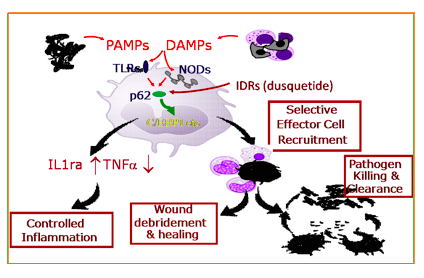
Unlike other attempts at immune modulations that target either the inputs or the outputs of the innate immune system, dusquetide targets a key intracellular convergence point in the innate immune signaling pathways. Thus, dusquetide is effective whether the innate immune system is triggered by tissue damage (damage associated molecular patterns or DAMPs) or by bacterial infection (pathogen associated molecular patterns or PAMPs).
Dusquetide Does Not Engender Resistance
Because dusquetide acts a point of convergence in the signaling pathways, it is able to redirect the emphasis given to a number of pathways – some are unaffected, some are increased and some are decreased. The result of this pathway modulation is an increased anti-inflammatory response and an enhanced recruitment of specific cells (e.g., macrophages) to the site of infection and /or tissue injury. Macrophages are responsible for “cleaning up” and can remove both bacteria and dead/dying tissue as needed. This contributes to the resolution of infection and tissue damage.
Dusquetide has no direct antibiotic activity but modulates host responses, increasing survival after infections with a broad range of bacterial Gram-negative and Gram-positive pathogens including both antibiotic sensitive and resistant strains, as well as accelerating resolution of tissue damage following exposure to a variety of agents including bacterial pathogens, trauma and chemo- or radiation-therapy.
Since dusquetide targets the host (and not the pathogen), it does not engender resistance and is active against resistant pathogens. In vitro data indicate that the endothelium plays a significant role in dusquetide activity and animal studies show that dusquetide selectively promotes monocyte and macrophage recruitment to disease sites and accelerate resolution of disease. Though dusquetide action depends on monocytes and macrophages, there is no dependence on either the adaptive immune system (e.g., T cells and B cells) or neutrophils. This suggests that dusquetide may be effective in immunosuppressed patients. Moreover, p62 functions downstream of signaling receptors (TLRs, NODs) responsible for sensing both infection and tissue damage, which gives it a role in innate immune modulation relevant to a wide range of diseases from infection (pathogen sensing) to colitis and mucositis (damage sensing).
Dusquetide Targets a Wide Range of Bacteria Including Superbugs
Because dusquetide is recruiting a more effective response from the host’s innate immune system, it is effective against many different kinds of bacteria including gram-negative and gram-positive. This is in direct contrast to antibiotics which target the bacteria directly and are usually only indicated for specific subtypes of bacteria, depending on how they target bacteria. This broad-spectrum activity of dusquetide means that it can be used in many situations before the infectious organism can be identified. Dusquetide can also be used:
- in high risk situations, to prevent infection,
- after infection but before specific pathogen is known, pre-emptively,
- after frank presentation of symptoms and diagnosis, therapeutically,
Moreover, because dusquetide does not target the bacteria, it is not likely to induce resistance the way antibiotics do, allowing for broader use.
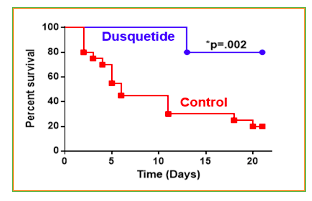
In the figure below, treatment with dusquetide alone resulted in a significant improvement in survival after infection with methicillin resistant Staphylococcus aureus (MRSA). MRSA is a gram-positive, primarily extracellular, antibiotic resistant bacteria.
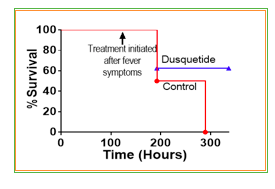
In the figure below, treatment with dusquetide alone 5 days after infection resulted in significant improvement in survival after infection with Pseudomonas aeruginosa in immune compromised animals. P. aeruginosa is a gram-negative, intracellular bacterium.
Dusquetide Can Be Used with Antibiotics
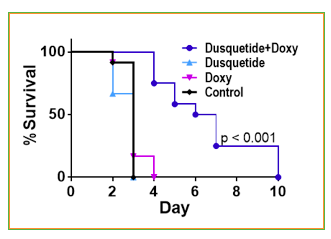
Dusquetide has a completely different mechanism from antibiotics and their action is complementary. So the combination of the two may be more effective than any one alone. For instance, in the figure below, dusquetide and doxycyline alone are not effective in improving survival after infection with Burkholderia pseudomallei. However, treatment with both together is more effective than either alone. B. pseudomallei is a gram-negative, intracellular, antibiotic-resistant bacterium what is also considered a Tier 1 biothreat.
In Summary, Dusquetide, a broad-spectrum, host-targeted therapeutic for the treatment of bacterial infections, would confer a number of unique clinical advantages including:
- A reduced likelihood of generating resistance since the IDR directly targets the host, not the pathogen
- Treatment when antibiotics are contra-indicated, e.g.:
- Before the infectious organism and/or its antibiotic susceptibility is known
- In at risk populations prior to infection
- An ability to be used as an adjunctive treatment for antibiotics, thereby:
- Enhancing efficacy of suboptimal antibiotic regimens such as in the case of antibiotic-resistant infections
- Enhancing clearance of infection, thereby minimizing the generation of antibiotic resistance
- Reducing the amount of antibiotic required, again potentially minimizing the generation of antibiotic resistance
- An ability to modulate the adverse consequences of inflammation in response to the infection
Development Status of Dusquetide in Infectious Disease
Preclinically, dusquetide has been extensively tested for both safety and efficacy. In a preclinical animal studies, dusquetide has demonstrated dose dependent efficacy for the treatment of S. aureus infection.
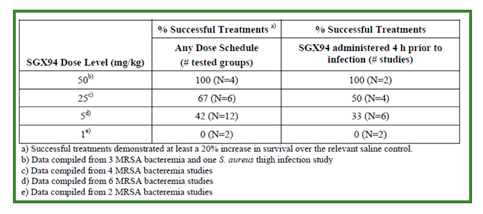
A Phase I study in 84 healthy human volunteers has been completed and demonstrated that dusquetide is safe.
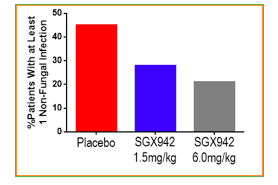
A Phase II study in oral mucositis in head and neck cancer patients receiving chemoradiation therapy is also completing. While this study looked at oral mucositis, an indication more associated with the anti-inflammatory and tissue-healing aspects of dusquetide activity, preliminary results demonstrated that all the preclinical biology observed in animals translated into the human clinical setting, including a reduced incidence of non-fungal (bacterial) infection in the dusquetide treated groups.
In the figure below, the incidence of non-fungal infection in the Phase II study is shown. Infection is also a serious side effect of the chemoradiation therapy the head and neck cancer patients receive for tumor treatment.
Market Opportunity for Dusquetide in Bacterial Infections
The dusquetide platform offers a new way to address serious infections and injury by enhancing the host response without increasing inflammation. Positive clinical activity in the Phase II study provides important Proof-of-Concept for the IDRs. Soligenix’ technology has the potential to provide adjunctive or stand-alone therapies for the broader antimicrobial/antibiotic (US$22B) antiviral (US$22B), anti-inflammatory (US$58B) and anti-cancer (US$50B) markets. More narrowly, the skin infection opportunity alone represents a $1B+ market.
Bacterial infections such as acute bacterial skin and skin structure infections (ABSSSI) are increasing dramatically, with treatment days in the US projected to rise from 20 to 30 million 2009-2015, with ~75% of cases caused by S. aureus (MSSA or MRSA).
Additional infection indications include prevention of infection in chemotherapy patients, as well as the treatment of ventilator associated pneumonia, tracheobronchitis, bacteremia, and endocarditis. As more and more pathogens become antibiotic resistant and the number of elderly and immuno-compromised patients increases, the demand for existing and new therapies is expected to rise. For example, the global anti-infectives market is forecast to expand at a compounded annual growth rate (CAGR) of 5.7% through 2013 according to Business Insights.
SUBSCRIBE TO ZACKS SMALL CAP RESEARCH to receive our articles and reports emailed directly to you each morning. Please visit our website for additional information on Zacks SCR and to view our disclaimer.