By Grant Zeng, CFA
OTC:SNGX
On Dec. 8, 2016, Soligenix (OTC:SNGX) announced the long-term follow-up data from its Phase II clinical trial with SGX942 (dusquetide) in the treatment of oral mucositis (OM) in head and neck cancer patients undergoing chemoradiation therapy (CRT).
SGX942 has received fast-track designation from the FDA.
The Phase II Trial
In December, 2013, SNGX initiated the Phase II study of SGX942 (NCT02013050) for the treatment of oral mucositis in head and neck cancer patients.
This Phase II trial is a randomized, double-blind, dose-ranging, placebo-controlled trial, initially set to enroll approximately 75 subjects across three SGX942 dose groups (1.5 mg/kg, 3.0 mg/kg and 6.0 mg/kg) and placebo, focused on demonstrating the safety and biologic activity of SGX942 in patients with tumors of the mouth and oropharynx who often experience debilitating oral mucositis as a consequence of tumor treatment with chemoradiation therapy (CRT).
In early March 2015, Soligenix received a positive recommendation from the Data Review Committee (DRC) to continue the enrollment. Following DRC review of available data on the subjects enrolled in the trial, the committee recommended that enrollment include an additional 20 subjects randomized into either a single SGX942 dose group or the placebo group to allow for a more targeted assessment of the drug's potential effect and to inform final dose selection in this patient population.
The primary efficacy assessment is the comparison of the incidence and/or duration of both ulcerative and severe oral mucositis throughout the subjects' 7 week course of CRT and for an additional 4 weeks thereafter. Other key efficacy measures will assess patient reported outcomes, pharmacoeconomic parameters such as hospitalization and radiation-associated side effects including mouth stiffness and dryness.
In August 2015, the trial completed the expanded enrollment.
The Initial Positive Data
In December 2015, Soligenix announced initial positive results from the Phase II clinical trial.
In June 2016, the Company presented the data at the Multinational Association for Supportive Care in Cancer (MASCC) conference in Adelaide, Australia.
The Phase II study enrolled 111 patients across three SGX942 dose groups (1.5, 3.0, and 6.0 mg/kg) and a placebo group and evaluated patients undergoing CRT for head and neck cancer.
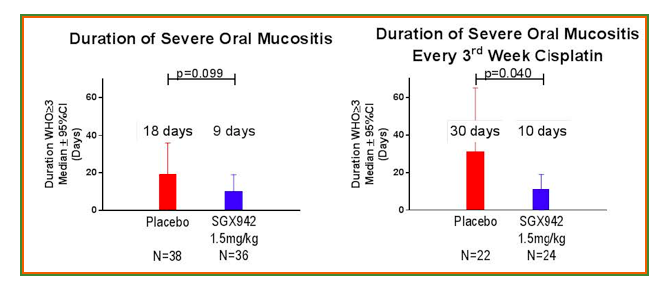
This POC Phase II study achieved all objectives. In the 1.5 mg/kg treatment group, the median duration of severe oral mucositis was decreased by 50% in all patients, from 18 days to 9 days (p=0.099), meeting the prospectively defined statistical threshold of p<0.1.
In a subgroup of patients receiving the most aggressive chemoradiation therapy, the median duration of severe oral mucositis was reduced even more from 30 days to 10 days (67%, p=0.04). The sample size was reasonable as well.
The 1.5 mg/kg dose was identified as the best dose for future trials.
Further, a trend towards increased incidence of "complete response" of tumor at the one month follow up visit was observed (47% in placebo vs. 63% in SGX942 at 1.5 mg/kg). Decreases in mortality and significant decreases in infection rate were also observed with SGX942 treatment and are being further evaluated.
SGX942 was generally safe and well tolerated, consistent with the safety profile observed in the prior Phase I study conducted in 84 healthy volunteers.
The Long-Term Follow Up Data
The additional 12-month safety data remained consistent with the preliminary positive safety and efficacy findings from the Phase II study and provided further support for advancing SGX942 into a pivotal Phase IIb/III clinical trial.
Long-term follow-up visits conducted throughout 2016 further demonstrated that SGX942 was safe, well-tolerated, and did not interfere with CRT as demonstrated by improved survival and tumor resolution at one and 12 months. Overall, there were no drug-related toxicities identified in this study.
While the placebo population experienced the expected 12-month survival rate of approximately 80%, as defined in the Surveillance, Epidemiology, and End Results (SEER) statistics 1975-2012 from the National Cancer Institute, the SGX942 1.5 mg/kg treatment group reported a 12-month survival rate of 93% (7% mortality in the SGX942 1.5 mg/kg group compared to 19% in the placebo group). Similarly, tumor resolution (complete response) at 12 months was better in the SGX942 1.5 mg/kg treatment group relative to the placebo population (80% in the 1.5 mg/kg group compared to 74% in the placebo group).
In addition to safety, evaluations of other secondary efficacy endpoints, such as the utilization of opioid pain medication, indicated that the SGX942 1.5 mg/kg treatment group had a 40% decrease in the use of opioids at the later stage of the treatment phase of the trial, when OM is usually most severe and expected to increase pain medication use. This was in contrast to the placebo group, which demonstrated a 10% increase in use of opioids over this same period. These results were consistent with the observed significant decrease in the duration of severe OM. There were no differences observed in the rates of xerostomia (dry mouth) and trismus (limited jaw range of motion) across the SGX942 and placebo dose groups in the study.
The Implication and Future Development Plan
The positive results from the POC Phase II trial represents a significant milestone in the development of SGX942 for the treatment of oral mucositis. The Company already generated results in large number of animal models and from a phase I safety trial in healthy volunteers, but this is the first time SGX942, which is considered a new chemical entity, has been used to treat sick patients of oral mucositis in head and neck cancer patients. This is a very sick and difficult patient population to study where there are currently no FDA approved drugs to combat this condition.
The study met all of its objectives including defining a clinically effective dose of SGX942 – specifically the 1.5 mg/kg as seen in both the acute and long-term follow-up phases of the trial. The Phase II study also identified the most appropriate clinical endpoint and patient population to use in a future pivotal study.
The company is engaging the FDA and the European Medicines Agency (EMA) on the design of a pivotal Phase IIb/III clinical program.
Simultaneous with the FDA meeting, the company will be aggressively pursuing opportunities for partnership to support subsequent clinical trials with SGX942. With the compelling data from the Phase II trial, it’s our belief that it should be relatively easy to find a partner with favorable terms.
Further, with the biologic activity of the IDR technology now confirmed in humans, Soligenix will also look to expand its potential utility in the infectious disease space.
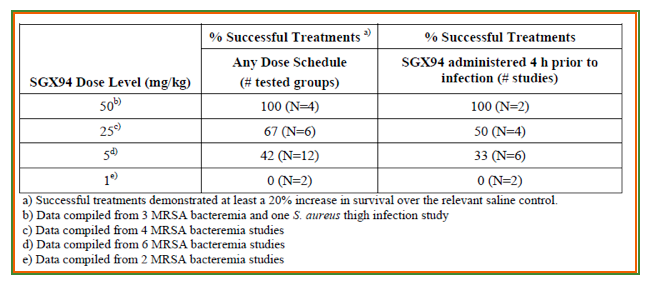
On March 29, 2016, the Company announced the publication of preclinical efficacy results with dusquetide (SGX942) in the Journal of Biotechnology. This publication further described the unique mechanism of action of dusquetide and its activity in infectious disease. The described preclinical results are very consistent with the reduction in the incidence of infection observed in the recently reported clinical results. In the publication, SGX942 demonstrated dose dependent efficacy for the treatment of S. aureus infection.
SGX942 Could be a Game Changer in the Treatment of Oral Mucositis
SGX942 belongs to a new class of compounds called Innate Defense Regulators (IDRs) which represents a novel and innovative approach to therapeutically modulating the immune system by targeting the innate immune system and has the potential to target multiple indications, especially for the treatment of tissue damages and infections.
Recently, we interviewed Dr. Stephen T. Sonis, DMD, DMSc with regard to his view on oral mucositis and biotech company Soligenix’s lead candidate SGX942 for the treatment of oral mucositis induced by cancer treatments.
Dr. Sonis is a Clinical Professor of Oral Medicine at Harvard School of Dental Medicine and Senior Surgeon and Chief, Divisions of Oral Medicine at Brigham and Women’s Hospital and the Dana-Farber Cancer Institute, and Chief Scientific Officer of BioModels, LLC. Dr. Sonis is a veteran in the field of oral mucositis induced by chemoradiation therapy (CRT).
According to Dr. Sonis, significant mucositis occurs in about 450,000 patients per year in the US including patients who receive standard chemotherapy regimens (breast, colorectal cancer, lung cancer, etc.). Consequently, chemotherapy dose-de-escalation is a current strategy.
Overall, clinically significant mucositis impacts almost all patients with head and neck cancer (HNC) treated with chemoradiation; 70% patients get severe mucositis. Patients develop extensive, deep, extremely painful ulcerations of the lining of the mouth and throat that requires narcotic analgesics. Despite narcotics, many patients have break-through pain which effects their ability to function (including eating). When asked, mucositis is most frequently reported as the worst treatment complication among HNC patients being treated with CRT.
The health and economic costs of mucositis in this population are profound: the incremental cost of mucositis is over $17,000 per patient with the condition and is largely driven with the need for hospitalization to manage dehydration or pain. Patients who are radiated are treated with small daily doses of radiation for about 7 weeks. Since the biological drivers of mucositis start immediately with the first dose of radiation, preventive strategies for mucositis start on day 1 and continue throughout the radiation course. Consequently, while the total number of new cases of HNC in the US is relatively small (about 50K new cases per year), the dosing opportunity is significant. HNC represents about 20% of the total potential mucositis market.
However, there are no approved, mechanistically-based prophylactic or treatment driven, interventions for mucositis in patients with HNC. A number of palliative devices are used for symptom management with modest results. Included in these are ‘magic mouthwash’ (a rinse usually formulated in hospitals and largely based on institutional folklore), GelClair, MuGard, Episil and Caphosol. Palifermin was studied in this population and did impact incidence (modestly), but has not been approved probably because of concern on tumor effect. Benzydamine HCl is approved in the EU and Canada for mucositis in radiated patients, but it fails to confer efficacy when concomitant chemoradiation is delivered (the standard of care). Low level laser therapy has been advocated by some. Its impact on tumor behavior and response to treatment is questionable.
Palifermin(Kepivance) is approved for the prevention of mucositis in patients with hematological malignancies who receive conditioning regimens prior to transplant. Its use is limited, probably because of cost ($10k for a 6 dose course) and because it has to be given prophylactically (the incidence of severe OM in this group is about 40% so one treats 10 when only 4 actually benefits).
The pathobiology of OM is more complex than was originally thought. The condition evolves through a sequence of biological events that culminate with destruction of epithelial stem cells that are critical to epithelial tissue renewal. It appears that the innate immune response is a key player in the initiation of the destructive process. Thus, by effectively mitigating this event, as proposed for SGX942, the process is delayed or prevented. Additional studies will be needed to conclusively demonstrate this MOA.
Given the proposed MOA, SGX942 has the potential to favorably impact other epithelial toxicities associated with radiotherapy including dermatitis, esophagitis and proctitis. In theory, it could also favorably impact other tissue-based injury such as fibrosis and, perhaps, systemic complications such as fatigue.
Dr. Sonis further pointed out that the annual global market for mucositis has been estimated to be between $750MM and $1.2B and is growing dramatically with the growing cancer market.
The interview with Dr. Sonis further convinces us that Soligenix SGX-942 has the potential to become the choice of agent for the management of OM resulted from HNC.
Balance Sheet Remains Relatively Strong
As of September 30, 2016, the Company had cash and cash equivalents of $5,655,200 as compared to $4,921,545 as of December 31, 2015, representing an increase of $733,655 or 15%.
As of September 30, 2016, the Company had working capital of $3,319,982, which excluded a non-cash warrant liability of $1,324,909, as compared to working capital of $2,179,694, which excluded a non-cash warrant liability of $2,434,101, as of December 31, 2015, representing an increase of $1,140,288 or 52%. The increase was primarily related to the net increase in cash as a result of the proceeds received pursuant to the stock purchase agreement with SciClone Pharmaceuticals, Inc.
Based on the Company’s current rate of cash outflows, cash on hand, proceeds from its government contract and grant programs, availability of funds from equity lines and proceeds from the state of New Jersey Technology Business Tax Certificate Transfer Program, we estimate that its current cash will be sufficient to meet the anticipated cash needs for working capital and capital expenditures for at least the next twelve months.
For a free copy of the full research report, please email scrinvestors@zacks.com with SNGX as the subject.
SUBSCRIBE TO ZACKS SMALL CAP RESEARCH to receive our articles and reports emailed directly to you each morning. Please visit our website for additional information on Zacks SCR and to view our disclaimer.