By
David Bautz, PhD
NASDAQ:SPHS
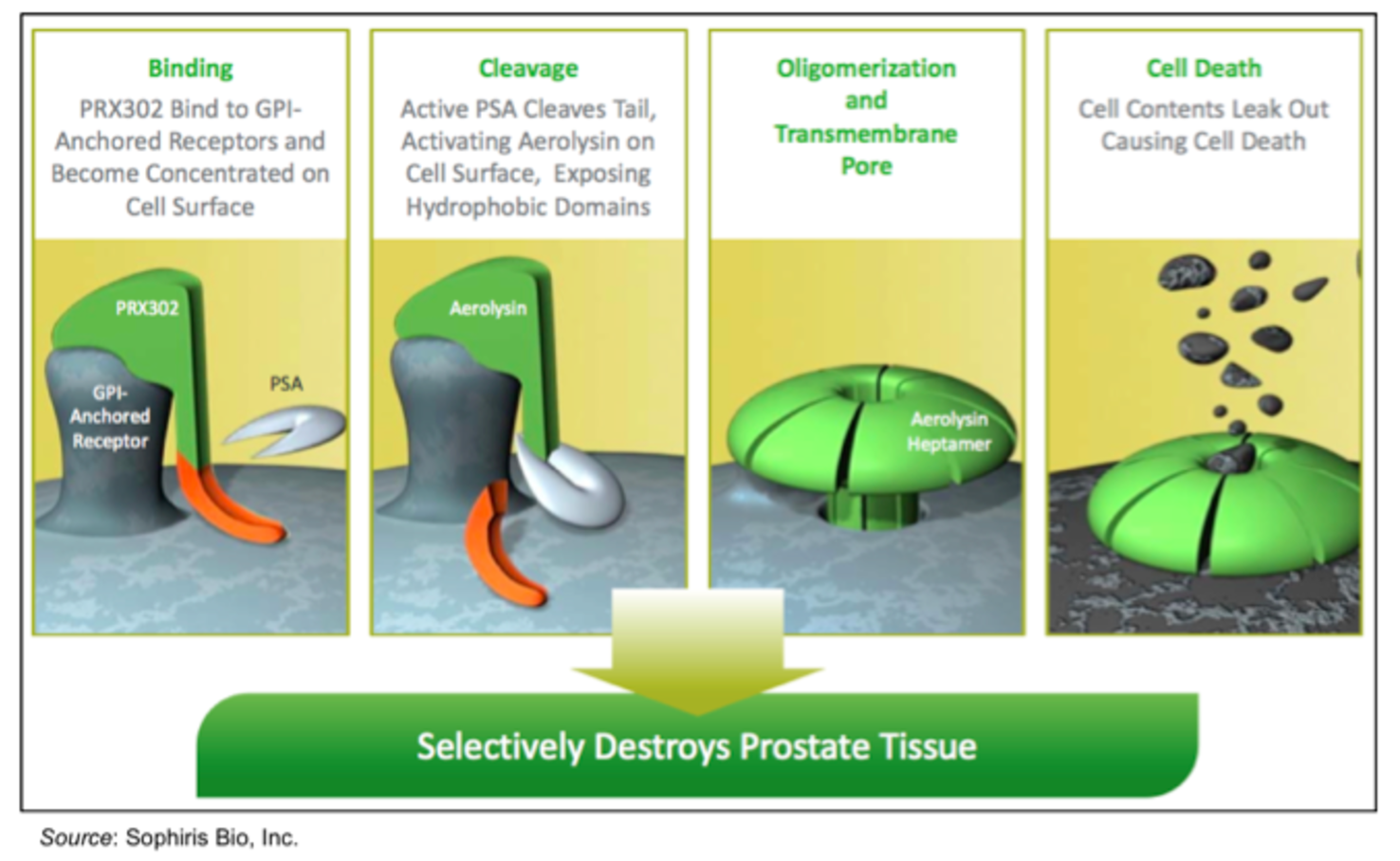
Sophiris Bio, Inc. (NASDAQ:SPHS) is developing treatments for lower urinary tract symptoms of benign prostatic hyperplasia (BPH) and localized clinically significant low to intermediate risk prostate cancer. The company’s lead candidate, PRX302 (topsalysin), is a genetically engineered recombinant protein that is activated through enzymatic cleavage by prostate specific antigen (PSA), which is produced in large quantities by the prostate gland. Once activated, topsalysin combines with other topsalysin molecules to form stable transmembrane pores and initiate cell death. The compound has been successfully tested in one Phase 3 clinical trial for BPH and a Phase 2a clinical trial for localized prostate cancer.
PRX302
PRX302 (topsalysin) is a genetically modified form of proaerolysin, a bacterial protein that binds to the surface of target cells, forming a transmembrane complex that opens pores in the cell surface and allows for the release of small molecules and ions critical for cell function. PRX302 is a prodrug that is activated through cleavage by prostate specific antigen (PSA), a protease produced by the prostate gland. Protease inhibitors inactivate PSA in the bloodstream, thus enzymatically active PSA is only found in normal and malignant prostate tissue. This specificity of PSA activity allows for the targeting of drugs to the prostate, with limited systemic side effects. PRX302 is further targeted through administration to patients through an ultrasound-guided series of injections into the prostate.
 PRX302 in BPH
A randomized, double blind, placebo controlled Phase 3 clinical trial was performed in 479 men suffering from BPH randomized 1:1 to receive PRX302 or placebo. Results from the study showed that injection of PRX302 resulted in a statistically significant improvement in IPSS total score from baseline over 52 weeks (7.60 vs. 6.58;
P=0.043). A secondary analysis of IPSS total score showed a maximal effect at week 18 between PRX302-treated and placebo-treated patients (8.31 vs. 6.89;
P=0.012).
Sophiris is currently evaluating options to advance PRX302 further in development for the treatment of BPH. A second Phase 3 clinical trial will be required in order to apply for approval with the FDA, which will cost a significant amount of money (we estimate approximately $35 million). While the company is currently uncertain about how exactly the second Phase 3 trial will be funded, it is likely that a non-dilutive partnership or royalty agreement will be utilized and that a second Phase 3 trial would not be initiated until such arrangement was procured.
PRX302 in Prostate Cancer
PRX302 was studied in a single center, open label, six month study in 18 men with a single, histologically proven, clinically significant prostate tumor. Patients needed to have a Gleason score of 7 and ≤ 10 mm Maximum Cancer Core Length (MCCL) or a Gleason score of 6 and > 3 mm MCCL. The primary outcome of the study was safety and tolerability over six months with secondary outcomes examining histological and MRI evidence of tumor control over six months.
Results from the study showed that two men experienced complete ablation of their targeted tumor with no evidence of tumor remaining at six months, seven men experienced a partial response, defined as either a reduction in the MCCL or a reduction in Gleason pattern, and nine patients had no response to treatment. The fact that two patients saw a complete response in the proof-of-concept clinical trial is very encouraging, as the study was only designed to allow for a greater understanding of the optimal dose and delivery method for PRX302. Based on the data obtained thus far, we believe that PRX302 could offer men with low-to-intermediate risk prostate cancer the potential to have their lesion ablated, or at least decreased to a size that warrants active surveillance as opposed to radical treatment (e.g., radical prostatectomy).
Valuation
We value Sophiris using a probability adjusted discounted cash flow that takes into account potential future revenues from the sale of PRX302 in both BPH and prostate cancer. For both BPH and prostate cancer, we anticipate the company ultimately entering into collaboration before commercialization of PRX302. For modeling purposes, we are estimating a second Phase 3 study starting in BPH in 2018 and approval in 2021. For prostate cancer, we estimate the upcoming Phase 2b trial concluding by the end of 2017, a Phase 3 program completing by 2020 and approval in 2021.
Prostate cancer likely represents the greatest value proposition for the company, as PRX302 is highly differentiated from other therapies currently available and under development and the company generated very promising data from the proof-of-concept study that included two complete responses. We estimate approximately 180,000 men will develop prostate cancer in 2016 and that approximately 80% of those will have localized disease, 50% of which will require treatment for a total target population of approximately 72,000. We believe that PRX302 could attain 20% market share and have peak revenues of approximately $950 million in the U.S. and $850 million in the E.U. Using a 15% royalty rate, a 13% discount rate, and a 40% chance of approval, we estimate the net present value for PRX302 in prostate cancer to be $178 million.
For BPH, we model for a low market share for the approximately 4 million men who receive treatment for BPH and peak revenues of approximately $300 million. Using a 15% royalty rate, a 13% discount rate, and a 60% chance of approval, we estimate the net present value for PRX302 in BPH to be $46 million.
Combining the values for PRX302 in prostate cancer and BPH along with the company’s current cash total and expected additional capital requirement of $30 million, we arrive at a net present value for the company of $219 million. Dividing this number by the fully diluted share count of approximately 36 million shares leads to a valuation of $6, and we note considerable upside is possible to this valuation with continued clinical success of PRX302 in the company’s upcoming Phase 2b trial in prostate cancer.
For a free copy of the full initiation research report, please email scrinvestors@zacks.com with SPHS as the subject.
SUBSCRIBE TO ZACKS SMALL CAP RESEARCH to receive our articles and reports emailed directly to you each morning. Please visit our website for additional information on Zacks SCR and to view our disclaimer.