By
John Vandermosten, CFA
NASDAQ:TENX
Tenax Reports Second Quarter 2016 ResultsOn August 9, 2016, Tenax Therapeutics, Inc. (NASDAQ:TENX)
filed its form 10-Q with the SEC for the three month period ending June 30, 2016. The company reported no revenues and a net loss of ($4.6) million or ($0.17) per share. This compares to our estimates also of zero revenues and a net loss of ($4.6) million or ($0.16) per share with the difference on a per share basis attributable to rounding and reported share count being slightly below our estimate. Total operational expenses for the quarter were $4.7 million, decreasing from the $4.9 million reported in the second quarter of the prior year. Research & development expenses increased while general & administrative expenses fell. Tenax also reported a $1 million impairment from write down of patents in 2Q:15, an expense that was not repeated in 2Q:16.
Research and development expenses increased from $1.9 million to $3.4 million in 2Q:16. Clinical and preclinical development costs experienced the largest dollar increase, rising to $3.1 million from $1.8 million arising from higher contract research organization (CRO) costs. Consulting expenses increased the most in percentage terms moving from $6,700 in 2Q:15 to $174,000 in 2Q:16 and were related to training, communication and implementing best practices at clinical trial sites. Personnel costs and other costs were both down modestly over the prior year.
General and administrative expenses were $1.2 million for 2Q:16, compared to $1.9 million in 2Q:15. Expenses in all categories fell as compared to the prior year. Personnel costs were almost halved, falling from $1.1 to $0.6 million due to lower accrued bonuses and to a lesser extent, lower salaries and benefits. Legal and professional fees fell by $95,000 to $449,000 in 2Q:16 as investor relations and accounting fees were cut. Other costs fell by approximately $75,000 predominantly due to a decrease in franchise tax.
Cash, cash equivalents and marketable securities were $29.5 million on June 30, 2016, falling $5.3 million sequentially. Cash burn was $5.2 million in the quarter and $8.5 million for the first half compared to $2.8 million and $5.3 million for 2Q:15 and 1H:15 respectively.
TENX updated its expense guidance for calendar year 2016, raising the amount due to the increased number of patients that are expected to be enrolled in the LEVO-CTS trial. FY:16 research and development spend was elevated from a range of $10.5 to $11.0 million to $13.0 to $13.5 million with the $2.5 million increase attributable to the additional 120 patients that are expected to be added to the study. The majority of the increase will be felt in the third quarter and we anticipate a decline in 4Q to match the run rate seen in the first half of 2015. As the company progresses into the late part of 2017 and early 2018, these amounts are anticipated to shift away from trial costs and reflect managing and monitoring fees, site close out costs, database clean up and data analysis. General and administrative expense guidance remains constant at $6.0 to $6.5 million. Total cash burn guidance was raised in line with the expected increase in trial costs and now stands at $19.0 to $20.0 million for the year. As the company moves toward filing the NDA with the FDA and ramping up a sales force we reflect an approximate $300,000 per head expense as individuals are added to the sales function. The sales function would eventually include about 60 to 65 salespersons and approximately 10 sales management individuals and medical science liaisons.
Levosimendan Background: Ongoing Phase 3 LEVO-CTS in LCOS Trial
On February 1, 2016, Tenax
provided an update for its ongoing Phase 3 LEVO-CTS trial for its lead product candidate, levosimendan, for low cardiac output syndrome (LCOS) in cardiac surgery. Levosimendan has been granted Fast Track status by the U.S. Food and Drug Administration (FDA), which approved Tenax’s Phase 3 LEVO-CTS clinical trial protocol under a Special Protocol Assessment (SPA) in 2012.
In mid-May 2016 Tenax reported that the independent Data and Safety Monitoring Board (DSMB) for LEVO-CTS completed its first interim analysis for the trial. The group evaluated the safety and efficacy of the first 451 patients and recommended that the company continue with the trial as planned without any modifications. The DSMB’s review is based on any potential safety issues that may have surfaced thus far in the trial. Based on the estimated completion of enrollment for the trial and the likelihood that the second interim analysis would not be ready until after enrollment has completed, the second interim analysis will not be performed.
As of May 2016, the company noted that some data was missing for patients and some patients did not receive the drug and as a result, in an effort to ensure the statistical robustness of the results, Tenax plans to enroll 880 total patients. Some of the lost data was attributable to changed status for the enrolled patient as they no longer met enrollment criteria, and other patients withdrew consent between the time they initially agreed and when the procedure was to take place. Management anticipates completing enrollment in the trial by the end of September 2016 and providing a top-line readout in 4Q:16. As of August 10, 2016, Tenax had enrolled 767 patients in the LEVO-CTS trial. On August 11, 2016, Tenax provided additional information regarding the rationale for the increase in target enrollment. In the May release they had noted that some patients did not receive the study drug and that some patients did not have the necessary component measurements required by the study. In the most recent release, Tenax also noted that the trial was generating a lower endpoint event rate than originally projected, requiring a higher number of observations to power statistical significance in the analysis. Initially, Tenax had anticipated an event rate of 26.4%, but it is currently tracking at 25%, thus requiring a larger data set. Click here for detail on the endpoints.
In the beginning of the year, Tenax made an investment in consulting services to optimize the efficiency at the trial sites. This effort added a field-based associate that assumed the duties of a medical science liaison to ensure the research sites are using best practices. The interaction of the associate had the additional beneficial effect of increasing recruitment at the site due to the increased visibility of the program.
As of August 2016, there are approximately 60 cardiac surgical sites in the U.S. and Canada that are active. Patient enrollment began back in September 2014 and has maintained its target duration of approximately 24 months despite the announced increase in trial size. The trial is targeting enrollment of approximately 880 patients who will undergo coronary artery bypass graft or mitral valve surgery and are at a risk of developing LCOS. Management continues to remain focused on increasing enrollment efforts, and continues to take steps in order to accelerate the process such as identifying additional sites for the trial (for example, by expanding to Canada), and increasing communication with current clinical sites by hiring two field based associates who will be in direct contact with the sites.
Review of Phase 3 LEVO-CTS…
In 2014, Tenax initiated the
“Levosimendan in Patients With Left Ventricular Systolic Dysfunction Undergoing Cardiac Surgery On Cardiopulmonary Bypass” (LEVO-CTS) Phase 3 trial to evaluate the efficacy of levosimendan in the reduction of the incidence of morbidity and mortality in cardiac surgery patients at risk of LCOS when levosimendan is administered before and during cardiopulmonary bypass. The LEVO-CTS trial is a double-blind, randomized, placebo-controlled study that looks at the 30-day composite event rate of all-cause death, perioperative myocardial infarction, the need for dialysis, or the use of mechanical assist (intra-aortic balloon pump [IABP], left ventricular assist device [LVAD], extracorporeal membrane oxygenation [ECMO]) in patients with left ventricular systolic dysfunction (reduced ejection fraction) preoperatively undergoing cardiac surgery via cardiopulmonary bypass.
Duke Clinical Research Institute (DCRI) is conducting the trial, and helped design the Phase 3 protocol.
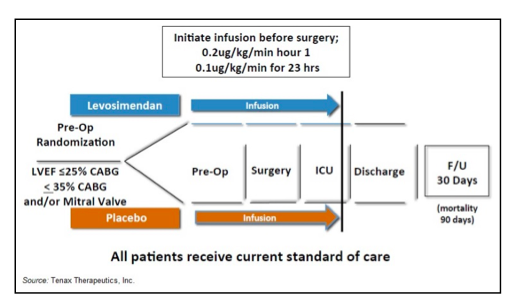
Co-primary endpoints in the trial include: (1) The all-cause death at 30 days or use of mechanical assist device (IABP, LVAD or ECMO) following the start of surgery for poor cardiac function despite inotropic support and adequate fluid replacement) through Day 5, and (2) Composite of all-cause death (at 30 days), or perioperative nonfatal MI [CK-MB >10xULN or >100 ng/mL, CK-MB >5xULN or 50 ng/mL with new Q wave (>0.04 seconds wide in two contiguous leads) or new left bundle branch block)] (through Day 5), or need for renal dialysis (through Day 30), or use of mechanical assist device (IABP, LVAD or ECMO) following the start of surgery for poor cardiac function despite inotropic support and adequate fluid replacement) (through Day 5). Secondary endpoints, which also intend to show the pharmacoeconomic benefit of the drug, include duration of ICU/CCU stay following surgery, and the incidence of LCOS. The safety endpoint is all-cause mortality through day 90, and since this an event-driven trial, there was a event rate check at 200 patients with interim analysis at 450 patients to check for futility or profound efficacy and to ensure safety.
It appears that low left ventricular ejection fraction (LVEF) cardiac surgery patients represent a high-risk population that experiences a higher incidence of LCOS and more severe outcomes. Based on levosimendan’s established clinical profile that has demonstrated potential benefits in LCOS, we see the potential in the drug to reduce mortality and morbidity in cardiac surgery patients at risk for LCOS, as well as lowering hospital related / pharmacoeconomic costs. In our opinion, the data that is available appears to be promising; however we do believe larger multi-site randomized controlled trials, like LEVO-CTS, with the proper dosage protocols in place will offer much needed data to confirm the benefit of levosimendan in cardiac surgery patients. We view levosimendan as potentially being able to address an unmet need with the dual value proposition mentioned above.
The importance of the pharmacoeconomic analysis of the trial is of critical importance as it will support the pricing efforts of the compound. In recent presentations, Tenax has highlighted the results of a study they conducted with Premier Health, which is a large GPO serving 3,600 hospitals and other providers. The study used Premier’s database to determine the additional costs of a LCOS patient in terms of additional time spent in the hospital, in the ICU and additional complications compared to other patients. Based on the analysis, the LCOS patient had an additional $15,000 of costs. The LCOS patient set also experienced $19,000 in additional readmission costs within 30 days of surgery. Based on the company’s internal analysis, the use of levosimendan could reduce costs from $2,000 to $5,000 per patient.
If all goes as expected, the company plans to request FDA Priority Review (6 to 8 months), and we think approval could occur at some point after mid-year 2017.
Levosimendan in Septic Shock: Phase 2b LeoPARDS trial
In addition to evaluating levosimendan in the Phase 3 LEVO-CTS trial for low cardiac output syndrome (LCOS) in cardiac surgery, Tenax is collaborating with the Imperial College London in the ongoing Phase 2 LeoPARDS trial of levosimendan in septic shock.
We view septic shock as an area of unmet clinical need, as the condition is often associated with high mortality, morbidity and critical care costs. In our opinion, LCOS and septic shock are potential large market opportunities because of the high mortality rates and insufficient standard of care practices in these patients. We think there is a demand for superior therapeutics in order to improve patient outcomes in both LCOS and septic shock in addition to reducing the high costs associated with complications for cardiac surgical patients.
The Phase 2 trial was initiated in the first quarter 2014, and on December 22, 2015, Tenax announced that the Imperial College of London completed enrollment for the LeoPARDS trial. As of August 2016, management anticipates a readout from the Imperial College of London in 4Q:16. The College will present data at a medical meeting in the fourth quarter and within 30 days of publication, Tenax anticipates receiving data. Following receipt of the data, Tenax will perform a separate analysis of the data for submission to the FDA.
Background on LeoPARDS
In August 2014, Tenax announced a collaboration with the Imperial College London to provide an additional $0.5 million funding for the ongoing Phase 2 LeoPARDS trial (“Levosimendan for the Prevention of Acute oRgan Dysfunction in Sepsis") in the UK evaluating levosimendan for sepsis. The trial is being funded by the UK Medical Research Council (MRC) and National Institute for Health Research (NIHR), and is led by the Imperial College London with Tenax having assisted in the acceleration of the enrollment process. The trial is designed to evaluate whether or not levosimendan reduces the incidence and severity of acute organ dysfunction in adult patients with septic shock, the effect of the drug on organ function, and evaluate the drug’s safety profile in sepsis.
LeoPARDS is a randomized, double-blind, placebo-controlled multi-center trial based on previous smaller studies that have evaluated levosimendan as it pertains to sepsis. Adult patients with suspected or confirmed infection and 2 or more SIRS (systemic inflammatory response syndrome) criteria [fever or hypothermia: temp >38°C/100.4°F or <36°C/96.8°F; tachycardia: heart rate >90bpm; tachypnea or need for mechanical ventilation: respiratory rate >20 or PaCO2 <32mmHg; leukocyte count (>12,000cells/mm3, <4000cells/mm3, or >10% immature band forms)] who are dependent on vasopressors to maintain their blood pressure are eligible for LeoPARDS enrollment. Once eligibility criteria are met there is a 24 hour window for recruitment to the trial, and enrolled patients are randomized to receive either levosimendan (0.05 to 0.20μg/kg/min) or placebo for 24 hours in addition to the standard of care.
The primary outcome measure will be the mean SOFA (sequential organ failure assessment) score on ICU after randomization between treatment groups. Secondary outcomes that are also being evaluated include oxygen delivery (ScvO2) & cardiac output; incidence & duration of renal failure (AKIN criteria); serum bilirubin; time to extubation; 28-day, hospital and three & six-month survival; ICU and hospital length of stay, and ICU-free days; duration of renal replacement therapy; and days free from catecholamine therapy.
The data collected from the LeoPARDS trial will help guide Tenax regarding the future plans for U.S. development. We believe that positive data from this trial could support an NDA filing. If all goes well and the data are positive, Tenax plans to request a pre-NDA meeting with the FDA regarding that path forward. We believe that Tenax could file an NDA in late 2017, and management believes that it may not be required to conduct a Phase 3 trial in the U.S. if the data are positive. We have included a modest level of sales in our forecasts for septic shock.
In November 2014, Tenax held a meeting with the FDA regarding the development of levosimendan in septic shock, and received guidance on how LeoPARDS data might be analyzed to support regulatory filing. As per management, the Imperial College London recently submitted the statistical analysis plan (SAP), with an addendum from Tenax, to the FDA. The SAP included additional secondary endpoints around clinically-meaningful measurements.
The Path Forward for Tenax
Below we have provided the upcoming milestones and events for Tenax in 2016.
- Completion of enrollment for the LEVO-CTS trial, end of September 2016.
- Report of topline data for LEVO-CTS trial in 4Q:16
- LeoPARDS data release in 4Q:16
- Follow-up data analysis of LeoPARDS data by Tenax
Conclusion
Tenax is poised to have two-late stage readouts in 4Q:16. In our opinion, the Tenax development portfolio includes a product candidate that has the potential to address various critical care conditions with high unmet medical need. There are currently no pharmacologic agents that are approved for the management, prevention and/or treatment of post-cardiac surgery LCOS. Tenax hopes to offer a solution with levosimendan, and believes that if administered pre- and peri-operatively, the incidence of LCOS and the associated morbidity and mortality could be decreased. Tenax is currently developing the drug in the U.S. and Canada for the reduction of morbidity and mortality in cardiac surgery patients at risk for developing low cardiac output syndrome (LCOS).
We view levosimendan as a relatively de-risked clinical development opportunity for the indication of LCOS due to the usage of Levosimendan (Simdax) in over 1 million patients outside of North America. There is extensive scientific evidence that supports the use of the drug in cardiovascular surgery, with over 35 published clinical trials, meta-analyses, and articles. We also believe that the interest surrounding the drug continues to increase. We also view septic shock as an area of unmet clinical need, as the condition is often associated with high mortality, morbidity and critical care costs. In our opinion, LCOS and septic shock are potential large market opportunities because of the present day high mortality rates and insufficient standard of care practices for these patients. We think there is a demand for superior therapeutics in order to improve patient outcomes in both LCOS and septic shock, in addition to reducing the high costs associated with complications surrounding cardiac surgery patients.
In our opinion, the Tenax management team has the critical care, clinical, and commercial experience necessary to obtain North American approval of levosimendan. Patient enrollment has been tracking very well for the LEVO-CTS trial and we believe that full enrollment by September is easily achievable.
We believe that Tenax has sufficient cash to fund activities through calendar year 2017, which will allow for the completion of the Phase 3 LEVO-CTS trial and a potential New Drug Application (NDA) for levosimendan for the low cardiac output (LCOS) indication. Based on our estimates, the company will need additional capital to support Tenax’s future commercialization activities including the anticipated commercial launch of levosimendan for LCOS.
We anticipate approval of levosimendan in the U.S. during calendar year 2017, with product launch late in the year. There is a high probability of approval given the success of the drug outside of the U.S, but ultimately, FDA approval will hinge on positive Phase 3 data. In our opinion, Tenax shares remain significantly undervalued given the potential market opportunity for levosimendan. We think the stock continues to have material upside at current levels and we maintain our price target of $10.00 per share based on our DCF model. If levosimendan proves to be successful in the cardiac surgical market, and if the company makes further progress with additional indications, including septic shock, there is the possibility for additional upside to this valuation. Furthermore, the company continues to evaluate other products and critical care opportunities to add to the pipeline, which could also provide investors with additional value.
READ THE FULL RESEARCH REPORT HERE
SUBSCRIBE TO ZACKS SMALL CAP RESEARCH to receive our articles and reports emailed directly to you each morning. Please visit our website for additional information on Zacks SCR and to view our disclaimer.