By
John Vandermosten, CFA
NASDAQ:TENX
Tenax Reports Third Quarter 2016 Results
On November 9, 2016, Tenax Therapeutics, Inc. (NASDAQ:TENX) filed its form 10-Q with the SEC for the three month period ending September 30, 2016. The company reported no revenues and a net loss of ($4.3) million or ($0.15) per share. This compares to our estimates also of zero revenues and a net loss of ($4.9) million or ($0.17) per share with the difference on a per share basis largely attributable lower general and administrative expense. Total operational expenses for the quarter were $4.5 million, increasing from the $3.1 million reported in the third quarter of the prior year. Research & development expenses almost doubled while general & administrative expenses fell.
Year over year research and development expenses increased by $1.5 million to $3.2 million in 3Q:16 and compare to our estimate of $3.3 million. Increased clinical activity for the LEVO-CTS trial contributed to the increase and was partially offset by the elimination of Oxycyte studies incurred in the prior year. Personnel costs rose almost 50% over the prior year to approximately $180,000, while consulting expenses fell by 41% to $92,000. Other costs were also down in the year over year period.
General and administrative expenses were $1.3 million for 3Q:16, compared to $1.4 million in 3Q:15 with the decline attributable to the absence of legal and professional fees related to changing the company’s fiscal year and lower taxes. With the exception of personnel, expenses in all categories fell as compared to the prior year. Personnel costs rose 6% to $629,000. Legal and professional fees fell by $109,000 to $379,000 in 3Q:16 and other costs fell by approximately $76,000 to $220,000.
Cash, cash equivalents and marketable securities were $25.1 million on September 30, 2016, falling $4.4 million sequentially. Cash burn was $4.2 million in the quarter and $12.7 million for the first nine months compared to $3.2 million and $8.5 million for the same respective periods in the prior year.
FY:16 research and development spend is expected to be near $13.0 million and to fall within a range of $2.0 to $2.5 million over the next few quarters as the LEVO-CTS trial winds down. As the company progresses into the late part of 2017 and early 2018, these amounts are anticipated to shift away from trial costs and reflect managing and monitoring fees, site close out costs, database clean up and data analysis. General and administrative expense guidance remains constant at $6.0 to $6.5 million. Total cash burn stands at $19.0 million for the year, narrowed from the previous $19 - $20 million range. As the company moves toward filing the NDA with the FDA and ramping up a sales force we reflect an approximate $300,000 per head expense as individuals are added to the sales function. The sales function would eventually include from 60 to 65 salespersons and approximately 10 sales management individuals and medical science liaisons.
Tenax Updates Trial Progress
As of November 18th, Tenax has completed enrollment of its 880 patient panel size. Following 30 days of observations on the final patients, the completion will be followed by a two or three week period to verify all data and lock the database, after which the data will be analyzed over another two week period. Given that this will occur during the holiday season, we anticipate a topline read in early January followed by the preparation and submission of the new drug application (NDA) which we anticipate will take two months. The FDA granted a fast track designation to Levosimendan, which makes the drug eligible for priority review. Priority review reduces approval time from 10 months to 6 months and if the data shows material efficacy, we expect it to be granted. Based on these assumptions, the FDA could announce approval for the drug early in the fourth quarter, at which time Tenax will begin to hire its salesforce, train them and work to be added to hospital formularies. Many hospitals hold periodic formulary review board meetings that decide which medicines are available at the hospital on monthly, quarterly and semi-annual bases. Given that the hospitals will be the predominant market for Levosimendan, we anticipate a two to three month delay between approval and hospital sales, placing first revenues at the beginning of 2018.
Data for Tenax’ second trial, LeoPARDS, was presented at the 29th Annual Congress of the European Society of Intensive Care Medicine (ESICM) on October 16. In the presentation, the Imperial College London indicated that the trial did not achieve either its primary endpoint of reducing the incidence and severity of acute organ dysfunction in adult patients who have septic shock, or its secondary endpoints. Despite previously completed, third party meta-analysis that showed efficacy in septic shock, Tenax does not expect to pursue an NDA for levosimendan in this indication. While there is evidence of some use of the drug off-label for septic shock in Europe, we do not expect this will be a material volume of sales when and if it is approved for use in the United States.
Levosimendan Background: Ongoing Phase 3 LEVO-CTS in LCOS Trial
As the trial settles into its last days, there are approximately 60 active cardiac surgical sites in the U.S. and Canada. Patients included in the study are undergoing coronary artery bypass graph, or CABG, and/or mitral valve surgery, CABG and aortic valve surgery who are at risk for developing LCOS. Enrollment began on September 18, 2014 and completed on November 18, 2016. An increase in trial population size was required to meet targeted event rates and powering requirements and led to the extension. The trial enrolled 880 patients that underwent coronary artery bypass graft or mitral valve surgery and are at a risk of developing LCOS. Management continues to remain focused on enrollment efforts, and is currently in the final stages of the trial as the last patients are added.
Phase 3 LEVO-CTS
In 2014, Tenax initiated the “Levosimendan in Patients With Left Ventricular Systolic Dysfunction Undergoing Cardiac Surgery On Cardiopulmonary Bypass” (LEVO-CTS) Phase 3 trial to evaluate the efficacy of levosimendan in the reduction of the incidence of morbidity and mortality in cardiac surgery patients at risk of LCOS when levosimendan is administered before and during cardiopulmonary bypass. The LEVO-CTS trial is a double-blind, randomized, placebo-controlled study that looks at the 30-day composite event rate of all-cause death, perioperative myocardial infarction, the need for dialysis, or the use of mechanical assist (intra-aortic balloon pump, left ventricular assist device, extracorporeal membrane oxygenation) in patients with left ventricular systolic dysfunction (reduced ejection fraction) preoperatively undergoing cardiac surgery via cardiopulmonary bypass. Duke Clinical Research Institute (DCRI) is conducting the trial, and helped design the Phase 3 protocol.
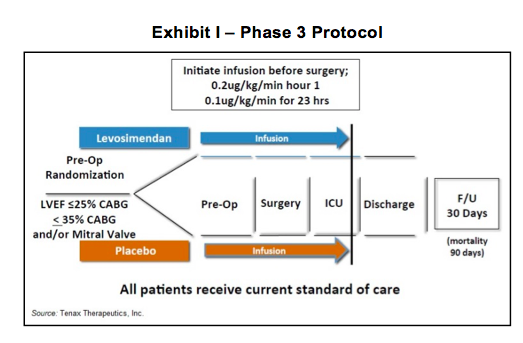
Co-primary endpoints in the trial include: (1) The all-cause death at 30 days or use of mechanical assist device following the start of surgery for poor cardiac function despite inotropic support and adequate fluid replacement) through Day 5, and (2) Composite of all-cause death (at 30 days), or perioperative nonfatal MI [CK-MB >10xULN or >100 ng/mL, CK-MB >5xULN or 50 ng/mL with new Q wave (>0.04 seconds wide in two contiguous leads) or new left bundle branch block)] (through Day 5), or need for renal dialysis (through Day 30), or use of mechanical assist device following the start of surgery for poor cardiac function despite inotropic support and adequate fluid replacement) (through Day 5). Secondary endpoints, which also intend to show the pharmacoeconomic benefit of the drug, include duration of ICU/CCU stay following surgery, and the incidence of LCOS. The safety endpoint is all-cause mortality through day 90, and since this an event-driven trial, there was a event rate check at 200 patients with interim analysis at 450 patients to check for futility or profound efficacy and to ensure safety.
It appears that low left ventricular ejection fraction (LVEF) cardiac surgery patients represent a high-risk population that experiences a higher incidence of LCOS and more severe outcomes. Based on levosimendan’s established clinical profile that has demonstrated potential benefits in LCOS, we see the potential in the drug to reduce mortality and morbidity in cardiac surgery patients at risk for LCOS, as well as lowering hospital related and readmission costs. In our opinion, the data that is available appears to be promising; however, we do believe larger multi-site randomized controlled trials, like LEVO-CTS, with the proper dosage protocols in place will offer much needed data to confirm the benefit of levosimendan in cardiac surgery patients.
The importance of the pharmacoeconomic analysis of the trial is of critical importance as it will support the pricing efforts of the compound. In recent presentations, Tenax has highlighted the results of a study they conducted with Premier Health, which is a large GPO serving 3,600 hospitals and other providers. The study used Premier’s database to determine the additional costs of a LCOS patient in terms of additional time spent in the hospital, in the ICU and additional complications compared to other patients. Based on the analysis, the LCOS patient had an additional $15,000 of costs. The LCOS patient set also experienced $19,000 in additional readmission costs within 30 days of surgery. Based on the company’s internal analysis, the use of levosimendan could reduce costs by $2,000 to $5,000 per patient.
The Path Forward for Tenax
Below we summarize upcoming milestones and events for Tenax:
- Completion of enrollment for the LEVO-CTS trial"
- Report of topline data for LEVO-CTS January 2017
- Preparation of NDA, submission to FDA and request for priority review
- Following anticipated approval of Levosimendan:
-Hire and train salesforce
-Obtain placement on formulary
Conclusion
We anticipate a readout on the LEVO-CTS trial in January 2017. In our opinion, the Tenax development portfolio includes a product candidate that has the potential to address a critical care condition with high unmet medical need. There are currently no pharmacologic agents that are approved for the management, prevention and/or treatment of post-cardiac surgery LCOS. Tenax hopes to offer a solution with levosimendan, and believes that if administered pre- and peri-operatively, the incidence of LCOS and the associated morbidity and mortality could be decreased. Tenax is currently developing the drug for commercialization in the U.S. and Canada.
We view levosimendan as a relatively de-risked clinical development opportunity for the indication of LCOS due to the usage of Levosimendan (Simdax) in over 1 million patients outside of North America. There is extensive scientific evidence that supports the use of the drug in cardiovascular surgery, with over 35 published clinical trials, meta-analyses, and articles. We also believe that the interest surrounding the drug continues to increase. We also view septic shock as an area of unmet clinical need, as the condition is often associated with high mortality, morbidity and critical care costs. In our opinion, LCOS and septic shock are potential large market opportunities because of high mortality rates and insufficient standard of care practices for these patients. We think there is a demand for superior therapeutics in order to improve patient outcomes in both LCOS and septic shock, in addition to reducing the high costs associated with complications surrounding cardiac surgery patients.
We believe that Tenax has sufficient cash to fund activities through calendar year 2017, which will allow for the completion of the Phase 3 LEVO-CTS trial and a potential New Drug Application (NDA) for levosimendan for the low cardiac output (LCOS) indication. Based on our estimates, the company will need additional capital to support Tenax’s future commercialization activities including hiring a salesforce and launching levosimendan for LCOS.
We update our forecast for approval of levosimendan in the U.S. to occur in 4Q:17, with product launch early in 2018. There is a higher than normal probability of approval given the success of the drug outside of the U.S, but ultimately, the FDA’s decision will hinge on positive Phase 3 data. In our opinion, Tenax shares remain significantly undervalued given the potential market opportunity for levosimendan. If levosimendan proves to be successful in LEVO-CTS, there is upside to our valuation.
For a free copy of the full research report, please email scrinvestors@zacks.com with TENX as the subject.
SUBSCRIBE TO ZACKS SMALL CAP RESEARCH to receive our articles and reports emailed directly to you each morning. Please visit our website for additional information on Zacks SCR and to view our disclaimer.