By John Vandermosten, CFA
NASDAQ:TENX
WHAT’S NEW
Tenax Reports Abbreviated 2015 Financial Results
Tenax Therapeutics, Inc. (NASDAQ:TENX) reported financial results for the eight month period ending December 31, 2015 during which time, no revenues were reported. Expenses for the partial year period were $10.4 million, which was higher than the $8.7 million spent in the 8-month period for the prior year. General and administrative fees fell compared to the same period in the prior year from $4.4 million to $3.9 million due to an $850,000 decline in legal and professional fees related to grants of warrants to an outside investor relations firm. This was partially offset by increase in personnel costs and higher franchise taxes.
Research and development expenses increased from $4.2 million to $6.5 million for the partial year period in 2014 and 2015 respectively. A sharp rise in clinical and preclinical development expenses comprised the majority of the increase and was due to increased contract research organization costs for the Levo-CTS Phase 3 clinical trial. Additionally, an increase in consulting fees related to training and communication at clinical trial sites also contributed to the period over period change.
TENX provided expense guidance for calendar year 2016 than anticipates general and administrative costs of $6.0 to $6.5 million for CY16 as the company moves toward filing the NDA with the FDA and ramping up a sales force. Research and development expenses are anticipated to range from $2.0 to $2.5 million per quarter in support of the final stages of the Phase 3 Levo-CTS trial and will reflect an increase in pass through patient costs. As the company progresses into the late part of 2017 and early 2018, these amounts are anticipated to remain in the same range, however, they will shift away from trial costs and towards managing and monitoring fees, site close out costs, database clean up and data analysis.
Company Change of Fiscal Year to Calendar Year
On April 9, 2015, the Board of Directors for Tenax approved a change in the fiscal year ending April 30, to a fiscal year that coincides with the calendar year ending December 31. As a transition filing, the company submitted form 10-KT for the eight month period from May 1, 2015 to December 31, 2015. The effective date of the change was January 1, 2016 and for all periods going forward Tenax’ fiscal year will conform to the calendar year for reporting purposes. For 2015, the company reported results for the eight month period from May 1, 2015 to December 31, 2015. Tenax was unable to provide comparable full-year (12-month) results and as a result of the one month offset in quarters between the old and new format, we could not construct 12-month financials with the existing data.
Levosimendan in Cardiac Surgery: Ongoing Phase 3 LEVO-CTS in LCOS Trial
On February 1, 2016, Tenax provided an update for its ongoing Phase 3 LEVO-CTS trial for its lead product candidate, levosimendan for low cardiac output syndrome (LCOS) in cardiac surgery. Levosimendan has been granted Fast Track status by the U.S. Food and Drug Administration (FDA), which approved Tenax’s Phase 3 LEVO-CTS clinical trial protocol under a Special Protocol Assessment (SPA) in 2012.
As per the update, the independent Data and Safety Monitoring Board (DSMB) for LEVO-CTS has completed its review of the first 254 patients enrolled in the trial and has recommended that the company continue with the trial as planned without any modifications. The DSMB’s review is based on any potential safety issues that may have surfaced thus far in the trial. We see this as great news for Tenax as things continue to progress in the right direction. We believe that the DSMB will review data and conduct the first interim analysis when ~400 patients have been enrolled, followed by a second interim analysis when ~600 patients have been enrolled. The interim analyses will be testing for efficacy and futility after approximately 50% and 70% of the planned primary endpoint events have been recorded in calendar year 2016. We believe that the 50% and 70% marks should fall somewhere in the second and third quarters of calendar year 2016, respectively. We do not expect to see any data at these points, but should see an acknowledgement from the company that it has reached these marks. While the analysis takes an additional 30 days prior to the surgery, we note that Tenax provides a running count of the number of patients enrolled on their website which is updated frequently.
As a reminder, Tenax achieved the first milestone in its ongoing Phase 3 LEVO-CTS trial following the enrollment of its 200th patient on October 1, 2015. As of April 11, 2016, 542 patients have been enrolled out of an estimated 760 total patients, or approximately 70%. During March the trial added 72 patients following just over 60 in each of the previous two months. At the current rate, the trial will have achieved its goal in approximately four months; however, some slowdown in the pace is anticipated during the early summer, but it appears that the trial may enroll the target patient population prior to the targeted 24 month duration.
We believe that the rise in enrollment is largely due to the FDA approving the Phase 3 LEVO-CTS protocol amendment back in October 2015. Under the previous protocol, patients undergoing only a coronary artery bypass grafting (CABG) procedure were limited to those with a left ventricular ejection fraction (LVEF) of ≤ 25%. This amendment changes the inclusion criteria for the trial to cardiac surgery patients with a LVEF of ≤ 35% undergoing CABG, CABG and an aortic valve procedure, and CABG and/or a mitral valve procedure. Entry criteria were also clarified so that unjustified patient exclusions are avoided. This amendment increases the potential patient population that is eligible for enrollment in the trial. We also think that the approval of the protocol amendment by the FDA has simplified and expedited the overall enrollment process since more patients will now be eligible for the study. All activated hospitals now have IRB approval of the amendment, and 169 patients have been enrolled under the amended protocol. It is uncertain whether or not the FDA will view the amended patient group differently, but management is confident that the FDA will be examining the event rates and should not need to compare the amended patient group separately.
As of early April 2016, there are 64 cardiac surgical sites in the U.S. and Canada that are activated. Several low or no volume sites were closed in January and February which allows additional focus on existing sites. Patient enrollment began back in September 2014 and is expected to have a duration of approximately 24 months. The trial is targeting enrollment of approximately 760 patients undergoing coronary artery bypass graft or mitral valve surgery who are at a risk of developing LCOS. Management continues to remain focused on increasing enrollment efforts, and continues to take steps in order accelerate the process such as identifying additional sites for the trial (for example, by expanding to Canada), and increasing communication with current clinical sites by hiring two field based associates who will be in direct contact with the sites.
Review of Phase 3 LEVO-CTS…
In 2014, Tenax initiated the “Levosimendan in Patients With Left Ventricular Systolic Dysfunction Undergoing Cardiac Surgery On Cardiopulmonary Bypass” (LEVO-CTS) Phase 3 trial to evaluate the efficacy of levosimendan in the reduction of the incidence of morbidity and mortality in cardiac surgery patients at risk of LCOS when levosimendan is administered before and during cardiopulmonary bypass. The LEVO-CTS trial is a double-blind, randomized, placebo-controlled study that looks at the 30-day composite event rate of all-cause death, perioperative myocardial infarction, the need for dialysis, or the use of mechanical assist (intra-aortic balloon pump [IABP], left ventricular assist device [LVAD], extracorporeal membrane oxygenation [ECMO]) in patients with left ventricular systolic dysfunction (reduced ejection fraction) preoperatively undergoing cardiac surgery via cardiopulmonary bypass. Duke Clinical Research Institute (DCRI) is conducting the trial, and helped design the Phase 3 protocol.
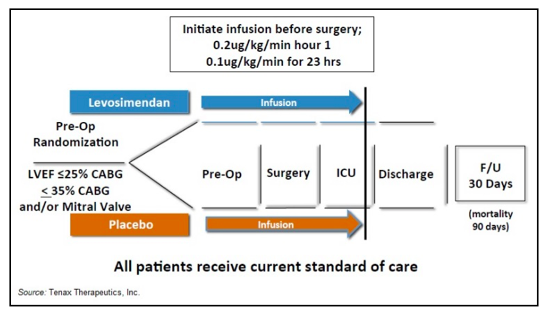
Co-primary endpoints in the trial include: (1) “Dual”: death or mechanical assist (IABP, LVAD) through day 5, p<0.04 sufficient, and (2) “Quad”: death (through day 30), perioperative non-fatal MI (day 5), renal dialysis (day 30), or mechanical assist (day 5), p<0.01 sufficient, while secondary endpoints, which also intend to show the pharmacoeconomic benefit of the drug, include duration of ICU/CCU stay following surgery, and the incidence of LCOS. The safety endpoint is all-cause mortality through day 90, and since this an event-driven trial, there was a event rate check at 200 patients with interim analysis expected at 50% and 70% total events to ensure anticipated event rate. The trial may be stopped for profound efficacy in “dual” endpoint.
It appears that low left ventricular ejection fraction (LVEF) cardiac surgery patients represent a high-risk population that experiences a higher incidence of LCOS and more severe outcomes. Based on levosimendan’s established clinical profile that has demonstrated potential benefits in LCOS, we see the potential in the drug to reduce mortality and morbidity in cardiac surgery patients at risk for LCOS, as well as lowering hospital related / pharmacoeconomic costs. In our opinion, the data that is available appears to be promising; however we do believe larger multi-site randomized controlled trials, like LEVO-CTS, with the proper dosage protocols in place will offer much needed data to confirm the benefit of levosimendan in cardiac surgery patients. We view levosimendan as potentially being able to address an unmet need with the dual value proposition mentioned above.
The importance of the pharmacoeconomic analysis of the trial is of critical importance as it will support the pricing efforts of the compound. In recent presentations, Tenax has highlighted the results of a study they conducted with Premier Health, which is a large GPO serving 3,600 hospitals and other providers. The study used Premier’s database to determine the additional costs of a LCOS patient in terms of additional time spent in the hospital, in the ICU and additional complications compared to other patients. Based on the analysis, the LCOS patient had an additional $15,000 of costs. The LCOS patient set also experienced $19,000 in additional readmission costs within 30 days of surgery. Based on the company’s internal analysis, the use of levosimendan could reduce costs from $2,000 to $5,000 per patient.
As per management, the FDA has provided guidance that a single successful trial will be sufficient to support approval of the drug for this particular indication. The LEVO-CTS data readout is expected near the end of calendar year 2016, and we are looking forward to reviewing the results once available. From start to finish, we believe that the trial will cost approximately $18 to $20 million. If all goes well, the company plans to request FDA Priority Review (6 to 8 months), and we think approval could occur at some point after mid-year 2017.
Levosimendan in Septic Shock: Phase 2b LeoPARDS trial
In addition to evaluating levosimendan in the Phase 3 LEVO-CTS trial for low cardiac output syndrome (LCOS) in cardiac surgery, Tenax is collaborating with the Imperial College London in the ongoing Phase 2 LeoPARDS trial of levosimendan in septic shock.
We view septic shock as an area of unmet clinical need, as the condition is often associated with high mortality, morbidity and critical care costs. In our opinion, LCOS and septic shock are potential large market opportunities because of the high mortality rates and insufficient standard of care practices in these patients. We think there is a demand for superior therapeutics in order to improve patient outcomes in both LCOS and septic shock in addition to reducing the high costs associated with complications for cardiac surgical patients.
The Phase 2 trial was initiated in the first quarter 2014, and on December 22, 2015, Tenax announced that the Imperial College of London completed enrollment for the LeoPARDS trial. All 516 patients have now been enrolled. We view this as great news for the company as enrollment was completed slightly ahead of schedule. As of April 2016, management updated their expectations for timing regarding the release of results and data from the study. The Imperial College of London has medical meetings that they are targeting for initial public presentation and they would like to publish in conjunction with this event. Based on the company’s conversation, we now expect the initial data to be available in the September or October 2016 timeframe.
Background on LeoPARDS
In August 2014, Tenax announced a collaboration with the Imperial College London to provide an additional $0.5 million funding for the ongoing Phase 2 LeoPARDS trial (“Levosimendan for the Prevention of Acute oRgan Dysfunction in Sepsis") in the UK evaluating levosimendan for sepsis. The trial is being funded by the UK Medical Research Council (MRC) and National Institute for Health Research (NIHR), and is led by the Imperial College London with Tenax having assisted in the acceleration of the enrollment process. The trial is designed to evaluate whether or not levosimendan reduces the incidence and severity of acute organ dysfunction in adult patients with septic shock, the effect of the drug on organ function, and evaluate the drug’s safety profile in sepsis.
LeoPARDS is a randomized, double-blind, placebo-controlled multi-center trial based on previous smaller studies that have evaluated levosimendan as it pertains to sepsis. Adult patients with suspected or confirmed infection and 2 or more SIRS (systemic inflammatory response syndrome) criteria [fever or hypothermia: temp >38°C/100.4°F or <36°C/96.8°F; tachycardia: heart rate >90bpm; tachypnea or need for mechanical ventilation: respiratory rate >20 or PaCO2 <32mmHg; leukocyte count (>12,000cells/mm3, <4000cells/mm3, or >10% immature band forms)] who are dependent on vasopressors to maintain their blood pressure are eligible for LeoPARDS enrollment. Once eligibility criteria are met there is a 24 hour window for recruitment to the trial, and enrolled patients are randomized to receive either levosimendan (0.05 to 0.20μg/kg/min) or placebo for 24 hours in addition to the standard of care.
The primary outcome measure will be the mean SOFA (sequential organ failure assessment) score on ICU after randomization between treatment groups. Secondary outcomes that are also being evaluated include oxygen delivery (ScvO2) & cardiac output; incidence & duration of renal failure (AKIN criteria); serum bilirubin; time to extubation; 28-day, hospital and three & six-month survival; ICU and hospital length of stay, and ICU-free days; duration of renal replacement therapy; and days free from catecholamine therapy.
Due to scheduling objectives, LeoPARDS data are now expected sometime in the fall of 2016. The data collected from the LeoPARDS trial will help guide Tenax regarding the future plans for U.S. development. We believe that positive data from this trial could support an NDA filing. If all goes well and the data are positive, Tenax plans to request a pre-NDA meeting with the FDA regarding that path forward. We believe that Tenax could file an NDA in late 2017, and management believes that it may not be required to conduct a Phase 3 trial in the U.S. if the data are positive. We have included a modest level of sales in our forecasts for septic shock.
In November 2014, Tenax held a meeting with the FDA regarding the development of levosimendan in septic shock, and received guidance on how LeoPARDS data might be analyzed to support regulatory filing. As per management, the Imperial College London recently submitted the statistical analysis plan (SAP), with an addendum from Tenax, to the FDA. The SAP included additional secondary endpoints around clinically-meaningful measurements.
The Path Forward for Tenax
Below we have provided the upcoming milestones and events for Tenax in 2016.
- Two interim analyses during LEVO-CTS trial testing for efficacy or futility after 400 and 600 of the planned primary endpoint events have been recorded. The next interim analysis is expected to occur at the end of the second quarter.
- Data reported from LeoPARDS trial in the fall of 2016
- Updated regulatory strategy for levosimendan in septic shock following LeoPARDS data release
- Data reported from Phase 3 LEVO-CTS trial in calendar year 2016
Conclusion
Tenax is poised to have two-late stage readouts in calendar year 2016. In our opinion, the Tenax development portfolio includes a product candidate that has the potential to address various critical care conditions with high unmet medical need. There are currently no pharmacologic agents that are approved for the management, prevention and/or treatment of post-cardiac surgery LCOS. Tenax hopes to offer a solution with levosimendan, and believes that if administered pre- and peri-operatively, the incidence of LCOS and the associated morbidity and mortality could be decreased. Tenax is currently developing the drug in the U.S. and Canada for the reduction of morbidity and mortality in cardiac surgery patients at risk for developing low cardiac output syndrome (LCOS).
We view levosimendan as a relatively de-risked clinical development opportunity for the indication of LCOS due to the usage of the drug in over 1 million patients outside of North America. There is extensive scientific evidence that supports the use of levosimendan in cardiovascular surgery, with over 35 published clinical trials, meta-analyses, and articles. We also believe that the interest surrounding the drug continues to increase. We also view septic shock as an area of unmet clinical need, as the condition is often associated with high mortality, morbidity and critical care costs. In our opinion, LCOS and septic shock are potential large market opportunities because of the present day high mortality rates and insufficient standard of care practices for these patients. We think there is a demand for superior therapeutics in order to improve patient outcomes in both LCOS and septic shock, in addition to reducing the high costs associated with complications surrounding cardiac surgery patients.
We believe that the Tenax management team has the critical care, clinical, and commercial experience necessary to obtain North American approval of levosimendan. With a focus on accelerating patient enrollment for LEVO-CTS, we believe that the company will achieve the projected second half of 2016 trial completion date, with data readout expected in the latter part of 2016.
As of December 31, 2015, Tenax held $38.2 million in cash, including the fair value of its short and long term marketable securities, compared to $40.9 million on October 31, 2015. We believe that Tenax has sufficient cash to fund activities through calendar year 2017, which will allow for the completion of the Phase 3 LEVO-CTS trial and a potential New Drug Application (NDA) for levosimendan for the low cardiac output (LCOS) indication. We do believe that the company will need additional capital to support Tenax’s future commercialization activities including the anticipated commercial launch of levosimendan for LCOS.
We continue to forecast approval of levosimendan in the U.S. during calendar year 2017, with product launch late in the year. We believe there is a high probability of approval given the success of the drug outside of the U.S, but ultimately, FDA approval will hinge on positive Phase 3 data. In our opinion, Tenax shares remain significantly undervalued given the potential market opportunity for levosimendan. We think the stock continues to have meaningful upside left given the big pullback. We offer our price target of $10.00 per share based on our DCF model. If levosimendan proves to be successful in the cardiac surgical market, and if the company makes further progress with additional indications, including septic shock, we believe that there is the possibility for significant upside to this valuation. Additionally, the company continues to evaluate other products and critical care opportunities to add to the pipeline, which could also provide investors with additional upside.
READ THE LATEST FULL RESEARCH REPORT HERE
SUBSCRIBE TO ZACKS SMALL CAP RESEARCH to receive our articles and reports emailed directly to you each morning. Please visit our website for additional information on Zacks SCR and to view our disclaimer.