By David Bautz, PhD
NASDAQ:TNXP
Financial Update
On March 4, 2016, Tonix Pharmaceutical Holdings Corp. (NASDAQ:TNXP) announced financial results for the fourth quarter and full year 2015. As expected, the company did not report any revenues for the fourth quarter of 2015 or the year. Net loss for the fourth quarter was $13.3 million, or $0.71 per share, and was comprised of $9.5 million in R&D expenses and $3.9 milion in G&A expenses. Actual cash burn for the fourth quarter was $11.9 million.
Net loss for the year ending December 31, 2015 was $48.1 million, or $2.86 per share, and was comprised of $35.5 million in R&D expenses and $12.7 million in G&A expenses. This included $4.6 million in non-cash stock-based compensation. The company burned a total of $42.5 million in cash during the year and exited 2015 with $43.0 million in cash and cash equivalents. With the TNX-201 program being discontinued and bulk manufacturing of Phase 3 TNX-102 SL drug product completed in 2015, we anticipate cash burn to decrease in 2016 and that the current cash balance should be sufficient to fund operations into the second quarter of 2017.
Pharmacokinetic Data for TNX-102 SL Presented at ASCPT 2016 Annual Meeting
On March 9, 2016, Tonix announced that pharmacokinetic (PK) data from the TNX-102 SL program was presented at the American Society for Clinical Pharmacology and Therapeutics 2016 Annual Meeting. The research confirms that the company’s proprietary cyclobenzaprine (CBP) sublingual formulation has a differentiated PK profile from the oral immediate release CBP tablet. Specifically, the PK data demonstrate that:
- TNX-102 SL rapidly delivers CBP across the mucosal membrane and into the plasma, resulting in 12X faster onset of absorption relative to the CBP immediate release tablet
- The plasma levels of CBP were 338% higher during the first hour and 83% higher during the first two hours following dosing with TNX-102 SL compared to the oral CBP tablet. The following figure shows the plasma level of CBP over 48 hours (below left) and a detailed look at the first hour after dosing showing a clear separation between TNX-102 SL and oral CBP.
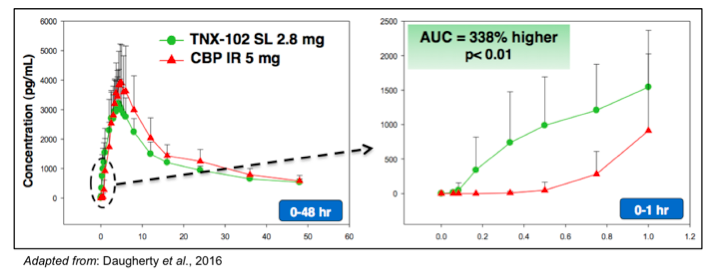
- The bioavailability of CBP is 154% higher with TNX-102 SL compared to the CBP tablet
- The most frequent adverse even reported with TNX-102 SL was transient numbness in the oral cavity, which was reported by 50% of the TNX-102 SL subjects. However, this resolved within 30-45 minutes.
These data clearly show how TNX-102 SL is differentiated from the currently available CBP products, which should help with physician and patient uptake upon approval of the drug.
Data from PTSD Trial to be Reported in the Second Quarter of 2016
Tonix is currently conducting a Phase 2 clinical trial (the AtEase Study) of TNX-102 SL in patients with military-related post-traumatic stress disorder (PTSD). The AtEase study is a randomized, double-blind, placebo-controlled trial to evaluate the efficacy and safety of TNX-102 SL in people with military-related PTSD and related conditions (NCT02277704). The three-arm trial enrolled over 240 participants, who were randomized to receive either 2.8 mg or 5.6 mg of TNX-102 SL or placebo taken sublingually at bedtime daily for 12 weeks. We are anticipating data in the second quarter of 2016.
The primary endpoint of the trial is the week twelve mean change from baseline in the total CAPS-5 (Clinician-Administered PTSD Scale) score in participants who received 2.8 mg of TNX-102 SL as compared to those who received placebo only. Safety will also be evaluated. The CAPS is a structured interview designed to make a categorical PTSD diagnosis and is considered the “gold standard” in PTSD assessment and corresponds to the DSM-5 (the latest edition of the Diagnostic and Statistical Manual of Mental Disorders) diagnosis for PTSD. The assessor combines information on frequency and intensity of an item into a single severity rating (0-4) for the 20 DSM-5 PTSD symptoms, thus patients are assigned a score with a maximum of 80 points possible. A higher score corresponds to more severe PTSD.
We feel its important for investors to understand that even if the trial does not hit statistical significance that does not mean it was a failure. A trend toward significance would be incredibly important and something that would certainly justify continuing the program. The reason for this is the AtEase study could be considered a “proof-of-concept” study as there was no prior data to use in order to make the proper powering assumptions in terms of number of patients necessary to see a statistically significant difference. A trend toward significance would allow for proper powering assumptions in future studies and the opportunity to apply for accelerated approval from the FDA (only one pivotal study necessary for approval) along with breakthrough designation due to the fact there are no treatments currently available for military related PTSD. Conversely, if the study does hit statistical significance it is even possible that the company could approach the FDA to request the AtEase study be the basis for approval. However, we will have to wait and see what the data shows before we know more about the next steps in the PTSD program.
Data from AFFIRM Trial of Tonmya™ in Fibromyalgia to be Reported in the Third Quarter of 2016
On June 17, 2015, Tonix announced the FDA has conditionally accepted the trade name Tonmya™ for TNX-102 SL for the treatment of fibromyalgia. Tonix is currently conducting the Phase 3 AFFIRM trial (NCT02436096). The trial is a randomized, double-blind, placebo-controlled 12-week safety and efficacy study that is expected to enroll approximately 500 fibromyalgia (FM) patients. The patients will be given either a 2.8 mg Tonmya™ tablet or placebo at bedtime in a 1:1 randomization. The trial is taking place at 35 sites in the U.S. We anticipate topline results in the third quarter of 2016.
Tonix is using a 30% responder analysis for the primary outcome measure in the AFFIRM study. The 30% responder analysis is defined as an improvement in pain, as measured by the number of subjects who achieve at least a 30% improvement in their pain scores. A 30% improvement is considered moderate or clinically significant response. For example, if pain is rated on a numeric rating scale of 0 to 10, with 10 being the highest, a patient with a baseline pain score of 6 that is reduced to 4 at the end of the treatment period would have experienced a ~33% reduction in pain. This patient would count towards the primary endpoint. However, a patient with a baseline of 8 reduced to 6 at the end of the study would only have seen a 25% reduction in pain and thus not counted as a responder towards the primary endpoint.
Tonix elected to use the 30% responder analysis for the planned Phase 3 trial because this endpoint demonstrated a statistically significant separation from the placebo group in the Phase 2b BESTFIT study. A 30% responder analysis was a pre-specified secondary outcome measure of BESTFIT. As a reminder, in late September 2014, Tonix announced top-line results for the Phase 2b BESTFIT trial. The study did not achieve statistical significance in the primary efficacy endpoint of change in average daily pain score at week 12 (p=0.086 by mixed-effect model repeated measure analysis, p=0.172 by jump-to-control, multiple imputation analysis).
However, the study demonstrated that TNX-102 SL had a statistically significant effect on pain as measured by a 30% responder analysis of the primary pain data (P =0.033). The 30% response rate in the final analysis was 34.0% in the active treatment arm as compared to 20.6% in the control arm. Based on inputting the 30% responder data from BESTFIT into our powering-calculator, we believe AFFIRM is approximately 90% powered to succeed (P<0.05).
There is the potential, albeit very small, that with strong results from the AFFIRM trial the company can package an application to the U.S. FDA using both BESTFIT and the new data on 30% responder analysis from AFFIRM. However, we view this as unlikely. Since results from two Phase 3 clinical trials will most likely be necessary to gain approval, the company will be initiating a second Phase 3 program for Tonmya™ in FM in the second quarter of 2016.
Development of TNX-201 Discontinued
TNX-201 was an improved formulation of isometheptene (IMH), a compound that had been previously utilized in combination for the treatment of tension-type and migraine headaches. IMH is composed of two isomers, (R)-IMH and (S)-IMH, of which (R)-IMH (the active ingredient in TNX-201) was shown to be a potent agonist of the imidazoline-1-receptor (I1-R) and significantly increased pain tolerance in multiple animal models.
Tonix initiated the Phase 2 study of TNX-201 in June 2015 (NCT02423408). The randomized, double blind, placebo controlled trial was designed to evaluate the efficacy of a single 140 mg dose of TNX-201 compared to placebo in 147 patients with ETTH. Both the TNX-201 (n=75) and placebo (n=72) groups were similar in demographics. The primary efficacy endpoint of headache pain-free at two hours post-dose was assessed on a four-point Numeric Rating Scale (NRS), a Visual Analog Scale (VAS), and a binary questionnaire for self-report of pain. The study also analyzed efficacy using the proportion of participants reported to be pain-free at various post-dose time intervals, the proportion of participants who utilized rescue medication during the 24-hour post dose period, and the change from baseline pain severity at several time intervals.
On February 16, 2016, Tonix reported that the study did not meet the primary efficacy endpoint of achieving headache pain-free status at two hours. The study also failed to meet additional efficacy endpoints that included the proportion of participants with at least a 70% reduction in pain from baseline on the VAS at two hours after dosing, and an increase of the mean change from baseline to two hours post-dose in the VAS score. Based on these results, the company has decided to cease all further development of TNX-201.
Conclusion and Recommendation
The U.S. PTSD population is estimated to be 8 million in size. We believe approximately 25% of these cases are associated with military service, about half of which seek medical treatment for the disease. This puts the U.S. military-associated PTSD population at around 1 million. Assuming a cost of $15 per day and 5% market penetration, we believe TNX-102 SL could have peak sales in PTSD of around $450 million in 2026. We assign a probability of 15% for approval of TNX-102 SL in PTSD based on the historic difficulty in treating PTSD patients and the earlier-stage nature of the program.
For FM, our model estimates that an NDA will be filed in 2018 after completion of two Phase 3 studies; the AFFIRM trial and the trial that will initiate in the second quarter of 2016. This would lead to approval and first sales in 2019. Of the 5 million Americans with fibromyalgia (NIAMS/NIH, November 2014), approximately 50% are diagnosed, which represents approximately 2.5 million U.S. adults. Of those diagnosed, 85% receive treatment (Robinson et al., 2012), thus making the target population approximately 2.1 million individuals in 2015. We estimate peak market share of 5%, which represents approximately 125,000 patients and close to $775 million in peak sales.
We believe the shares are worth $10, and we are maintaining a ‘Buy’ rating on the stock. The decrease in the share price following the discontinuation of TNX-201 was an over-reaction in our estimate and represents a nice buying opportunity ahead of the expected data read-outs in the second and third quarter of 2016.
READ THE FULL RESEARCH REPORT HERE
SUBSCRIBE TO ZACKS SMALL CAP RESEARCH to receive our articles and reports emailed directly to you each morning. Please visit our website for additional information on Zacks SCR and to view our disclaimer.