By
David Bautz, PhD
NASDAQ:TNXP
Business Update
Tonix Pharmaceuticals Holding Corp. (NASDAQ:TNXP) is a pharmaceutical company focused on the development of products for treating disorder of the central nervous system. The company’s lead product, TNX-102 SL, is currently being developed as a treatment for posttraumatic stress disorder (PTSD). The company recently held a PTSD awareness day, which included a comprehensive background on the condition, current treatment options, as well as a review of data from AtEase, the Phase 2 clinical trial of TNX-102 SL in military-related PTSD.
PTSD Background
PTSD is a psychiatric disorder that occurs from exposure to a wide variety of extreme stressors. One of the most common is war and combat. The Diagnostic and Statistical Manual of Mental Disorders (DSM) of the American Psychiatric Association (APA) first defined PTSD in DSM-III in 1980. The definition has changed three times since then: in 1987 in DSM-III-R, in 1994 in DSM-IV, and in 2013 in DSM-5. In contrast to the DSM-IV definition, in DSM-5 PTSD is no longer considered an anxiety disorder but is included in a chapter on Stress- and Trauma-related disorders.
In order to be diagnosed with PTSD, a patient must meet a certain set of criteria related to exposure to a traumatic event, four sets of symptom clusters, two subtypes, the duration of symptoms, the impact on an individuals ability to function, and the lack of substance abuse and other medical illnesses that could account for the symptoms.
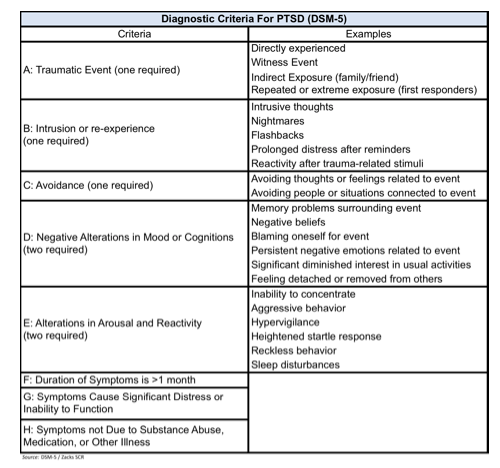
Specify the presence of dissociative symptoms
In addition to meeting the criteria for diagnosis of PTSD, whether a person experiences dissociation can be specified if they meet one of the following:
- Depersonalization, or feeling disconnected from oneself
- Derealization, a feeling that a person’s experience is not real
Treatment of PTSD
Treatments available for PTSD include a number of different pharmacologic and psychotherapeutic modalities. However, while there are a number of different pharmacological treatments that are currently utilized, very few of them have shown efficacy in randomized controlled clinical trials and only two have ever been approved by the FDA for the treatment of PTSD.
Pharmacologic
Alpha-adrenergic blockers: Prazosin is an anti-hypertensive medication that is proposed to reduce nightmares and improve sleep in patients with PTSD. It is believed to work by blocking noradrenergic arousal during sleep. Side effects for prazosin include dizziness, drowsiness, headache, and nausea.
Anticonvulsants: Lamotrigine and topiramate are anticonvulsants used to treat PTSD. Drugs from this class are used to control seizures, prevent migraines, and treat various other brain disorders. Lamotrigine is FDA approved for the treatment of seizures and bipolar disorder while topiramate is FDA approved to treat seizures and migraines. Side effects of anticonvulsants include dizziness, drowsiness, fatigue, and nausea.
Atypical antipsychotics: Olanzapine and risperidone are both used for the treatment of PTSD. Both compounds are hypothesized to work by blocking selected dopamine and serotonin receptors. Olanzapine is FDA approved to treat bipolar disorder while risperidone is FDA approved for the treatment of schizophrenia and symptoms of bipolar disorder. Side effects for olanzapine include agitation, restlessness, and trembling. Side effects for risperidone include dizziness, hyperactivity, and nausea.
Benzodiazepines: These compounds are used for the treatment of anxiety, insomnia, and irritability and are sometimes used for the treatment of PTSD. However, their use is limited by a known risk of dependency and withdrawal after abrupt discontinuation and studies showing they may be less effective than placebo (Gelpin et al., 1996).
Monoamine oxidase inhibitors (MAOIs): Phenelzine is an MAOI used for the treatment of PTSD. This class of compounds works by inhibiting monoamine oxidase, which is responsible for degrading serotonin and related molecules in the central nervous system. Side effects of MAOIs include dizziness, weakness, insomnia, and upset stomach. A 1991 study of phenelzine in male combat veterans showed that it was superior to both placebo and imipramine in reducing PTSD symptoms, however there was no effect shown for the avoidance subscale (Kosten et al., 1991).
Selective Serotonin Reuptake Inhibitors (SSRIs): Paroxetine, sertraline, fluoxetine, and citalopram are examples of SSRIs used to treat PTSD. They are believed to work by blocking the reuptake of serotonin at certain synapses in the brain. Sertraline and paroxetine are the only pharmacologic agents approved by the FDA to treat PTSD. Common side effects of SSRIs include nausea, sexual dysfunction, headache, and weight gain. In addition, stopping treatment abruptly can lead to withdrawal symptoms.
The American Psychiatric Association (APA) groups recommendations into three categories: I) recommended with substantial clinical confidence; II) recommended with moderate clinical confidence; III) may be recommended on the basis of individual circumstances. SSRIs are the only pharmacologic treatment to be rated as category I, while MAOIs were rated category II, and benzodiazepenes, anticonvulsants, antipsychotics, and adrenergic inhibitors were rated category III.
The VA/Department of Defense (DoD) Clinical Practice Guidelines only lists SSRIs as being of significant benefit to patients with PTSD, MAOIs are listed as having some benefit, anticonvulsants and atypical antipsychotics and identified as having unknown benefit, and benzodiazepenes are listed as having no benefit or possibly causing harm.
Psychotherapies
There are a number of different psychotherapies used in the treatment of PTSD, occasionally in concert with medication. These interventions are designed to reduce the intrusion, avoidance, and hyperarousal symptoms of PTSD through a combination of re-experiencing and working through trauma-related memories and emotions, and teaching how to cope with trauma-related stressors. Behavioral therapy includes approaches such as systematic desensitization, biofeedback, and relaxation.
The APA assigned cognitive based therapy and other exposure-based therapies as category I while the VA/DoD classified four psychotherapy treatments as being of significant benefit: cognitive therapy, exposure therapy, stress inoculation therapy, and eye movement desensitization and reprocessing.
PTSD in the Military
Military personnel appear to be at especially high risk for developing PTSD due to the necessity of being in potentially traumatic scenarios involving armed combat and war. There have been multiple studies examining the prevalence of combat-related PTSD in military personnel (Richardson et al., 2011). According to the U.S. Department of Veterans Affairs (VA), approximately 15% of Vietnam veterans are currently diagnosed with PTSD and approximately 11-20% of Operations Iraqi Freedom (OIF) and Enduring Freedom (OEF) veterans have PTSD in a given year.
PTSD is now the third most common disability for which veterans receive disability benefits, behind tinnitus and hearing loss (McNally et al., 2013). The number of veterans receiving PTSD-related disability benefits increased by 80% from 1999 to 2004 (Frueh et al., 2007). For veterans receiving benefits for mental health disorders, 58% are for PTSD, with that percentage increasing to 75% for veterans of Operation Iraqi Freedom/Operation Enduring Freedom (OIF/OEF). In 2012, the total number of veterans diagnosed with PTSD in the VA system was 638,451 (Bowe et al., 2015).
Whether due to stigma are lack of awareness, approximately 50% of military veterans do not seek treatment for PTSD. Of those that do seek treatment, only half get “minimally adequate” treatment (RAND study). Four double blind clinical trials in U.S. veterans using SSRIs, including one with the FDA-approved SSRI sertraline, failed to demonstrate any effect whatsoever (Davidson et al., 2015). In addition, many of the beneficial psychotherapies are not available to a large majority of military veterans due to a lack of qualified personnel and financial resources. The unfortunate consequence to this is that the suicide rate among military veterans is quite high, with as many as five to eight thousand suicides a year (2012 VA Suicide Data Report). Clearly, PTSD is a significant problem with military veterans, and more treatment options are clearly warranted to combat the issue in this underserved population.
TNX-102 SL for the Treatment of PTSD
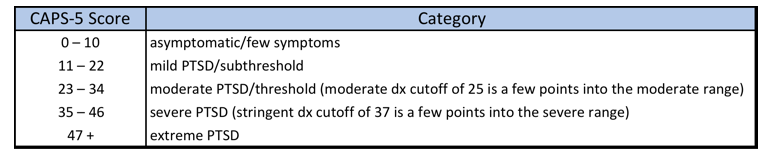
In May 2016, Tonix announced positive results from the AtEase Phase 2 clinical trial of TNX-102 SL in patients with military-related PTSD. The three-arm trial enrolled 231 participants, who were randomized to receive either 2.8 mg of TNX-102 SL (n=90), 5.6 mg of TNX-102 SL (n=49), or placebo (n=92) taken sublingually at bedtime daily for 12 weeks. The primary endpoint of the trial was the week 12 mean change from baseline in the total CAPS-5 (Clinician-Administered PTSD Scale) score in participants who received TNX-102 SL as compared to those who received placebo. Safety was also evaluated. The CAPS is a structured interview designed to make a categorical PTSD diagnosis and provide a total PTSD symptom severity score, and is considered the “gold standard” in PTSD assessment and corresponds to the DSM-5 diagnosis for PTSD. The assessor combines information on frequency and intensity of an item into a single severity rating (0-4) for the 20 DSM-5 PTSD symptoms, thus patients are assigned a score with a maximum of 80 points possible. A higher score corresponds to more severe PTSD and patients are categorized as follows:
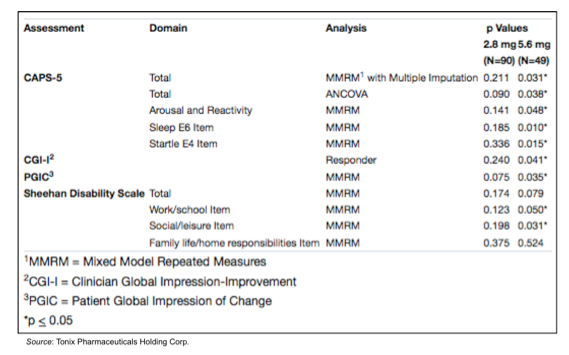
The following table gives results for various parameters of the AtEase study. The results showed that the 5.6 mg dose had a statistically significant effect on total CAPS-5 by two statistical analyses, mixed model repeated measures (MMRM) with multiple imputation (P=0.031) and ANCOVA (P=0.038). In addition, there was a statistically significant effect for various items that go into the CAPS-5 score, including the Sleep E6 item (P=0.010), the Arousal and Reactivity criteria cluster (P=0.048), and Startle E4 item (P=0.015). The fact that the Arousal and Reactivity criteria cluster was significant is very important, as this set of symptoms has been notoriously difficult to treat in PTSD patients. The 5.6 mg dose was also statistically significant for the Clinician Global Impression-Improvement (CGI-I; P=0.041) and the Patient Global Impression of Change (PGIC; P=0.035). Lastly, the percentage of those who finished the trial were 73% on placebo, 79% on 2.8 mg of TNX-102 SL, and 84% on 5.6 mg of TNX-102 SL. The fact that the highest retention rate was in the 5.6 mg dosage group potentially alludes to the clinical efficacy seen with that dose and the fact that the drug was well tolerated. In addition, attaining statistically significant results with a patient population of only 49 individuals means there was a substantial effect size for TNX-102 SL at the 5.6 mg dose.
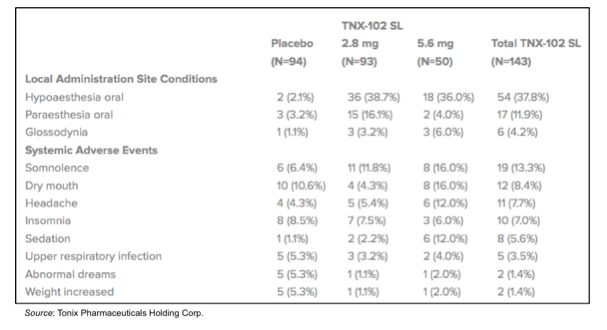
Side effects reported during the trial were generally mild. Patients who took TNX-102 SL experienced a higher degree of tongue numbness than those on placebo. However, this side effect has been seen previously in clinical trials involving TNX-102 SL, is usually transient, and often resolves within 30-45 minutes after administration. The following table lists adverse events that were reported by >5% of subjects in any treatment arm.
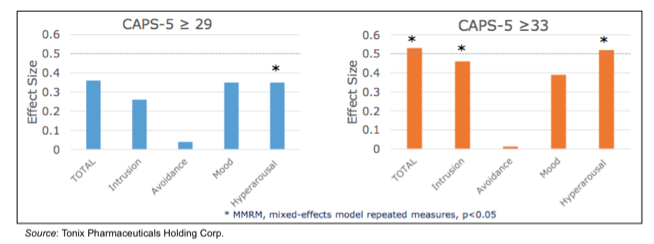
Entry criteria for the AtEase study included a CAPS-5 score of ≥29. Since prior PTSD pharmacotherapy trials used different CAPS scales that typically involved higher CAPS entry criteria, a retrospective analysis was performed by examining the effectiveness of TNX-102 SL based on CAPS-5 entry score. The following chart shows that TNX-102 SL had a more robust effect in patients with CAPS-5 entry score of ≥33 compared to those patients with CAPS-5 score ≥29. A CAPS-5 score of 33 corresponds approximately to a CAPS score of 50 in prior versions of the CAPS, which was a typical cutoff for previous PTSD pharmacotherapy clinical trials.
Next Steps in PTSD
The company is currently developing a Phase 3 program for the 5.6 mg dose of TNX-102 SL in PTSD. On August 29, 2016, the company announced a successful end-of-Phase 2 meeting with the FDA with the meeting minutes indicating that positive results from two adequate, well-controlled Phase 3 efficacy and safety studies and long-term (six- and 12-month) safety exposure studies would support the registration of 5.6 mg TNX-102 SL for the treatment of PTSD. Importantly, the same primary endpoint that was used in the Phase 2 study will be used for both upcoming Phase 3 studies.
The first Phase 3 clinical trial will be in military-related PTSD and be similar to the AtEase study. The trial is likely to begin in the first quarter of 2017 and we anticipate enrollment of approximately 550 patients divided evenly between placebo and 5.6 mg TNX-102 SL treatment. We expect topline data to be available in the fourth quarter of 2018. The company will be performing up to two planned interim analyses to test for efficacy or sample size adjustment: the first will be conducted when approximately 30% (~180 patients) of the total planned enrollment is evaluable for efficacy and the second analysis after 50% (~270 patients) of the total planned enrollment is eligible for efficacy. The study will be limited to those patients with a CAPS-5 score ≥33. The primary endpoint will be the mean change from baseline in total CAPS-5 at Week 12 between those treated with TNX-102 SL 5.6 mg and placebo.
The second Phase 3 study will involve individuals with any type of PTSD. The reason for this is because the company will need to show efficacy in a broader population of patients with PTSD in order for a label of treating PTSD, not just military-related PTSD. In addition, since the military-related PTSD studies have predominantly male subjects, the FDA will require data in a larger female PTSD population. The second Phase 3 study will also be limited to those with a CAPS-5 score ≥33 and will likely enroll approximately 550 patients. The primary endpoint will be the mean change from baseline in total CAPS-5 at Week 12 between those treated with TNX-102 SL 5.6 mg and placebo.
We anticipate each of the trials costing approximately $10-$15 million to fully complete, however the cost to get the trials to the first interim analysis, when they could be stopped early for efficacy, will be much less (approximately $5-$6 million).
Financial Update
On November 10, 2016, Tonix announced financial results for the third quarter of 2016. As expected, the company did not report any revenues. Net loss for the third quarter of 2016 was $7.6 million, or $0.29 per share, and was comprised of $5.5 million in R&D expenses and $2.1 million in G&A expenses. Actual cash burn during the third quarter was $8.4 million.
As of September 30, 2016, Tonix had cash, cash equivalents, and marketable securities of $26.7 million. Subsequent to the end of the third quarter, Tonix announced the closing of a $5.2 million public offering of 9.5 million units sold at $0.55 per unit. Each unit consisted of 1 share of common stock and one warrant to purchase one-half of a share of common stock. The warrants have an exercise price of $0.63 and are exercisable for five years. We estimate this will be sufficient to fund operations for at least the next 12 months, which will last through the first interim analysis of the first PTSD study.
Conclusion and Valuation
Tonix is now a PTSD-focused company, as the company has decided to focus exclusively on this opportunity given the clear regulatory pathway and positive results seen in the Phase 2 AtEase study. The final minutes from the end-of-Phase 2 meeting with the FDA indicate that the same efficacy endpoint that was used in the AtEase study can be employed in the upcoming Phase 3 trials, thus somewhat de-risking this program. The first Phase 3 trial should initiate in the first quarter of 2017 with an interim efficacy analysis taking place near the end of 2017. While we estimate the company has sufficient capital to fund operations through the first interim analysis, additional financing will be necessary in order to complete the Phase 3 program. Whether that comes from partnerships, government grants, or the sale of equity or debt is unclear at this time, but it could represent a potential overhang on the stock in the near term.
Our valuation for Tonix is derived from a probability adjusted discounted cash flow model that takes into account potential future revenues from the sale of TNX-102 SL in PTSD. Of the approximately 8 million individuals in the U.S. who suffer from PTSD, its estimated that approximately 20% seek treatment. With a peak market share of only 6%, we currently estimate that peak sales of $650 million are possible. Using a discount rate of 18% and a 50% probability of approval leads to a net present value for the PTSD program of $61 million. Combined with the company’s current cash position and dividing by a reasonable fully diluted share count of 43.9 million shares leads to a valuation of $2 per share.
For a free copy of the full research report, please email scrinvestors@zacks.com with TNXP as the subject.
SUBSCRIBE TO ZACKS SMALL CAP RESEARCH to receive our articles and reports emailed directly to you each morning. Please visit our website for additional information on Zacks SCR and to view our disclaimer.