By David Bautz, PhD
NASDAQ:TNXP
Positive Topline Results for AtEase Trial
On May 19, 2016, Tonix Pharmaceuticals Holding Corp. (NASDAQ:TNXP) announced positive topline results for TNX-102 SL in the AtEase study of patients with post-traumatic stress disorder (PTSD). Based on these results, the company will be meeting soon with the Food and Drug Administration (FDA) to map out a Phase 3 program.
Overview of PTSD
PTSD is a psychiatric disorder that occurs from exposure to a wide variety of extreme stressors. One of the most common is war and combat. The Diagnostic and Statistical Manual of Mental Disorders (DSM) of the American Psychiatric Association (APA) most recent definition of PTSD was published in 2013 in DSM-5. Diagnosis of PTSD occurs when a patient meets a certain set of criteria related to exposure to a traumatic event, four sets of symptom clusters, two subtypes, the duration of symptoms, the impact on an individuals ability to function, and the lack of substance abuse and other medical illnesses that could account for the symptoms. It is estimated that approximately 8 million individuals in the U.S. suffer from PTSD.
Military personnel are at an increased risk of developing PTSD, with an estimated 14% of all veterans from Operation Iraqi Freedom and Operation Enduring Freedom (OIF/OEF) suffering from the condition. PTSD is now the third most common disability for which veterans receive disability benefits, behind tinnitus and hearing loss (McNally et al., 2013). The number of veterans receiving PTSD-related disability benefits increased by 80% from 1999 to 2004 (Frueh et al., 2007). For veterans receiving benefits for mental health disorders, 58% are for PTSD, with that percentage increasing to 75% for veterans of OIF/OEF. In 2012, the total number of veterans diagnosed with PTSD in the VA system was 638,451 (Bowe et al., 2015).
Current treatment options for PTSD include both pharmacological and psychotherapeutic modalities. A number of different pharmacological treatments are utilized for PTSD (including alpha-adrenergic blockers, anticonvulsants, atypical antipsychotics, monoamine oxidase inhibitors, and selective serotonin reuptake inhibitors), but only two are FDA-approved for the treatment of PTSD (sertraline and paroxetine) and they typically have undesirable side effects such as weight gain and sexual dysfunction.
AtEase Study of TNX-102 SL in PTSD
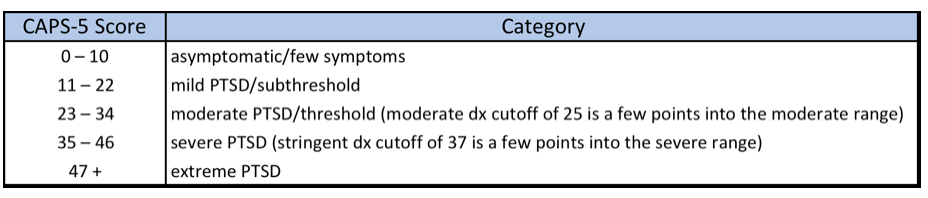
The AtEase study was a Phase 2 randomized, double blind, placebo controlled trial of TNX-102 SL in patients with military-related PTSD (NCT02277704). The three-arm trial enrolled 231 participants, who were randomized to receive either 2.8 mg of TNX-102 SL (n=90), 5.6 mg of TNX-102 SL (n=49), or placebo (n=92) taken sublingually at bedtime daily for 12 weeks. The primary endpoint of the trial was the week twelve mean change from baseline in the total CAPS-5 (Clinician-Administered PTSD Scale) score in participants who received TNX-102 SL as compared to those who received placebo. Safety was also evaluated. The CAPS is a structured interview designed to make a categorical PTSD diagnosis and provide a total PTSD symptom severity score, and is considered the “gold standard” in PTSD assessment and corresponds to the DSM-5 diagnosis for PTSD. The assessor combines information on frequency and intensity of an item into a single severity rating (0-4) for the 20 DSM-5 PTSD symptoms, thus patients are assigned a score with a maximum of 80 points possible. A higher score corresponds to more severe PTSD and patients are categorized as follows:
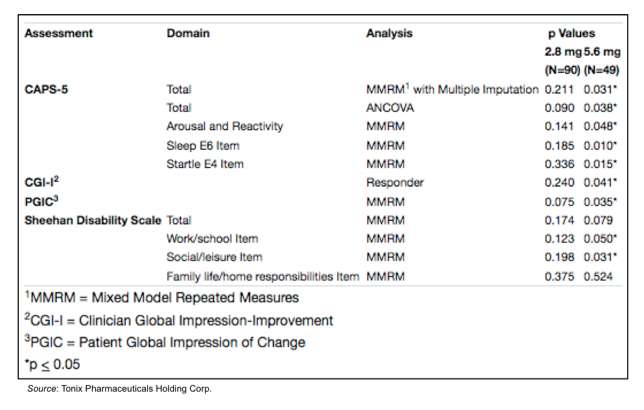
The following table gives results for various parameters of the AtEase study. The results showed that the 5.6 mg dose had a statistically significant effect on total CAPS-5 by two statistical analyses, mixed model repeat measures (MMRM) with multiple imputations (P=0.031) and ANCOVA (P=0.038). In addition, there was a statistically significant effect for various items that go into the CAPS-5 score, including the Sleep E6 item (P=0.010), the Arousal and Reactivity criteria cluster (P=0.048), and Startle E4 item (P=0.015). The fact that the Arousal and Reactivity criteria cluster was significant is very important, as this set of symptoms has been notoriously difficult to treat in PTSD patients. The 5.6 mg dose was also statistically significant for the Clinician Global Impression-Improvement (CGI-I; P=0.041) and the Patient Global Impression of Change (PGIC; P=0.035). Lastly, the percentage of those who finished the trial were 73% on placebo, 79% on 2.8 mg of TNX-102 SL, and 84% on 5.6 mg of TNX-102 SL. The fact that the highest retention rate was in the 5.6 mg dosage group potentially alludes to the clinical efficacy seen with that dose and the fact that the drug was well tolerated. In addition, attaining statistically significant results with a patient population of only 49 individuals means there was a large effect size for TNX-102 SL at the 5.6 mg dose. Thus, fewer patients will be required for properly powering Phase 3 studies than would have been necessary had there been a small effect size.
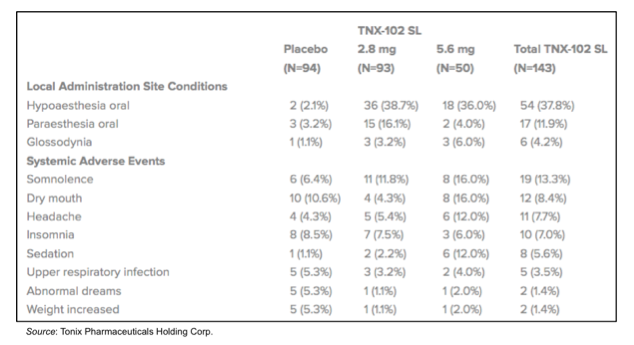
Side effects reported during the trial were generally mild. Patients who took TNX-102 SL experienced a higher degree of tongue numbness than those on placebo. However, this side effect has been seen previously in clinical trials involving TNX-102 SL, is usually transient, and often clears up within 30-45 minutes after administration. The following table lists adverse events that were reported by >5% of subjects in any treatment arm.
Tonix’s Chief Medical Officer, Dr. Gregory Sullivan, will present topline data from the AtEase study at the American Society of Clinical Psychopharmacology Annual Meeting, which is being held in Scottsdale, AZ on May 31, 2016. We’re looking forward to getting a more detailed look at the data at that time and we will provide an update on the data after it is presented.
Next Steps in PTSD
The company will meet with the FDA to map out a Phase 3 program for the 5.6 mg dose of TNX-102 SL in PTSD. It will likely involve two clinical trials. The first clinical trial will likely be in military-related PTSD and could begin as soon as the first quarter of 2017 and will probably enroll approximately twice as many patients as the AtEase study. Now that Tonix knows how to recruit for a study such as that, we expect enrollment to take approximately one year, with topline data under this scenario being available in the first half of 2018.
The second Phase 3 study would likely involve individuals with any type of PTSD, not just military-related. The reason for this is because recruiting for two studies in military-related PTSD would likely prove difficult, as there are many more civilian patients with PTSD than military-related. In addition, civilians with PTSD are more amenable to being treated for PTSD and are an easier patient population to treat. For example, the FDA approved sertraline for the treatment of PTSD based on studies involving only civilians. However, a clinical trial of sertraline for military-related PTSD was unsuccessful. It is unclear at this point whether this second trial would be run concurrently with the first trial or not.
Based on the fact that PTSD is such a serious issue, particularly in the military, as exemplified by the fact that the suicide rate among military veterans is quite high, with as many as five to eight thousand suicides a year (2012 VA Suicide Data Report), it is conceivable that strong results in one Phase 3 clinical trial in PTSD could form the basis for a regulatory filing along with the data from the AtEase trial. This would be entirely dependent upon the Phase 3 results being highly statistically significant, and at this point we only mention it as a possibility. We may get more clarity on this option after Tonix is able to meet with the FDA regarding the Phase 3 program.
Data from AFFIRM Trial of Tonmya™ in Fibromyalgia to be Reported in the Third Quarter of 2016
On June 17, 2015, Tonix announced the FDA has conditionally accepted the trade name Tonmya™ for TNX-102 SL for the treatment of fibromyalgia. Tonix is currently conducting the Phase 3 AFFIRM trial (NCT02436096). The trial is a randomized, double-blind, placebo-controlled 12-week safety and efficacy study that has enrolled approximately 500 fibromyalgia (FM) patients. The patients are being treated with either a 2.8 mg Tonmya™ tablet or placebo at bedtime in a 1:1 randomization. The trial is taking place at 35 sites in the U.S. We anticipate topline results in the third quarter of 2016.
Tonix is using a 30% responder analysis for the primary outcome measure in the AFFIRM study. The 30% responder analysis is defined as an improvement in pain, as measured by the number of subjects who achieve at least a 30% improvement in their pain scores. A 30% improvement is considered moderate or clinically significant response. For example, if pain is rated on a numeric rating scale of 0 to 10, with 10 being the highest, a patient with a baseline pain score of 6 that is reduced to 4 at the end of the treatment period would have experienced a ~33% reduction in pain. This patient would count towards the primary endpoint. However, a patient with a baseline of 8 reduced to 6 at the end of the study would only have seen a 25% reduction in pain and thus not counted as a responder towards the primary endpoint.
Tonix elected to use the 30% responder analysis for the planned Phase 3 trial because this endpoint demonstrated a statistically significant separation from the placebo group in the Phase 2b BESTFIT study. A 30% responder analysis was a pre-specified secondary outcome measure of BESTFIT. As a reminder, in late September 2014, Tonix announced top-line results for the Phase 2b BESTFIT trial. The study did not achieve statistical significance in the primary efficacy endpoint of change in average daily pain score at week 12 (P=0.086 by mixed-effect model repeated measure analysis, P=0.172 by jump-to-control, multiple imputation analysis).
However, the study demonstrated that TNX-102 SL had a statistically significant effect on pain as measured by a 30% responder analysis of the primary pain data (P =0.033). The 30% response rate in the final analysis was 34.0% in the active treatment arm as compared to 20.6% in the control arm. Based on inputting the 30% responder data from BESTFIT into our powering-calculator, we believe AFFIRM is approximately 90% powered to succeed (P<0.05).
There is the potential, albeit very small, that with strong results from the AFFIRM trial the company can package an application to the U.S. FDA using both BESTFIT and the new data on 30% responder analysis from AFFIRM. However, we view this as unlikely. Since results from two Phase 3 clinical trials will most likely be necessary to gain approval, the company will be initiating a second Phase 3 program for Tonmya™ in FM in the second quarter of 2016.
Conclusion and Valuation
The positive results for the Phase 2 AtEase trial is welcome news for the company, but especially for patients who suffer from PTSD, particularly military veterans afflicted with the condition. Up to this point, there was essentially no effective pharmacological treatment option for these patients, and the AtEase results could be looked at as a real scientific breakthrough. We look forward to seeing additional data from the trial when it is presented at the end of this month. In addition, we will be interested to hear more about the company’s plan for a Phase 3 program once management has had a chance to meet with the FDA.
In terms of timeline, we anticipate the first Phase 3 trial for PTSD initiating in the first quarter of 2017, with results from that trial most likely by the first half of 2018. We will await further guidance on whether the second Phase 3 trial will be run concurrently with the first Phase 3 trial or not. We have modified our probability adjusted discounted cash flow model to take into account the full population with PTSD, not just military-related. We now see peak sales in PTSD of approximately $650 million, but this number is highly contingent upon successful results in a Phase 3 program in both a military and civilian population.
Based on our model, we value TNXP at $12/share. The stock currently trades a large discount to this valuation, and positive data from the AFFIRM trial, which will be released in the third quarter of 2016, could move the stock closer to our target.
READ THE FULL RESEARCH REPORT HERE
SUBSCRIBE TO ZACKS SMALL CAP RESEARCH to receive our articles and reports emailed directly to you each morning. Please visit our website for additional information on Zacks SCR and to view our disclaimer.