By: Nisha Hirani, MD & David Bautz, PhD
NASDAQ:TTNP
On January 12, 2016, The Psychopharmacologic Drugs Advisory Committee (PDAC) of the U.S. Food and Drug Administration (FDA) voted 12-to-5 to recommend approval of Probuphine, the first long-acting, subdermal buprenorphine implant for the maintenance treatment of opioid addiction in stable patients receiving 8 mg or less per day of buprenorphine. The PDUFA date for Probuphine is set for February 27, 2016. There were eight discussion questions asked of the panel, and only one voting question, which we will proceed to highlight below. A detailed analysis of the discussion questions can be found in our full research report. Briefing materials were also made available prior to the meeting.
As a reminder, the new drug application (NDA) for Probuphine was resubmitted to the FDA in August 2015 by Braeburn Pharmaceuticals, Inc. on behalf of Titan Pharmaceuticals (NASDAQ:TTNP), and was later accepted for six-month priority review in September 2015. The Probuphine NDA resubmission included results from the Phase 3 double-blind, double-dummy study that we have reviewed in previous updates. The study met the pre-specified primary endpoint of non-inferiority in addition to secondary efficacy endpoints.
Quick Recap of Probuphine Regulatory History
As a reminder to investors, Titan reported positive topline results from a confirmatory Phase 3 study with Probuphine in subjects with opioid addiction on June 8, 2015. This was the third positive Phase 3 trial for the company since 2011. Titan had previously completed two Phase 3 safety and efficacy trials on the drug with both showing superiority over placebo implants and non-inferiority to sublingual buprenorphine/naloxone for the treatment of opioid addiction (1stP3, 2ndP3). The company also conducted two open label long-term treatment safety studies and one relative bioavailability study. Titan filed for U.S. approval in October 2012, and along with commercialization partner, Braeburn Pharmaceuticals, was granted priority review by the agency in January 2013. In March 2013, the FDA's Psychopharmacologic Drugs Advisory Committee (PDAC) voted (10 positive votes, 4 negative votes, and 1 abstention) to recommend approval of the product; however, the FDA issued a complete response letter (CRL) in April 2013 stating that approval was not granted, and requested additional data on the use of the product in patients stable on lower doses of sublingual buprenorphine/naloxone than previously tested in the first two Phase 3 clinical trials. Back in 2013, concerns mainly revolved around dosing, dosage, and human factors testing associated with the insertion and removal. The CRL also included recommendations regarding product labeling and the implementations of the Risk Evaluation and Mitigation Strategy (REMS). A post-action meeting took place on November 19, 2013, and it was established that the FDA would consider a limited indication, but a trial would be needed. A series of post-meeting communications to discuss the study design also took place.
PDAC Voting Question
Voting Question #8: Based on the data presented and discussed today, do the efficacy, safety, and risk-benefit profile of Probuphine support the approval of this application?
VOTE: 12 YES, 5 NO
The voting went pretty much as we anticipated as we were expecting for the panel to recommend approval of Probuphine. The majority of the panel (12 out of 17 members, or about 71%) voted that based on the data presented and discussed at the meeting, the efficacy, safety, and risk-benefit profile of Probuphine supports the approval of the NDA for the proposed indication of maintenance treatment of opioid dependence in patients who are stable on a dose of 8mg or less per day of sublingual buprenorphine. Several panel members that voted in favor of Probuphine approval stated that the trial data demonstrated non-inferiority in light of the FDA’s thorough sensitivity analyses. Furthermore, several committee members emphasized that the patient population needs to be clearly defined and outlined in the labeling material if Probuphine is ultimately approved.
The panel members that voted against approval voiced concerns regarding identification of the appropriate patient population, the missing urine data, the implications of rescue medication use, and mitigating risks that were associated with implantation and removal of the Probuphine implant. We think it’s important to point out that a few of the panel members that voted ‘NO’ had some interesting explanations when accounting for their positions regarding the vote. For instance, one panel member voted ‘NO’ because she wasn’t quite sure what she was voting for, and she mentioned that she could very well change her mind in a month. Another panel member voted ‘NO’ because of how the question was phrased. Regardless, in our opinion, it seems that although there were some issues brought up, using the FDA’s conservative analysis methods for non-inferiority, the panel generally felt that Probuphine should be approved as the benefits clearly outweigh the risks. Most of the panel members agreed that Probuphine seems to offer utility for the maintenance treatment of opioid addiction, and that the product does have some unique characteristics with respect to reducing the potential for diversion and improving compliance.
Open Public Hearing
As part of the advisory committee meeting, an open public hearing included first-hand accounts, letters and feedback from patients, physicians, clinical trial investigators, and advocacy organizations. There were 18 speakers during the open public hearing, and 17 of them spoke in favor of Probuphine approval. Only one speaker, a pharmacist from the National Center for Health Research, spoke out against approval, as she believed that there was not enough evidence to support efficacy and that the trial had some flaws. Overall, the hearing demonstrated the public’s strong desire for new treatment options like Probuphine to be available for the treatment of opioid addiction in order to combat the current opioid public health crisis.
Our Perspective
We have included slide 51 from the FDA’s presentation (by Clinical Reviewer, Dr. Rachel Skeete, of the Division of Anesthesia, Analgesia, and Addiction Products and Statistical Reviewer, James Travis, PhD, of the Division of Biometrics II) below. This slide summarizes the challenges that the FDA saw with the PRO-814 trial data relating to efficacy data, definition of the intent-to-treat population, and presentation of results:
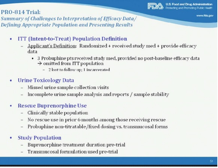
As a reminder, in June 2015, Titan reported that its Phase 3 trial met its pre-specified primary endpoint of non-inferiority. In the trial, patients (n=177) were randomized to treatment with either 4 active implants plus daily placebo tablets or 4 placebo implants plus daily active control tablets (≤8 mg/day sublingual buprenorphine/naloxone) for 6 months. A responder was defined as having at least four out of six months free of illicit opioids based on urine testing and subject self-report. Analyses conducted according to the pre-planned Statistical Analysis Plan indicated response rates of 96.4% for the Probuphine arm and 87.6% for the sublingual buprenorphine/naloxone arm. The two-sided 95% confidence interval (0.009, 0.167) of the treatment difference (Probuphine – sublingual buprenorphine/naloxone) was well within the pre-defined successful margin for non-inferiority. In fact, sequential analysis showed that Probuphine was clinically superior to sublingual buprenorphine/naloxone (p < 0.05). The safety and tolerability profiles for both treatment groups were also reported to be comparable.
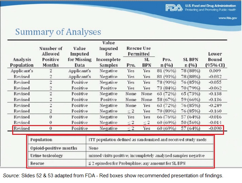
Our view is that the FDA came up with several different ways to analyze the data to account for the missing samples and need for rescue use, including a preferred analysis of the data (above in red). We view the FDA’s evaluation of the data and sensitivity analyses to be thorough, and believe that even using the FDA’s conservative preferred recommendation of analysis, Probuphine is still within the pre-defined margin for non-inferiority. Although this is the second positive advisory committee for Probuphine, we would like to mention that the FDA is not obligated to follow the recommendations of its panel, but will consider the committee’s guidance as it completes its review of the Probuphine NDA.
We continue to believe that Probuphine could be a potentially life-saving treatment option for a particular group of patients that are not responding well to currently available treatment options. We do agree that that the implant has risks associated with it, but a well-defined, stable patient population could greatly benefit from this treatment option if approved. As mentioned before, the FDA recognizes the public health crisis related to opioid abuse and has been willing to be flexible. We believe that the labeling for Probuphine, if approved, needs to be very specific, and there needs to be strict guidelines in place related to prescribing practices. We do believe risk still exists, and that there are some issues with the implant, but like the majority of the PDAC, we believe that the benefits outweigh the risks for a pre-specified group of patients where the treatment could be potentially life-saving. We believe the risks are mainly related to the REMS and use of rescue medication. The patient population at hand is a very difficult one to manage in a clinical trial setting, and we see challenges with trial design and compliance as being unavoidable to some degree. We are not sure if two positive advisory committee votes (2013 & 2016) and positive data from three Phase 3 trials will be enough for approval this time around, so we will just have to wait and see until the agency action date.
We would also like to mention that Probuphine has been gaining quite a bit of media attention since the Psychopharmacologic Drugs Advisory Committee (PDAC) of the U.S. Food and Drug Administration (FDA) voted 12-to-5 to recommend approval of Probuphine. Articles have been popping up in the NY Times, NPR, and USA Today to name a few. President Obama even brought to light the severity of the opioid of the epidemic in the opening remarks of his State of the Union speech. Opioid abuse, addiction and dependence remain major public health and social challenges, especially in the United States. It is estimated that between 26 million and 36 million individuals worldwide abuse opioids (UNODC, World Drug Report 2012) with approximately 2.1 million people in the U.S. suffering from substance use disorders related to prescription opioid pain relievers in 2012, and an estimated 467,000 suffering with heroin addition (National Survey on Drug Use and Health, 2012). Opioid dependence is increasingly being recognized as a global epidemic by various health authorities.
On September 17, 2015, U.S. Health and Human Services Department (HHS) Secretary Sylvia Burwell announced that HHS plans to revise the regulations surrounding the prescribing of buprenorphine to allow for expanded access to medication-assisted treatment (MAT) for the treatment of opioid dependence. Currently, there is a limit to the number of patients that can be treated with buprenorphine products by certified physicians. This cap restricts availability to these important and often life-saving medication-assisted therapies. The HHS revision aims to “provide a balance between expanding the supply of this important treatment, encouraging use of evidence-based MAT, and minimizing the risk of drug diversion.” Federal officials are aiming to address the opioid epidemic in an effort to offer greater access to safe and effective treatment options for opioid maintenance. If approved, we see the potential for Probuphine to help address the nation’s opioid abuse epidemic, which is consistent with HHS’s objectives.
Titan exited the third quarter of 2015 (September 30, 2015) with approximately $9.7 million in cash. We believe that these funds are sufficient to support Titan’s planned operations into the fourth quarter of 2016. If Probuphine is approved, Titan will receive a $15.0 million milestone payment from Braeburn. We also believe that potential licenses outside the U.S. could occur in the near future, thus bringing in more non-dilutive cash to the company. All-in-all, we believe Titan is currently in a strong financial position, especially with the possibility of receiving the $15.0 million milestone payment from Braeburn. Titan continues to work with its contract manufacturer and Braeburn in preparation for product launch. We are not sure how long the final labeling and packaging will ultimately take, but if all goes well and Probuphine gets approved this time around, we could see a product launch as early as mid-2016.
We view the recent pullback in the biotechnology sector as a nice opportunity for investors to initiate or add to a position in Titan. We believe that Probuphine approval would be a transformational event for the company, and allow management to continue to expand upon the novel delivery of the ProNeura technology platform. We remind investors that Titan continues to move forward with the ProNeura in Parkinson’s Disease program, and the company announced the addition of an implantable product for hypothyroidism to its pipeline in November 2015 while it continues to evaluate other chronic disease settings for potential ProNeura platform expansion.
We think Titan’s stock continues to have some meaningful upside left given the big pull back. We would also like to point out that Titan has also made progress in evaluating additional compounds that can be delivered in the ProNeura implant, and just added an implantable triiodothyronine (T3) product for the treatment of hypothyroidism to its product development pipeline. We are looking forward to learning more about this product and additional pipeline candidates in the future. With both late and early-stage programs utilizing the ProNeura platform under way, we continue to see the shares worth $8.25 right now, with potential upside upon Probuphine approval in 2016. At this point, our model has very little contribution from ProNeura in Parkinson’s disease, hypothyroidism or other chronic indications or in value for Probuphine outside the U.S. We believe these situations may also present additional upside to our financial model. However, in the event that Titan receives another complete response letter (CRL) from the FDA, we would re-visit our model and need to make significant changes to our valuation and target price.
READ THE LATEST FULL RESEARCH REPORT HERE
SUBSCRIBE TO ZACKS SMALL CAP RESEARCH to receive our articles and reports emailed directly to you each morning. Please visit our website for additional information on Zacks SCR and to view our disclaimer.