By
Steven Ralston, CFA
OTC:DXIEF
In the last few months, DXI Energy (OTC:DXIEF) reported results for the second quarter ending June 30, 2016, began trading on the OTCQB and completed two tranches of a private placement. In addition, management provided a strategic plan to expand production at Woodrush. Furthermore, the U.S. Geological Survey (USGS) reassessed the potential of the Mancos Shale formation in Colorado's Piceance Basin, estimating that it now holds about 66 trillion cubic feet of natural gas, up from the 1.6 trillion cubic feet estimated in 2003.
On August 11, 2016, after the close, DXI Energy reported results for the second quarter ending June 30, 2016. DXI reported a loss of CDN $0.015 per diluted share versus a loss of $0.014 in the comparable quarter last year. Gross oil and gas revenues (before royalties) decreased 45.1% to $1.18 million versus $2.15 million in the second quarter of 2015.
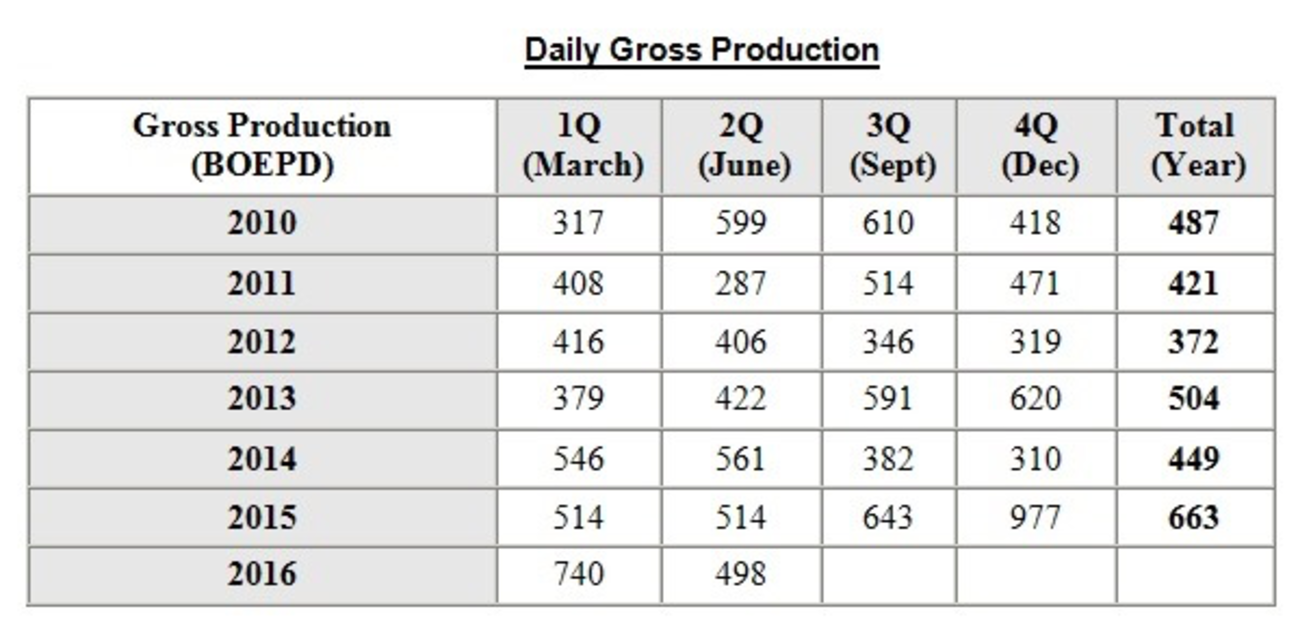
Gross production averaged 498 BOEPD during the quarter, only a 3.1% decrease year-over-year (YOY) from 514 BOEPD during the second quarter of 2015, but a 32.7% sequential decline from 740 BOEPD during the first quarter of 2016. The declining production profile, together with only four more months remaining in the year, make it doubtful that management will attain its production profile target of 1,200+ BOEPD, even if an opportunistic bolt-on acquisition is completed this year.
Nevertheless, management has a self-imposed mandate to significantly expand DXI Energy’s oil production profile, and on May 26, 2016, management announced its strategic plan to improve operational efficiencies as well as expand oil production at Woodrush. The company's engineers have determined that by reconfiguring the waterflood operations, oil production could be significantly increased. To fund this opportunity, in May and June, DXI energy closed two tranches of a private placement totaling 8,298,333 shares at CDN$0.12 per share providing net proceeds of roughly CDN$934,000. The proceeds give management the flexibility to pursue its strategic objective; however, as a result, shares outstanding increased approximately 23%, considerably diluting shareholders.
The next stage of development would be to address the declining production profile at Kokopelli. However, any new initiatives are contingent on natural gas pricing being greater than US$3.00 per MCF at the wellhead in order that management can achieve its 24-month investment recapture mandate.
A USGS geology-based assessment report released in June estimates that the Mancos Shale in the Piceance may now contain 66 trillion cubic feet of natural gas (or 40 times more than the previous assessment of 1.6 trillion cubic feet completed in 2003). The revised assessment of technically recoverable, undiscovered oil and gas is based on new drilling in the Mancos Shale that provided additional geologic data that made the revision necessary. Potentially, this report could motivate the independent petroleum reserve engineering consultants to consider adding the potential of the Mancos horizon throughout the southern Kokopelli lease when evaluating the 2016 year-end assessment of the company's reserves.
Lastly, rather than again affecting a reverse stock split in order to remain in compliance with the NYSE MKT, management decided to list the company’s stock in the United States on the OTCQB. In early August, DXI Energy
voluntarily delisted its stock from the NYSE MKT, and the company's stock
began trading on the OTCQB under the ticker symbol
DXIEF. DXI Energy’s primary trading jurisdiction continues to be the Toronto Stock Exchange.
SUBSCRIBE TO ZACKS SMALL CAP RESEARCH to receive our articles and reports emailed directly to you each morning. Please visit our website for additional information on Zacks SCR and to view our disclaimer.