By
David Bautz, PhD
NASDAQ:VBIV
VBI Vaccines, Inc. (NASDAQ:VBIV) is a commercial stage biopharmaceutical company developing vaccines to prevent and treat infectious diseases and cancer. The company is currently focused on the following key value drivers:
➢ A third-generation hepatitis B vaccine (Sci-B-Vac™) that is currently marketed in 15 countries around the world. VBI is planning to meet with regulators from the FDA and EMA to determine a path forward for approval in those jurisdictions.
➢ The eVLP vaccine platform, which allows for the production of enveloped (“e”) virus-like particles (“VLP”) that closely mimic the target virus. The lead eVLP asset in the company’s pipeline is a prophylactic cytomegalovirus (CMV) vaccine. The company is also pursuing a CMV vaccine as an immuno-oncology treatment for glioblastoma multiforme (GBM), a type of brain cancer. A respiratory syncytial virus (RSV) and Zika virus vaccine are also in preclinical development.
➢ A thermostable technology for vaccines and biologic therapies that allows storage of those products at various temperatures, as currently 90% of those treatments are required to be stored at 4°C - 8°C. The thermostable technology has led to partnerships with biopharmaceutical companies Sanofi and GlaxoSmithKline.
Sci-B-Vac™
Sci-B-Vac™ is a third-generation vaccine for the prevention of hepatitis B (HBV) infection. The vaccine has been used in over 300,000 patients and is currently approved for use in Israel and 14 additional countries. The company will be meeting soon with regulators in the U.S. and Europe to map out a pathway for approval in those jurisdictions.
Hepatitis B Virus
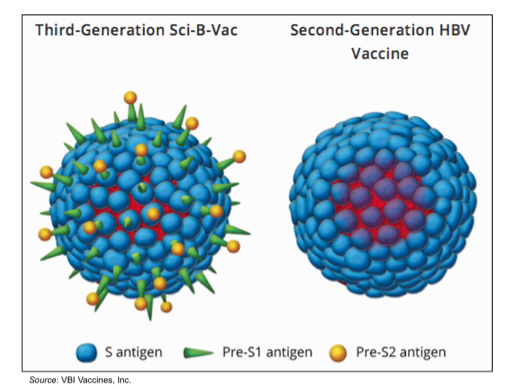
The hepatitis B virus (HBV) is a member of the hepadnavirus family that causes both acute and chronic liver infections. The virus is composed of an outer lipid layer that contains three surface proteins (pre-S1, pre-S2, and S) along with a nucleocapsid core that contains a circular DNA genome.
Acute infection with the hepatitis B virus typically results in a loss of appetite, nausea, vomiting, body aches, mild fever, and jaundice. More than 90% of people infected with the hepatitis B virus will recover and be completely free of the virus within six months. According to the World Health Organization, the likelihood of developing a chronic hepatitis B infection is highly dependent upon the age when the infection occurs, and is highest in infants and young children (WHO fact sheet N°204).
Transmission of the virus occurs by exposure to infected blood or bodily fluids, with the most typical modes being sexual contact, blood transfusion, re-use of contaminated syringes, and transmission from mother to child during childbirth.
It is estimated that approximately 350-400 million people worldwide have a chronic, lifelong infection. According to the WHO, the world can be divided into three areas based on the prevalence of chronic HBV infection: high (>8%), intermediate (2-8%), and low (<2%). High areas of chronic infection include southeast Asia, sub-Saharan Africa, the Amazon Basin, and some countries in eastern Europe where approximately 8-20% of the population are HBV carriers (Hollinger et al., 2001). Low areas of chronic infection include North America, Western and Northern Europe, and Australia. The rest of the world makes up the intermediate range of HBV prevalence.
The following figure shows how immigration trends are resulting in a significant number of individuals moving to the U.S. and Europe from areas with a high prevalence of HBV infection. This shows the necessity for superior HBV vaccines that can be utilized in those regions to help limit the spread of the disease.

Hepatitis B Vaccine
A vaccine to prevent hepatitis B infection has been available in the U.S. for over 30 years. The first-generation of the vaccine was produced with HBV S antigen purified from the blood of chronically infected HBV patients. This vaccine was replaced with a second-generation vaccine that utilizes recombinantly produced S antigen that is expressed in yeast, thus eliminating any risk of pathogenic transfer from human derived blood products. These second-generation vaccines are currently utilized in universal vaccination programs around the world. Both Engerix-B® (sold by GlaxoSmithKline) and Recombivax-HB® (sold by Merck) are available in the U.S. Twinrix® is a combination hepatitis A and hepatitis B vaccine that is also available in the U.S. Thus far, over one billion doses of the hepatitis B vaccine have been administered around the world with an excellent record of safety and efficacy.
The WHO currently recommends that all newborns should receive the first dose of the hepatitis B vaccine as soon as possible after birth, preferably within 24 hours. This should then be followed up by two or three doses to complete the primary series. A protective antibody response (defined as ≥ 10 mIU/mL) is seen in approximately 30-55% of healthy adults ≤ 40 years after the first dose, 75% after the second dose, and >90% after the third dose (André, 1989). After age 40, the proportion of individuals with a protective antibody response after a 3-dose vaccination regimen declines below 90%, and by age 60, a protective level of antibody response only develops in 75% of those vaccinated (Averhoff et al., 1998).
While seroprotection rates to the hepatitis B S antigen are close to 100% in children and 95% in healthy young adults, there is increasing awareness of certain cohorts of patients whose seroprotection wanes over time, including those who are elderly, obese, heavy smokers, and patients on haemodialysis or are immuno-compromised (Averhoff et al., 1998). As shown in the following table, there exist high-risk populations of non-responders and low-responders to the current HBV vaccine, including those with cancer, patients with chronic liver or kidney disease, HIV positive patients, and post-transplantation patients.
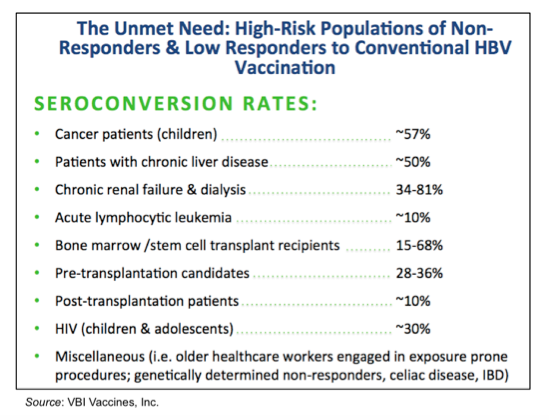
The current strategies employed to overcome the low rate of seroprotection in high-risk patients include increasing the dose or adding additional injections, adding a more immunogenic adjuvant, or administering an intra-dermal injection instead of an intramuscular injection. However, the current HBV vaccines are not approved for extra doses or for intra-dermal injections. What would be most beneficial is a more potent HBV vaccine that is more effective in high-risk patient populations and does not require a work-around to increase its effectiveness.
Sci-B-Vac™
Sci-B-Vac™ is a third generation HBV vaccine for adults, children, and newborns that is currently marketed in 15 countries. In Israel, Sci-B-Vac™ is administered to approximately 50% of all neonates (the other 50% receive Engerix-B®), which equates to approximately 300,000 doses per year. The vaccine has been developed to enhance immunogenicity to solve the following issues:
➢ Lack of robust response to conventional HBV vaccine in high-risk populations
➢ The necessity for three doses of HBV vaccine to achieve >90% seroprotection in a population
➢ Low compliance with the three-dose regimen that leads to decreased efficacy
➢ Evidence of waning efficacy 20 years after primary immunization with current HBV vaccine
Sci-B-Vac™ differs from the current HBV vaccine in that it is composed of the three major surface antigens of HBV and is produced in mammalian cell culture, as opposed to the current vaccine that only contains the S antigen and is produced in yeast. Additional examples of mammalian cell derived, third-generation HBV vaccines include Gen Hevac B® (marketed by Aventis Pasteur in France) and AG-3™ (which is no longer manufactured).
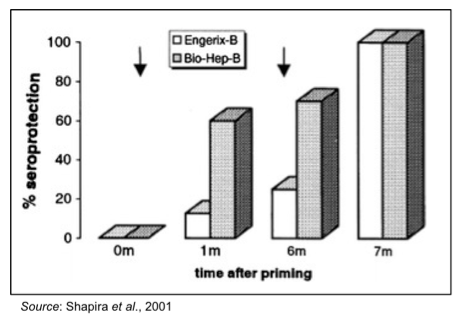
Thus far there have been 20 clinical trials conducted with Sci-B-Vac™ in >3,000 patients, including adults, children, and neonates. In all of those studies the vaccine had an excellent safety profile. The following figure shows results from a pilot study comparing Sci-B-Vac™ to Engerix-B® in which a single 10 μg dose of Sci-B-Vac™ resulted in seroprotection in 70% of subjects compared to only 25% who received a single 20 μg dose of Engerix-B® at six months following immunization (Shapira et al., 2001). Following a booster injection at six months, 100% seroprotection was achieved in both groups, however anti-HBV antibody levels averaged 28,800 mIU/mL for Sci-B-Vac™ immunized subjects compared to 923 mIU/mL in Engerix-B® immunized subjects.
Additional data showing the efficacy of Sci-B-Vac™ includes (Shouval et al., 2015):
• 97% and 98% seroprotection at month six in young adults after two injections at month 0 and 1;
• A dose response in anti-HBV antibody titers in neonates in Vietnam;
• A pooled analysis of multiple studies comparing Sci-B-Vac™ to Engerix-B® showed initial seroprotection at month 1 to be 67% and 19% in Sci-B-Vac™ and Engerix-B® immunized subjects, respectively;
• 25/29 end stage renal disease (ESRD) patients who did not respond to repeated immunization with a second-generation HBV vaccine developed seroprotective anti-HBV antibody levels following three 10 μg doses of Sci-B-Vac™;
• A study of 716 “non-responders” to a second-generation HBV vaccine showed 81.7% developed seroprotective levels of anti-HBV antibodies when immunized with Sci-B-Vac™ compared to 49.1% of those immunized with Engerix-B®;
• Increased body weight was inversely correlated with seroprotection rates for second generation vaccines, while body weight had virtually no effect on seroprotection for those immunized with Sci-B-Vac™;
• Immunization with Sci-B-Vac™ was effective in 50% of immunosuppressed, HBV-infected liver transplant patients
In summary, Sci-B-Vac™ targets all three HBV surface antigens, produces a rapid onset of protection, induces a high level of anti-HBV neutralizing antibodies, is administered at lower doses than the currently available HBV vaccine, and is effective in patients that do not respond to the current HBV vaccine.
VBI is planning to meet with regulators in both the U.S. and Europe in the second half of 2016 to determine the path forward for regulatory approval in each of those jurisdictions.
HEPLISAV-B™
Dynavax (DVAX) is currently developing HEPLISAV-B™, a second-generation HBV vaccine that utilizes a novel toll-like receptor 9 (TLR9) agonist as an adjuvant. Dynavax has completed three Phase 3 clinical trials comparing HEPLISAV-B™ with Engerix-B® in over 10,000 individuals age 18 and older. HEPLISAV-B™ is given as two injections separated by a month compared to the current HBV vaccines that are given at 0, 1, and 6 months. The company originally filed a Biologics License Application (BLA) in 2012 based on the results of two Phase 3 clinical trials. The FDA issued a Complete Response Letter (CRL) in 2013 indicating that it would not approve the BLA for HEPLISAV-B™ due to hypothetical risks of the TLR9 adjuvant that could result in an increased possibility of rare autoimmune side effects.
Results from the third Phase 3 clinical trial showed seroprotecion rates of 95% for HEPLISAV-B™ treated patients compared to 81% for Engerix-B® treated patients. The study also showed an imbalance in the cases of Bell’s Palsy (five for HEPLISAV-B™ treated patients compared with one for Engerix-B® treated patients) and overall “new-onset” autoimmune diseases (eight on HEPLISAV-B™ and one on Engerix-B®).
Following the completion of a third Phase 3 clinical trial, the company resubmitted the BLA, which was accepted by the FDA in March 2016. At the time, the company was assigned a Prescription Drug User Fee Act (PDUFA) date of Sep. 15, 2016. In April 2016, the company received notice from the FDA that the PDUFA date was extended to Dec. 15, 2016 due to Dynavax submitting individual trial data sets that had been provided as integrated data in the March 2016 BLA filing.
Hepatitis B Vaccine Market
There are three hepatitis B vaccines currently available in the U.S.: Engerix-B® (sold by GlaxoSmithKline), Recombivax-HB® (sold by Merck), and the combination hepatitis A and hepatitis B vaccine Twinrix® (sold by GlaxoSmithKline). In 2013, Sanofi received approval by the European Medical Association (EMA) for Hexyon, which is a childhood vaccine that provides protection against six pathogens including HBV.
The global hepatitis B vaccine market was worth approximately $960 million in 2012 (PharmaPoint), while the U.S. market is approximately $270 million annually. In 2012, the Advisory Committee on Immunization Practices (ACIP) updated recommendations for adults who should be vaccinated against HBV to include people with diabetes mellitus type 1 and type 2. This represents approximately 20 million individuals in the U.S. and could dramatically increase the overall HBV vaccine market.
eVLPs
VBI is utilizing its proprietary enveloped virus-like particle (eVLP) technology to develop a class of synthetic vaccines designed to closely mimic the structure of viruses but without the viral genome, thus offering the potential for more efficacious and safer vaccines.

The eVLP platform has a number of positive attributes including a high degree of immunogenicity, the ability to control the type and level of expression for different antigens, no risk of reversion to an infectious state that is possible with live-attenuated viruses, and the ability to be manufactured in commercial scale quantities.
The company is currently developing eVLPs to target cytomegalovirus (CMV) through two separate avenues: the development of a prophylactic vaccine and an immuno-oncology product for the treatment of certain types of cancer. A vaccine targeting respiratory syncytial virus (RSV) is also under development, along with a recently announced program to prevent Zika virus.
CMV Infection
CMV is a member of the herpesviridae family that infects a large percentage of the population, typically with few or no symptoms. Like other herpesviruses, once infected a person retains the virus in their body for life. Approximately 50-80% of the population is infected with CMV by the age of 40 (NIH). For healthy individuals, the virus typically remains dormant. However, for pregnant women, those with weakened immune systems, and solid-organ transplant recipients, CMV infection is a cause for concern.
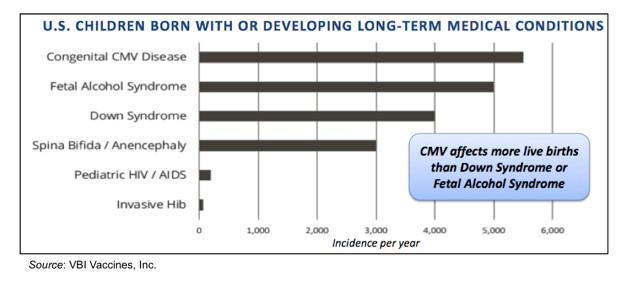
For immunocompromised patients, an illness resembling mononucleosis is the most common presentation of CMV, which can include fever, pneumonia, diarrhea, and hepatitis. Pregnant women who become infected with CMV are at low risk of passing the virus to their babies, however if it is a primary infection, the risk is much higher. Babies that are infected in the womb (congenital CMV) typically appear healthy at birth with some developing serious complications as they get older. The most common complication is hearing loss, however a few may develop vision impairment or mental retardation. Babies born with congenital CMV who show signs at birth tend to be very sick, and can have jaundice, low birth weight, an enlarged spleen, and seizures. As the following chart shows, the number of children born in the U.S. with congenital CMV that develop long-term medical conditions is greater than the number born with fetal alcohol syndrome or Down syndrome.
CMV Vaccine (VBI-1501A)
Neutralizing antibodies against glycoprotein B (gB), which is displayed on the surface of CMV, appear to offer efficacy against infection as gB is necessary for virus entry and cell-to-cell spread (Isaacson et al., 2009). Two previous Phase 2 clinical trials with recombinant gB vaccines showed efficacy in preventing congenital transmission of CMV (Pass et al., 2009) and transmission of CMV to seronegative recipients of CMV-positive solid organ donors (Griffiths et al., 2011). However, recombinant gB vaccines suffer from a short duration of vaccine-induced immunity (Lilja et al., 2012) and do not prevent the infection of epithelial cells (Cui et al., 2008).
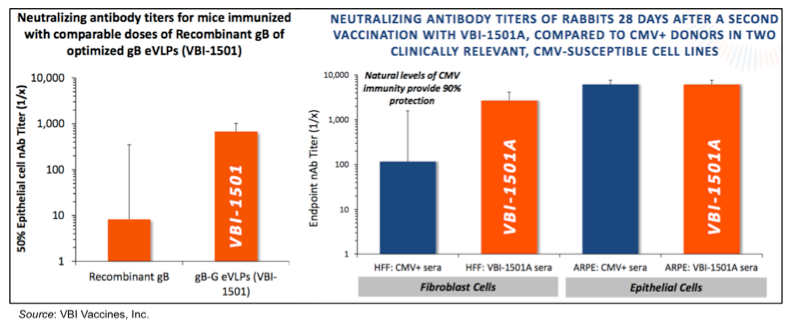
In order to overcome these shortcomings, VBI is developing a CMV vaccine using the company’s eVLP platform. Preclinical results show that eVLPs expressing gB induce neutralizing antibody titers against fibroblast and epithelial cell CMV infections that are much higher than those induced by injection with a recombinant gB protein (lower left figure). In addition, the level of neutralizing antibodies induced by the gB eVLP is comparable to the antibody titer in CMV-positive individuals (lower right figure).
The company recently announced the initiation of a Phase 1 clinical trial of VBI-1501A. The trial is designed to test the safety and tolerability of VBI-1501A in approximately 125 CMV-seronegative adults. Participants will be split into five groups that will receive three varying doses of VBI-1501A with an adjuvant, VBI-1501A with no adjuvant, or a placebo control at zero, two, and six months. The trial is anticipated to take 20 months to complete. An interim data readout will occur in the first half of 2017 after all participants have received the second vaccination.
While safety and tolerability are the primary outcome measures of the study, the company will also be examining the immune response generated by the vaccine and comparing it the response typically seen in those with naturally acquired CMV immunity. Naturally acquired CMV immunity can provide 90% protection from congenital CMV transmission (Adler et al., 1995), which provides an appropriate comparison for the results of the Phase 1 study and could provide an immunological proof-of-concept at an early stage of development.
CMV Market Analysis
There is currently no approved CMV vaccine, however we have identified the following CMV programs currently under development:
➢ GSK is developing a recombinant gB-based vaccine CMV vaccine candidate, however the company does not appear to have advanced beyond a Phase 1 clinical trial that concluded in 2012.
➢ Merck is currently conducting a Phase 1 clinical trial of V160, which is based on the attenuated CMV strain AD169. In preclinical testing V160 elicited a weaker immune response in rabbits and non-human primates than natural CMV infection. In addition, the use of an attenuated virus may raise safety concerns, thus complicating the regulatory pathway for this product.
➢ In 2015, Pfizer (PFE) acquired Redvax GmbH, a privately held biotechnology company headquartered in Switzerland, which provided access to a preclinical CMV vaccine candidate that utilizes VLP technology. Terms of the deal were not disclosed.
In addition to offering the vaccine to young CMV seronegative females to prevent congenital CMV infections, vaccine-mediated prevention of CMV infection could be attained through targeting additional patient populations including:
➢ Infants and toddlers, particularly those attending group day-care. While CMV infection in this age group typically does not produce serious disease, immunization of infants and toddlers could decrease the risk of mothers acquiring CMV from their child.
➢ Immunocompromised patients. Those who receive bone marrow/stem cell and solid organ transplants are at an increased risk for CMV disease. Both CMV-positive transplant recipients and seronegative recipients of a CMV-positive graft have a mortality disadvantage compared to seronegative recipients (Boeckh et al., 2003).
Gardasil®, a vaccine to prevent human papillomavirus, costs approximately $140. A CMV vaccine comparably priced could potentially generate hundreds of millions of dollars in revenue.
CMV in Oncology
Glioblastoma multiforme (GBM) is an aggressive and lethal brain cancer with reported median overall survival of only 12-15 months (Johnson et al., 2012). Standard of care treatment currently includes surgery, radiation, and chemotherapy (temozolomide, TMZ). There have been few successes seen in the development of new treatments. Therapeutic cancer vaccines are regarded as a promising avenue of research as they could potentially be utilized to harness the power of the immune system to eliminate tumor cells. However, there exist a very limited number of tumor-associated antigens (TAAs) that are uniquely expressed on cancer cells and not on normal tissue, and it is very difficult to elicit a proper immune response to self-TAAs. An ideal TAA would be one that is not normally expressed by the host, thus having robust immunogenicity in order to overcome the immunosuppressive tumor microenvironment.
There exist a number of viruses that are known to promote the development of cancer, including Epstein-Barr virus, hepatitis B virus, and human papillomavirus. Other viruses, such as CMV, while not directly associated with the development of cancer, can still produce some of the hallmarks of cancer. While unlikely to be a direct tumor-causing agent, CMV infection is know to promote genomic instability (Fortunato et al., 2000), cell migration (Vomaske et al., 2010), and immune evasion (Powers et al., 2008), all factors that could contribute to a pro-oncogenic environment.
In 2002, Cobbs et al. published a report showing that 27 GBM samples out of 27 examined had evidence for CMV expression, both in terms of viral proteins and DNA (Cobbs et al., 2002). Evidence of CMV was not found in healthy brain tissue or samples from patients with other brain diseases. These results were confirmed through additional studies from around the world that reported CMV protein and genetic expression in GBM samples (Ranganathan et al., 2012). CMV proteins could be thought of as ideal TAAs for use in a therapeutic vaccine as they are “foreign” and are likely to induce a robust immune response.
Clinical support for the use of CMV-targeted treatments for GBM comes from a 2015 study that utilized dendritic cells (DCs) pulsed with CMV protein pp65 combined with a tetanus toxoid or control preconditioning step along with standard of care treatment (Mitchell et al. 2015). The preconditioning step is designed to activate the immune system, thus increasing the ability of the DCs to reach the lymph nodes and increasing the efficacy of the treatment. Patients who received the control preconditioning step (n=6) lived for an average of 18.5 months, which is slightly better than the expected 12-15 months for those who receive only standard of care treatment. However, three of the six patients who received tetanus toxoid preconditioning did not progress and were alive at the time of survival analysis (>36 months). A second study performed by the same research group utilized DCs pulsed with pp65 along with enhanced chemotherapy. Results from that study showed that four out of 11 patients were progression free at 59 to 64 months after their diagnosis. These results show great promise for CMV-targeting GBM therapies when combined with an immune system stimulator, examples of which also include granulocyte-macrophage colony-stimulating factor (GM-CSF) and interferon-gamma (INF-γ).
GBM is not the only cancer indication in which CMV has been implicated. CMV expression was shown in 31/32 (97%) patients with ductal carcinoma in situ (Harkins et al., 2010) and in 100% of 73 breast cancer tumor samples (Taher et al., 2013). Additional cancers where CMV has been found include medulloblastoma (Baryawno et al., 2011) and meningioma (Libard et al., 2014), thus indicating that CMV may become a novel target for a wide range of oncology indications. VBI was recently awarded a grant to investigate the potential of targeting CMV in meduloblastoma.
GBM Immunotherapy Program
VBI is developing a GBM immuno-oncology product that targets CMV. The treatment is based on the company’s prophylactic eVLP CMV vaccine with the addition of the pp65 protein.
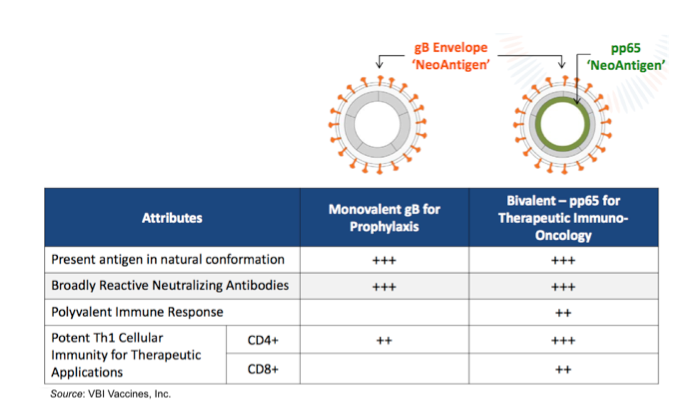
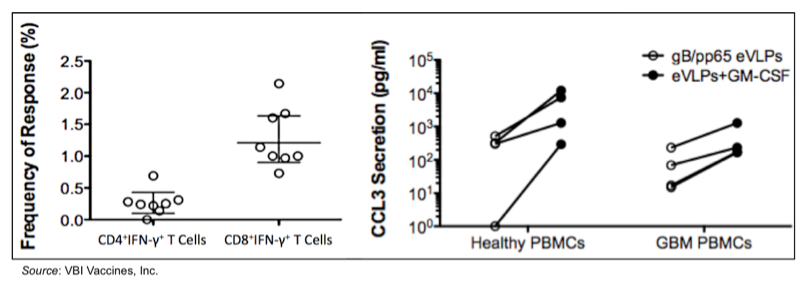
The pp65 protein helps to elicit a potent Th1 response, which drives the production of both CD4+ and CD8+ T-cells (lower left figure). In addition, when added to human PBMC’s, the combination of gB/pp65 eVLPs and GM-CSF results in a strong increase in CCL3 secretion, which was shown to be necessary for a robust immunological response in the study by Mitchell et al. (lower right figure).
VBI is planning to submit an Investigational New Drug (IND) application with the FDA during the second half of 2016 such that a clinical trial for the GBM immunotherapy eVLP can begin in the first half of 2017.
GBM Market Analysis
There will be approximately 25,000 malignant brain tumors diagnosed in the U.S. in 2016 (CBTRUS). Gliomas make up approximately 81% of all malignant brain tumors, with GBM comprising approximately 45% of all gliomas (Ostrom et al., 2014). Thus, we estimate that there will be approximately 9,000 cases of GBM diagnosed in the U.S. in 2016. Worldwide, there were an estimated 250,000 malignant brain tumors diagnosed in 2012 (GLOBOCAN 2012). There were a similar percentage of gliomas and GBM worldwide, thus we estimate that 90,000 individuals were diagnosed with GBM in 2012.
The FDA originally approved TMZ in 1999 for the treatment of GBM. Schering-Plough marketed the drug until their 2009 merger with Merck. At the time of the merger, TMZ (sold as Temodar®) was a blockbuster medication, with 2008 revenues of just over $1 billion. Patent exclusivity for Temodar® (marketed as Temodal® outside the US) ended in 2009 in the EU and in 2014 in the US. However, based upon an agreement between Merck and Teva Pharmaceuticals, a generic version of Temodar® was launched in the US in August 2013. Thus, sales have declined from a high of $1.065 billion in 2010 to $312 million in 2015 (EvaluatePharma).
Avastin® is one of the world’s top-selling medications, with annual sales close to $7 billion (EvaluatePharma). It is approved to treat recurrent GBM. However, given the small patient population associated with GBM, we estimate sales for Avastin® in this indication of only approximately $170 million per year.
LPV™ Platform
VBI’s lipid particle vaccine (LPV™) platform is designed to allow development of vaccines that can withstand temperature fluctuations during transport. Approximately 90% of vaccines require constant storage at 4°C - 8°C (refrigerator temperature), without which the products can lose potency or reduce safety, thus limiting any potential therapeutic benefits. The technology consists of three lipids (monopalmitoylglycerol, dihexadecyl phosphate, and cholesterol) mixed in a proprietary ratio with the vaccine antigen before lyophilizing (freeze drying) the product. The LPV™ platform has a number of unique attributes that should make it appealing to producers of biological drug products, including:
• Long-lasting stability at multiple storage conditions: VBI has demonstrated that products formulated using the LPV™ platform maintain potency when tested in multiple preclinical animal models, including vaccine formulations that were stored at 4°C and 40°C for one year.
• Amenable to use with different types of biological products: VBI has data showing that LPV™ can be used not just with vaccines, but also other biological products including monoclonal antibodies.
• Formulation is easily scalable: The LPV™ platform has been successfully tested in a cGMP-compliant production plant, with data demonstrating consistency across different batches.
The following data shows how the LPV™ platform can increase the purity of a monoclonal antibody while also preserving activity of the drug when stored at accelerated conditions (eight weeks at 40°C).

VBI has entered into the following collaborations with regard to the LPV™ technology:
• Sanofi: On April 6, 2015, VBI announced a collaboration agreement with Sanofi for the purpose of allowing Sanofi to evaluate the feasibility of using the LPV™ platform to reformulate a Sanofi vaccine candidate for improved stability. Following the evaluation period, Sanofi has the option to acquire certain worldwide rights to use the LPV™ technology in its vaccines. Terms of the deal were not disclosed.
• GlaxoSmithKline: On February 9, 2016, VBI announced a research collaboration with GlaxoSmithKline (GSK) to allow GSK to evaluate the LPV™ technology to formulate a vaccine candidate. GSK also has the option to negotiate an exclusive license to the LPV™ platform for use in a defined field. Terms of the deal were not disclosed.
We anticipate the company pursuing additional collaborations with larger pharmaceutical companies for the use of the LPV™ technology in both vaccines and other biologic treatments including monoclonal antibodies.
Financials and Capital Structure
As of March 31, 2016, VBI had approximately $11 million in cash and cash equivalents. The company recently completed a $13.6 million private placement, which was led by institutional investors OPKO Health and Perception Advisors along with ARCH Venture Partners. We believe the company has sufficient funds to operate for at least the next 12 months.
As of May 11, 2016, there were 32.7 million shares outstanding along with 2.1 million stock options and 363,771 warrants.
Conclusion
VBI has a number of positive attributes that should interest investors:
• Unlike most other small-cap biopharmaceutical company’s, VBI has a revenue generating product, which we believe is capable of generating significant revenues once the company is able to secure approval in the U.S. and European markets.
• The eVLP platform could lead to efficacious vaccine products with increased safety due to the lack of any viral genetic material.
• The company’s immuno-oncology platform is highly differentiated and potentially offers a unique approach to combating devastating diseases such as GBM.
• The LPV™ technology should foster additional partnerships with larger pharmaceutical company’s, which could inject additional non-dilutive capital into the company.
Over the next 18 months we anticipate the company: 1) determining a clinical path forward for Sci-B-Vac™ in the U.S. and Europe, 2) reporting interim data from the CMV Phase 1 clinical trial, 3) initiating a Phase 1 clinical trial in GBM, and 4) entering into additional partnerships with larger biopharmaceutical companies for the LPV™ platform. With plenty of cash, an experienced management team, prominent institutional investors, and novel technology platforms, we believe investors should keep a close eye on VBI.
SUBSCRIBE TO ZACKS SMALL CAP RESEARCH to receive our articles and reports emailed directly to you each morning. Please visit our website for additional information on Zacks SCR and to view our disclaimer.