By Brian Marckx, CFA
OTC:VIVMD
Highly Positive VIVEVE I Study Results…
Viveve (OTC:VIVMD) announced positive top-line results of VIVEVE I (VIveve Treatment of the Vaginal Introitus to EValuate Effectiveness), its sham-controlled clinical trial assessing safety and efficacy of the Viveve System in more than 150 patients at 9 sites in Europe, Canada and Japan. While results of two previous smaller studies (one in U.S.: n = 23, one in Japan: n = 30) had already demonstrated that treatment with the Viveve System can significantly reduce vaginal laxity and improve sexual function, this VIVEVE I study is the largest to-date and the first sham-controlled study evaluating the Viveve System for the treatment of vaginal laxity as well as for sexual function. See our Appendix for results of the two prior studies.
VIVEVE I Design / Protocol…
Enrollment was initially expected to be 113 patients - the study protocol was subsequently updated (per clinicaltrials.gov) to enroll an expected 145 – final enrollment ended up being 174 patients (117 active, 57 sham) with vaginal laxity efficacy data on a ‘per-protocol’ population of 155. Subjects were randomized 2:1 (active:control) - patients were blinded, treating personnel were not. The treatment group received 90 Joules/cm2 of RF energy delivered via the Viveve System while the sham group received <1 Joule/cm2. Subjects were followed through the six month follow-up period with assessments at day 10 and months 1, 3 and 6.
Key inclusion / exclusion criteria included;
- Inclusion:
- pre-menopausal and ≥ 18 years of age
- had least one full term vaginal delivery (>37 completed weeks) at least 12 months prior to enrollment date
- experienced vaginal looseness (i.e. VSQ < 4) during vaginal intercourse
- Exclusion:
- Pregnant or planning to become pregnant within the next 12 months or has had a delivery within the last 12 month
- currently meets the criteria for a female sexual disorder including DSM V, FSAD, FOD, Genitopelvic Pain, Sexual Aversion, Dyspareunia or Vaginismus and has not been treated for this condition within the past 12 months
- taking SSNRI or SSRI drugs
Primary efficacy endpoint was the proportion of women in the treatment arm as compared to the proportion of women in the sham (i.e. - control) arm that report no vaginal laxity six months following treatment as measured by Viveve's specially designed questionnaire, VSQ ("Viveve System Questionnaire"). VSQ, which is similar to the VLQ questionnaire used in the two prior studies, is based on a seven point scale (1:very loose, 2:moderately loose, 3:slightly loose, 4:neither loose nor tight, 5:slightly tight, 6:moderately tight, 7:very tight). "No vaginal laxity", as defined in the VIVEVE study protocol, is a VSQ score of >4.
Secondary efficacy endpoints were the percentage change in mean score from baseline to six months following treatment of the active arm as compared to the control arm in 1) the Vaginal Laxity Inventory (VALI), 2) Total FSFI and 3) FSDS-R. See our Appendix for detailed description of these secondary measures.
Study Results: Primary and FSFI Endpoints Highly Statistically Significant….
Top-line results were positive, showing a highly statistically significant difference between the active and sham arms on the VSQ (i.e. laxity) primary endpoint as well as the FSFI (i.e. sexual function) secondary endpoint. In addition, safety was considered excellent with no difference in adverse event rates between the treatment and sham cohorts.
VSQ
Of the 174 subjects enrolled and randomized, 19 were not evaluable for efficacy purposes due to not completing the 6-month follow-up or for other protocol violations. The per-protocol population included 103 active and 52 sham subjects. At the 6-month follow-up, 41.7% (43/103) of active subjects reported having no vaginal laxity (i.e. VSQ > 4) compared to just 19.2% (10/52) of subjects that received sham treatment. The difference was highly statistically significant with a Chi-squared p-value of 0.005. Active subjects were 3.05x more likely to achieve ‘no vaginal laxity’ at 6 months than were sham subjects (95% confidence interval, p-value = 0.006).
Mean VSQ score at the 1, 3 and 6 month follow up periods were;
- 1-month: 3.9 active vs. 3.8 sham (difference of 0.1)
- 3-month: 4.1 active vs. 3.9 sham (difference of 0.2)
- 6-month: 4.1 active vs. 3.4 sham (difference of 0.7)
The mean difference at 6 months of 0.7 is statistically significant at a 95% confidence interval (p=0.007). The widening difference in mean VSQ over the course of the assessment periods is believed to be representative of weakening of a placebo effect in the sham arm.
FSFI
Similar to the two prior studies, VIVEVE I demonstrated that treatment with the Viveve System is associated with a significant increase in sexual function. FSFI is a brief, 19-item self-report measure of female sexual function that provides scores on six domains of sexual function as well as a total score. It was developed for the specific purpose of assessing sexual functioning in clinical trials. These 19 items include: desire (2 items), arousal (4 items), lubrication (4 items), orgasm (3 items), satisfaction (3 items), and pain (3 items) and are scored from 0 to 5. The FSFI total score is a weighted average of the six domains with each contributing a maximum of six points to the total (maximum score of 36). Wiegel, Meston and Rosen demonstrated that a cutoff of 26.55 discriminates between women with and without sexual dysfunction.
103 (71 active, 32 sham) patients were included in the FSFI per-protocol population. Of the six domains, two (sexual arousal and orgasm) were statistically different favoring the active arm. And while the other four were not statistically different, there was a positive response favoring the active group. The individual p-values were (p-value < 0.05 is considered statistically significant);
- desire 0.081
- arousal 0.007
- lubrication 0.095
- orgasm 0.004
- satisfaction 0.097
- pain 0.122
But while just two of the six individual domains hit statistical significance, the weighted average of the six domains of the active arm (27.5) was statistically different from that of the sham arm (24.3) at the 6-month follow-up. In addition, the weighted average scores of the six domains on the active arm at 1-month (27.0), 3-month (27.6) and 6-month (27.5) follow up were all above 26.55 (i.e. considered sexually functional) while the scores of the sham arm at each of these timepoints (1-month: 25.5, 3-month: 25.9, 6-month: 24.3) were all below 26.55 (i.e. considered sexually dysfunctional). Similar to the VSQ measure, there was some placebo effect in the sham arm that began to wane at about 3 months following initiation of treatment.
Importantly, the expectation is that the weighted average total score, as opposed to individual domain scores, is what FDA will be looking for as an endpoint in VIVMD’s proposed pivotal U.S. study. And while it is uncertain as to whether FDA will accept FSFI as a primary endpoint in VIVEVE II, we are encouraged that this is a clinical industry metric which has already been well-validated and documented. We think if accepted by FDA, that these VIVEVE I results, coupled with similarly positive FSFI results in the prior two studies, bode well for chances that VIVEVE II also hits statistical significance on FSFI.
VALI and FSDS-R
Vaginal Introitus Laxity Inventory and Female Sexual Distress Scale-Revised were the other two secondary endpoints. VALI relates to the respondents’ concern of laxity and how that may affect sexual functioning while FSDS-R relates to a respondents’ feelings of sexual activity-related distress based on a 13-item questionnaire.
While neither VALI or FSDS-R scores were statistically different between active and sham arms in VIVEVE I, we do not view this as problematic as it relates to the proposed U.S.-based controlled study as they have no cross-over relevance to the expected primary (FSFI) or secondary (VSQ) endpoints for VIVEVE II (i.e. – upcoming study). We think VIVMD likely included VALI and FSDS-R in VIVEVE I in order to stack in additional metrics so as to offer other options in the event FSFI and/or VSQ failed to show statistical significance.
SAFETY
Similar to the two prior studies, safety was considered excellent in VIVEVE I. All 174 (117 active, 57 sham) enrolled and randomized patients underwent a safety evaluation. There was no statistical difference in safety measures between the two arms;
- treatment-emergent adverse events; 32.5% active vs. 35.1% sham
- related treatment-emergent adverse events; 11.1% active vs. 12.3% sham
- serious treatment-emergent adverse events; 0% active vs. 1.8% sham
NEXT STEPS
U.S. IDE: VIVMD will complete any final analysis and package the data with their expected upcoming IDE submission in anticipation of conducting a U.S.-based pivotal study in support of an eventual de novo 510(k) filing. While the company had previously guided for IDE submission happening in Q1 of this year, clearly they were awaiting these study results to provide the majority of the substantive backbone to the filing. Management did not offer a specific timeline for when they think they’ll have the package in FDA’s hands but intimated it could be sometime this summer.
VIVMD noted on the clinical trial update call that they intend to seek an indication for ‘improvement in sexual function’, with (weighted average total) FSFI as the primary endpoint. While ‘vaginal laxity’ as measured by VSQ (or a version of) was the primary endpoint in all three of Viveve’s clinical trials, VSQ is a proprietary metric developed by Viveve and may not be deemed acceptable to FDA without further scrutiny and validation. By contrast, FSFI is a clinical industry metric which has already been well-validated and documented and, we expect, already been proposed by VIVMD to FDA as the primary in VIVEVE II. Management noted on the call that they hope to incorporate VSQ as a secondary endpoint.
So assuming FDA concurs with a proposed FSFI endpoint and eventual FDA clearance for ‘sexual function’ indication (or some related language), the Viveve System may not carry a specific ‘vaginal laxity’ label – which is similar to its CE Mark indication. But, clearly the main purpose of treatment with the device is to improve sexual function via vaginal tightening and this message should be clear with a ‘sexual function’ indication.
Marketing Message: once the VIVEVE I data is finalized, VIVMD expects to submit for publication. They will also certainly be incorporated into the current marketing message outside of the U.S. We think this data could be potent – while the two prior studies provided evidence of significant efficacy of the Viveve System in both vaginal laxity and sexual function, the larger size and sham-controlled nature of VIVEVE I should provide clinicians with a much more definitive conclusion to the device’s effectiveness.
U.S. Study: assuming IDE approval, VIVMD will move towards clinical trial site selection and IRB approvals. While the company has yet to offer expectations of design / size of a U.S.-based study, given that VIVEVE I was able to hit highly statistically significant results with enrollment of less than 200 patients, we don’t expect VIVEVE II would be much different in size – although with the possibility of slightly greater enrollment (~10% - 20%) to provide an additional cushion. VIVEVE I was conducted at nine sites – expect a similar number, possibly one or two additional, for VIVEVE II.
We expect additional interaction between VIVMD and FDA leading up to and following the IDE submission. Discussions should include finalizing clinical trial design including size, endpoints and indications. We note that VIVEVE I was obviously not a U.S. or in any way an FDA-affiliated study – as such, design, size, endpoints and other components of VIVEVE II could differ from that of VIVEVE I, and potentially meaningfully so. We may know more in the coming few months.
In the meantime….VIVMD will continue to seek labeling for general surgical procedures for coagulation and hemostasis for their current device, which includes enhancements of their legacy device which already has FDA clearance for general surgical procedures. VIVMF submitted a Special 510(k) in March 2015 for this additional labeling. If granted, Viveve could introduce the system to the U.S. market with the general surgical procedure label which would still allow it to be used off-label for vaginal laxity/sexual function. While we think this may not provide much in the way of financial contribution, it would allow for awareness-building which could be a meaningful in terms of early marketing, particularly at the key opinion leader level. And if and when the system gains FDA clearance for a sexual function indication, this early introduction may provide a head start as they begin to market it for that indication.
APPENDIX
U.S. Study
The single-center, single-arm U.S. study, which commenced in 2008, enrolled 24 women ages 25 - 44 years old which had had at least one vaginal delivery. All subjects were treated once with RF energy at various levels delivered via the Viveve System through the vaginal mucosa. The first three women received 60 Joules/cm2, the next three received 75 Joules/cm2 and the remaining 18 received 90 Joules/cm2. Outcomes were measured at five time points; day zero (i.e. - prior to treatment), one month, three months, six months and 12 months. Outcomes were measured using self-reporting questionnaires (with questions focused on level of vaginal tightness and sexual satisfaction), modified Female Sexual Function Index (mFSFI), Female Sexual Distress Scale-Revised (FSDS-R) and the Global Response Assessment. Pelvic exams were performed to assess safety.
At baseline, all of the women in the study expressed significant vaginal laxity (based on a Vaginal Laxity Questionnaire or VLQ) with an average score of 2.6 on a 1.0 - 6.0 scale (higher = tighter). In addition, approximately 50% of the study population conveyed reduced sexual satisfaction (based on a Sexual Satisfaction Questionnaire or SSQ) as compared to prior to giving birth.
23 (of 24) of the subjects completed the three and six month evaluations, 18 the nine month evaluation and 17 the twelve month evaluation. A 95% confidence interval was used to designate statistical significance on all measures. Results showed rapid and prolonged improvement in vaginal laxity with a statistically significant (p<0.0001) increase in tightness to pre-childbirth levels occurring by the one-month assessment point in all 24 women. This tightness level was sustained through to the final 12-month assessment time point. In addition, at every assessment point there was a statistically significant (p>0.0001) improvement in vaginal laxity.
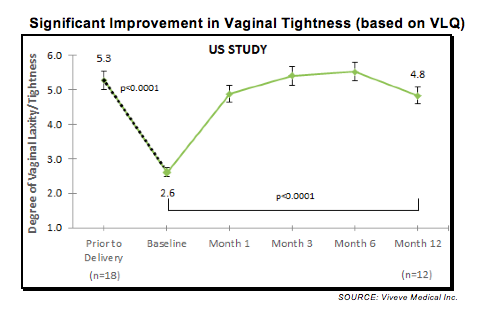
Top-line results, through the six-month evaluation period, were published in the Journal of Sexual Medicine in September 2010 and presented at the American College of Obstetricians and Gynecologists annual meeting earlier that year.
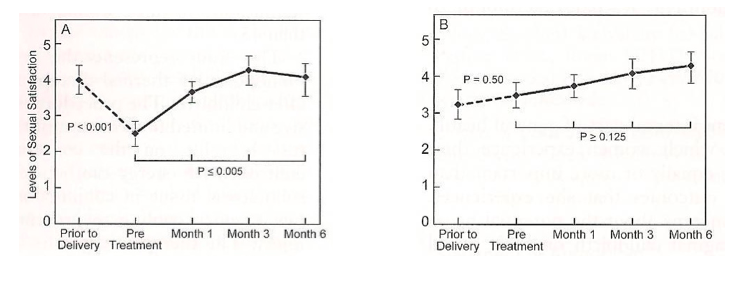
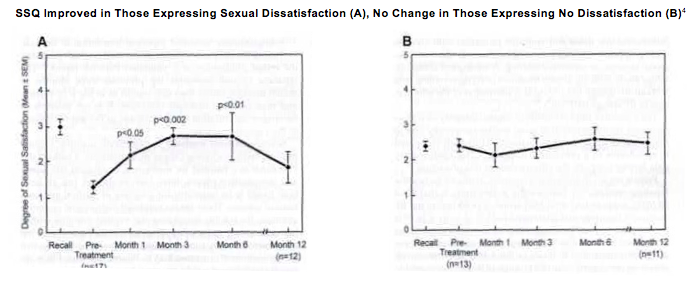
Sexual satisfaction also improved with treatment. Prior to treatment, 12 (of the 24) women expressed a diminished level of sexual satisfaction after their vaginal deliveries. The other 12 women reported either no change in sexual satisfaction or an increase in sexual satisfaction after their vaginal deliveries. SSQ scores significantly improved for all of the women who had reported a diminished level of sexual satisfaction (chart A below) at six months following treatment (from an average of 2.5 to 4.1). There was no significant change in SSQ scores of the women who had reported no change in sexual satisfaction (chart B below).
The FSFI and FSDS measures are used to assess changes in sexual function and sexually related distress, respectively. These showed the study participants did not experience any negative effects related to sexual function related to the RF treatment. In addition, throughout the six-month evaluation period, all FSFI scores (other than pain) significantly improved and personal distress (measured by FSDS) decreased significantly for all 24 patients at one month and all 23 patients at three and six months.
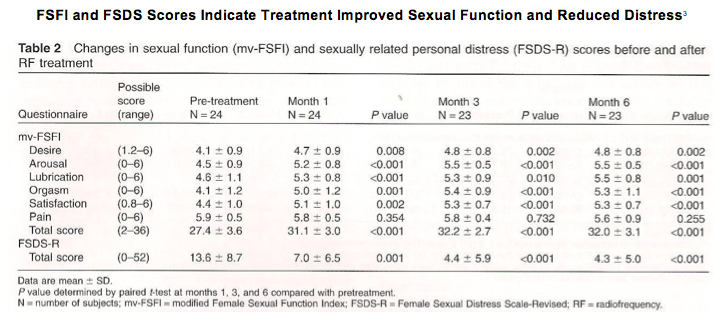
There were no treatment-related adverse events during either the treatment phase or throughout the 12-month follow-up period. Most of the women experienced a sensation of warmth during treatment but no significant pain.
Japan Study
In March 2010 the Viveve System commenced evaluation in a second clinical trial, this time in Japan. The study design was very similar to that of the U.S. trial, with the most significant exception being no variability in the treatment dose with the Japan study.
The single-arm, single-site study enrolled 30 women ages 21 - 55 years old which had had at least one vaginal delivery. All women were treated once with RF energy of 90 Joules/cm2. Outcomes were measured at baseline (i.e. - prior to treatment), one month, three months, six months and 12 months. Outcome measures were also similar to the U.S. study and included questionnaires related to vaginal tightness (VLQ) and sexual satisfaction (SSQ), mFSFI, FSDS-R and Global Response Assessment.
All 30 women completed the one month, three month and six month evaluations. At 12 months, 23 women completed the VLQ and SSQ questionnaires and 22 women completed were evaluable in FSFI and FSDS.
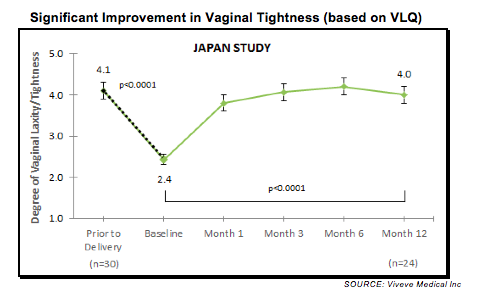
Results were published in the Journal of Women's Health in September 2013. At baseline 17 of the 30 subjects reported a decrease in sexual satisfaction with 13 reporting no change or decrease in sexual satisfaction since their last vaginal delivery. Average vaginal laxity of all the women prior to treatment was 2.4 on a 1.0 - 6.0 scale (higher = tighter).
A 95% confidence interval was used to designate statistical significance on all measures. Results showed statistically significant improvement in vaginal laxity within one month of treatment and throughout the 12-month evaluation period. The pre-treatment mean score of 2.4 increased to 4.2 at six months and was 4.0 at twelve months (23 patients were evaluable at 12 months).
Also, similar to results of the U.S. study, sexual satisfaction improved significantly. As reported by the Sexual Satisfaction Questionnaire (SSQ), sexual satisfaction improved at each follow-up period in 13 of the 17 women who expressed decreased sexual satisfaction at baseline. SSQ assesses sexual satisfaction using six levels of response (none, poor, fair, good, very good or excellent), with a higher score reflecting more satisfaction. SSQ scores of the 13 women who expressed decreased sexual satisfaction prior to treatment increased from an average of 1.29 at baseline to 2.71 at six months. At 12 months only 13 of these 17 women remained evaluable.
The SSQ scores of the 13 women who expressed no change (or no decrease) in sexual satisfaction prior to treatment remained significantly unchanged throughout the treatment period.
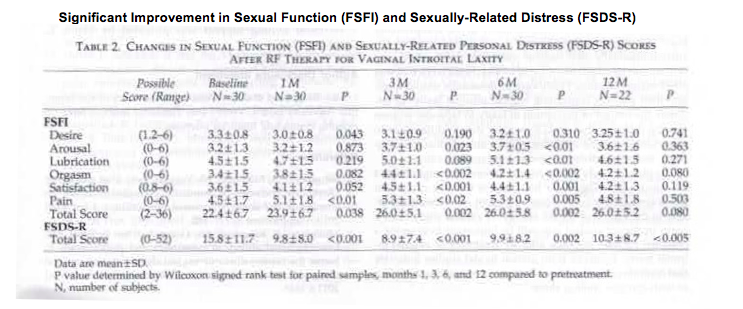
Sexual function, as measured by FSFI showed significant improvement through the six month evaluation period, although not through 12 months (note that all 30 women were evaluable at six months while 22 were evaluable at 12 months). FSFI improved from a mean of 22.4 prior to treatment to 26.0 (p=0.002) at six months. Five of the six FSFI measures showed statistically significant improvement (all but "desire") at six months. At 12 months mean FSFI was 26.0 (p=0.080).
Distress related to sexual activity, as measured by FSDS-R, also significantly improved. Mean FSDS-R prior to treatment of 15.8 decreased to 9.8 at one month (p<0.001) and remained statistically lower throughout the evaluation period. At 12 months mean FSDR-R (for the remaining 22 evaluable subjects) was 10.3 (p<0.005).
Relative to safety, there were no serious treatment related adverse events. On a visual analog (VAS) pain scale of 1 - 10 (10 most pain) the average score was 1.5 with seven subjects reporting sporadic pain in the range of 5 - 7. All women reported returning to their normal activities when questioned at 72-hour follow-up. Subjects reported that they returned to vaginal intercourse within 10 days post-treatment.
VIVEVE I Secondary Outcome Measures
Female Sexual Function Index (FSFI)
FSFI is a brief, 19-item self-report measure of female sexual function that provides scores on six domains of sexual function as well as a total score. It was developed for the specific purpose of assessing sexual functioning in clinical trials. These 19 items include: desire (2 items), arousal (4 items), lubrication (4 items), orgasm (3 items), satisfaction (3 items), and pain (3 items) and are scored from 0 to 5. The FSFI total score is a weighted average of the six domains with each contributing a maximum of six points to the total (maximum score of 36). Wiegel, Meston and Rosen demonstrated that a cutoff of 26.55 discriminates between women with and without sexual dysfunction.
Female Sexual Distress Scale-Revised (FSDS-R)
FSDS-R is a patient-reported outcomes measure consisting of 13 items assessing different aspects of sexual activity-related distress in women. It has a high degree of discriminative sensitivity to distinguish between sexually dysfunctional and normal functional women and is sensitive to therapeutically inducted changes in function. Items are scored on a five-point Likert-type scale as never (0), rarely (1), occasionally (2), frequently (3), or always (4). A total score, ranging from 0 to 52, can be computed by adding all 13 item scores. Higher scores indicate higher levels of sexual distress. The provisional cut-off score of >15 reliably identifies over 90% of women who are currently experiencing sexually related personal distress (Derogatis et al 2008).
Vaginal Introitus Laxity Inventory (VALI)
Vaginal Introitus Laxity Inventory is a 12-item patient reported outcome measure (i.e., PRO) designed to describe and quantify the nature of a female respondent s concern with the perception of laxity ( looseness ) and its impact on the qualities of satisfaction and enjoyment of her sexual functioning. Items of the VALI address the impact of laxity on the major aspects of the female sexual response cycle (i.e., sexual desire, arousal and orgasm), and quantify the patient s experience of sexual pleasure, sensitivity and satisfaction. The VALI items also address the potential impact of vaginal introitus laxity on sexual confidence and the patient s partner. All 12 items are measured on 5-point Likert scales and scores are summed to achieve a VALI Total score, range 0-48).
READ THE FULL RESEARCH REPORT HERE
SUBSCRIBE TO ZACKS SMALL CAP RESEARCH to receive our articles and reports emailed directly to you each morning. Please visit our website for additional information on Zacks SCR and to view our disclaimer.