By Brian Marckx, CFA
NASDAQ:VIVE
Q1 Financial Results / Capital Raise…
In mid-May Viveve (NASDAQ:VIVE) reported financial results for the first quarter ending March 31. Revenue, as expected following the company's earlier preannouncement, was just a hair shy of $1.3M. This represents sequential growth of 71% and 34x the $38k booked in Q1 of last year. VIVMF recognized sales of 33 systems and approximately 480 treatment tips in the most recent quarter. As of the Q1 10-Q filing date (May 13th), the systems installed base stood at approximately 76 units - which implies the recent placement rate of ~10 units per month is continuing to hold.
In January VIVMF penned a distribution agreement with Dynamic Medical Technologies for certain Asian countries. The agreement includes minimum purchase quotas of 47 systems in 2016, 75 in 2017 and 109 in 2018. Growth will be further facilitated by the system gaining regulatory clearance in more countries. In March Viveve announced a distribution agreement for Brazil. Brazil could be a particularly strong market for Viveve given that it leads the world in the number of vaginal rejuvenation procedures. The other potential significant near-term impetus to system placements and consumables utilization could come from the recently announced positive results of the VIVEVE I study (discussed below) which VIVMF will certainly be looking to incorporate into their marketing message.
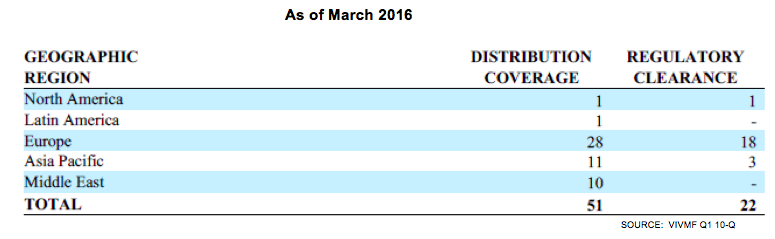
While system placements have grown sequentially over the last three quarters and beat our respective estimates in each of those periods, we continue to take a cautious approach and have made only incremental upward revisions to our modeled installed base. We continue to expect some short-term variability in revenue. We now look for the installed base to grow to 129 units by current year-end, revised from 122 units prior to the Q1 results announcement.
But while revenues have consistently come in better than our numbers, gross margin and OpEx have not. Gross margin, at 27% was well below our expected 42%. While we continue to expect margin expansion with greater production volumes, we have narrowed our near-term gross margin estimates as we think our ramp may have been somewhat too aggressive. Meanwhile, Q1 OpEx at $4.3M was similarly less favorable than what we anticipated ($3.4M). We also continue to expect to see greater leverage in expenses going forward but have also made upward revisions to these lines in our model.
Cash
VIVMF used approximately $3.7M (ex-changes in working capital) of cash in operating activities in Q1. Cash balance stood at $5.6M at quarter-end. Pro forma for today's (6/14) announced public offering of 2.7M common shares at $5/share, which is expected to close ~June 17th and net ~$12.2M, cash balance was approximately $17.8M. We expect this to be sufficient to fund the company into 2017. The offering includes an underwriters 405k share overallotment option which would gross another $2M.
Highly Positive VIVEVE I Study Results…
Viveve announced positive top-line results of VIVEVE I (VIveve Treatment of the Vaginal Introitus to EValuate Effectiveness), its sham-controlled clinical trial assessing safety and efficacy of the Viveve System in more than 150 patients at 9 sites in Europe, Canada and Japan. While results of two previous smaller studies (one in U.S.: n = 23, one in Japan: n = 30) had already demonstrated that treatment with the Viveve System can significantly reduce vaginal laxity and improve sexual function, this VIVEVE I study is the largest to-date and the first sham-controlled study evaluating the Viveve System for the treatment of vaginal laxity as well as for sexual function.
VIVEVE I Design / Protocol…
Enrollment was initially expected to be 113 patients - the study protocol was subsequently updated (per clinicaltrials.gov) to enroll an expected 145 – final enrollment ended up being 174 patients (117 active, 57 sham) with vaginal laxity efficacy data on a ‘per-protocol’ population of 155. Subjects were randomized 2:1 (active:control) - patients were blinded, treating personnel were not. The treatment group received 90 Joules/cm2 of RF energy delivered via the Viveve System while the sham group received <1 Joule/cm2. Subjects were followed through the six month follow-up period with assessments at day 10 and months 1, 3 and 6.
Key inclusion / exclusion criteria included;
- Inclusion:
- pre-menopausal and ≥ 18 years of age
- had least one full term vaginal delivery (>37 completed weeks) at least 12 months prior to enrollment date
- experienced vaginal looseness (i.e. VSQ < 4) during vaginal intercourse
- Exclusion:
- Pregnant or planning to become pregnant within the next 12 months or has had a delivery within the last 12 month
- currently meets the criteria for a female sexual disorder including DSM V, FSAD, FOD, Genitopelvic Pain, Sexual Aversion, Dyspareunia or Vaginismus and has not been treated for this condition within the past 12 months
- taking SSNRI or SSRI drugs
Primary efficacy endpoint was the proportion of women in the treatment arm as compared to the proportion of women in the sham (i.e. - control) arm that report no vaginal laxity six months following treatment as measured by Viveve's specially designed questionnaire, VSQ ("Viveve System Questionnaire"). VSQ, which is similar to the VLQ questionnaire used in the two prior studies, is based on a seven point scale (1:very loose, 2:moderately loose, 3:slightly loose, 4:neither loose nor tight, 5:slightly tight, 6:moderately tight, 7:very tight). "No vaginal laxity", as defined in the VIVEVE study protocol, is a VSQ score of >4.
Secondary efficacy endpoints were the percentage change in mean score from baseline to six months following treatment of the active arm as compared to the control arm in 1) the Vaginal Laxity Inventory (VALI), 2) Total FSFI and 3) FSDS-R. See our Appendix for detailed description of these secondary measures.
Study Results: Primary and FSFI Endpoints Highly Statistically Significant….
Top-line results were positive, showing a highly statistically significant difference between the active and sham arms on the VSQ (i.e. laxity) primary endpoint as well as the FSFI (i.e. sexual function) secondary endpoint. In addition, safety was considered excellent with no difference in adverse event rates between the treatment and sham cohorts.
VSQ
Of the 174 subjects enrolled and randomized, 19 were not evaluable for efficacy purposes due to not completing the 6-month follow-up or for other protocol violations. The per-protocol population included 103 active and 52 sham subjects. At the 6-month follow-up, 41.7% (43/103) of active subjects reported having no vaginal laxity (i.e. VSQ > 4) compared to just 19.2% (10/52) of subjects that received sham treatment. The difference was highly statistically significant with a Chi-squared p-value of 0.005. Active subjects were 3.05x more likely to achieve ‘no vaginal laxity’ at 6 months than were sham subjects (95% confidence interval, p-value = 0.006).
Mean VSQ score at the 1, 3 and 6 month follow up periods were;
- 1-month: 3.9 active vs. 3.8 sham (difference of 0.1)
- 3-month: 4.1 active vs. 3.9 sham (difference of 0.2)
- 6-month: 4.1 active vs. 3.4 sham (difference of 0.7)
The mean difference at 6 months of 0.7 is statistically significant at a 95% confidence interval (p=0.007). The widening difference in mean VSQ over the course of the assessment periods is believed to be representative of weakening of a placebo effect in the sham arm.
FSFI
Similar to the two prior studies, VIVEVE I demonstrated that treatment with the Viveve System is associated with a significant increase in sexual function. FSFI is a brief, 19-item self-report measure of female sexual function that provides scores on six domains of sexual function as well as a total score. It was developed for the specific purpose of assessing sexual functioning in clinical trials. These 19 items include: desire (2 items), arousal (4 items), lubrication (4 items), orgasm (3 items), satisfaction (3 items), and pain (3 items) and are scored from 0 to 5. The FSFI total score is a weighted average of the six domains with each contributing a maximum of six points to the total (maximum score of 36). Wiegel, Meston and Rosen demonstrated that a cutoff of 26.55 discriminates between women with and without sexual dysfunction.
103 (71 active, 32 sham) patients were included in the FSFI per-protocol population. Of the six domains, two (sexual arousal and orgasm) were statistically different favoring the active arm. And while the other four were not statistically different, there was a positive response favoring the active group. The individual p-values were (p-value < 0.05 is considered statistically significant);
- desire 0.081
- arousal 0.007
- lubrication 0.095
- orgasm 0.004
- satisfaction 0.097
- pain 0.122
But while just two of the six individual domains hit statistical significance, the weighted average of the six domains of the active arm (27.5) was statistically different from that of the sham arm (24.3) at the 6-month follow-up. In addition, the weighted average scores of the six domains on the active arm at 1-month (27.0), 3-month (27.6) and 6-month (27.5) follow up were all above 26.55 (i.e. considered sexually functional) while the scores of the sham arm at each of these timepoints (1-month: 25.5, 3-month: 25.9, 6-month: 24.3) were all below 26.55 (i.e. considered sexually dysfunctional). Similar to the VSQ measure, there was some placebo effect in the sham arm that began to wane at about 3 months following initiation of treatment.
Importantly, the expectation is that the weighted average total score, as opposed to individual domain scores, is what FDA will be looking for as an endpoint in VIVMF’s proposed pivotal U.S. study. And while it is uncertain as to whether FDA will accept FSFI as a primary endpoint in VIVEVE II, we are encouraged that this is a clinical industry metric which has already been well-validated and documented. We think if accepted by FDA, that these VIVEVE I results, coupled with similarly positive FSFI results in the prior two studies, bode well for chances that VIVEVE II also hits statistical significance on FSFI.
VALI and FSDS-R
Vaginal Introitus Laxity Inventory and Female Sexual Distress Scale-Revised were the other two secondary endpoints. VALI relates to the respondents’ concern of laxity and how that may affect sexual functioning while FSDS-R relates to a respondents’ feelings of sexual activity-related distress based on a 13-item questionnaire.
While neither VALI or FSDS-R scores were statistically different between active and sham arms in VIVEVE I, we do not view this as problematic as it relates to the proposed U.S.-based controlled study as they have no cross-over relevance to the expected primary (FSFI) or secondary (VSQ) endpoints for VIVEVE II (i.e. – upcoming study). We think VIVMF likely included VALI and FSDS-R in VIVEVE I in order to stack in additional metrics so as to offer other options in the event FSFI and/or VSQ failed to show statistical significance.
SAFETY
Similar to the two prior studies, safety was considered excellent in VIVEVE I. All 174 (117 active, 57 sham) enrolled and randomized patients underwent a safety evaluation. There was no statistical difference in safety measures between the two arms;
- treatment-emergent adverse events; 32.5% active vs. 35.1% sham
- related treatment-emergent adverse events; 11.1% active vs. 12.3% sham
- serious treatment-emergent adverse events; 0% active vs. 1.8% sham
NEXT STEPS
U.S. IDE: VIVMF will complete any final analysis and package the data with their expected upcoming IDE submission in anticipation of conducting a U.S.-based pivotal study in support of an eventual de novo 510(k) filing. While the company had previously guided for IDE submission happening in Q1 of this year, clearly they were awaiting these study results to provide the majority of the substantive backbone to the filing. Management did not offer a specific timeline for when they think they’ll have the package in FDA’s hands but intimated it could be sometime this summer.
VIVMF noted on the clinical trial update call that they intend to seek an indication for ‘improvement in sexual function’, with (weighted average total) FSFI as the primary endpoint. While ‘vaginal laxity’ as measured by VSQ (or a version of) was the primary endpoint in all three of Viveve’s clinical trials, VSQ is a proprietary metric developed by Viveve and may not be deemed acceptable to FDA without further scrutiny and validation. By contrast, FSFI is a clinical industry metric which has already been well-validated and documented and, we expect, already been proposed by VIVMF to FDA as the primary in VIVEVE II. Management noted on the call that they hope to incorporate VSQ as a secondary endpoint.
So assuming FDA concurs with a proposed FSFI endpoint and eventual FDA clearance for ‘sexual function’ indication (or some related language), the Viveve System may not carry a specific ‘vaginal laxity’ label – which is similar to its CE Mark indication. But, clearly the main purpose of treatment with the device is to improve sexual function via vaginal tightening and this message should be clear with a ‘sexual function’ indication.
Marketing Message: once the VIVEVE I data is finalized, VIVMF expects to submit for publication. They will also certainly be incorporated into the current marketing message outside of the U.S. We think this data could be potent – while the two prior studies provided evidence of significant efficacy of the Viveve System in both vaginal laxity and sexual function, the larger size and sham-controlled nature of VIVEVE I should provide clinicians with a much more definitive conclusion to the device’s effectiveness.
U.S. Study: assuming IDE approval, VIVMF will move towards clinical trial site selection and IRB approvals. While the company has yet to offer expectations of design / size of a U.S.-based study, given that VIVEVE I was able to hit highly statistically significant results with enrollment of less than 200 patients, we don’t expect VIVEVE II would be much different in size – although with the possibility of slightly greater enrollment (~10% - 20%) to provide an additional cushion. VIVEVE I was conducted at nine sites – expect a similar number, possibly one or two additional, for VIVEVE II.
We expect additional interaction between VIVMF and FDA leading up to and following the IDE submission. Discussions should include finalizing clinical trial design including size, endpoints and indications. We note that VIVEVE I was obviously not a U.S. or in any way an FDA-affiliated study – as such, design, size, endpoints and other components of VIVEVE II could differ from that of VIVEVE I, and potentially meaningfully so. We may know more in the coming few months.
In the meantime….VIVMF will continue to seek labeling for general surgical procedures for coagulation and hemostasis for their current device, which includes enhancements of their legacy device which already has FDA clearance for general surgical procedures. VIVMF submitted a Special 510(k) in March 2015 for this additional labeling. If granted, Viveve could introduce the system to the U.S. market with the general surgical procedure label which would still allow it to be used off-label for vaginal laxity/sexual function. While we think this may not provide much in the way of financial contribution, it would allow for awareness-building which could be a meaningful in terms of early marketing, particularly at the key opinion leader level. And if and when the system gains FDA clearance for a sexual function indication, this early introduction may provide a head start as they begin to market it for that indication.
See link below for access to our updated report on VIVMF.
READ THE FULL RESEARCH REPORT HERE
SUBSCRIBE TO ZACKS SMALL CAP RESEARCH to receive our articles and reports emailed directly to you each morning. Please visit our website for additional information on Zacks SCR and to view our disclaimer.