By
David Bautz, PhD
NASDAQ:VKTX
Business Update
VK2809 Update
VK2809 (formerly known as MB07811) is a novel, orally available, selective thyroid hormone receptor (TR) agonist that is in development for lipid disorders such as hypercholesterolemia and fatty liver disease. It was originally developed by Metabasis Therapeutics, Inc., which was acquired by Ligand in 2009. The compound has been tested in multiple preclinical models as well as two Phase 1 clinical trials. In the second quarter update, Viking (NASDAQ:VKTX) reiterated plans to initiate a Phase 2 trial of VK2809 in patients with hypercholesterolemia and fatty liver disease. We expect the study to commence this month.
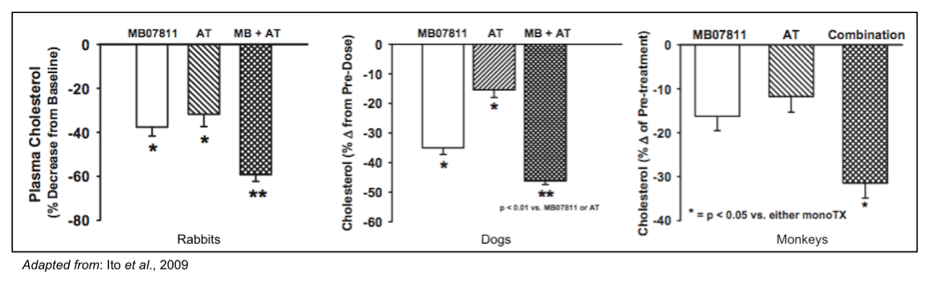
There are two major isoforms of TR, TRα and TRβ, which are encoded by separate genes. TRα and TRβ also have markedly different expression patterns, with TRα expression highest in the heart and brain while TRβ expression is highest in the liver (Bookout et al., 2006). VK2809 is a prodrug of a potent TRb agonist that is converted to the active compound through cleavage by the liver specific cytochrome P450 isoenzyme CYP3A4 (Erion et al., 2007). The activated form of the drug has approximately 16-fold higher affinity for TRβ (Ki = 2.2 nM) than for TRα (Ki = 35.2 nM). The cholesterol lowering properties of VK2809 were exhibited in multiple studies in rabbits, dogs, and monkeys (Ito et al., 2009). The following figures show that VK2809 was at least as effective in lowering plasma cholesterol as atorvastatin (Lipitor®) in all three species, and an additive effect exists with the combination of VK2809 and atorvastatin.
On April 8, 2016, Viking presented positive Phase 1b clinical data for VK2809 in patients with hypercholesterolemia in a poster session at the 65th Annual Scientific Session and Expo of the American College of Cardiology. The Phase 1b trial was a 14-day, placebo controlled trial in patients with mild hypercholesterolemia (defined as baseline LDL cholesterol of at least 100 mg/dL). VK2809 was shown to be safe and well tolerated in doses ranging from 0.25 mg to 40 mg per day. No serious adverse events were reported and the frequency of adverse events in VK2809-treated subjects was similar to placebo-treated subjects. There were also no differences in heart rate, heart rhythm, or blood pressure between VK2809 and placebo-treated patients.
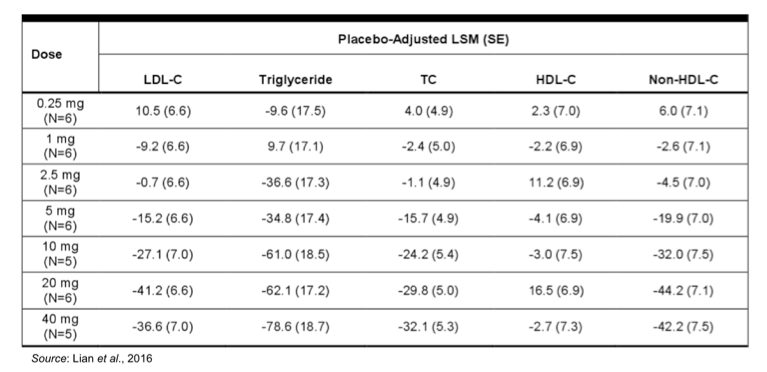
Results from the trial showed that treatment with VK2809 resulted in statistically significant placebo-adjusted reductions in low-density lipoprotein (LDL) cholesterol of 15.2% at the 5 mg dose to 41.2% at the 20 mg dose (p<0.05 for both doses). In addition, decreases in triglycerides of as much as 78.6% were seen at the 40 mg dose. The following table summarizes the placebo-adjusted percentage decreases in LDL cholesterol, triglycerides, total cholesterol, high-density lipoprotein (HDL) cholesterol, and non-HDL cholesterol.
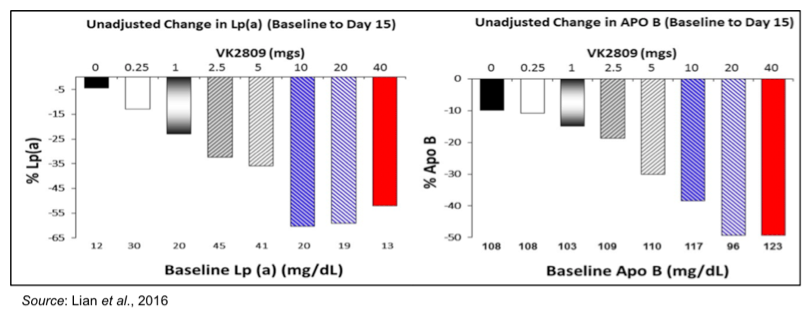
In addition to the results shown above, statistically significant reductions of lipoprotein a (Lp(a)) and apolipoprotein B (Apo(B)), which are believed to be positively associated with a patient’s risk of developing cardiovascular disease, were observed in certain cohorts as shown in the following figure.
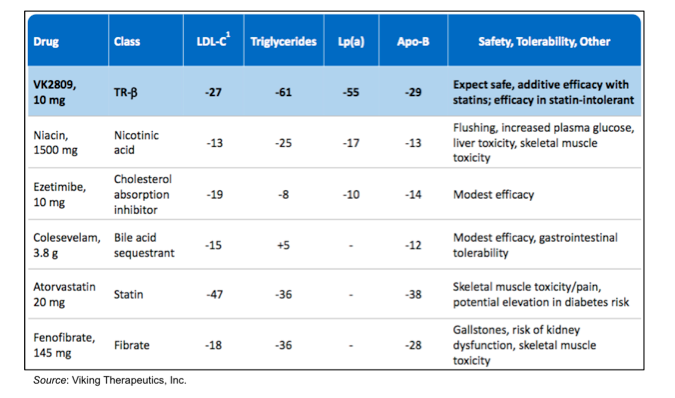
Lastly, the table below gives a comparison of the Phase 1b efficacy results of VK2809 and data from existing hyperlipidemia treatments.
The preceding data is the basis for Viking to conduct a Phase 2 trial to evaluate VK2809 as a treatment for both hypercholesterolemia and fatty liver disease. The company is planning to target patients with elevated cholesterol, fatty liver disease, and at least three risk factors for metabolic syndrome, which is considered a major driver for the onset of nonalcoholic steatohepatitis (NASH). The primary endpoint will assess changes in LDL following 12 weeks of treatment, with exploratory endpoints evaluating changes in liver fat content, inflammatory markers, and histological changes. Upon conclusion, the company hopes to be in a position to move forward in either hypercholesterolemia or NASH. Thus, it could be viewed as a two-in-one study – confirmatory on LDL and exploratory for fatty liver disease. We anticipate the study initiating in the third quarter of 2016 with topline results reported in the second quarter of 2017.
VK0214
VK0214 is also a TRβ agonist, however it has a different pharmacokinetic and pharmacodynamic profile than VK2809 (shorter half-life but higher Cmax). In addition, the drug is activated by carboxyesterases, which are ubiquitously expressed in the body, thus potentially making the drug more suitable for a more diffuse disease than hypercholesterolemia and fatty liver disease. In the second quarter update, Viking highlighted promising recent data from an in vivo model of X-linked adrenoleukodystrophy (X-ALD) and updated plans to present these results near-term.
Viking is currently focused on the development of VK0214 for the treatment of X-ALD, which is an X-linked genetic disorder caused by a mutation in the ABCD1 gene that encodes ALDP, a peroxisomal membrane protein (Mosser et al., 1993). The defect leads to an accumulation of very long chain fatty acids (VLCFA) in almost all tissues, however the adrenal glands, testes, brain, spinal cord, and peripheral nerves are most affected clinically (Moser et al., 2001). It is thought that the accumulation of VLCFA leads to a disruption in the cellular membrane and damage to the myelin sheath of neural cells. The damage leads to decreased motor coordination and function, visual and hearing disturbances, loss of cognitive function, and even death. In the U.S., there are approximately 8,000 patients suffering from ALD while in the E.U. there are approximately 12,000 patients.
Allogenic hematopoietic stem cell transplantation (HSCT) is the only currently available effective treatment option for ALD, but is only effective when done early in the course of the disease. Oral administration of Lorenzo’s oil (LO; a 4:1 mixture of glyceryl trioleate and glyceryl trierucate) causes a rapid decrease in circulating levels of VLCFA in the bloodstream (Rizzo et al., 1989). This rapid decrease in circulating VLCFA levels led to the hope that LO could alter the clinical course of the disease. Unfortunately, multiple clinical trials did not show any effect of LO supplementation in patients who were already symptomatic when treatment was initiated, particularly those with CALD (van Geel et al., 1999; Aubourg et al., 1993). While a few treatment options do exist for X-ALD patients, there is still a pressing need for a more robust therapy that can offer treatment to a larger segment of the X-ALD population without unnecessary risks to the patient.
ABCD1 is one of three genes encoding peroxisomal ABC-transporters, which includes ABCD2 and ABCD3. ALDR is the protein encoded by ABCD2, and it shares 66% homology with ALDP, the protein encoded by ABCD1 (Holzinger et al., 1997). When ALDR was overexpressed in cultured fibroblasts from ALD patients, impaired peroxisomal beta-oxidation was restored (Netik et al., 1999), suggesting that ALDR activity could compensate for the loss of ALDP activity. In addition, when murine ALDR was ubiquitously overexpressed from a transgene in Abcd1-deficient mice, it normalized VLCFA levels in target tissues and rescued late-onset motor coordination defects (Pujol et al., 2004). The reason that ALDR does not compensate for loss of ALDP function in X-ALD patients is because of complimentary expression of ABCD1 and ABCD2 (i.e., in tissues where ABCD1 is expressed, ABCD2 is not and vice versa) (Troffer-Charlier et al., 1998). Thus, while ALDR would appear to be able to replace the function of ALDP, it would be necessary to induce its expression in the tissues where it is not usually expressed.
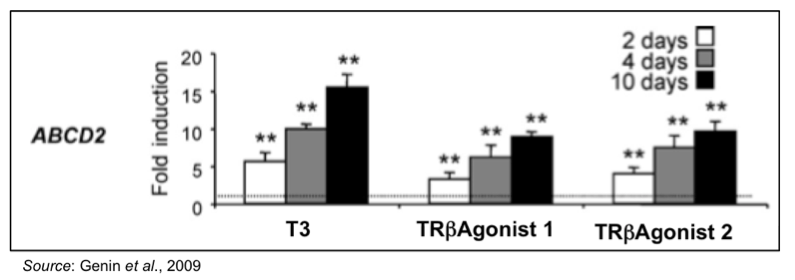
Fibrates (Albet et al., 1997), thyroid hormones T3 and T4 (Fourcade et al., 2003), and 4-phenylbutyrate (Gondcaille et al., 2005) all stimulate the expression of ABCD2 in the liver, thus proving that pharmacological induction of ABCD2 expression is feasible. Furthermore, since T3 is able to induce expression of ABCD2 (through binding of TRβ), it stands to reason that a TRβ-specific agonist would also cause the same effect. In fact, TRβ-specific agonists have been shown to increase expression of ABCD2 in a manner similar to T3 (Genin et al., 2009). The following figure shows the results of treating human HepG2 liver cells with either T3 or TRβ-specific agonists, with ABCD2 expression being significantly increased compared to control treated cells (dashed line) after 2, 4, and 10 days of treatment. Thus, we believe there is ample evidence to support the development of a TRβ agonist such as VK0214 as a treatment for X-ALD.
On July 26, 2016, Viking announced positive results from a study of VK0214 in an in vivo model of X-ALD. The model is based on the ABCD1 knockout mouse, which is intended to mirror the loss of ABCD1 transporter activity in patients suffering from X-ALD. The results of the study showed that VK0214 rapidly reduced VLCFA in plasma by more than 25% compared to placebo (P<0.01). Reductions in VLCFA were noted after only two weeks of treatment and these reductions generally increased over the course of the study. There were reductions in multiple types of VLCFAs including significantly lower levels of C26, C24, C22, and C20. The full results from the study will be presented at the upcoming 86th Annual Meeting of the American Thyroid Association, September 21-25, 2016, which we will discuss in a future report.
VK5211
Viking’s most advanced drug candidate is VK5211, a third-generation non-steroidal Selective Androgen Receptor Modulator (SARM) that is being developed for maintenance or improvement of lean body mass (LBM), bone mineral density (BMD), and function in patients recovering from non-elective hip fracture surgery. Hip fracture is associated with a number of morbidities, the majority of which are the result of deleterious changes in body composition following the injury. In the first year after a hip fracture, fat mass increases by up to 7% (Karlsson et al., 1996) while lean mass decreases by up to 11% (Fox et al., 2000). This is in comparison to healthy older females who lose approximately 1% of lean mass per year and gain approximately 1.7% in fat mass (Karlsson et al., 2000). In the second quarter update, Viking highlighted progress with enrollment in an ongoing Phase 2 trial of patients who are recovering from hip fracture surgery. This study is expected to be completed in the first half of 2017.
SARMs are a group of compounds designed to act as androgen receptor (AR) agonists in muscle and bone while being partial agonists in other areas of the body (e.g., prostate). The most prominent androgen, testosterone, stimulates the growth of muscle and bone (anabolic effects) as well as the prostate and sebaceous glands (androgenic effects), and is considered a non-tissue-selective androgen.
While androgens inhibit fat accumulation and increase skeletal muscle growth, two properties that make them ideal therapeutic candidates for restoring or preserving body composition following hip fracture, the use of testosterone therapy has a number of side effects including prostate growth (Meikle et al., 1997) and polycythemia (Snyder et al., 2000) in men and acne, alopecia, and hirsutism in women (Phillips et al., 1997) that precludes its use in a large number of patients. Thus, what would be most beneficial would be a product that provided the anabolic effects of androgen therapy with limited androgenic effects.
VK5211 (then known as LGD-4033) was originally developed by Ligand Pharmaceuticals, Inc. (LGND) and was previously tested in preclinical models and early stage clinical trials. Two Phase 1 clinical trials showed the drug to be safe and well-tolerated at all doses following daily oral administration for up to 21 days. The drug selectively activates AR in muscle and bone, stimulating muscle and bone growth, while avoiding undesirable side effects, such as unwanted hair growth, acne, or prostate growth.
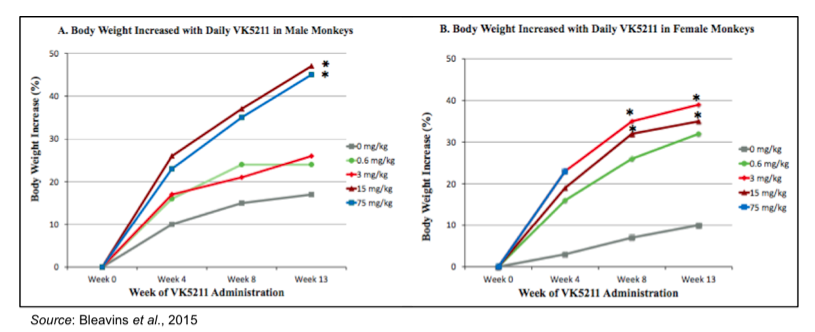
To examine the safety and physiological changes that occur after 13 weeks of VK5211 dosing, cynomolgus monkeys were orally administered VK5211 once daily at 0, 0.6, 3, 15, or 75 mg/kg. The following figure shows a significant increase in body weight in both male and female monkeys during the 13 weeks of dosing. The fact that the results were seen in females is important, as the majority of hip fractures occur in females.
In November 2015, Viking initiated a Phase 2 study in patients ≥ 65 years of age who have suffered a hip fracture within the past three to seven weeks. This is a multicenter, randomized, parallel group, double blind, placebo controlled trial, where patients will be administered placebo or 0.5 mg, 1.0 mg, or 2.0 mg of VK5211 once-daily for 12 weeks (NCT02578095). A total of 120 patients are expected to enroll in the trial evenly split between the four treatment groups. The primary outcome of the trial is the change in LBM after 12 weeks of treatment. Secondary and exploratory endpoints include assessments of functional performance, quality-of-life, and activities of daily living. All 16 clinical sites in the U.S. are now open and enrolling patients, and the company has begun opening up to 17 clinical sites in Europe. We anticipate topline results will be reported in the second quarter of 2017.
Valuation of Madrigal Pharmaceuticals Shows Viking is Significantly Undervalued
On July 22, 2016, Madrigal Pharmaceuticals (MDGL) announced the completion of the merger with Synta Pharmaceuticals. The newly combined company will be focused on the development of MGL-3196, a TRβ agonist similar to VK2809, for the treatment of NASH and hypercholesterolemia. A 2013 publication reported results from a Phase 1b study of MGL-3196 in patients with mildly elevated LDL cholesterol (>110 mg/dl) (Taub et al., 2013). The multi-dose study took place over two weeks and was a randomized, double blind, placebo controlled trial to examine the safety and tolerability of various doses of MGL-3196 along with the effect on lipid levels. As shown in the following figure, MGL-1396 does appear to be effective at decreasing LDL, ApoB, and triglycerides.
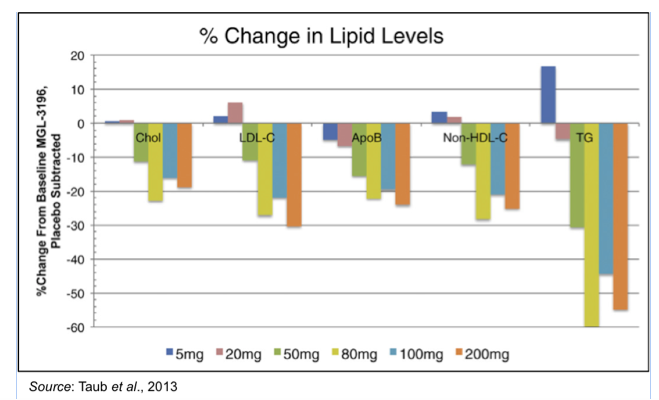
When taking a closer look at some of the lipid values, it appears that MGL-1396 may not be as effective as VK2809. For triglycerides, of the six cohorts tested with MGL-3196, only one of them was statistically significantly different from the placebo cohort. In comparison, VK2809 was statistically significantly different from placebo in multiple cohorts for triglycerides. In addition, treatment with MGL-3196 resulted in decreases in Lp(a) of between +2.7% to -20%, compared to decreases in Lp(a) from treatment with VK2809 of -15% to -60%. Lastly, treatment with MGL-3196 resulted in decreases in ApoB of -4.9% to -24%, compared to decreases in ApoB from treatment with VK2809 of -10% to -50%. As mentioned earlier, reductions in both Lp(a) and ApoB are associated with increased cardiovascular health, thus the data so far would indicate that VK2809 is superior to MGL-1396 in this regard.
Even with a potentially superior TRβ agonist compound, the valuation for Viking in comparison to Madrigal does not reflect this fact. Following the recent public offering, Viking has approximately 19.3 million common shares outstanding. The stock has recently traded near $1.30, putting Viking’s valuation at approximately $25 million. Following the merger with Synta and a 1:35 reverse split, Madrigal has approximately 11.3 million shares outstanding. Madrigal’s stock recently traded at $8.00, which would give Madrigal a valuation of approximately $90 million, almost four times as much as Viking! MGL-3196 is set to enter a Phase 2 clinical trial, thus it is at the same development stage as VK2809. In addition, Viking has VK5211, which is currently in a Phase 2 clinical trial for the prevention of loss of lean body mass following hip fracture in elderly patients. Thus, based upon the valuation assigned to Madrigal we believe that Viking is significantly undervalued.
Financial Update
On August 10, 2016, Viking announced financial results for the second quarter of 2016. The company reported a net loss of $3.7 million, or $0.22 per share, which was comprised of $2.4 million in R&D expenses and $1.2 million in G&A expenses. The company exited the second quarter with approximately $17.2 million in cash and cash equivalents, compared to $14.1 million on Dec. 31, 2015. This increase in cash was the result of a public offering of 7.5 million shares of common stock and warrants at a price of $1.25 per share. The warrants have an exercise price of $1.50, are exercisable until Apr. 13, 2021, and will trade on the Nasdaq under the ticker symbol ‘VKTXW’. The underwriters of the public offering fully exercised their over-allotment option and purchased 1.125 million shares for $1.24 per share, thus the aggregate gross proceeds to the company were approximately $10.8 million before deducting underwriting discounts, commissions, and other offering expenses. In addition, in June the company filed an at-the-money (ATM) sales prospectus, allowing for the sale of up to approximately $5 million in common stock at prevailing market prices. We believe this facility could provide further cash runway beyond our current expectation of the third quarter of 2017, representing an important potential means of strengthening the company’s balance sheet.
As of July 31, 2016, Viking had approximately 19.3 million shares of common stock outstanding, with Ligand owning approximately 33% of the total number of outstanding shares. When factoring in the outstanding shares of restricted stock, stock options, and warrants the company has a fully diluted share count of approximately 33 million shares.
Valuation
For valuation purposes, we have constructed a probability adjusted discounted cash flow model that takes into account potential revenues from VK5211 in hip fracture, VK2809 in NASH, and VK0214 in adrenoleukodystrophy (ALD).
The pre-clinical and clinical data for VK5211 are quite encouraging, particularly the magnitude of the effect, the durability of response, and the lack of any serious adverse events. We model for peak revenues of VK5211 of approximately $600 million in the U.S. and $1 billion in the E.U.
Viking has presented compelling data for VK2809, particularly given the low level of adverse events coupled with data that rivals many of the current treatment options for dyslipidemia. We estimate potential peak worldwide revenues for VK2809 of $2.5 billion.
For ALD, since it is an orphan indication we believe the drug would likely command premium pricing, thus we model for a yearly cost of $150,000 in the U.S. and $120,000 in Europe, leading to estimated peak worldwide sales of approximately $450 million.
Based on these numbers, and using an 18% discount rate, leads to a valuation of $8/share. The fact that Viking has a market cap of only $25 million is quite perplexing, particularly given the valuation of Madrigal and its TRβ agonist of approximately $90 million following the completion of its merger with Synta Pharmaceuticals. There is no discernable reason that Viking, with a TRβ agonist with potentially superior efficacy to Madrigal’s, should have a market cap approximately 1/4th that of Madrigal and we believe it is only a matter of time until Viking’s valuation matches the company’s potential. In the meantime, we believe Viking’s current valuation presents investors with a valuable opportunity to acquire shares or add to a position in a very promising small-cap biotechnology company ahead of expected data read outs in the second quarter of 2017 for both VK5211 and VK2809.
READ THE FULL RESEARCH REPORT HERE
SUBSCRIBE TO ZACKS SMALL CAP RESEARCH to receive our articles and reports emailed directly to you each morning. Please visit our website for additional information on Zacks SCR and to view our disclaimer.