Financial Update
On March 8, 2016, Viking Therapeutics, Inc. (NASDAQ:VKTX) announced financial results for the fourth quarter and full year 2015. For the fourth quarter of 2015, the company had a net loss of $5.1 million, or $0.56 per share, which was comprised of $3.2 million in R&D expenses and $1.4 million in G&A expenses. For the full year, the company reported a net loss of $23.4 million, or $3.68 per share, and was comprised of $7.0 million in R&D expenses and $5.0 million in G&A expenses.
Viking exited 2015 with approximately $14.1 million in cash and cash equivalents. The company executed an initial public offering (IPO) on May 4, 2015 through the sale of a total of 3 million shares of common stock at $8.00 per share. Upon closing of the IPO the company had raised a total of $22.1 million in net proceeds after deducting underwriting discounts and commissions. On May 26, 2015, the underwriters for the IPO exercised the full over-allotment option and purchased an additional 450,000 shares of common stock at $8.00 per share, which resulted in net proceeds to Viking of $3.3 million after deducting underwriting discounts and commissions. We believe the company has sufficient cash to fund operations into the fourth quarter of 2016.
At the end of 2015, the company had approximately 9.7 million shares of common stock outstanding, with Ligand Pharmaceuticals, Inc. (LGND) owning approximately 35% of the total number of outstanding shares. Combined with the outstanding shares of restricted stock, stock options, and warrants the company has a fully diluted share count of approximately 11.5 million shares.
The company has modified the existing loan with Ligand, which originally loaned Viking $2.5 million. Under the new terms, the loan will now not have to be paid back until May 21, 2017 (from May 21, 2016), the annual interest rate has been reduced from 5.0% to 2.5%, and Ligand’s lock-up period has been extended to January 23, 2017. Following Viking raising at least $2.0 million, the company will be required to repay $1.5 million of the loan, with at least $300,000 of that due in cash and the rest payable in equity. The share price used in the conversion to equity will be the lower of the next financing price or the IPO ($8).
VK5211 Update
Preclinical Data Shows Robust Weight Gain in VK5211-Treated Primates
On December 7, 2015, Viking Therapeutics, Inc. (VKTX) announced new preclinical data on the effect of VK5211 on weight gain in cynomolgus monkeys after 13 weeks of treatment. The results showed progressive weight gain throughout the course of treatment, with a substantial portion of the weight gain maintained after treatment was stopped. The results were presented at the 8th International Conference on Cachexia, Sarcopenia, and Muscle Wasting in Paris, France.
VK5211
Viking’s lead drug candidate,VK5211, is a third-generation non-steroidal Selective Androgen Receptor Modulator (SARM) that is being developed for maintenance or improvement of lean body mass (LBM), bone mineral density (BMD), and function in patients recovering from non-elective hip fracture surgery. Hip fracture is associated with a number of morbidities, the majority of which are the result of deleterious changes in body composition following the injury. In the first year after a hip fracture, fat mass increases by up to 7% (Karlsson et al., 1996) while lean mass decreases by up to 11% (Fox et al., 2000). This is in comparison to healthy older females who lose approximately 1% of lean mass per year and gain approximately 1.7% in fat mass (Karlsson et al., 2000).
SARMs are a group of compounds designed to act as androgen receptor (AR) agonists in muscle and bone while being partial agonists in other areas of the body (e.g., prostate). The most prominent androgen, testosterone, stimulates the growth of muscle and bone (anabolic effects) as well as the prostate and sebaceous glands (androgenic effects), and is considered a non-tissue-selective androgen.
While androgens inhibit fat accumulation and increase skeletal muscle growth, two properties that make them ideal therapeutic candidates for restoring or preserving body composition following hip fracture, the use of testosterone therapy has a number of side effects including prostate growth (Meikle et al., 1997) and polycythemia (Snyder et al., 2000) in men and acne, alopecia, and hirsutism in women (Phillips et al., 1997) that precludes its use in a large number of patients. Thus, what would be most beneficial would be a product that provided the anabolic effects of androgen therapy with limited androgenic effects.
VK5211 (then known as LGD-4033) was originally developed by Ligand and was previously tested in preclinical models and early stage clinical trials. Two Phase 1 clinical trials showed the drug to be safe and well-tolerated at all doses following daily oral administration for up to 21 days. The drug selectively activates AR in muscle and bone, stimulating muscle and bone growth, while avoiding undesirable side effects, such as unwanted hair growth, acne, or prostate growth.
Preclinical Primate Data
To examine the safety and physiological changes that occur after 13 weeks of VK5211 dosing, cynomolgus monkeys were orally administered VK5211 once daily at 0, 0.6, 3, 15, or 75 mg/kg. The following figure shows a significant increase in body weight in both male and female monkeys during the 13 weeks of dosing. The fact that the results were seen in females is important, as the majority of hip fractures occur in females.
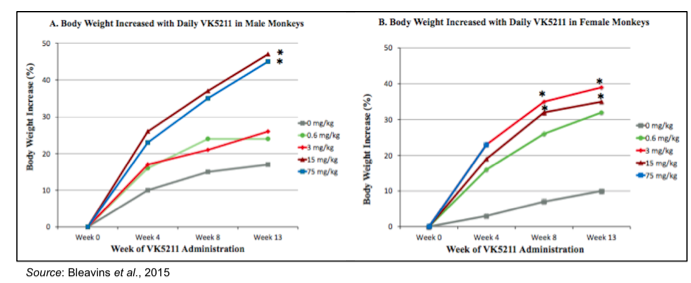
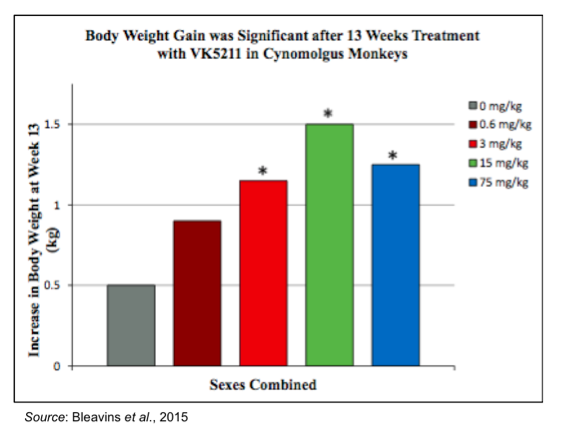
At the end of 13 weeks of dosing, there was a significant increase in body weight for the monkeys dosed with 3 and 15 mg/kg. The 75 mg/kg dosing was halted after 48 days due to signs of toxicity, however this is not a concern for the ongoing Phase 2 clinical trial as that dose is well above the 0.5, 1.0, and 2.0 mg doses being administered. In addition, 70% of the increased weight was retained after a four-week recovery period.
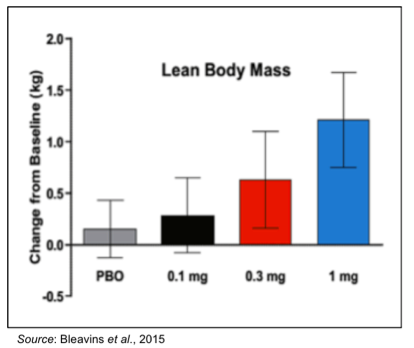
The primate data compares quite well with previously disclosed data from a Phase 1 multiple ascending dose clinical trial in 76 healthy men that received daily doses of placebo, 0.1 mg, 0.3 mg, or 1 mg of VK5211 for 21 consecutive days (Basaria et al., 2013). Those results showed a dose dependent increase in LBM and no serious adverse events.
VK5211 Clinical Trial Underway
Viking has initiated a Phase 2 study in patients ≥ 65 years of age who have suffered a hip fracture within the past three to seven weeks. This is a multicenter, randomized, parallel group, double blind, placebo controlled trial, where patients will be administered placebo or 0.5 mg, 1.0 mg, or 2.0 mg of VK5211 once-daily for 12 weeks (NCT02578095). A total of 120 patients are expected to enroll in the trial evenly split between the four treatment groups. The primary outcome of the trial is the change in LBM after 12 weeks of treatment. Secondary and exploratory endpoints include assessments of functional performance, quality-of-life, and activities of daily living. We anticipate topline results being available in the first quarter of 2017.
VK2809 Update
VK2809 ((2R,4S)-4-(3-chlorophenyl)-2-((3,5-dimethyl-4- (4′-hydroxy-3′-isopropylbenzyl)phenoxy)methyl)-2-oxido-(1,3,2)-dioxaphosphonane; formerly known as MB07811) is a novel, orally available, selective thyroid hormone receptor (TR) agonist that is in development for lipid disorders such as hypercholesterolemia and fatty liver disease. It was originally developed by Metabasis Therapeutics, Inc., which was acquired by Ligand in 2009. The compound has been tested in multiple preclinical models as well as two Phase 1 clinical trials.
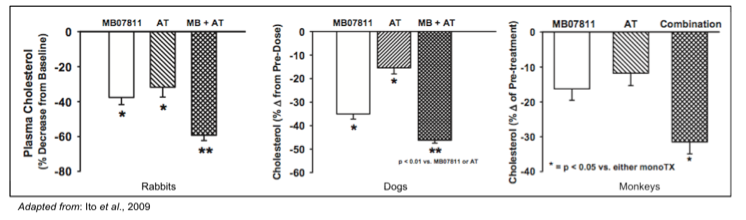
There are two major isoforms of TR, TRα and TRβ, which are encoded by separate genes. TRα and TRβ also have markedly different expression patterns, with TRα expression highest in the heart and brain while TRβ expression is highest in the liver (Bookout et al., 2006). VK2809 is a prodrug of a potent TRb agonist that is converted to the active compound through cleavage by the liver specific cytochrome P450 isoenzyme CYP3A4 (Erion et al., 2007). The activated form of the drug has approximately 16-fold higher affinity for TRβ (Ki = 2.2 nM) than for TRα (Ki = 35.2 nM). The cholesterol lowering properties of VK2809 were exhibited in multiple studies in rabbits, dogs, and monkeys (Ito et al., 2009). The following figures show that VK2809 (MB07811) was at least as effective in lowering plasma cholesterol as atorvastatin (Lipitor®) in all three species, and an additive effect exists with the combination of VK2809 and atorvastatin.
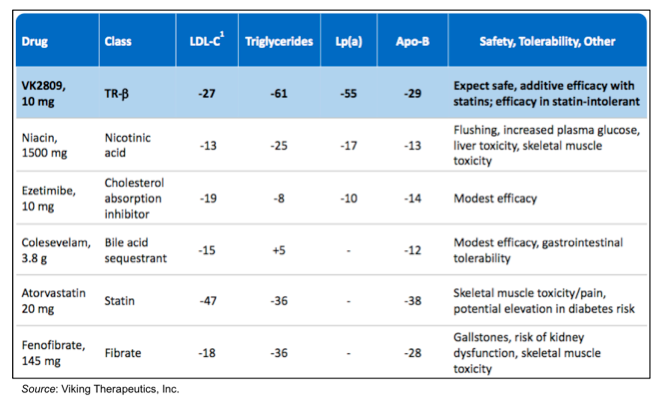
VK2809 has been evaluated in two Phase 1 clinical trials, the first conducted in 2006 and a second Phase 1b trial conducted between 2007-2008. The Phase 1b trial was a 14-day, placebo controlled trial in patients with mild hypercholesterolemia (defined as baseline LDL cholesterol of at least 100 mg/dL). VK2809 was shown to be safe and well tolerated in doses ranging from 0.25 mg to 40 mg per day. No serious adverse events were reported and the frequency of adverse events in VK2809-treated subjects was similar to placebo-treated subjects. There were also no differences in heart rate, heart rhythm, or blood pressure between VK2809 and placebo-treated patients. The clinical trial results also showed dose-related reductions in fasting LDL cholesterol and fasting triglyceride levels at day 14. Significant placebo-adjusted LDL cholesterol reductions from baseline were observed at doses of 5 mg and above and ranged from approximately 15%—41%, while placebo-adjusted triglyceride levels were reduced by more than 30% at doses of 2.5 mg and above. In addition, statistically significant reductions of lipoprotein a (Lp(a)) and apolipoprotein (Apo(B)), which are believed to be positively associated with a patient’s risk of developing cardiovascular disease, were observed in certain cohorts. The table below gives a comparison of the Phase 1b efficacy results of VK2809 and data from existing hyperlipidemia treatments.
VK2809 Clinical Development Plan
Since prior data show excellent results in both the lipid-lowering setting and in models of fatty liver disease, Viking plans to conduct a Phase 2 trial to evaluate both potential indications. The company is planning to target patients with elevated cholesterol, fatty liver disease, and at least three risk factors for metabolic syndrome, which is considered a major driver for the onset of nonalcoholic steatohepatitis (NASH). The primary endpoint will assess changes in LDL, with exploratory endpoints evaluating changes in liver fat content, inflammatory markers, and histological changes. Upon conclusion, the company hopes to be in a position to move forward in either hypercholesterolemia or NASH. Thus, it could be viewed as a two-in-one study – confirmatory on LDL and exploratory for fatty liver disease. We anticipate the study initiating in mid-2016 and topline results to be available in 2017.
VK0214 Update
VK0214 is also a TRβ agonist, however it has a different pharmacokinetic and pharmacodynamic profile than VK2809 (shorter half-life but higher Cmax). In addition, the drug is activated by carboxyesterases, which are ubiquitously expressed in the body, thus potentially making the drug more suitable for a more diffuse disease than hypercholesterolemia and fatty liver disease.
Viking is currently focused on the development of VK0214 for the treatment of adrenoleukodystrophy (ALD), which is an X-linked genetic disorder caused by a mutation in the ABCD1 gene that encodes ALDP, a peroxisomal membrane protein (Mosser et al., 1993). The defect leads to an accumulation of very long chain fatty acids (VLCFA) in almost all tissues, however the adrenal glands, testes, brain, spinal cord, and peripheral nerves are most affected clinically (Moser et al., 2001). It is thought that the accumulation of VLCFA leads to a disruption in the cellular membrane and damage to the myelin sheath of neural cells. The damage leads to decreased motor coordination and function, visual and hearing disturbances, loss of cognitive function, and even death.
Allogenic hematopoietic stem cell transplantation (HSCT) is the only currently available effective treatment option for ALD, but is only effective when done early in the course of the disease. Oral administration of Lorenzo’s oil (LO; a 4:1 mixture of glyceryl trioleate and glyceryl trierucate) causes a rapid decrease in circulating levels of VLCFA in the bloodstream (Rizzo et al., 1989). This rapid decrease in circulating VLCFA levels led to the hope that LO could alter the clinical course of the disease. Unfortunately, multiple clinical trials did not show any effect of LO supplementation in patients who were already symptomatic when treatment was initiated, particularly those with CALD (van Geel et al., 1999; Aubourg et al., 1993). While a few treatment options do exist for ALD patients, there is still a pressing need for a more robust therapy that can offer treatment to a larger segment of the ALD population without unnecessary risks to the patient.
TRβ Agonists for the Treatment of ALD
ABCD1 is one of three genes encoding peroxisomal ABC-transporters, which includes ABCD2 and ABCD3. ALDR is the protein encoded by ABCD2, and it shares 66% homology with ALDP, the protein encoded by ABCD1 (Holzinger et al., 1997). When ALDR was overexpressed in cultured fibroblasts from ALD patients, impaired peroxisomal beta-oxidation was restored (Netik et al., 1999), suggesting that ALDR activity could compensate for the loss of ALDP activity. In addition, when murine ALDR was ubiquitously overexpressed from a transgene in Abcd1-deficient mice, it normalized VLCFA levels in target tissues and rescued late-onset motor coordination defects (Pujol et al., 2004). The reason that ALDR does not compensate for loss of ALDP function in ALD patients is because of complimentary expression of ABCD1 and ABCD2 (i.e., in tissues where ABCD1 is expressed, ABCD2 is not and vice versa) (Troffer-Charlier et al., 1998). Thus, while ALDR would appear to be able to replace the function of ALDP, it would be necessary to induce its expression in the tissues where it is not usually expressed.
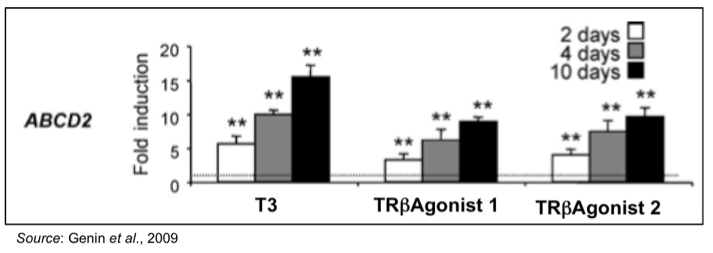
Fibrates (Albet et al., 1997), thyroid hormones T3 and T4 (Fourcade et al., 2003), and 4-phenylbutyrate (Gondcaille et al., 2005) all stimulate the expression of ABCD2 in the liver, thus proving that pharmacological induction of ABCD2 expression is feasible. Furthermore, since T3 is able to induce expression of ABCD2 (through binding of TRβ), it stands to reason that a TRβ-specific agonist would also cause the same effect. In fact, TRβ-specific agonists have been shown to increase expression of ABCD2 in a manner similar to T3 (Genin et al., 2009). The following figure shows the results of treating human HepG2 liver cells with either T3 or TRβ-specific agonists, with ABCD2 expression being significantly increased compared to control treated cells (dashed line) after 2, 4, and 10 days of treatment. Thus, we believe there is ample evidence to support the development of a TRβ agonist such as VK0214 as a treatment for ALD.
Market Opportunity for ALD and Clinical Development Plan
In the U.S., there are approximately 8,000 patients suffering from ALD while in the E.U. there are approximately 12,000 patients. Since the only effective therapy currently available for these patients is HSCT, there exists an unmet medical need for less dangerous treatment options. In addition, since so few individuals suffer from this condition, Viking could apply for orphan drug designation from the FDA for whichever compound is advanced into clinical testing. Orphan drug designation carries a number of potential incentives for the company, including increased feedback from the FDA regarding clinical trial design, seven years of market exclusivity following approval for the treatment of ALD, tax credits, and a waiver of PDUFA fees. Lastly, therapeutics that treat orphan diseases typically enjoy premium pricing, often in excess of $300,000 per year for treatment.
Viking has entered into a sponsored research agreement with the Kennedy Krieger Institute to evaluate the company’s TRβ agonists in an in vivo ALD model to assess the impact of VK0214 on key biomarkers of the disease. Positive results will lead to IND-enabling studies beginning in the second half of 2016. We would then anticipate an IND being filed in 2017 in advance of a Phase 1 clinical trial in mid-2017.
Conclusion and Recommendation
Since initiating coverage of Viking in November 2015, the stock has fallen along with the rest of the biotechnology sector even though the company continues to execute on its business plan. Specifically, the Phase 2 clinical trial of VK5211 in patients with a recent hip fracture was initiated, additional positive preclinical data on VK5211 was presented that fully supports its ability to increase lean muscle mass, the company entered into a sponsored research collaboration to gain additional insight into the use of VK0214 in ALD, and the company was able to negotiate more favorable terms for the loan from Ligand. Thus, we see no discernable reason for the sell-off in the shares, and we continue to be positive on the Viking story. Our probability adjusted discounted cash flow model values the shares at approximately $15, as the company is targeting multiple potential blockbuster indications that are fully supported by early clinical studies. We view the downturn in the share price as a nice opportunity to start or add to a position and we are maintaining a ‘Buy’ rating.
READ THE LATEST FULL RESEARCH REPORT HERE
SUBSCRIBE TO ZACKS SMALL CAP RESEARCH to receive our articles and reports emailed directly to you each morning. Please visit our website for additional information on Zacks SCR and to view our disclaimer.