VK2809 Update
VK2809 ((2R,4S)-4-(3-chlorophenyl)-2-((3,5-dimethyl-4- (4′-hydroxy-3′-isopropylbenzyl)phenoxy)methyl)-2-oxido-(1,3,2)-dioxaphosphonane; formerly known as MB07811) is a novel, orally available, selective thyroid hormone receptor (TR) agonist that is in development for lipid disorders such as hypercholesterolemia and fatty liver disease. It was originally developed by Metabasis Therapeutics, Inc., which was acquired by Ligand in 2009. The compound has been tested in multiple preclinical models as well as two Phase 1 clinical trials.
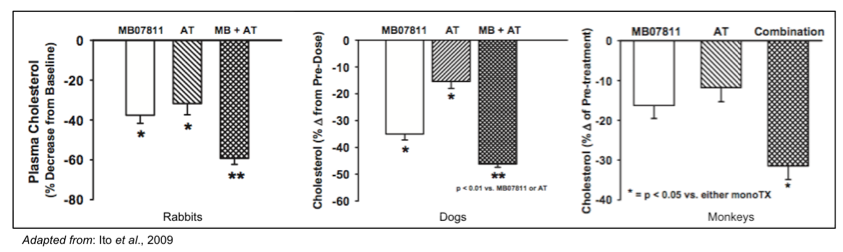
There are two major isoforms of TR, TRα and TRβ, which are encoded by separate genes. TRα and TRβ also have markedly different expression patterns, with TRα expression highest in the heart and brain while TRβ expression is highest in the liver (Bookout et al., 2006). VK2809 is a prodrug of a potent TRb agonist that is converted to the active compound through cleavage by the liver specific cytochrome P450 isoenzyme CYP3A4 (Erion et al., 2007). The activated form of the drug has approximately 16-fold higher affinity for TRβ (Ki = 2.2 nM) than for TRα (Ki = 35.2 nM). The cholesterol lowering properties of VK2809 were exhibited in multiple studies in rabbits, dogs, and monkeys (Ito et al., 2009). The following figures show that VK2809 (MB07811) was at least as effective in lowering plasma cholesterol as atorvastatin (Lipitor®) in all three species, and an additive effect exists with the combination of VK2809 and atorvastatin.
On April 8, 2016, Viking (NASDAQ:VKTX) presented positive Phase 1b clinical data for VK2809 in patients with hypercholesterolemia in a poster session at the 65th Annual Scientific Session and Expo of the American College of Cardiology. The Phase 1b trial was a 14-day, placebo controlled trial in patients with mild hypercholesterolemia (defined as baseline LDL cholesterol of at least 100 mg/dL). VK2809 was shown to be safe and well tolerated in doses ranging from 0.25 mg to 40 mg per day. No serious adverse events were reported and the frequency of adverse events in VK2809-treated subjects was similar to placebo-treated subjects. There were also no differences in heart rate, heart rhythm, or blood pressure between VK2809 and placebo-treated patients.
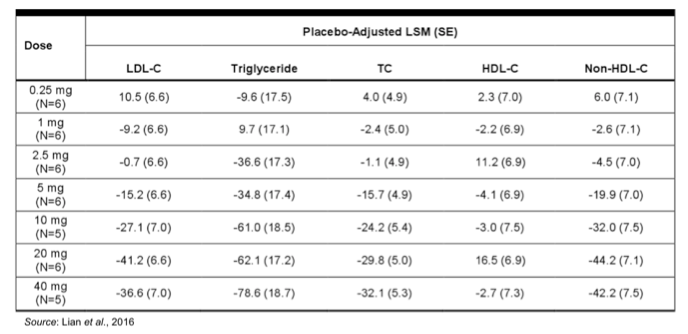
Results from the trial showed that treatment with VK2809 resulted in statistically significant placebo-adjusted reductions in low-density lipoprotein (LDL) cholesterol of 15.2% at the 5 mg dose to 41.2% at the 20 mg dose (p<0.05 for both doses). In addition, decreases in triglycerides of as much as 78.6% were seen at the 40 mg dose. The following table summarizes the placebo-adjusted percentage decreases in LDL cholesterol, triglycerides, total cholesterol, high-density lipoprotein (HDL) cholesterol, and non-HDL cholesterol.
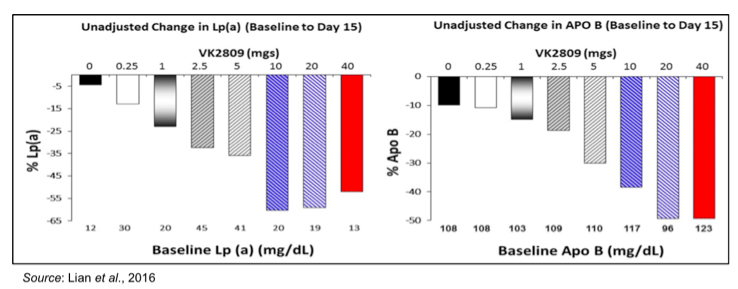
In addition to the results shown above, statistically significant reductions of lipoprotein a (Lp(a)) and apolipoprotein B (Apo(B)), which are believed to be positively associated with a patient’s risk of developing cardiovascular disease, were observed in certain cohorts as shown in the following figure.
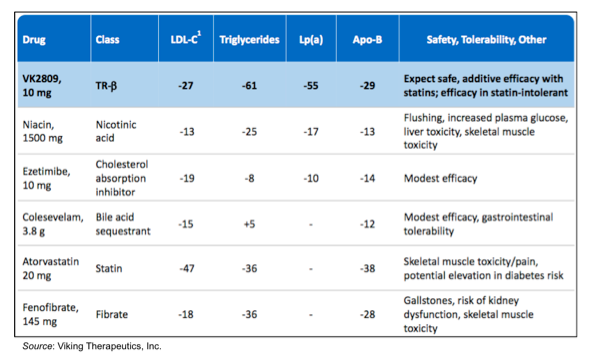
Lastly, the table below gives a comparison of the Phase 1b efficacy results of VK2809 and data from existing hyperlipidemia treatments.
VK2809 Clinical Development Plan
The preceding data is the basis for Viking to conduct a Phase 2 trial to evaluate VK2809 as a treatment for both hypercholesterolemia and fatty liver disease. The company is planning to target patients with elevated cholesterol, fatty liver disease, and at least three risk factors for metabolic syndrome, which is considered a major driver for the onset of nonalcoholic steatohepatitis (NASH). The primary endpoint will assess changes in LDL, with exploratory endpoints evaluating changes in liver fat content, inflammatory markers, and histological changes. Upon conclusion, the company hopes to be in a position to move forward in either hypercholesterolemia or NASH. Thus, it could be viewed as a two-in-one study – confirmatory on LDL and exploratory for fatty liver disease. We anticipate the study initiating in mid-2016 and topline results to be available in 2017.
Synta Merger with Madrigal Shows Viking is Significantly Undervalued
On April 14, 2016, Synta Pharmaceuticals Corp. (SNTA) announced a merger agreement with Madrigal Pharmaceuticals, Inc., a privately held company developing treatments for metabolic and cardiovascular diseases. Madrigals lead compound, MGL-3196, is a TRβ agonist similar to VK2809. A 2013 publication reported results from a Phase 1b study of MGL-3196 in patients with mildly elevated LDL cholesterol (>110 mg/dl) (Taub et al., 2013). The multi-dose study took place over two weeks and was a randomized, double blind, placebo controlled trial to examine the safety and tolerability of various doses of MGL-3196 along with the effect on lipid levels. As shown in the following figure, MGL-1396 does appear to be effective at decreasing LDL, ApoB, and triglycerides.
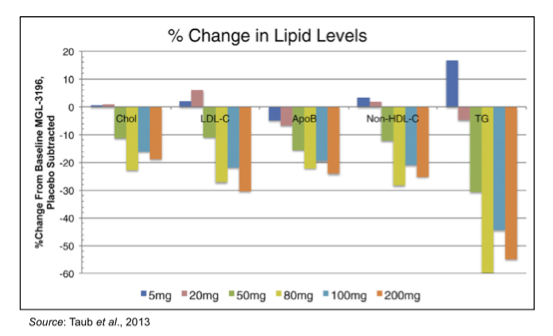
However, when taking a closer look at some of the lipid values, it appears that MGL-1396 may not be as effective as VK2809. For triglycerides, of the six cohorts tested with MGL-3196, only one of them was statistically significantly different from the placebo cohort. In comparison, VK2809 was statistically significantly different from placebo in multiple cohorts for triglycerides. In addition, treatment with MGL-3196 resulted in decreases in Lp(a) of between +2.7% to -20%, compared to decreases in Lp(a) from treatment with VK2809 of -15% to -60%. Lastly, treatment with MGL-3196 resulted in decreases in ApoB of -4.9% to -24%, compared to decreases in ApoB from treatment with VK2809 of -10% to -50%. As mentioned earlier, reductions in both Lp(a) and ApoB are associated with increased cardiovascular health, thus the data so far would indicate that VK2809 is superior to MGL-1396 in this regard.
Even with a potentially superior TRβ agonist compound, the valuation for Viking in comparison to Madrigal does not reflect this fact. Following the recent public offering, we estimate that Viking has approximately 18.1 million common shares outstanding. The stock has recently traded near $1.25, putting the company’s valuation at approximately $23 million. Following the merger with Synta, Madrigal will have approximately 392 million shares outstanding. Synta’s stock recently traded at $0.40, which would give Madrigal a valuation of approximately $157 million, almost six times as much as Viking! MGL-3196 has not yet entered a Phase 2 clinical trial, thus it is at the same development stage as VK2809. In addition, Viking has VK5211, which is currently in a Phase 2 clinical trial for the prevention of loss of lean body mass following hip fracture in elderly patients. Thus, based upon the valuation assigned to Madrigal following the announcement of the merger with Synta we believe that Viking is significantly undervalued.
Financial Update
On April 13, 2016, Viking Therapeutics, Inc. (VKTX) announced the closing of a previously announced public offering of 7.5 million shares of its common stock and warrants to purchase up to 7.5 million shares of common stock at a public offering price of $1.25 per share. The warrants have an exercise price of $1.50 and are exercisable until Apr. 13, 2021. This resulted in gross proceeds to the company of approximately $9.4 million before deducting underwriting discounts, commissions, and other offering expenses. The warrants will trade on the Nasdaq under the ticker symbol ‘VKTXW’.
Per the company’s $2.5 million loan agreement with Ligand Pharmaceuticals, Inc. (LGND), Viking was required to repay $1.5 million of the loan following the company raising at least $2.0 million, with $300,000 due in cash and the rest payable in equity. On April 14, 2016, Viking issued to Ligand 960,000 shares of common stock and a warrant to purchase 960,000 shares of common stock with an exercise price of $1.50 per share and expiration date of April 13, 2021. According to the loan agreement, Ligand will not sell any securities of Viking before January 23, 2017.
At the end of 2015, the company had approximately 9.7 million shares of common stock outstanding, with Ligand owning approximately 35% of the total number of outstanding shares. When factoring in the public offering and shares issued to Ligand, we estimate the company now has approximately 18.1 million shares outstanding. Combined with the outstanding shares of restricted stock, stock options, and warrants the company has a fully diluted share count of approximately 28.5 million shares.
Conclusion and Recommendation
The data for VK2809 are quite encouraging, particularly given the low level of adverse events coupled with data that rivals many of the current treatment options for dyslipidemia. The fact that Viking has a market cap of only $23 million is quite perplexing, particularly given the valuation of Madrigal and its TRβ agonist of approximately $150 million following the announcement of its merger with Synta Pharmaceuticals. There is no discernable reason that Viking, with a TRβ agonist with potentially superior efficacy to Madrigal’s, should have a market cap approximately 1/6th that of Madrigal and we believe it is only a matter of time until Viking’s valuation matches the company’s potential. In the meantime, we believe Viking’s current valuation presents investors with a valuable opportunity to acquire shares or add to a position in a very promising small-cap biotechnology company. Due to the increase in the fully diluted share count from the public offering, we have made adjustments to our model that has resulted in a lowering of our target price to $8, however we are still every enthusiastic about Viking’s story and are reiterating a ‘Buy’ rating.
READ THE FULL RESEARCH REPORT HERE
SUBSCRIBE TO ZACKS SMALL CAP RESEARCH to receive our articles and reports emailed directly to you each morning. Please visit our website for additional information on Zacks SCR and to view our disclaimer.