By Brian Marckx, CFA
NYSE:VNRX
Q1 Results / Operational and Milestones Update:
VolitionRx (NYSE:VNRX) reported Q1 financial results and provided and operational and milestones update. On the financials side, results continue to trend within our expectations. We continue to expect negligible revenue in the current year but a more meaningful contribution beginning in 2017 following launch of the initial panel(s) in Europe.
Q1 OpEx was $2.5M, inline with the $2.5M quarterly average throughout 2015 and moderately lower than our $2.9M estimate. We expect operating expenses over the near term on additional clinical trial and regulatory activities associated with CE Marking of more assays and the initial panel. And VNRX also expects to begin implementing an FDA-clearance/approval strategy which includes preparations for a U.S.-based colorectal cancer study this year to support a potential future 510(k) de novo submission.
Q1 net income and EPS were ($2.5)M and ($0.13), compared to our ($2.9)M and ($0.16) estimates. Cash used in operating activities was $2.2M. We expect this to increase going forward with the ramp-up in ongoing studies, the recent commencement of others, regulatory submission activities and pre-launch (Europe) preparations. Cash balance was $17M at quarter end and recently bolstered by the public sale of $14.1M ($12.8M net) worth of common stock.
As we noted in our prior update (March 14th) we had expected a capital raise would be in the cards in the near term. A few days later VNRX announced strong pricing of a Raymond James-led deal under an existing shelf. It closed on March 23rd, with 4.33M shares (including 565k over-allotment) sold at $3.25/share (~10 – 15% discount to market, no warrants). VNRX’s operational performance, notably a regular stream of positive clinical data, is reflective of the solid pricing and size of the deal. We forecast the current cash balance to fund operations well into next year.
On the operational front – on the call management provided an update to ongoing studies, the European and U.S strategies and laid out some expected upcoming milestones. Importantly, the major expected milestone timelines remain largely intact – this includes the anticipated European launch of the initial colorectal cancer panel which is still expected to happen prior to current year-end.
Recent (since our March update) operational highlights include CE Marking of two additional colorectal cancer assays (three assays are now CE Marked), initial (and very positive) prostate cancer clinical data and the initiation of a (German-based) pancreatic cancer study.
Colorectal Cancer:
- 4,800 sample retrospective trial expected to have full and final results in 2H 2016. Will be used to support CE Marking of initial panel
- 14k sample prospective trial expected to have preliminary data in late 2016. This study is comparing NuQ to FIT test, the market standard for CRC in Europe. Positive results could provide support for NuQ as a CRC screen which could significantly broaden its appeal
- Additional data from (pre-cancerous) adenomas later in 2016
- CE Marking – expect to CE Mark additional CRC assays during 2016 and CE Mark the initial panel by year-end. Also expect to launch the panel in Europe in 2016. Hope to have CE Marking for CRC screen in 2017
- FDA – expect to meet with FDA regarding proposed 510(k) de novo pathway seeking clearance for use as an adjunct to standard of care in high-risk symptomatic patients
- Hope to begin 510(k) supporting studies in 2016. Initial indication will be CRC
- Anticipate ~600 patient study at cost of $1M - $1.5M per indication
- Hope to file for first 510(k) clearance in 2017
- Follow-on indications in other cancers would follow including potentially lung and pancreatic cancer in 2018
- PMA – hope to initiate PMA supporting studies in 2017 for NuQ as a screening test for CRC. Expect pivotal PMA study to be significantly larger than those for 510(k) clearance – if all goes well VNRX thinks PMA studies would complete in 2018
- LDT – will continue to investigate the CLIA lab route. We think LDT would be a fall-back if for some reason 510(k) de novo proves not viable.
Pancreatic Cancer:
- Recently announced data from 59-patient study showing pancreatic panel demonstrated 92% sensitivity @ 90% specificity. Study published in Clinical Epigenetics.
- Shortly after the 59-patient data, VNRX announced NuQ was able to correctly detect 19 of 20 (95% sensitivity) pancreatic cancers with an 84% specificity in patients from their 4,800-sample retrospective colorectal cancer study using two NuQ assays along with carcino-embryonic antigen (CEA) test
- Subsequent to the positive data from the (above) two smaller pilot studies, in May 2016 VNRX announces 750-patient pancreatic cancer study will be done with DKFZ, the German Cancer Research Center. Will use assays from two pilot studies as well as new assays (as well as CEA test). This 750-patient study is expected to conclude in 2016
- Assuming further positive data, VNRX thinks they could have CE Mark for pancreatic cancer in early 2017
Lung Cancer:
- Expect full analysis of 240-patient lung cancer study in 2H 2016. As a reminder VNRX announced interim results, on 73 patients (29 with NSCLC, 22 with COPD and 22 healthy controls), in November 2015 which showed a panel of four NuQ assays detected 93% of lung cancer cases (27/29) with 91% specificity (2 false positives among 22 healthy controls).
- The larger 600-patient lung cancer trial, being conducted at University Hospital in Bonn Germany, is expected to have results this year.
- May initiate other studies in lung cancer in 2016
- If all goes well hope to have CE Mark for lung cancer assay/panel in Q2 2017
Prostate Cancer:
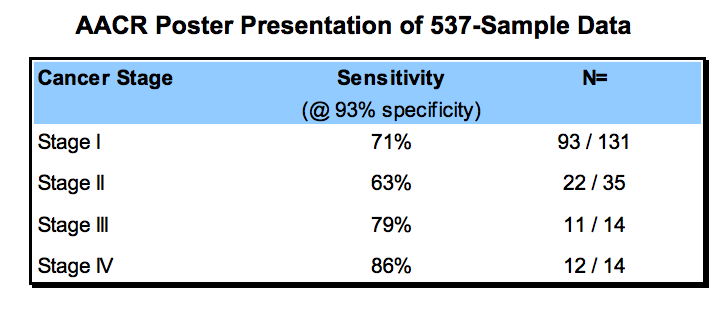
- Results from retrospective study using 537 blood samples from hospital patients in collaboration with Surrey Cancer Research Institute (Univ of Surrey, UK) announced in April 2016 and presented at AACR. Showed a single NuQ assay detected 71% of early stage I (and 86% of late stage IV) prostate cancer cases at 93% specificity – this is significantly more accurate than that of the widely used PSA test. These results are particularly encouraging given that the study used just one NuQ assay. Follow-on studies incorporating more than one NuQ assay and/or in combination with PSA may further improve on this already highly positive data
- Prospective 120-patient study being done by Immune Health. Recruiting patients – shooting to have data completed in Q1 2017
- May initiate other studies in prostate cancer in 2016
- Given the highly encouraging 537-sample data, prostate cancer is now one of the front-runners to follow colorectal cancer as next assay for commercialization
27-Cancer (Pan-Cancer): 4,700 patients looking at 27 of the most prevalent cancers. Analysis will be conducted with several (~25) NuQ assays. Expected to complete in 1H 2017
Non-Cancers: in March 2016 VNRX announced the first data from a non-cancer study. Preliminary data showed NuQ was able to detect 86% of patients with Idiopathic Pulmonary Fibrosis (IPF), a fatal lung disease. The study, being conducted at Liege University Hospital in Belgium, included 30 healthy subjects and 47 IPF patients; 21 which had not been treated and 27 which had. Interim data showed NuQ detected IPF in 18 of the 21 non-treated (86%) from the healthy cohort at 80% specificity (6 false positives). VNRX expects to move into a larger study to help confirm results. Data could be available later this year. While IPF affects only about 100k in the U.S., it is usually fatal and diagnosis options are limited and costly. As such, an accurate blood-based IPF test could have real appeal.
CLINICAL TRIAL DETAILS:
Prostate Cancer: feasibility study assessing NuQ in detecting prostate cancer done in collaboration with Surrey Cancer Research Institute (Univ of Surrey, UK) showed very encouraging data. Data, announced in April 2016 and presented at AACR, showed a single NuQ assay detected 71% of early stage I (and 86% of late stage IV) prostate cancer cases at 93% specificity (detailed results below) – this is significantly more accurate than that of the widely used PSA test. The retrospective study used 537 blood samples (266 prostate cancer, 271 age-matched healthy samples) from hospital patients. Evaluated groupings were patients with; aggressive prostate cancer, slow-growth prostate cancer and age-matched healthy individuals (control group). We view this 537-sample results as particularly encouraging given that the study used just one NuQ assay. Follow-on studies incorporating more than one NuQ assay and/or in combination with PSA (similar to VNRX’s pancreatic cancer studies which use NuQ in combo with CEA) may further improve on this already highly positive data.
We think eventual pursuit of prostate cancer was almost a given based on the relatively high incidence of the disease (~250k U.S. diagnoses each year) and widespread testing despite the poor accuracy of current non-invasive diagnostics. There’s significant debate about the benefits of prostate cancer testing as onset of the disease mostly occurs in older age, it is relatively slow-growing and usually is not the cause of death. Prostate serum antigen (PSA) tests are the most widely used front-line diagnostic with ~20 million tests performed each year in U.S. and ~45 million worldwide. But PSA is fraught with accuracy issues as studies have shown that PSA testing has a sensitivity and specificity of approximately 85% and 30%, respectively, indicating that while it is fairly good at detecting cancer (detects 85% of cases) it is very poor at differentiating between what is, and what is not cancer (i.e. - very low specificity, resulting in high false-positive rate).
PSA's lack of accuracy in detecting prostate cancer as well as its effectiveness in reducing mortality (the ultimate goal) is highly controversial and has recently come under increasing scrutiny. In fact the USPSTF recommends that healthy men without any symptoms of prostate cancer not receive a PSA test with the USPSTF chairwoman at the time of the decision noting that, "Unfortunately, the evidence now shows that this test does not save men’s lives. This test cannot tell the difference between cancers that will and will not affect a man during his natural lifetime. We need to find one that does." This 537-sample feasibility study provides initial support that NuQ may eventually provide the technology backbone of a test that USPSTF is looking for.
VNRX is also working with the MD Anderson Cancer Center on a retrospective study to determine NuQ’s ability to distinguish anaplastic prostate cancer, a particularly aggressive form of the disease, from typical castration resistant prostate cancer.
Colorectal Cancer:
- Hvidore Retrospective: in September 2015 VNRX reported additional positive interim data. The presentation supports earlier data that found the NuQ technology has better than 80% sensitivity at 78% specificity with high accuracy at all stages of the disease, including Stage I (i.e. earliest) – we discuss more fully below. VNRX expects to have full data, including early-stage pre-cancerous lesions, from the 4,800-patient retrospective colorectal cancer study in 2H 2016. This data will be used to support CE Marking of the first CRC panel (4 to 6 assays) – which is expected to happen by year end
- Hvidore Prospective: the timeline for release of the initial data from the 14,000 sample prospective colorectal cancer study is expected in late 2016. 2,500 samples have already been run and VNRX will finish another 2,500. Initial data announcement may include the first batch or both, depending on timing of analysis. This study is comparing NuQ to FIT test, the market standard for CRC in Europe. Positive results could provide support for NuQ as a CRC screen which could significantly broaden its appeal
- Pre-Cancerous Colorectal Study: a subset of the Hvidore retrospective study included patients with precancerous lesions, or adenomas. NuQ was able to detect 60% of these lesions. This prompted VNRX to initiate a study, which will is also being conducted at Hvidore Hospital, for the detection of precancerous polyps. Data was announced in mid-February which showed highly promising accuracy in this difficult to diagnose population. The double-blinded trial was and designed to detect adenomas before they become cancerous, as well as early stage colorectal cancer. It included 430 samples who either had symptoms of colorectal cancer or were at high risk. This included 42 with stage I CRC, 46 with stage II CRC and 181 with adenomas. The healthy cohort included 160 patients. A panel of five NuQ assays detected 75% of adenomas and 86% of stage I CRCs at 78% specificity. VNRX may include additional assays in this other early stage CRC studies in order to try and further improve on accuracy. The company expects to release additional data from this study later this year. The current thinking is that an adenoma assay/panel could be layered into a colorectal cancer assay or as a stand-alone product. As precancerous polyps have proven difficult to detect, relatively high accuracy in this indication could be a meaningful differentiator compared to other colon cancer tests such as Cologuard and Epi proColon. Epi proColon (Epigenomics) showed sensitivity of just 20% with small polyps and Cologuard 42% with precancerous lesions
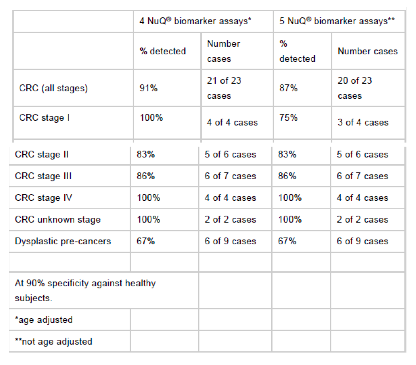
- CHU Dinant Godine Colon Cancer Study: NuQ continues to show high accuracy in colon cancer trials. Some of the most recent data comes from a small study conducted at the university hospital, CHU Dinant Godinne - UCL Namur, in Belgium. 121 patients which either had symptoms of colon cancer or were at high risk were given a colonoscopy and 23 were found to have colon cancer. The same subjects’ blood samples were tested with a panel of four NuQ tests which detected 90% of colon cancer cases at 90% specificity and 67% of precancerous polyps. The panel was able to detect cancer at all stages. The results (below) are inline with earlier findings (and larger studies) which have shown NuQ to be able to detect colon cancer at specificity of at least 80% and in some cases, better than 90% and precancerous polyps at 60% or better. Additional data from VNRX’s two large colon cancer studies being conducted at Hvidore hospital which combined includes almost 20k samples as well as an 800-sample precancerous polyp study, are expected to be released in 2H 2016. These data announcements should provide even greater insight into the detection ability of NuQ in colon cancer.
Lung Cancer: In December 2014 VNRX announced that they were pursuing a larger lung cancer study, which followed positive data from a pilot study, announced in November of that year. 46 individuals were included in the pilot study, including 21 with non-small cell lung cancer, 12 with COPD and 13 healthy subjects. Both sputum and blood samples were tested. With sputum, NuQ was able to detect 18 of the 21 (85%) lung cancer cases with no false positives for healthy individuals. In addition, NuQ was able to differentiate between lung cancer and COPD.
With blood samples, NuQ identified 76% (16 of 21) patients with lung cancer with only one false positive (1 of 13) of a healthy individual. With blood, NuQ was also able to differentiate between lung cancer and COPD.
VNRX since initiated a larger prospective study – which includes 240 patients and is being conducted at Liege University Hospital in Belgium. Interim results, on 73 patients (29 with NSCLC, 22 with COPD and 22 healthy controls), were announced in November 2015 which showed a panel of four NuQ assays detected 93% of lung cancer cases (27/29) with 91% specificity (2 false positives among 22 healthy controls). VNRX expects the full data set from this trial to be available later this year as well as interim data from the company’s larger 600-patient lung cancer trial being conducted at University Hospital in Bonn Germany. We think if NuQ can confirm accuracy at this 90%+ level in larger studies, particularly in early-stage cancers, that this should be a catalyst to the stock price given the dearth of reliable testing options, high mortality of lung cancer and significant incidence of the disease. If all goes well, VNRX thinks they can have CE Mark for lung cancer assay/panel in Q2 2017.
27-Cancers Study: 4,700 patients looking at 27 of the most prevalent cancers at the U of Bonn. May have some interim data in 2016 and expect to complete the study in 1H 2017. The study has the potential to produce an enormous amount of data given the number of assays (~25) that may be included as well as the diverse sample set. It is still a question mark as to how the output will applied, although if the data supports it, a home-run would be eventual development of an assay/panel that could detect and differentiate between several cancer types
Pancreatic Panel Shows 92% Sensitivity @ 90% Specificity: Study Published in Clinical Epigenetics. Could It Become The New “Gold Standard”???….
In mid-October 2015 VNRX announced that results of their pancreatic cancer pilot study were published in the online version of Clinical Epigenetics. The study included 59 individuals; 25 with stage IIa or stage IIb pancreatic cancer (i.e. early-stage, operable cancers), 24 healthy subjects and 10 with other pancreatic non-cancer disorders (i.e. benign pancreatic disease). Blood samples were taken from patients prior to being treated at Skane University Hospital in Lund, Sweden. Healthy samples came from a local blood bank.
In January VNRX announced interim results which showed a five-assay NuQ panel correctly identified 21 of the 25 cancer cases (84% sensitivity) at a 90% specificity among the healthy subjects (i.e. - two false positives). This panel was also able to distinguish 18 of the pancreatic cancer cases from healthy individuals or those with other pancreatic non-cancer disorders with a 72% sensitivity at 90% specificity (three false positive results; one from healthy group and two from benign group).
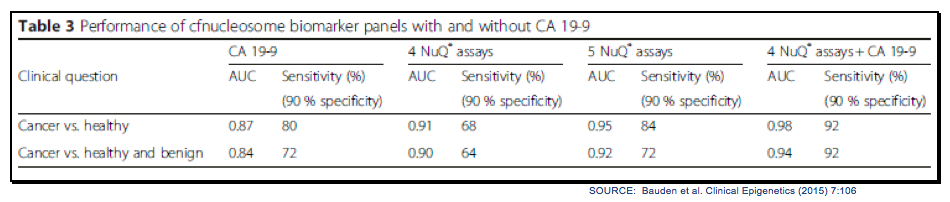
As we noted in January 2015, we characterized the interim results as highly encouraging given the impressive accuracy seen with the interim data. However, we are even more inspired with the results of the full data set which included, in addition to the initial five-assay panel, a four-NuQ assay panel in combination with a generic CA19-9 ELISA test. Carbohydrate antigen 19-9 (CA 19-9) is considered the current gold-standard diagnostic for pancreatic cancer testing and is used as a benchmark for comparing novel pancreatic cancer diagnostics. This is despite it not being particularly accurate – with reported sensitivity/specificity of 79%/82%.
But when four of the five NuQ assays in the original panel (the least incrementally additive assay was excluded) were combined with CA 19-9, VNRX was able to achieve higher accuracy as compared to both their initial five-assay panel as well as to CA 19-9. This four NuQ panel plus CA 19-9 achieved 92% sensitivity using a 90% specificity (identified 23 of 25 cancer cases) on discriminating cancer versus healthy subjects as well as versus healthy and benign subjects. This is significantly higher than CA 19-9 alone. The table below illustrates the superiority of the four NuQ panel plus CA 19-9 as compared to CA 19-9 alone, the four NuQ assay panel alone and the original five NuQ assay panel. In addition to the high accuracy of the four NuQ panel plus CA 19-9, it is also noteworthy that all of the three false positives were from the benign group, with none coming from the healthy group (i.e. – 100% specificity versus healthy group).
Despite CA 19-9’s high risk of false negative results and the American Society of Clinical Oncology discouraging its use, it remains the gold standard for diagnosis of pancreatic cancer. However, its main use has mostly been relegated to determine whether a tumor is secreting carbohydrate antigen 19-9 and to monitor the level following treatment. The results of this small pilot study suggest NuQ assays in combination with CA 19-9 could have more than high enough accuracy as a clinical pancreatic cancer diagnostic and would be the only test able to identify early stage pancreatic cancer with relatively very high sensitivity.
And additional data, from a separate study, further supported the findings of high accuracy of NuQ in detection of pancreatic cancer. Later in October 2015 VNRX announced that NuQ was able to correctly detect 19 of 20 (95% sensitivity) pancreatic cancers with an 84% specificity in patients from their 4,800-sample retrospective colorectal cancer study (while it is a colorectal cancer study, it also picked up patients with other cancers, including 20 with pancreatic cancer). Two NuQ assays along with carcino-embryonic antigen (CEA) test were used in the analysis.
Subsequent to these results, in May 2016 VNRX announced a 750-patient pancreatic cancer study will be done with DKFZ, the German Cancer Research Center. The study will use assays from the two pilot studies as well as new assays (as well as CEA test). This 750-patient study is expected to conclude in 2016 and could form the basis for a CE Mark filing for pancreatic cancer – potentially in 2017.
Diagnosis of pancreatic cancer is almost always a death sentence given that no tests currently on the market can reliably identify early-stage pancreatic cancer. Currently only about 6% of people diagnosed with pancreatic cancer survive five years or more. The USPSTF has a grade D recommendation on pancreatic cancer screening, recommending "against routine screening for pancreatic cancer in asymptomatic adults using abdominal palpitation, ultrasonography, or serological markers." The USPSTF notes that they "found no evidence that screening for pancreatic cancer is effective in reducing mortality. There is a potential for significant harm due to the very low prevalence of pancreatic cancer, limited accuracy of available screening tests, the invasive nature of diagnostic tests, and the poor outcomes of treatment. As a result, the USPSTF concluded that the harms of screening for pancreatic cancer exceed any potential benefits."
As such a test that could identify pancreatic cancer at an early stage may allow for more effective clinical intervention and vastly improve mortality rates. If VNRX can demonstrate similar results of this pilot study in larger trials, we think eventual FDA approval would be almost a given and believe it is reasonable that this panel could one day become the new gold standard for pancreatic cancer diagnosis. Importantly, CA 19-9 is a generic ELISA test so it is easily available with no intellectual property protection and, therefore, can be freely combined and commercialized in a VNRX panel.
COMMERCIALIZATION
- CE Mark / European Commercialization: NuQ X001S was the first assay to receive CE Mark, which happened in September 2015. A second and third (NuQ V001 and NuQ T003) assay received CE Mark in April 2016. Despite some delay in expected release of data from the Hvidore studies, VNRX continues to expect that additional assays and the initial panel will be approved and launch sometime in 2016. Initial panel will be supported by 4,800-sample colorectal cancer study. Follow on CRC screen could also come in 2017 and be supported by 14K-sample study.
- Follow-ons…: VNRX will then look to strengthen both the clinical support for their technology as well as the performance. Follow-on data from the two large Hvidore studies should provide support for both – as noted, additional data should be available fairly quickly. The 14k sample prospective trial expected to have preliminary data in late 2016. This study is comparing NuQ to FIT test, the market standard for CRC in Europe. Positive results could provide support for NuQ as a CRC screen which could significantly broaden its appeal. The data should help drive development of new and higher performing assays on a regular basis and, combined into panels, can further enhance performance, providing opportunity for the next iteration of CE Marked products. Providers and payers are also interested in seeing as much data as possible to make informed use and reimbursement decisions – so a regular flow of positive trial data will be key to maximizing initial chances of success in the marketplace
- Commercialization: VNRX does not expect to launch into Europe until they have more supporting data and the full panel CE Marked – which they think can happen in late 2016. And while we model some (immaterial) revenue related to an assumed introduction in Europe in late 2016, it is possible launch slips to 1H 2017. VNRX recently brought on two consulting firms to guide the European commercialization strategy which includes advice on market selection, reimbursement expectations, distribution, etc. They also recently brought on a Chief Marketing and Communications Officer to help lead the roll-out in Europe as well as (eventually) the U.S.
- More follow-ons…: with the plethora of data expected to come out of the various studies, VNRX hopes to further enhance the performance of their tests and bring further iterations of cancer panels through CE Marking. Clearly the initial focus is colorectal cancer but pancreatic, prostate, lung and others could potentially follow in short-order. And possibly, eventually a multi-cancer panel. Pancreatic and lung looks to be the two next indications that VNRX will pursue after colorectal, both of which the company hopes to have CE Marking for in 2017.
- Our Comments: Epigenomics has had a tough go of it in Europe with their IVD Epi proColon colon cancer blood test. While the test has been available since 2012 product revenue from Europe amounted to roughly $1 million in all of 2014. They cite a difficult reimbursement environment and high barriers to get into the government level screening programs. Part of the difficulty is most likely pricing - as Cameron noted on a prior call, the government programs are tight-fisted and to be competitive pricing needs to be near the EUR 20 – 30 range (~$20 - $30). And if Epigenomics can’t or won’t come in near there, then it is reasonable they may not qualify. VNRX indicated that they believe they can meet that price point and maintain reasonable margins. They brought on the two consulting firms (one focused on the U.K. and the other the rest of Europe) to help navigate the intricacies and difficulties – one potentially major one being reimbursement – of the European market. VNRX may also have an advantage in accuracy – the data to-date has suggested NuQ may have superior accuracy as compared to the 79% sensitivity / 68% specificity Epi proColon demonstrated in their PMA-supporting studies. This could be particularly true in pre-cancerous lesions – a much more difficult population to identify but one which NuQ has shown impressive accuracy. If confirmed in larger studies, this could draw particularly strong appeal. As more data is announced, it should provide greater insight. We think it is reasonable to expect revenue from Europe will not be overly significant in the first year of launch, particularly if initial commercialization does not happen until late in the year. This could improve with further penetration throughout Europe and also depend on reimbursement and inclusion in government screening programs.
- U.S. Pathway: initial U.S. introduction had until recently expected to be in the form of licensing rights to the technology to CLIA certified labs to develop LDT tests. However VNRX is now clearly leaning towards the 510(k) de novo (FDA clearance) route. Concurrent with that VNRX would work to bring an FDA approved test (i.e. PMA) to market.
VNRX has brought on another consultant to guide them in their U.S. plans. VNRX’s Chief Medical Officer, Dr. Terrell will lead their U.S. FDA strategy and commercialization plan. Timelines for the possible CLIA lab route are uncertain although management indicated on the Q4 2015 call that they will continue to investigate this along with the more recent strategy to potentially pursue 510(k) clearance. They will first meet with FDA regarding proposed 510(k) de novo pathway seeking clearance for use as an adjunct to standard of care in high-risk symptomatic patients. Assuming that route remains feasible, current expectations include;
- FDA – expect to meet with FDA this year regarding proposed 510(k) de novo pathway seeking clearance for use as an adjunct to standard of care in high-risk symptomatic patients
- Hope to begin 510(k) supporting studies in 2016. Initial indication will be CRC
- Anticipate ~600 patient study at cost of $1M - $1.5M per indication
- Hope to file for first 510(k) clearance in 2017
- Follow-on indications in other cancers would follow including potentially lung and pancreatic cancer which could potentially begin PMA studies next year
LDT – will continue to investigate the CLIA lab route. This could be in lieu of or in parallel with 510(k) pursuit – we think LDT is likely more of a fall-back proposition and one VNRX may pursue if 510(k) de novo is deemed unviable.
The 510(k) clearance pathway affords the potentially to market the test on a broader scale and one which VNRX would have control over. As we’ve noted before, while LDT’s offer the opportunity to get the tests into the market, generate earlier revenue and build some front-end awareness about the technology (although the tests would likely be marketed under another brand), they may hold only a fraction of the revenue potential that a PMA approved product would – and quite possibly less than an FDA-cleared (i.e. 510(k) pathway) would. As an example, Epigenomics’ Epi proColon (methylated Septin 9 DNA) test has been distributed by Quest Diagnostics as an LDT but generated little interest.
Relative to the FDA PMA-approval process – this is still being refined – initially VNRX was hoping to support a PMA filing with data from the ongoing studies (prospective and retrospective most likely) and then potentially supplement that with a “bridging” study – essentially additional samples from more ethnicities to more represent the broader U.S. population. This, however, is not yet definitive and something that we expect we will hear more about as more info is available. The goal with PMA approval would be to gain FDA approval as a CRC screen – this would be essentially the best possible indication as it would be a first-line diagnosis.
Timelines for an eventual FDA approved product are highly uncertain right now as there still needs to be clarification from FDA on what they will require to support a filing. VNRX hopes to initiate a PMA-supporting study this year or next and believes that if all goes well the studies could complete in 2018. If that timeline is feasible, the earliest that an FDA approved (i.e. PMA pathway) assay/panel could likely come to the U.S. market is 2019. We think it is not unlikely that it would be later than 2019, however.
FDA Approval of Epi proColon Could Be Positive for VNRX…
We think VNRX has a reasonable chance of eventually getting a NuQ panel for colorectal cancer approved by FDA. Noteworthy is that in April 2016 FDA approved Epigenomics’ Epi proColon colon cancer blood test despite less than compelling accuracy. Epi proColon’s pivotal study versus FIT showed sensitivity of 79% and specificity of 68% (much lower than what NuQ has demonstrated in CRC clinical studies). The relatively low accuracy of the test resulted in a somewhat limited label – that being an indication for those people who decide not to undergo other screening options such as colonoscopy or fecal-based tests. So given that Epi proColon received FDA approval on relatively low accuracy, we view this has a positive event for VNRX as the bar for approval has been set low and one which, in studies to date, NuQ looks superior to. And, depending on the strength of NuQ’s data, an eventual FDA (PMA) approval as a screen may not carry a label as limited as Epi proColon.
Outlook
We continue to model launch in Europe in late 2016 – although it is quite possible that this could slip until 2017. Broadening the label in Europe to include as a CRC screen could have the effect of accelerating interest in demand. We continue to expect data from the large Danish CRC studies as well as pre- and early-stage cancer to provide greater insight into the utility of the assays for CRC. With studies ongoing in several other cancer types, including pancreatic and breast, among several others, subsequent CE Marking in other cancers could potentially come in fairly short order – as noted, we think pancreatic could emerge as a very formidable indication if larger studies confirm the early highly encouraging data. We also expect VNRX will look to continually enhance the performance of their commercialized panels. Ongoing study data will also be used to support reimbursement.
Relative to the U.S. market, we think VNRX’s current game-plan – that is, to initially tap the LDT channel via licensing agreement(s) with established CLIA lab(s) and/or 510(k), makes a lot of sense. Not only are these earlier revenue opportunities in the U.S. as the company continues to pursue FDA (PMA) approval, it also provides additional and valuable clinical experience and awareness benefits.
In terms of the road towards eventual FDA approval – which is the ultimate quest and one which we think could rapidly steepen VNRX’s revenue curve – this could be a years-long process and require U.S.-based clinical studies.
In terms of the accuracy hurdle that a PMA filing may have to clear - one yardstick that may be relevant to look at is that a FDA recently (April 2016) approved Epigneomics' Epi proColon colorectal cancer test which in a pivotal trial versus FIT showed sensitivity of 79% and specificity of 68%. This compares to VNRX's interim data (n = 938) from the Danish retrospective study, which showed the three-panel NuQ tests were able to detect 84% of colorectal cancers (60% of polyps) at 78% specificity. Epi proColon has also shown relatively low sensitivity (20%) in precancerous polyps – which is another potential indication that NuQ could demonstrate superior accuracy.
Valuation Remains Attractive…
Based on our DCF model which goes out to year 2026 and uses a 9.5% discount rate (based on CAPM) and 2% terminal growth rate, VNRX is valued at $6.44/share (which we round to $6.50). Our model and assumptions will be updated if appropriate based on news flow which could also influence valuation.
Based on the number of studies anticipated to read out in the near term, this should be a telling year in terms of the potential utility of the NuQ assays in a variety cancers. And 2016 is also expected to include CE Marking of the initial CRC panel, commercial introduction in Europe and more clarity on the U.S. commercialization pathway. We will be eagerly awaiting additional clinical data in several cancers which, assuming positive, could prompt upward revisions to our modeled revenue and related valuation. For example, as we noted, we have yet to model any contribution from a potential pancreatic cancer panel but will likely do so if high accuracy of the diagnostic is maintained in subsequent studies (particularly the recently announced 750-patient Germany-based study).
As it is now, we value VNRX at $6.50/share. We feel the current market price ($3.40) remains cheaper than warranted and undervalues the company. We think additional and ongoing positive clinical data should further benefit appreciation of the share price towards our target.
READ THE FULL RESEARCH REPORT HERE
SUBSCRIBE TO ZACKS SMALL CAP RESEARCH to receive our articles and reports emailed directly to you each morning. Please visit our website for additional information on Zacks SCR and to view our disclaimer.