By Brian Marckx, CFA
NYSE:VNRX
UPDATES: Prostate Trial Starts, Add’l Positive Data in Colon and Lung, ISO Cert, New Patents…
It’s been a busy few months for VolitionRX (NYSE:VNRX) which, most importantly, included release of additional positive data from both lung and colon cancer studies. And today the company announced initiation of a new prostate cancer feasibility study – this is a relatively new target for NuQ and, given the relatively high incidence of the disease and lack of accurate non-invasive testing of it, could be particularly attractive.
Prostate Cancer: announced today (2/2) that a feasibility study will initiate to assess NuQ in detecting prostate cancer. Will be done in collaboration with Surrey Cancer Research Institute (Univ of Surrey, UK). Retrospective using 550 blood samples from hospital patients. Evaluated groupings will be patients with; aggressive prostate cancer, slow-growth prostate cancer and age-matched healthy individuals (control group). NuQ will also be assessed in ability to distinguish between the different prostate conditions and the controls. We think eventual pursuit of prostate cancer was almost a given based on the relatively high incidence of the disease (~250k U.S. diagnoses each year) and widespread testing despite the poor accuracy of current non-invasive diagnostics.
There’s significant debate about the benefits of prostate cancer testing as onset of the disease mostly occurs in older age, it is relatively slow-growing and usually is not the cause of death. Prostate serum antigen (PSA) tests are the most widely used front-line diagnostic with ~20 million tests performed each year in U.S. and ~45 million worldwide. But PSA is fraught with accuracy issues as studies have shown that PSA testing has a sensitivity and specificity of approximately 85% and 30%, respectively, indicating that while it is fairly good at detecting cancer (detects 85% of cases) it is very poor at differentiating between what is, and what is not cancer (i.e. - very low specificity, resulting in high false-positive rate).
PSA's lack of accuracy in detecting prostate cancer as well as its effectiveness in reducing mortality (the ultimate goal) is highly controversial and has recently come under increasing scrutiny. In fact the USPSTF recommends that healthy men without any symptoms of prostate cancer not receive a PSA test with the USPSTF chairwoman at the time of the decision noting that, "Unfortunately, the evidence now shows that this
test does not save men’s lives. This test cannot tell the difference between cancers that will and will not affect a man during his natural lifetime. We need to find one that does." This 550-sample feasibility study may provide some insight into if NuQ could be the test that USPSTF is looking for.
VNRX is also working with the MD Anderson Cancer Center on a retrospective study to determine NuQ’s ability to distinguish anaplastic prostate cancer, a particularly aggressive form of the disease, from typical castration resistant prostate cancer.
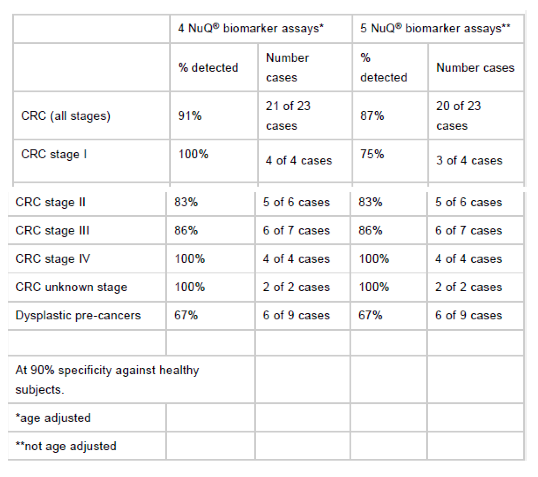
CHU Dinant Godine Colon Cancer Study: NuQ continues to show high accuracy in colon cancer trials. The most recent data comes from a small study conducted at the university hospital, CHU Dinant Godinne - UCL Namur, in Belgium. 121 patients which either had symptoms of colon cancer or were at high risk were given a colonoscopy and 23 were found to have colon cancer. The same subjects’ blood samples were tested with a panel of four NuQ tests which detected 90% of colon cancer cases at 90% specificity and 67% of precancerous polyps. The panel was able to detect cancer at all stages. The results (below) are inline with earlier findings (and larger studies) which have shown NuQ to be able to detect colon cancer at specificity of at least 80% and in some cases, better than 90% and precancerous polyps at 60% or better. Additional data from VNRX’s two large colon cancer studies being conducted at Hvidore hospital which combined includes almost 20k samples as well as an 800-sample precancerous polyp study, are expected to be released in the very near-term. These data announcements should provide even greater insight into the detection ability of NuQ in colon cancer. The first NuQ panel (NuQ X001S), which was CE Marked in late 2015, is slated for launch in Europe sometime later this year. Follow-on panels are expected to be commercialized on a regular basis.
Lung Cancer: In December 2014 VNRX announced that they were pursuing a larger lung cancer study, which followed positive data from a pilot study, announced in November of that year. 46 individuals were included in the pilot study, including 21 with non-small cell lung cancer, 12 with COPD and 13 healthy subjects. Both sputum and blood samples were tested. With sputum, NuQ was able to detect 18 of the 21 (85%) lung cancer cases with no false positives for healthy individuals. In addition, NuQ was able to differentiate between lung cancer and COPD.
With blood samples, NuQ identified 76% (16 of 21) patients with lung cancer with only one false positive (1 of 13) of a healthy individual. With blood, NuQ was also able to differentiate between lung cancer and COPD.
VNRX since initiated a larger prospective study – which will include 240 patients and is being conducted at Liege University Hospital in Belgium. Interim results, on 73 patients (29 with NSCLC, 22 with COPD and 22 healthy controls), were announced in November which showed a panel of four NuQ assays detected 93% of lung cancer cases (27/29) with 91% specificity (2 false positives among 22 healthy controls). VNRX expects the full data set from this trial to be available later this year as well as interim data from the company’s larger 600-patient lung cancer trial being conducted at University Hospital in Bonn Germany. We think if NuQ can confirm accuracy at this 90%+ level in larger studies, particularly in early-stage cancers, that this should be a catalyst to the stock price given the dearth of reliable testing options, high mortality of lung cancer and significant incidence of the disease.
Other News: VNRX received ISO Certification, EN ISO 13485:2012 – which they announced last week. This is one of the last few boxes that needed to be checked in prior to commencing commercialization – which is slated to start in Europe this year.
In early January VNRX announced receipt of its third U.S. patent covering their NuQ technology, specifically “Method for Detecting Nuclesomes”.
We cover VNRX with a Buy recommendation and $6.50/share price target. See below for access to our research on the company.
READ THE LATEST FULL RESEARCH REPORT HERE
SUBSCRIBE TO ZACKS SMALL CAP RESEARCH to receive our articles and reports emailed directly to you each morning. Please visit our website for additional information on Zacks SCR and to view our disclaimer.