By Brian Marckx, CFA
OBB:BNKL
OBB:EKSO
NASDAQ:RWLK
Last week we initiated coverage of Bionik Laboratories with a Buy recommendation and $1.25/share price target. The following are excerpts from our 28-page report, which is available via the link at the bottom of the page.
SNAPSHOT
Bionik Laboratories Corp. (OBB:BNKL) is a pre-revenue stage company engaged in the development of products for individuals suffering from spinal cord injuries (SCI) and certain mobility-inhibiting diseases. The company’s lead product candidate, ARKE, is a lower-body powered exoskeleton initially targeted for the rehabilitation clinic market and later, potentially, for home use.
Exoskeletons, in the context of this report, are frames attached to the outside of the body which are powered by electric or pneumatic motors to assist in the movement of the limbs. In addition to medical applications, exoskeletons have also been designed for military and industrial use in order to provide for greater endurance and strength of able-bodied individuals. But to-date, the area where these machines have generated the most interest is with full or partial paralysis of the legs due to SCI and other conditions that severely limit mobility of the lower body such as stroke, multiple sclerosis (MS) and cerebral palsy (CP).
In the rehabilitation clinic setting they are used to reduce paralysis-related complications which can include deep vein thrombosis, autonomic dysreflexia, bone loss, pressure sores and others. For home use they can also be used as a mobility aid and may be a substitute for wheelchairs. The rehabilitation clinic market is where the majority of sales to-date have been made, although the home-use segment looks to become much more viable with advances in technology.
The market for lower-body medical exoskeletons includes a portion of the roughly 3.7M Americans and 10M+ people worldwide living with some form of paralysis. The industry is still very much in its infancy despite several new entrants over the last few years. Industry analysts peg the current market for exoskeletons (in all applications) at just around $17M but forecast this to grow to $2.1B by 2021 (99% CAGR).
Only a handful of the 20 or more companies developing medical exoskeletons currently have a product on the market and while some are farther along than others in commercialization, none have established a dominant position. The environment is dynamic and characterized by lack of widespread or consistently reliable reimbursement, rapid technological advances, wide diversity in functionality and cost, recent regulatory changes and different penetration strategies by the various industry participants.
This offers potentially significant opportunity for those that can most effectively navigate the challenges of the immature yet nascent medical exoskeleton market. Attributes such as ease of use for both the patient and clinician, affordability, programmability, size (i.e. bulkiness, weight), data analytics and ability to walk up inclines or steps, among many others, have the potential to be meaningful and competitive differentiators.
ARKE GEN2, Bionik’s second generation (lighter, more control, improved electronics) machine is currently undergoing assembly and testing and is anticipated to be evaluated by select Canadian rehabilitation centers throughout 2016. If all goes to-plan, data could be available later this year, filings in Canada and Europe would follow and initial commercialization in those areas could potentially happen sometime in 2017. The U.S. is a longer-term goal. FDA recently reclassified exoskeletons as Class II devices with special controls which will require formal clinical studies to demonstrate safety and patients’ ability to use the device.
And while ARKE is BNKL’s current main focus, the company has other irons in the fire. In early March they announced the planned acquisition of Interactive Motion Technologies (IMT), a leading innovator of neurorehabilitation robotics. IMT’s robotics portfolio, developed at Massachusetts Institute of Technology, currently includes three FDA-approved upper extremity rehabilitation devices as well as two lower body product candidates. IMT, which notes that their robots “are the most thoroughly research technology available in the rehabilitation industry”, currently generates approximately $2M in annual sales. The acquisition, expected to close in April (IMT shareholders will receive 23.7M BNKL shares) will provide BNKL with an immediate revenue stream, but more importantly a synergistic product portfolio and technology platform as well as key personnel additions.
VALUATION / RECOMMENDATION
Near-term milestones include completing preclinical verification of ARKE, followed by commencement of clinical validation studies (1H 2016). If all goes well data could be available later in 2016 and regulatory filings for Canada and Europe happening in early 2017. Bionik hopes to have marketing approvals in both of these territories in the first half of 2017.
The quest for U.S. regulatory clearance will be more involved and require at least one formal U.S.-based clinical study in order to satisfy all of the special controls requirements. This is also predicated on first raising additional capital. We expect more information regarding what a U.S. regulatory program would entail will be gleaned from a potential future meeting with FDA. Hypothetically, assuming ReWalk Rehabilitation (NASDAQ:RWLK) could be cited as a predicate device and a single, small (~n<10) clinical study would acceptable to support the filing, we think a reasonable timeline from initiation to FDA clearance could be ~2.5 years. This includes approximate estimates of the study design taking about 6 months, 9-12 months to conduct the study, 6 months for data analysis, preparation of the filing (including aggregating all other special controls information) and FDA submission and another 6 months for turnaround of FDA clearance. This, however, will not move forward until at least BNKL has raised sufficient capital to support the cost of the program.
Commercialization: BNKL has provided only general information relative to their plans for commercialization, indicating that they expect to initially leverage the exposure from the clinical evaluations to detail to research centers and key opinion leaders in Canada. Initial strategy will be to generate awareness about ARKE. BNKL may be able to leverage some of IMT’s contacts and sales channels (assuming the deal closes) which could be done with a small marketing team. Attendance at industry conferences and events is also likely to be part of the early marketing efforts. Target customers will be hospitals and rehab clinics.
The next phase of the commercialization strategy may entail establishing training centers and building a direct sales force in Canada and, assuming eventual FDA clearance, the U.S. as well. The game plan for Europe will be to sell through third-party distributors.
And as IMT’s products offer synergies with that of ARKE, this may provide the benefits of detailing the combined product catalog at the same call points (i.e. rehab centers and hospitals), the ability to leverage existing customer and distributor relationships (both in and outside of the U.S.), additional competitive differentiation from other exoskeleton manufacturers and, most importantly, bolt on additional revenue drivers.
ARKE-Related Financial Model: We think the above regulatory and commercialization timelines may be do-able as the scope of validation and clinical trials should not be particularly burdensome, the company has indicated that they have at least two completed ARKE GEN-2 systems and initiation of clinical validation in Canada should be imminent.
Our model incorporates the following assumptions;
ARKE launches: in Canada in late 2017 and in Europe in 1H 2018. As the feasibility, cost and timing of an FDA regulatory program and subsequent entry into the U.S. market is much more uncertain, we do not currently model any U.S. related revenue. This, as is the case with all of our assumptions, is subject to updating.
Revenue: we model year 1 (2017), year 2 (2018) and year 3 (2019) revenue of $100k, $450k and $925k, respectively. For context, Ekso Bionics (OBB:EKSO) did over $500k in sales in its first year and $2.9M in its third year. ReWalk did $972k in its second year (the initial year with publicly available data) on the market. Some of the delta between our BNKL forecasted revenue and the much higher levels of RWLK and EKSO relates to an assumed lower placement rate as a result of what we think will be greater discernment in marketing spend and related focus on profitability with Bionik as compared to the other two companies.
Unit placements: BNKL has indicated that they expect to pursue a leasing/revenue-share as opposed to or (possibly) in addition to an outright sales business model. While leasing may be feasible, until there is more clarity on how the company intends to implement this (which might require some type of asset-backed financing or sell-leaseback arrangement), we incorporate an assumption (which is subject to updating) that systems are sold outright. Using an average ~50k unit sales price (which is based on earlier communications by the company), we model an installed base of approximately 30 systems through the end of 2019. For context, RWLK and EKSO have installed bases of 211 (104 of which are in rehab centers) and ~170 units, respectively
Expenses: while ReWalk and Ekso have a several-year lead on BNKL in commercialization of their products and could each have installed bases of several hundred units by the time Bionik makes their first sale, neither has demonstrated an ability to profitably scale their businesses. Growing the installed base appears to be the sole goal of ReWalk’s and Ekso’s business models with little regard to how much it costs to make those sales.
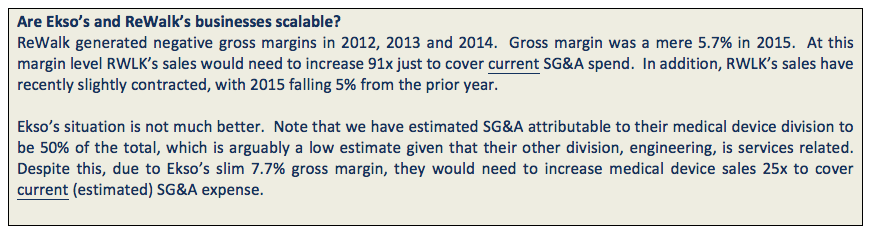
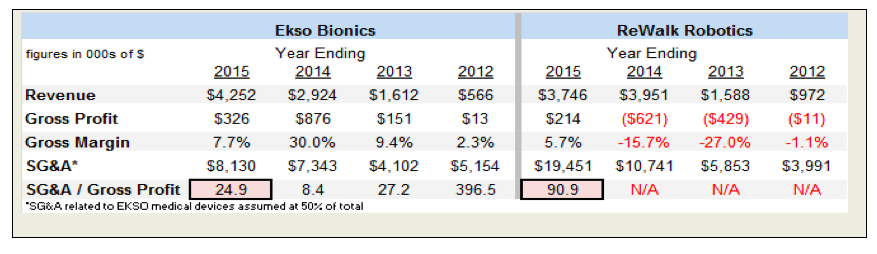
Both Ekso and ReWalk have spent exorbitantly on sales and marketing to promote their products, for reimbursement-related promotional activities and in general awareness building of exoskeletons which has resulted in massive net losses since their respective product launches. With gross margins in the 7% – 9% range, Ekso would need sales of at least $90M (exoskeleton-related sales were $4.2M in 2015) in their medical device division just to cover current SG&A expenses (assuming 50% of SG&A is attributable to medical vs. engineering segments) while ReWalk would need ~$340M (2015 revenue was just $3.7M) in sales. While gross margins may be scalable at higher production volumes, aggregate SG&A expense will also increase with higher sales volumes.
We expect BNKL to incur significantly lower SG&A expense as; initial sales efforts will focus on already established relationships in Canada, Europe is expected to be detailed via third-party distribution, IMT’s customer and distribution relationships may be exploitable, the “burden” of general awareness building (and related cost) about exoskeletons should be lower and much of the initial legwork towards promotion of more substantial reimbursement should already have been done (although we expect the quest for greater reimbursement will be a many-years long and ongoing process).
In terms of gross margin, through developing components in-house and utilizing low-cost overseas manufacturing, Bionik believes they can achieve positive gross margins at initial commercialization and scale that with higher production volumes. Per our discussions with Bionik’s management, their focus is on reaching profitability and not on reaching a hypothetical level of system placements. With a greater emphasis on expense control we think BNKL may be able to reach a point of break-even at a much lower level of sales than either EKSO or RWLK (this, of course, is hypothetical until proven).
IMT-Related Financial Model: IMT, the acquisition of which is expected to close in April, should provide BNKL with an immediate revenue stream. IMT generated approximately $2M in revenue in 2015 from its three currently commercialized products. As IMT is privately-held, there is no other financial or operational-specific information that is publicly available. It is also unclear as to the specifics of the development status of the pipeline product candidates or timelines on when these could potentially reach the commercial market. While we believe the addition of IMT may offer significant synergistic and scalable opportunities to ARKE and Bionic in general, we initially model annual incremental revenue to BNKL at the current $2M level. While this is certainly more conservative than management’s expectations of 2016 being a “breakthrough year”, our more tempered near-term outlook reflects the challenges inherent of forecasting with only very limited information. This is also subject to updating and based on relevant information flow. Our model also includes best-guesses in terms of incremental operating expenses related to IMT.
Cash balance at the end of the most recent reporting period (12/31/2015) was approximately $6.6M. Operating burn averaged about $1.1M per quarter in 2015. BNKL expects the cash balance to sustain operations, including the expected IMT acquisition, for at least the next 12 months. We anticipate that the company will need to raise additional operating capital prior to reaching a point of break-even cash flow which is reflected in our outstanding share counts in our model (while we have no particular insight into the form of future capital raises, common equity is used as a placeholder).
Valuation:
We think comp valuation is the most appropriate methodology given the lack of foresight in regards to near-term sales. We feel RWLK and EKSO are the most appropriate comps given that they are mostly pure-play exoskeleton manufacturers for the medical market (we acknowledge EKSO has some aside segmentation), have devices of similar size and weight, are targeting geographies and customers/patient profiles similar to those of BNKL and are also of similar size as Bionik. We have excluded Parker Hannifin and Cyberdyne from our comp cohort as they are not pure play and are many multiples larger than BNKL. Rex, while pure-play and targeting similar markets, was excluded as their device has generated very little interest (as measured by revenue) which may be due to its certain uniqueness including high price and bulkiness.
Comparable ratio analysis is meaningless given the early stage of the companies and related minimal sales and large running operating losses. As such, metrics such as P/S, EV/S, EV/EBITDA and P/E are either highly skewed or return negative values. The market is therefore likely valuing RWLK and EKSO based on the potential of their technology and business models and how they fit with current and evolving market fundamentals, which we think is a fair proxy for enterprise value.
RWLK and EKSO trade at market values of approximately $123M and $106M, respectively. At least some of RWLK’s premium relates to the December 14th announcement that VA will cover use of its device, which sent the stock price up almost three-fold over the ensuing two weeks (the stock has since given back some of those gains). While we view this as a potentially positive development for RWLK in terms of their systems placement rate, there remains no indication that this contract will meaningfully improve their negligible gross margins or even substantively reduce operating losses. We also think that there is very little or possibly negative value in the installed bases of RWLK and EKSO given that these systems were placed at barely better than cost and may actually be more of a cash drain going forward depending on the amount of in-period warranty claims. In fact EKSO’s gross margins in their medical device segment narrowed from almost 30% in YE2014 to less than 8% in 2015 due to “increased service related expenses related to an accelerated maintenance program”.
If Bionik can manufacture and sell ARKE at a lower price point than competitors’ systems and assuming upcoming validation studies confirm a potential benefit in ease of use/programmability, we think these can provide substantive competitive advantages over ReWalk, Ekso GT and other systems. BNKL should also benefit from and be able to leverage off of the awareness building and the reimbursement promotion groundwork laid by its predecessors.
Given the massive ongoing losses and razor-thin margins of both RWLK and EKSO, we think a case could be made that BNKL should be valued at a premium to both. But despite what looks like it may be a better mousetrap (and a potentially better business model), ARKE has yet to be fully validated by a third party and does not yet have regulatory clearance. And the potential lower price point advantage will only be able to be confirmed following commercialization. We assign an approximate 20% discount as a result of these trade-offs and believe an appropriate value of BNKL is 80% of the average of RWLK and EKSO, or ~$90M market capitalization. In addition, we assign a current value of $30M for IMT, representing the value of the commercialized and pipeline portfolios, R&D assets including facilities, intellectual property and library of clinical data. This does not include realization of potential synergistic benefits of the combined companies – value of which could eventually be significant but which we feel is too early to be able to accurately estimate.
We think there is upside to our valuation with successful completion of the following milestones;
- outcomes of third-party validation. Validation at rehabilitation centers in Canada is expected to be completed in 2H 2016
- regulatory clearance. Assuming positive clinical validation results come in 2H 2016, BNKL believes they can file for CE Mark and Health Canada approval shortly afterwards and may have marketing clearance in both territories in 1H 2017
- price point. ARKE pricing will depend on cost to manufacture as well as be determined by what the market is willing to pay. Whether this is realizable is something that will not be known until after the system has been commercialized
Other potential catalysts that could benefit the share price include additional competitive upgrades to ARKE, successful integration of IMT and significant growth of their product portfolio (and pipeline), additional synergistic and non-dilutive product acquisitions/licenses, confirmation of our supposition of BNKL’s more efficient business model and improvement to market fundamentals (such as reimbursement, greater adoption, etc).
A $90M market capitalization, which equates to ~$1.25/share, is a 50% premium to the current $0.83 share price. We are initiating coverage of BNKL with a Buy recommendation and look for positive outcomes on certain events including those listed above as triggers that could potentially move our target price higher.
READ THE FULL INITIATION REPORT HERE
SUBSCRIBE TO ZACKS SMALL CAP RESEARCH to receive our articles and reports emailed directly to you each morning. Please visit our website for additional information on Zacks SCR and to view our disclaimer.