By
David Bautz, PhD
TSX:ATE.V
Antibe Therapeutics Inc. (TSX:ATE.V) is a Canadian biotechnology company developing treatments for pain, inflammation, and regenerative medicine. The company’s lead compound, ATB-346, is an improved non-steroidal anti-inflammatory drug (NSAID) that attempts to overcome the well-known and serious side effects of that class of compounds, including ulcers and bleeding in the gastrointestinal (GI) tract. Antibe has successfully completed a series of Phase 1 and 2 clinical trials for ATB-346. Recently, the company initiated a Phase 2b trial designed to show superiority in gastrointestinal (GI) safety, with a second Phase 2 dose-ranging effectiveness study set to commence in 2018. The results of these trials will support a potential partnering opportunity with a larger pharmaceutical company in order to advance ATB-346 into a Phase 3 program.
The company is complementing the high-risk nature of the drug development process with its subsidiary Citagenix, a low-risk, revenue generating entity that is the leader in Canada in the sales and marketing of tissue regenerative products for primarily the dental market.
Business Update
Phase 2b Program UnderwayOn September 8, 2017, Antibe
announced the enrollment of the first subject in the Phase 2b trial of ATB-346. The double-blind, GI safety study is expected to enroll approximately 240 healthy volunteers, in which participants will be given either ATB-346 once daily or naproxen twice-daily for two weeks. All subjects will have an endoscopic examination of the upper GI tract prior to drug treatment and at the end of the 14-day study period. The primary endpoint of the study is the percentage of subjects with a GI ulcer ≥3 mm in diameter. This study is necessary as the FDA considers endoscopically examining upper GI ulceration the ‘gold standard’ in assessing NSAID-associated toxicity. Positive results from this study would allow Antibe to pursue a GI safety claim of superiority to naproxen. Antibe has
engaged Topstone Research Inc. as the contract research organization (CRO) to manage the study. In addition, Dr. Francis Chen, the Dean of Medicine at the Chinese University of Hong Kong, has been retained as a key advisor in the study.
The second trial from the Phase 2 program will be a placebo-controlled, dose-ranging effectiveness study and consist of approximately 200 patients with osteoarthritis of the knee in order to validate effectiveness and to establish the proper dose for Phase 3 registration studies.
Antibe is currently planning on targeting patients with osteoarthritis, for whom NSAIDs are the most commonly used therapy. Given the risks associated with NSAID use, these patients could benefit greatly from an effective anti-inflammatory/analgesic medication that did not carry the same GI risk. Additional indications for which ATB-346 could be approved include all traditional markets for NSAIDs, including rheumatoid arthritis, ankylosing spondylitis, etc.
ATB-346Antibe is developing ATB-346 as a solution to the dose-related GI side effects associated with NSAIDs. ATB-346 uses naproxen as a base molecule with a hydrogen sulfide releasing moiety covalently attached. Hydrogen sulfide (H2S) has been identified as an important gasotransmitter, a gas that serves as an important signaling molecule in the body. Other examples of gasotransmitters are nitric oxide (NO) and carbon monoxide (CO).
In 2016, Antibe
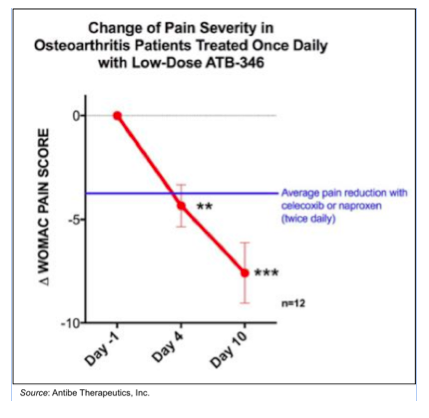
announced the successful completion of a Phase 2 study of ATB-346 in patients with osteoarthritis of the knee. Twelve patients were treated once daily with 250 mg of ATB-346, which is only 1/6th of the typical daily dose of naproxen for treating osteoarthritis. The patients recorded their pain level one day prior to starting treatment and then again on days 4 and 10 of treatment using the WOMAC pain scale. The graph below shows the change in recorded pain level over the 10 days of the study. Previous studies show typical reductions in WOMAC pain scores for osteoarthritis patients taking celecoxib of approximately 4 units following one week of treatment, with no additional improvement beyond that with continued treatment (Wittenberg et al., 2006). Thus, the average reduction of 7.6 units is quite impressive in that study population.
Citagenix UpdateAntibe’s subsidiary, Citagenix, is a leader in Canada in the sales and marketing of tissue regenerative products serving the orthopedic and dental markets. Citagenix was founded in 1997, and since that time it has built up a comprehensive portfolio of high-quality, branded biologics and medical devices to promote bone regeneration. The company is currently active in 15 countries, which includes a direct sales staff in Canada and a network of distributor partnerships outside of Canada.
On Oct. 26, 2017, Antibe
announced a distribution partnership with Darby Dental, a leading dental distributor in the U.S. that has been in business for approximately 70 years. Antibe has made it a top business priority to expand market share in the U.S. and this move should help the company meet that objective.
In addition, the company has instituted a number of key initiatives in support of its global growth strategy, including: 1) marketing, training, and support tools for field representatives; 2) the launch of full e-commerce capabilities; and 3) the launch of a new brand identity. We anticipate these initiatives leading to increased overall performance by the end of fiscal 2018.
Financial UpdateOn November 28, 2017, Antibe
reported financial results for the second quarter of fiscal year 2018 ending September 30, 2017. The company reported revenue of CAD$1.8 million compared to CAD$2.2 million for the three months ended September 30, 2016. The decrease in sales was mostly due to the usual seasonal slowness of the business during the summer months and competitive pressures in Canada.
General and administrative, selling and marketing, research and development, stock-based compensation, and depreciation and amortization expenses totaled CAD$2.4 million for the quarter ending September 30, 2017, compared to CAD$1.8 million for the quarter ending September 30, 2016. The increases in expenses were due to the following:
➢ G&A expenses decreased CAD$0.23 million primarily due to lower professional and consulting fees partially offset by higher salaries and wages.
➢ Selling and marketing expenses increased CAD$0.43 million due to higher salaries and wages, commissions, advertising, and promotion costs.
➢ R&D expenses increased CAD$0.23 million due to higher salaries and wage costs and development costs for the Phase 2b GI safety study.
➢ Stock based compensation increased CAD$0.078 million.
➢ Depreciation and amortization expenses increased by CAD$6,477 primarily due to amortization of Citagenix brand and trademarks.
As of September 30, 2017, Antibe had cash and cash equivalents of CAD$2.6 million with another CAD$0.5 million in restricted cash. We believe the current cash position is sufficient to fund operations into the second quarter of 2018.
On February 22, 2017 the company announced a regional licensing agreement with Laboratories Acbel SA for ATB-346 in Albania, Algeria, Bulgaria, Greece, Jordan, Romania, and Serbia. Acbel is a pharmaceutical company with a strong sales and distribution presence in the Balkan region. As part of the agreement, Antibe was issued an upfront payment of approximately $1.1 million and is entitled to receive a 5% royalty on net sales. Given that the territory licensed represents approximately 1% of the global market for NSAIDs, Acbel is valuing ATB-346 at $110 million, not including the royalty. The company is continuing to engage in discussions with other potential regional partners.
As of Sep. 30, 2017, the company had approximately 163.0 million common shares outstanding along with approximately 21.1 million stock options and approximately 60.2 million warrants. In addition, the company has approximately CAD$3.4 million in convertible debt that can be converted into approximately 15.2 million shares. We estimate the fully diluted share count currently stands at 259.5 million shares.
ValuationWe value Antibe using a probability adjusted discounted cash flow model that takes into account potential future revenues for ATB-346 and Citagenix. For ATB-346, we anticipate that the company will enter into a collaboration with a larger pharmaceutical company before Phase 3 studies commence. For modeling purposes, we are estimating that Phase 3 studies for ATB-346 will begin in 2019, with an NDA filing in 2020 and approval in 2021. We model for approval in the E.U. a year later.
ATB-346 is the main value driver for Antibe as the NSAID market is valued at $8 billion total. We model for approval in OA, however we believe that if the drug is approved it will likely go on to be approved for multiple indications similar to celecoxib. There are approximately 27 million individuals in the U.S. with OA (NIAMS). Of those, we estimate approximately 50% are taking or are open to taking oral NSAIDs. With a conservatively estimated 6% of the market, ATB-346 would have peak sales of $1.0 billion. In the E.U., where there are approximately 40 million patients with OA (WHO), a similar market share could generate close to $1 billion in revenue. Using a 12% royalty rate, an 18% discount rate, and a 50% chance of approval, we estimate the net present value of ATB-346 to be $171 million. When taking into account estimated capital requirements, the current conversion to Canadian Dollars (USD$1 = CAD$1.24), and dividing by the fully diluted share count of 259.5 million shares leads to a valuation of approximately CAD$0.85. Antibe is certainly an interesting story and we encourage investors to get familiar with the company ahead of Phase 2 data readouts in 2018.
READ THE FULL RESEARCH REPORT HERESUBSCRIBE TO ZACKS SMALL CAP RESEARCH to receive our articles and reports emailed directly to you each morning. Please visit our website for additional information on Zacks SCR.
DISCLOSURE: Zacks SCR has received compensation from the issuer directly or from an investor relations consulting firm, engaged by the issuer, for providing research coverage for a period of no less than one year. Research articles, as seen here, are part of the service Zacks provides and Zacks receives quarterly payments totaling a maximum fee of $30,000 annually for these services. Full Disclaimer HERE.