By
Brian Marckx, CFA
NASDAQ:GNMX
Post-Hoc SAGA Analysis Finds Nine Genes Associated With Potent Response To AEVI-001Aevi (NASDAQ:GNMX) management indicated during the March 20th reveal of topline SAGA data, which showed the studies’ primary endpoint (i.e. change from baseline in ADHD-RS-5 score) was not met, that they believed further parsing of the results may offer opportunities to further refine design of the next study in order to improve on efficacy.
As a reminder (and which is explained in further detail below), while SAGA data showed that the primary endpoint was not met, secondary analyses were quite positive. This includes meeting statistical significance on the CGI-I secondary endpoint as well as on the ADHD-RS responder measure (prespecified as decrease of ADHD-RS score of 30% or more). Additionally, the ADHD-RS inattention subscale (i.e. the 9 questions related to inattention), just barely missed statistical significance (p=0.0515). And, importantly, AEVI-001 was deemed to be well tolerated with no associated serious adverse events.
But, given that change from baseline in ADHD-RS score has been FDA’s preferred measuring stick in assessing pivotal ADHD drug studies, SAGA’s failure on the primary endpoint means a study-redesign to better enrich for AEVI-001 responders is necessary. It didn’t take long for GNMX to parse out what appears may be the low-hanging-fruit in that regard.
Post-hoc analysis, presented at the World Congress on ADHD on April 21st, showed that among the 273 genes encompassing the ‘Tier 1’ (76 genes in the mGluR receptors) and ‘Tier 2’ (197 genes that encode proteins that influence mGluR) mGluR network, mutations of which have been found in approximately 22% of children with ADHD, GNMX found nine that were predictive of a clinically meaningful and statistically significant response to AEVI-001.
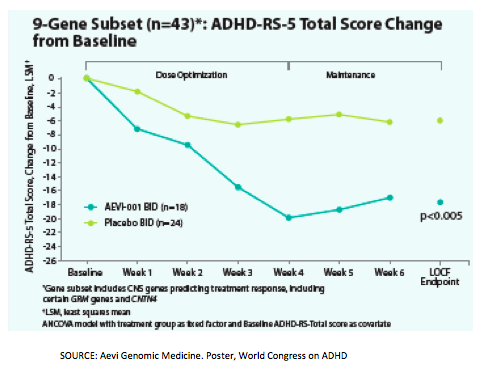
Specifically, patients (n=42: 18 AEVI, 24 placebo) which had copy-number variation (i.e. mutations) to one of nine genes (the identity of only one was revealed) which include “certain glutamate metabotropic receptors (GRM) and neurodevelopmental genes” had a much higher and statistically significant response to AEVI-001 – which included the primary endpoint as well as CGI-I and ‘responder’ secondary measures. These nine genes are believed to be prevalent in approximately 10% of all pediatric ADHD subjects – or about one-half the prevalence with mutations in the entire Tier 2 network.
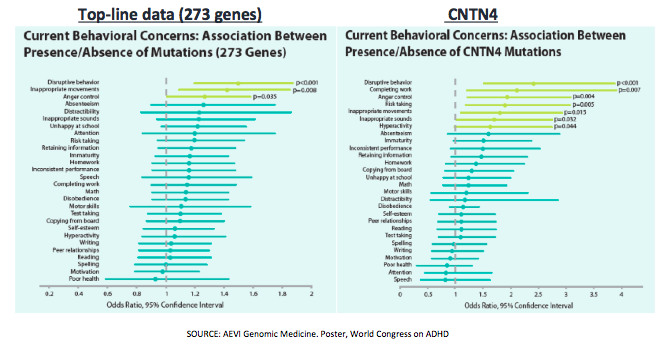
The response appears to be even more robust among those patients (n=18: 6 AEVI, 12 placebo) with mutations to contactin-4 (CNTN4), which has been associated with more severe ADHD due to a higher prevalence of disruptive behavior including inability to control anger as well as inappropriate movements and sounds (graphics below). Given that CNTN4 mutations/deletions, which may also play a role in Autism Spectrum Disorder (ASD), relate to such problematic phenotypes, we think that effectively addressing and treating these patients could be a major breakthrough. Approximately 5% of people with ADHD are believed to carry a CNTN4 mutation.
ADHD-RS:
As a reminder, ADHD-RS (rating scale) is a parent-reported measure consisting 18 questions across two 9-question subscales; inattention and hyperactivity. Each question is scored on a 4-point scale (0=never, 1=rarely, 2=sometimes, 3=often, 4=very often) relative to observance of behaviors. ADHD-RS is a well-established primary endpoint in ADHD clinical trials.
Topline (announced March 20th):
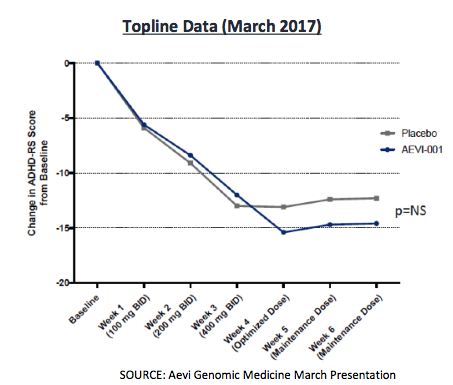
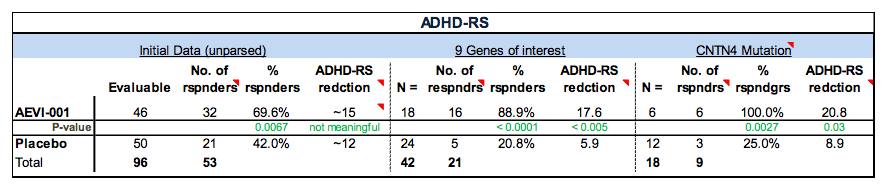
While GNMX did not disclose the specific ADHD-RS data (i.e. % change in each arm or p-value), they did note that absolute change was approximately 15 in the AEVI-001 arm and ~12 in the placebo group, with separation (although not statistically different) between the two exhibited at the highest (i.e. 400mg) dose (graphic below). Also noteworthy, was that 20% of AEVI-001 subjects had no appreciable reduction (i.e. < 3) in ADHD-RS score.
In terms of ADHD-RS response (a key secondary endpoint used in SAGA), 70% of AEVI-001 subjects showed ADHD-RS decrease of 30% or more, compared to 42% of placebo subjects. The difference was highly statistically significant (p=0.0067) at week-6 and also statistically significant at week-5 (p=0.0203). Interestingly, the absolute reduction in ADHD-RS among the 70% of AVEI-001 subjects that responded was over 19 points but was “almost nothing” (per management on the call) among the 30% that did not respond.
GNMX noted on the topline data conference call that their game plan would be to (genetically) identify and weed-out this 30% in a planned pediatric study through further refinement of a biomarker. As we noted at the time, given the huge discrepancy in reduction of ADHD-RS between responders and non-responders, if a biomarker can indeed ‘identify’ and eliminate non-responders, we think successful development of it could be a significant near-term win for GNMX as it could be an initial sign of the likelihood of a follow-on mGluR+ADHD study’s ultimate success. That (i.e. development of a refined biomarker eliminating non-responders), in our opinion, is a pre-study milestone that investors should be closely following.
9 Genes of Interest:
Mutations in one of nine genes, per the updated data presented at the World Congress on ADHD on April 21st , were associated with a relatively much more robust and clinically meaningful and statistically significant response. Specifically, reduction of ADHD-RS (i.e. primary endpoint) among the 18 patients in this cohort (i.e. with a mutation in one of these nine genes) treated with AEVI-001 was 17.6 – compared to just 5.9 among the 24 subjects in this cohort receiving placebo. The difference was highly statistically significant (p < 0.005).
The percentage of responders (i.e. one of two key secondary measures), as measured by the number of patients in each arm that achieved 30% or more reduction in ADHD-RS score from baseline, was also highly statistically significant among the 9-genes subset and also improved as compared to the unparsed data (i.e. topline results incorporating data from all study participants). 16 of 18 patients, or 89%, treated with AEVI-001 among this 9-gene subset met the 30%+ responder endpoint – compared to just 5 of the 24, or 21%, of those patients receiving placebo (p < 0.0001).
CNTN4:
The data at the World Congress on ADHD was even more compelling when looking at just the CNTN4 gene. CNTN4 encodes a member of the immunoglobin family. It is a glycosylphosphatidylinositol-anchored neuronal membrane protein that is believed to play a role in the formation of axon connections in the developing nervous system. As noted, it has also been implicated in playing a role in ASD.
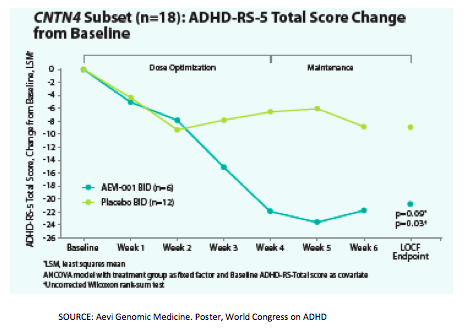
Reduction of ADHD-RS (i.e. primary endpoint) among the 6 patients in this subset (i.e. CNTN4 CNV) treated with AEVI-001 was 20.8 – compared to 8.9 among the 12 patients receiving placebo. Despite the relatively small sample size, the difference was statistically significant (p = 0.03).
The percentage of responders (i.e. one of two key secondary measures), as measured by the number of patients in each arm that achieved 30% or more reduction in ADHD-RS score from baseline, was also highly statistically significant among this CNTN4 gene subset and also improved as compared to the unparsed data (i.e. topline results incorporating data from all study participants). 6 of 6 patients, or 100%, treated with AEVI-001 among this CNTN4 subset met the 30%+ responder endpoint – compared to just 3 of the 12 patients, or 25%, receiving placebo (p = 0.0027).
CGI-I:
As a reminder, CGI-I (Clinical Global Impressions) was another key secondary measure used in SAGA. It is a clinician-scored measure which uses a 7-point scale (1=very much improved…, 7=very much worse) to assess how much a patient’s condition improved or worsened (or stayed the same). Treatment response in SAGA was prespecified as CGI-I of 1 (very much improved) or 2 (much improved).
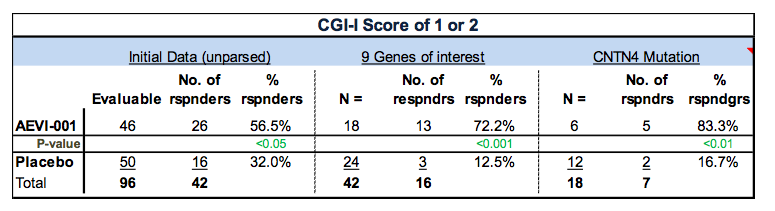
The updated data (i.e. 9-genes including CNTN4) on the CGI-I measure were similar to that for both the ADHD-RS measures – that is, reaching statistical significance and improving relative to the unparsed topline data announced in March. Additionally, response was further improved when parsed to only those patients with CNTN4 mutations.
9 Genes of Interest:
13 of 18 patients, or 72%, treated with AEVI-001 among the 9-gene subset achieved a CGI-I score of 1 or 2, compared to 3 of 24 patients, or 13%, receiving placebo (p < 0.001).
CNTN4:
5 of 6 patients, or 83%, treated with AEVI-001 among the CNTN4 subset achieved a CGI-I score of 1 or 2, compared to 2 of 12 patients, or 17%, receiving placebo (p < 0.01).
Our Comments:
As we noted following release of the SAGA topline data in March, while it was disappointing that the primary endpoint was not met, there were reasons to remain optimistic. This includes meeting statistical significance on the CGI-I secondary endpoint as well as on the ADHD-RS responder measure. Additionally, the ADHD-RS inattention subscale, just barely missed statistical significance (p=0.0515). And, importantly, AEVI-001 was deemed to be well tolerated with no associated serious adverse events.
So while the primary endpoint was not met, we think there was a clear signal of efficacy of AEVI-001 based on the supplementary measures. This combined with a lack of serious safety issues is expected to bolster GNMX’s anticipated petition to FDA to conduct another mGluR+AHDH study – management outlined their plans on the SAGA call which includes several updates to the trial design, all of which are aimed at improving upon efficacy and meeting the ADHD-RS primary endpoint.
Part of the redesign includes refining the biomarker to improve response to AEVI-001. This more recent updated data related to nine specific genes, including CNTN4, that have been subsequently identified as particularly sensitive responders, clearly represent at least one major step towards further refining and enriching the next mGluR+ADHD trial for improved response to AEVI-001.
And while such a redesign could reduce the potential target ADHD population of AEVI-001 from the initial ~20% down to 5% or 10%, this still represents a U.S. pediatric/adolescent ADHD population of ~300k – 600k - a potential market opportunity which we calculate to be ~$600M - $1.2B. And critically, the CNTN4-mutation positive ADHD population are generally associated with the most severe disruptive behaviors and may be among the most challenging to effectively treat with traditional ADHD drugs such as stimulants.
As such, further validation of AEVI-001 in this subset of ADHD patients could eventually provide it with a very receptive market and one with little direct competition – the benefits of which would mean not having to fight for ‘space’ among the traditional ADHD drugs (backed by substantial marketing resources) nor worry about pricing pressure from related off-patent generics. Additionally, targeting (genetically identified) subset patient populations affords the benefit of lean marketing budgets. And, finally, it is important to note that severity of disease among the general pediatric/adolescent ADHD population ranges from relatively mild (including those exhibiting more attention-deficit than hyperactivity) to quite severe (marked by greater hyperactivity) – (parents of) the more extreme cases are likely to be particularly receptive to trying novel therapies, such as AEVI-001 – which, these nine-gene and CNTN4 subsets, suggest may be effective for these particularly severe cases.
See below for free access to our updated report on GNMX.
READ THE FULL RESEARCH REPORT HERE
SUBSCRIBE TO ZACKS SMALL CAP RESEARCH to receive our articles and reports emailed directly to you each morning. Please visit our website for additional information on Zacks SCR and to view our disclaimer.