By
David Bautz, PhD
NASDAQ:OPNT
Financial UpdateOn December 13, 2017, Opiant Pharmaceuticals, Inc. (NASDAQ:OPNT) announced financial results for the first quarter of fiscal year (FY) 2018 that ended Oct. 31, 2017. During the 1QFY18, Opiant generated revenue of approximately $22,000, compared to approximately $1.1 million during the corresponding period in FY2017. General and administrative expenses were approximately $4.0 million for the 1QFY18, compared to approximately $1.2 million for the 1QFY17. The increase in expenses was primarily due to increased severance payments, stock based compensation, and salaries. Research and development expenses were approximately $1.6 million for the 1QFY18, compared to approximately $0.4 million in 1QFY17. The increase was primarily due to increased third party expenses and stock based compensation. The company recorded no selling expenses in 1QFY18, compared with approximately $42,000 for the 1QFY17, as there was no revenue recognized related to the sale of NARCAN® Nasal Spray.
Net loss for 1QFY18 was $5.6 million, or $2.77 per share, compared with a net loss of $0.6 million, or $0.30 per share, in 1QFY17. As of Oct. 31, 2017, Opiant had approximately $5.9 million in cash and cash equivalents, which we anticipate is sufficient to fund operations for at least the next 12 months. As of Dec. 1, 2017, the company had approximately 2.1 million shares of common stock outstanding, and when factoring in stock options and warrants a fully diluted share count of approximately 5.6 million. Opiant recently announced that the Board of Directors has approved a resolution changing the company’s fiscal year-end from July 31 to December 31. Opiant will file a 10-K for the transition period ending Dec. 31, 2017.
Business UpdateOpiant is a specialty pharmaceutical company developing treatments for substance use, eating disorders, and addiction disorders based on the company’s expertise in opioid receptor antagonists. Opiant currently has one FDA approved drug, NARCAN® Nasal Spray, which is marketed by Adapt Pharmaceuticals through an exclusive collaboration.
Recent News on Opioid Crisis Pertaining to NARCAN® Nasal SprayThe U.S. continues to battle an opioid crisis nationwide. In 2015 (which is the latest figures that the Centers for Disease Control has published), nearly 13,000 people died from heroin overdose, which represented approximately 25% of all overdose deaths, up from 8% in 2010 (CDC). A number of recent news items related to the opioid crisis have come out that directly relate to NARCAN® Nasal Spray:
1) The state of Pennsylvania ordered $5 million worth of NARCAN® Nasal Spray (for a total of 120,000 doses) to equip all first responders in the state. More than 4,600 people died of drug overdoses in Pennsylvania in 2016, which was up 37% from the previous year. The increase was largely due to fentanyl, a powerful synthetic opioid that is sometimes mixed with heroin to increase its potency.
2) Walgreen’s (WAG) announced that it would stock NARCAN® Nasal Spray in all of its 8,000+ pharmacies nationwide, and is adopting CDC recommendations on educating patients about NARCAN® when they are dispensed a controlled substance >50 morphine mg equivalents.
3) Beginning January 1, 2018, Aetna will waive the co-pay for NARCAN® Nasal Spray. In addition, it will cap the supply of opioids prescribed for acute pain, or after surgery, to seven days.
All of these announcements are positive for Opiant and the potential for NARCAN® Nasal Spray. We will continue to follow the ongoing opioid crisis and any additional news pertinent to Opiant, and we believe these announcements lend support to our estimate of royalty rights for NARCAN® Nasal Spray reverting back to Opiant by the end of 2018, as discussed in our previous report.
Clinical Trial of OPNT001 in Bulimia Nervosa On March 20, 2017, Opiant announced the initiation of a Phase 2 clinical trial evaluating OPNT001, a novel nasally-delivered opioid antagonist, in bulimia nervosa (BN). BN is a serious and potentially life-threatening eating disorder characterized by a cycle of binge eating and purging. BN affects approximately 1-2% of the adult population with 80% of those affected being female. Complications of BN include dehydration, heart problems, severe tooth decay and gum disease, anxiety and depression, and increased risk of suicide.
The only pharmacological agent approved to treat BN is fluoxetine (Prozac®). Two multicenter, double blind, placebo controlled randomized clinical trials of fluoxetine found that a 60 mg dose resulted in a statistically significant reduction in binge eating and vomiting episodes compared to placebo regardless of whether a patient was also suffering from depression, while a 20 mg dose of fluoxetine was only effective in those that did not also have depression (Goldstein et al., 1999). While effective, fluoxetine has a number of potential adverse side effects including increased suicidal thoughts, sleep problems, headache, dizziness, and gastrointestinal issues.
The randomized, double blind, placebo controlled Phase 2 clinical trial of OPNT001 is expected to enroll up to 80 patients in the United Kingdom who have been diagnosed with BN. The study will evaluate OPNT001’s safety and tolerability as well as its impact on various clinical outcomes, including change in eating behavior. We anticipate enrollment to be completed during the first half of 2018 and results in the third quarter of 2018.
OPNT002 in Alcohol Use DisorderEarlier in 2017, Opiant announced that the U.S. Food and Drug Administration (FDA) gave supportive feedback from a Type B meeting in regards to the proposed development plan for OPNT002, an intranasally (IN) administered opioid antagonist, for the treatment of Alcohol Use Disorder (AUD).
The SAMHSA 2015 National Survey on Drug Use and Health reported approximately 17.3 million people in the U.S. with alcohol dependence or abuse. There are three FDA approved medicines to treat alcohol dependence including Antabuse®, Vivitrol®, and Campral®. However, there is still a pressing need for a safe and effective treatment for alcohol addiction as the FDA approved compounds have limited efficacy (Witkiewitz et al., 2012).
In July 2017, Opiant announced results from a Phase 1 study of OPNT002, which examined the effects of Intravail® on the pharmacokinetic properties of IN naltrexone in healthy volunteers. A total of 14 men and women between the ages of 18 to 55 participated in the study. Each subject received four naltrexone treatments.
Results from the study showed that Intravail® both increased the maximal plasma concentration (Cmax) of IN naltrexone and decreased the time to reach Cmax from 30 minutes to 10 minutes. The median time to reach Cmax following administration of IN naltrexone with Intravail® was also more rapid than an intramuscular (IM) injection of naltrexone. Oral administration of 50 mg of naltrexone resulted in a slower time to reach Cmax than either IN or IM administration. Importantly, the results with IN naltrexone seen without any identified safety or tolerability issues. There was also no evidence of nasal irritation.
To follow up on these results, Opiant signed a contract manufacturing agreement with Renaissance to develop an IN naltrexone formulation for Phase 2 studies. The company has previously worked with Renaissance for commercial manufacturing of NARCAN® Nasal Spray. We anticipate learning more details about the Phase 2 trial as the company gets closer to initiating it later in 2018.
Preclinical Results Published for OPNT005On December 18, 2017, Opiant announced the publication of preclinical results for the company’s heroin vaccine (OPNT005), which was licensed from the National Institute on Drug Abuse in 2016 (Sulima et al., 2017). The results describe the synthesis of a haptogenic heroin surrogate (shown in the figure below) that was used to immunize rodents.
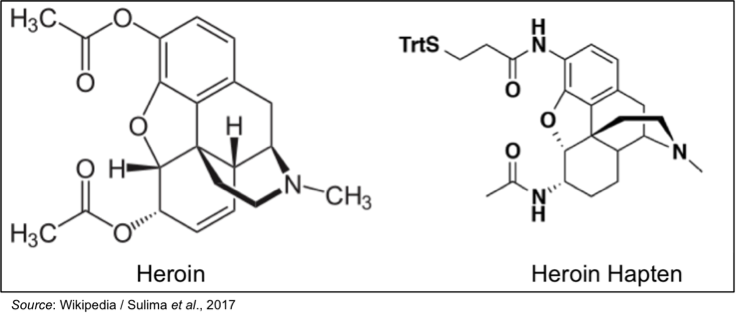
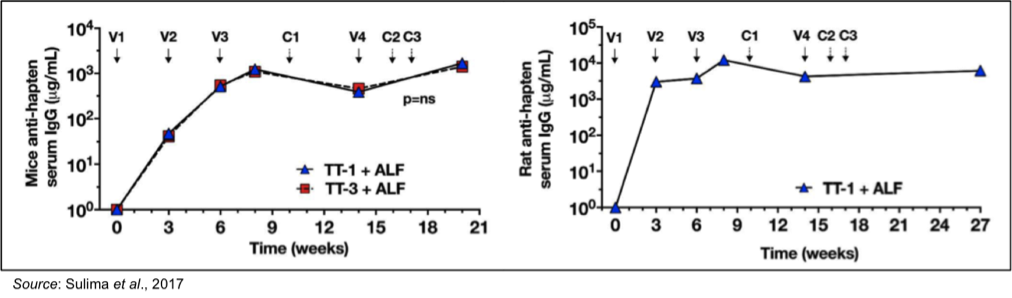
The hapten was conjugated to tetanus toxoid (TT) and administered with Army Liposome Formulation (ALF) as an adjuvant. Two different conjugations were performed and are denoted as TT-1 and TT-3. Following immunization, the rodents developed a high titer of anti-hapten IgG antibodies that reduced the physiologic effects of repeated subcutaneous administrations of heroin. The following graphs show that both mice and rats developed similar levels of anti-hapten antibodies that persisted following four total immunizations (indicated by V1-V4). C1-3 denote when the mice were challenged with heroin.
The following figure shows the results of administering heroin both subcutaneously (SC) and intravenously (IV) to control mice as well as those administered haptens TT-1 or TT-3. The top panel shows a statistically significant decrease in heroin-induced antinociception in the tail flick assay for mice administered TT-1 or TT-3, while the bottom panel shows a statistically significant decrease in heroin-induced hyperlocomotion as judged by the total distance moved.
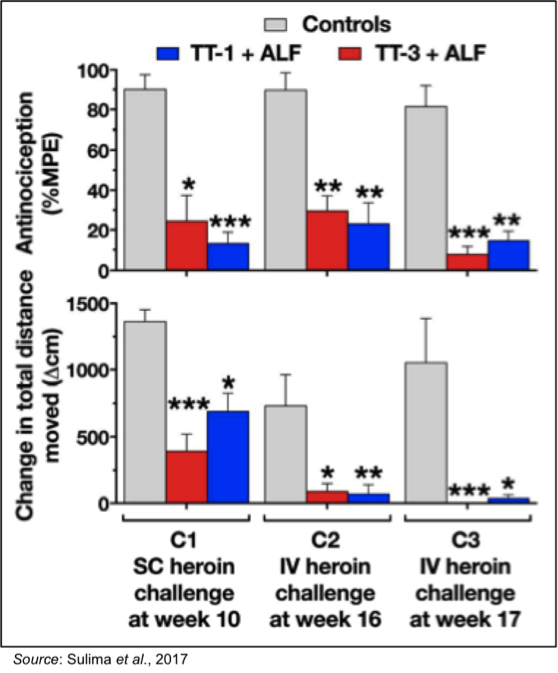
These results are encouraging as they show the development of a high titer of antibodies along with protection from heroin challenges. The antibodies were shown to cross-react with heroin as well as its metabolites (6-AM, morphine, and M-6G) while not showing reactivity to drugs that are used for opioid abuse therapy (methadone, buprenorphine, naloxone, and naltrexone). We look forward to learning more about a clinical program for the anti-heroin vaccine in the near future.
ValuationWe continue to believe that peak sales of approximately $250 million are possible for NARCAN® Nasal Spray. We estimate that Opiant will begin receiving 90% of royalties on NARCAN® Nasal Spray in 2019, and that the company will also receive $15 million milestone payments in 2019 and in 2021 based on sales of >$100 million and >$200 million, respectively. The company has patent protection through 2035, although there are litigation proceedings occurring now that may result in a generic version of NARCAN® Nasal Spray entering the market before then, depending on the outcome of those cases. Using a 12% discount rate gives a net present value for NARCAN® Nasal Spray of approximately $197 million.
In addition to NARCAN® Nasal Spray, Opiant has a development pipeline of nasally administered opioid antagonists for treating bulimia nervosa (BN), binge eating disorder (BED), and alcohol use disorder (AUD). The company is expected to report results from a Phase 2 study of OPNT001 in 80 patients with BN in the third quarter of 2018.
For BN, our estimates are for an NDA in 2021 and approval in 2022. There are approximately 3.3 million Americans who suffer from BN and we believe approximately 1/3rd of these individuals seek treatment. Based on a conservative 10% market share we model for potential peak revenues of approximately $300 million. We assign a 12% discount rate and a 50% probability of approval to arrive at a net present value for the BN program of $22 million.
For BED, we model for an NDA filing in 2021 and approval in 2022. We estimate there are approximately eight million individuals who suffer from BED in the U.S. and that 45% of them will seek treatment for their condition leading to peak sales of approximately $150 million. We assign a 12% discount rate and a 50% probability of approval to arrive at a net present value for the BED program of $16 million.
For AUD, we anticipate a clinical trial initiating in late 2018 and we model for an NDA filing in 2022 and approval in 2023. We estimate potential peak revenues of approximately $300 million. We assign a 12% discount rate and a 50% probability of approval to arrive at a net present value for the AUD program of $24 million.
Combining the net present value for each of the company’s programs along with the current cash total and the potential cash brought in from exercise of warrants leads to a value of $268 million for the company. Dividing by the fully diluted share count of 5.6 million (2.1 million common shares + 2.8 million options + 0.7 million exercisable warrants
READ THE FULL RESEARCH REPORT HERESUBSCRIBE TO ZACKS SMALL CAP RESEARCH to receive our articles and reports emailed directly to you each morning. Please visit our website for additional information on Zacks SCR.
DISCLOSURE: Zacks SCR has received compensation from the issuer directly or from an investor relations consulting firm, engaged by the issuer, for providing research coverage for a period of no less than one year. Research articles, as seen here, are part of the service Zacks provides and Zacks receives quarterly payments totaling a maximum fee of $30,000 annually for these services. Full Disclaimer HERE.