By Steven Ralston, CFA
TSX:WML.V
OTC:WMLLF
Summary of Recent Exploratory and Testing Programs
• Laboratory test work on a 50-liter surface brine sample confirms that the TAT (Tenova Advanced Technologies) can be successfully applied to Laguna Verde surface brines
o The sample was estimated to contain approximately 220 mg/l of lithium
o TAT’s proprietary solvent extraction process (LiSX™) succeeded in producing a lithium sulfate solution with purity of 99.9%.
• Additional geophysical survey results from Laguna Verde Project are revealed
o Area defined for shallow lithium brine drill targets
o Drilling has already commenced at Laguna Verde
• Geophysical surveys have been completed at Atacama and Trinity
o Results from Atacama have provided many near-surface and deeper drill targets
• Drilling planned for first quarter of 2018
o Results from Trinity are expected very soon
Process Work at Laguna Verde Project
Tenova Advanced Technologies (TAT) has completed process test work on samples collected at the Laguna Verde project. On November 17, 2017, Wealth Minerals announced that the test work confirmed that the TAT Process can be successfully applied to Laguna Verde surface brines.
The laboratory test work on a
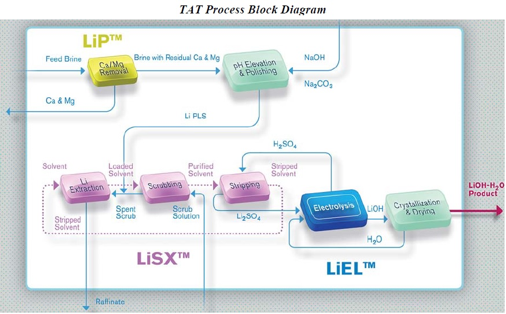
50-liter surface brine sample from Laguna Verde demonstrated that both TAT processes of LiP™ and LiSX™ can be utilized to successfully extract lithium. The sample was analyzed and estimated to contain
approximately 220 mg/l of lithium. In order to remove calcium and magnesium contaminants, the sample was pretreated by the LiP™ process, through which approximately 88% of the calcium and 97% of the magnesium were removed in a two-pass membrane filtering regimen. Test work for the recovery of lithium sulfate (Li₂SO₄) through TAT’s LiSX™ (proprietary solvent extraction)
process succeeded in producing a lithium sulfate solution with purity of 99.9%. In addition, a
100% recovery rate is assumed since analysis of the waste stream did not detect the presence of lithium at a 3 mg/l detection limit.
In due course, management expects to initiate a Stage II order of magnitude cost estimate study for the purpose of estimating the capital expenditures and operating expenses required to annually produce 20,000 tons of LCE (lithium carbonate equivalent or LiOH·H₂O) from Laguna Verde.
In addition to the known surface brines at Laguna Verde, there is
considerable potential for the discovery of subsurface brines. Management plans to drill subsurface brine targets that are indicated from anomalies detected in the recently completed geophysical surveys.
On December 8, 2017, Wealth Minerals (TSX:WML.V) (OTC:WMLLF) announced that the company is
transitioning from a focus on acquisitions to one on development, initially at the Laguna Verde, Atacama and Trinity projects.
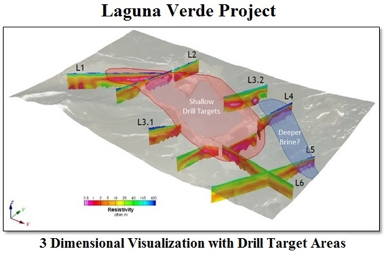
Geophysical Results at Laguna Verde ProjectGeophysical data defined an area for shallow lithium brine drill targets approximately 200-to-300 meters below surface (the transparent red area in the figure below). Groundwater / brine samples will be collected at 50-meter intervals and later analyzed for lithium content.
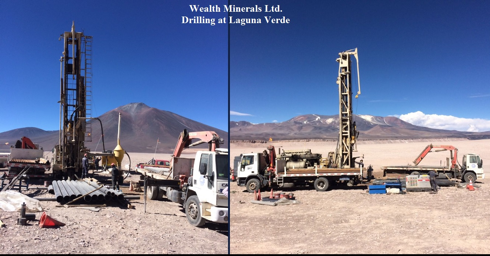
Drilling at Laguna Verde Project
Drilling has commenced at Laguna Verde. Targets were determined by analyzing the results of the Transient Electromagnetic (TEM) and gravity geophysical surveys completed earlier this year.
Initial Geophysical Results at the Atacama ProjectHaving started in October 2017,
geophysical surveys have been completed at Atacama and Trinity. While management expects to receive the results on the Trinity Project soon, on December 14, 2017, Wealth Minerals announced it has received
positive geophysical results for the Atacama Lithium Brine Project. The Magneto-Telluric (MT) and Transient Electromagnetic (TEM) surveys conducted by Southernrock Geophysics S.A. have identified very highly conductive (very low resistivity) zones, which are being interpreted as representing porous media with high-salinity fluids (and potentially lithium-bearing brines).
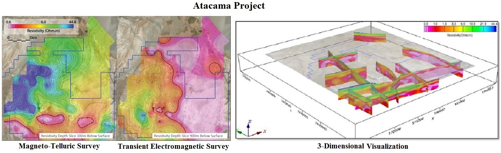
The surveys consisted of 141 MT and coincident loop TEM sites. In addition to the resistivity imaging, 1D inversion model data (presented as depth slices) were used to generate a 3D visualization in order to interpret the resistivity structure at depth.
The geophysical surveys provide many near-surface and deeper drill targets.
Initial drill testing of shallow targets in the southwest (to a depth of between 100 and 150 meters)
is being planned for the first quarter of 2018.
Wealth MineralsManagement has recognized the increasing interest in lithium brines located with the Lithium Triangle, especially Chile. Rising prices of the lithium compounds, especially lithium carbonate, appeared to be forerunner of an expected potential future supply shortage of high-grade lithium to feed the demand being generated by Electric Vehicle (EV) manufacturers and builders of battery gigafactories. The company’s business plan is comprised of acquiring greenfield lithium concessions, advancing the properties through exploratory studies (brine sampling, geophysics and drilling) to an extent that they appear technically feasibility and economically viable and then developing these properties into revenue generating operations.
Management is positioning the company to benefit from the upcoming expected growth of demand in the lithium space and continues to seek the acquisition of additional interests in prospective concessions.
READ THE FULL RESEARCH REPORT HERESUBSCRIBE TO ZACKS SMALL CAP RESEARCH to receive our articles and reports emailed directly to you each morning. Please visit our website for additional information on Zacks SCR.
DISCLOSURE: Zacks SCR has received compensation from the issuer directly or from an investor relations consulting firm, engaged by the issuer, for providing research coverage for a period of no less than one year. Research articles, as seen here, are part of the service Zacks provides and Zacks receives quarterly payments totaling a maximum fee of $30,000 annually for these services. Full Disclaimer HERE.