By
David Bautz, PhD
NASDAQ:TNXP
READ THE FULL TNXP RESEARCH REPORT
Business Update
New Phase 3 Trial for TNX-102 SL to Initiate in 1Q19
On October 31, 2018, Tonix Pharmaceuticals Holding Corp. (NASDAQ:TNXP)
announced that the company will be initiating a new Phase 3 trial for TNX-102 SL in posttraumatic stress disorder (PTSD) in the first quarter of 2019. The trial will incorporate several important changes in comparison to the Phase 3 HONOR study, including:
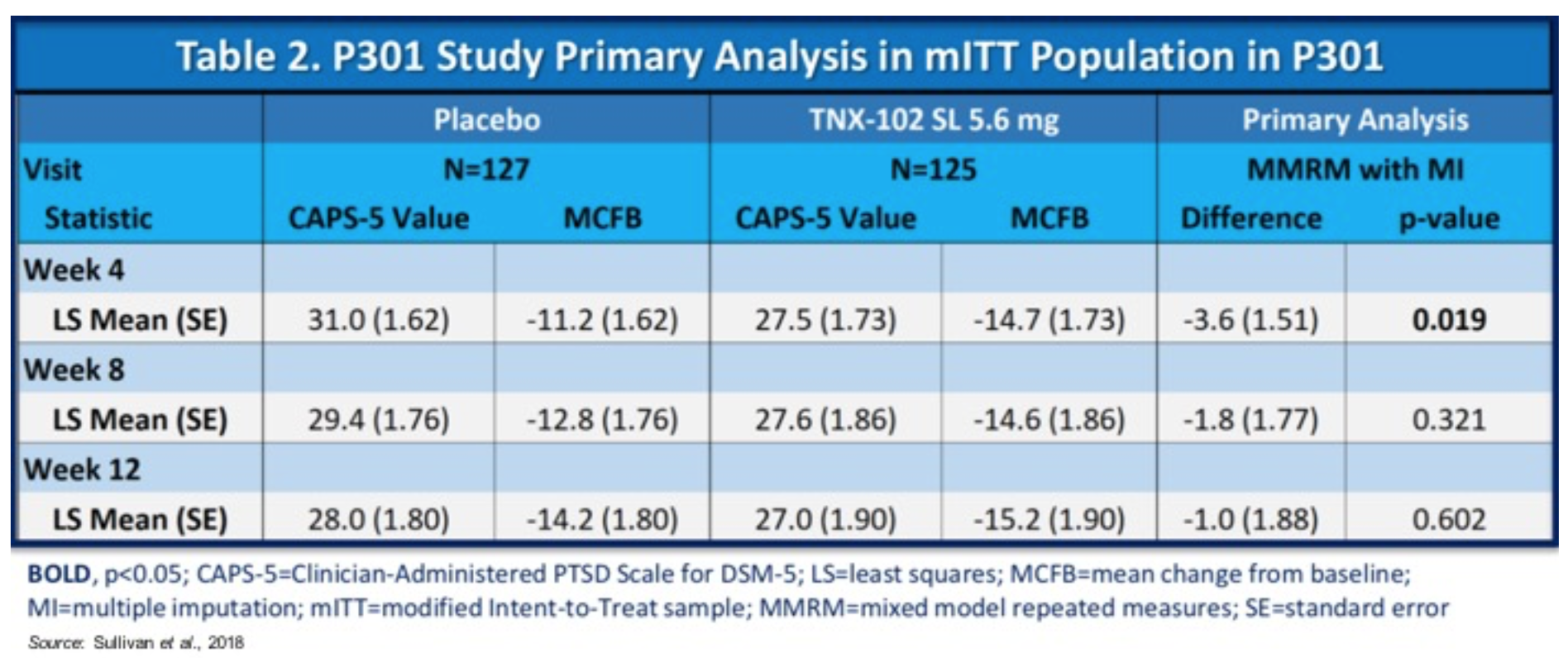
1) The primary endpoint will be the change from baseline in CAPS-5 score at 4 weeks. The primary outcome of the HONOR study was the change from baseline in CAPS-5 score at 12 weeks. The HONOR study was stopped early due to lack of separation between treated and control subjects at 12 weeks, however there was a clinically meaningful separation at 4 weeks (P=0.019).
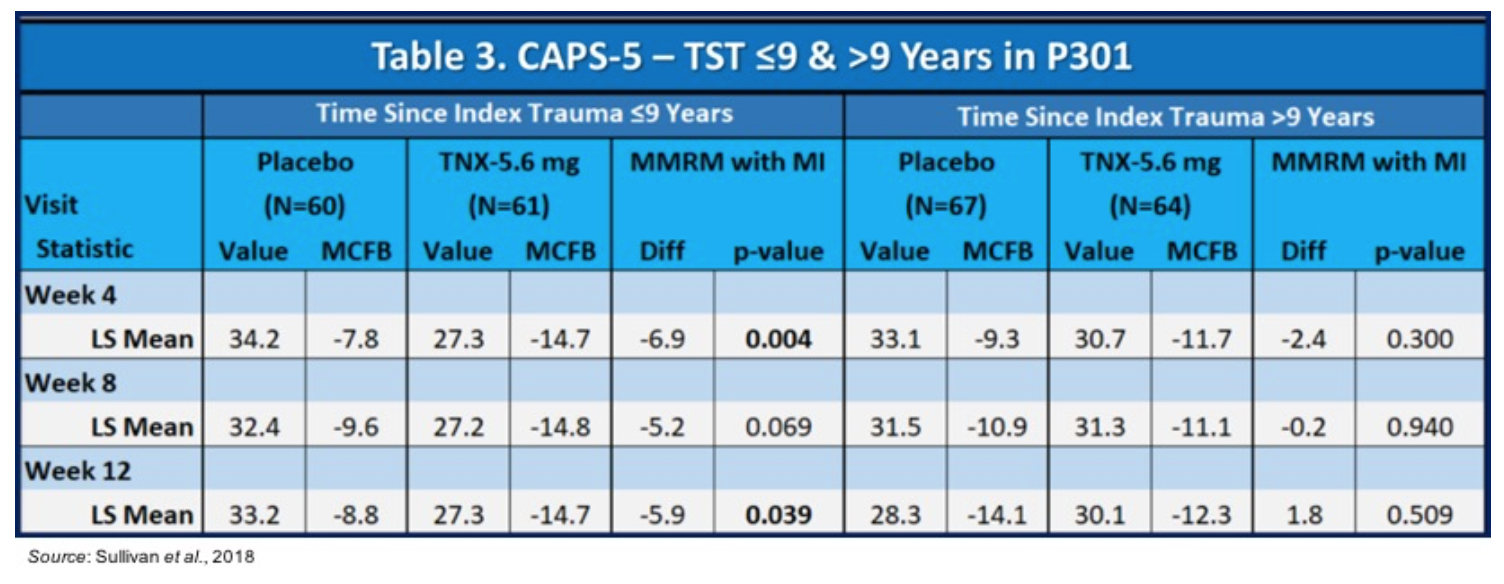
2) Inclusion will be limited to individuals with PTSD who experienced their trauma within the past nine years, while the HONOR study included individuals who experienced a trauma from 2001 or later. A retrospective analysis showed a treatment effect in those patients, while no treatment effect was seen in patients who were > nine years removed from their trauma.
3) The study will include both civilian and military PTSD patients, while the HONOR study had limited inclusion to only those with military-related PTSD.
The new trial was designed based on input the company received from the U.S. FDA following a Breakthrough Therapy Type B clinical meeting with the agency. It will be a randomized, double blind, placebo controlled study of TNX-102 SL over 12 weeks with the primary endpoint being the Week 4 mean change in CAPS-5 score from baseline between TNX-102 SL and placebo-treated patients. The Week 12 mean change in CAPS-5 score will be a key secondary endpoint.
Analysis of Time Since Trauma in HONOR Study
On Nov. 6, 2018, Tonix
announced the presentation of a poster reporting a retrospective analysis of the Phase 3 HONOR study that showed a clinically meaningful response to treatment in those that were nine years or fewer removed from their trauma, including non-combat-related traumas, as well as in female participants overall.
The interim results from the study are shown in the following table. As can be seen, there was a statistically significant difference in the CAPS-5 score at Week 4 between the placebo group and the TNX-102 SL group (P = 0.019). However, this effect was not seen at either Week 8 or Week 12, owing mostly to the continued decrease in CAPS-5 for the placebo group and virtually no change in CAPS-5 for the TNX-102 SL group from Week 4 to Week 12.
 View Exhibit I
The following table shows the change in CAPS-5 score for participants that is divided by whether their trauma occurred more or less than nine years ago. The data shows that there was a clinically meaningful result for participants who experienced a trauma less than or equal to nine years ago at four (P=0.004) and 12 weeks (P=0.039). There was no clinically meaningful separation between TNX-102 SL and placebo-treated patients for those who experienced a trauma greater than nine years ago.
 View Exhibit II
We’ve heard from some investors that were confused by the fact that the LS means for the ≤9 years and >9 years subgroups do not equal the LS means for the mITT group (for example, at week 4 the LS Mean for the placebo ≤9 years subgroup is 34.2, for the >9 years subgroup it is 33.1, but for the mITT group it is 31.0). The reason for this is these are least squares (LS) means rather than raw means and they depend on both the covariates and the MMRM model with the multiple imputation method. That statistical method relies on imputations to account for missing data and covariate effects, which are estimated separately and adjusted to the means for each subgroup. What is shown in the preceding tables is based upon using statistical models with covariates that are recalculated for each subgroup. It would not be expected that the LS Means for the two subgroups would average out to the group as a whole based on the different estimates of covariate effects for each group. Tonix did not show the simple means for each group because that was not the data analysis plan for the primary outcome measure that had been agreed upon with the FDA.
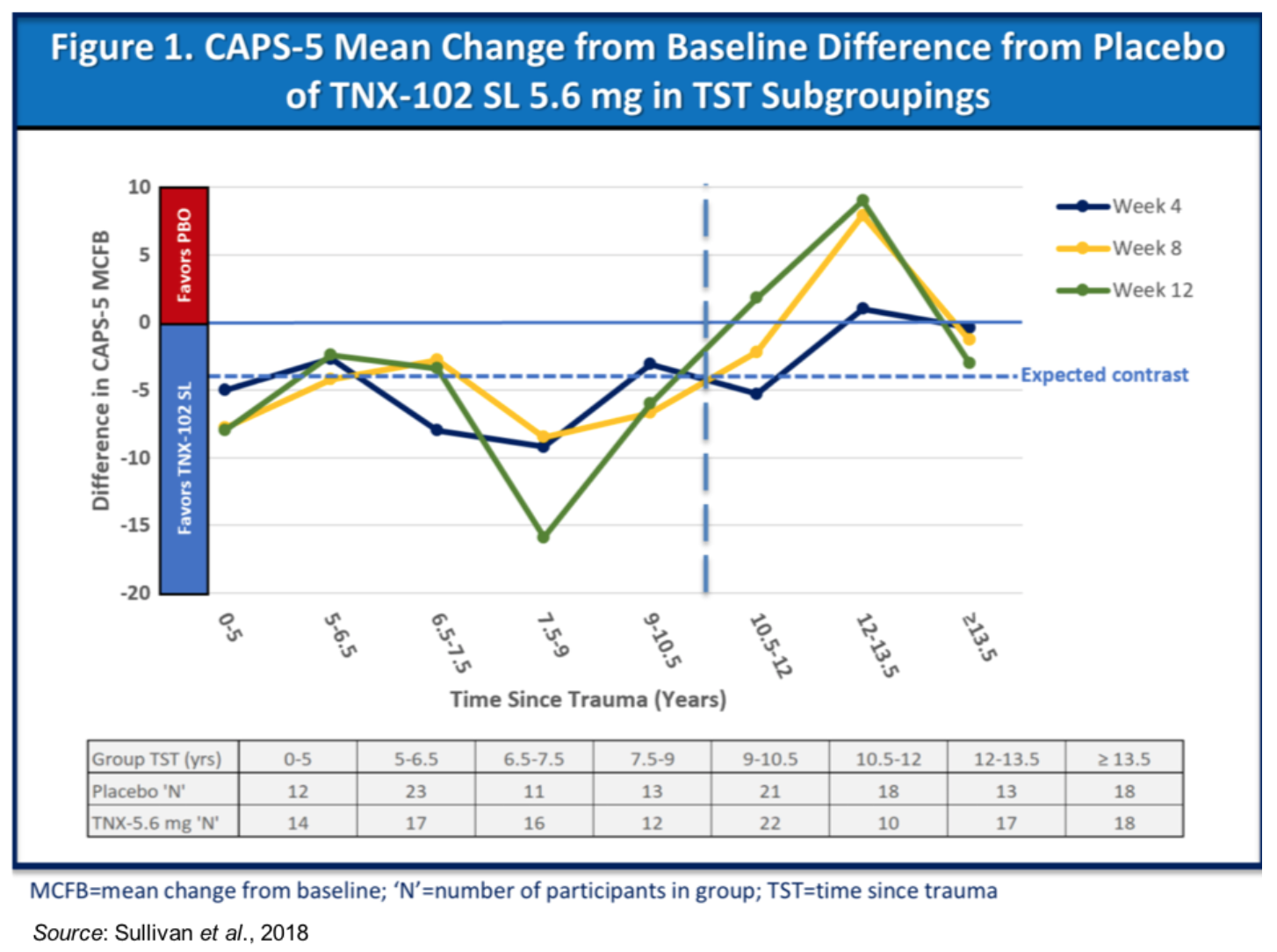
The following figure represents another way to look at the data, in which patients were divided into cohorts based on their time since trauma (TST). What is clear from that graph is that for all cohorts of patients who experienced their trauma less than 10.5 years ago there is a clear effect that favors treatment with TNX-102 SL. In contrast, for those who are >10.5 years removed from their trauma there is little separation between placebo and TNX-102 SL or the effect favored the placebo. The dashed line (“expected contrast”) indicates the observed effect from the Phase 2 AtEase trial.
 View Exhibit III
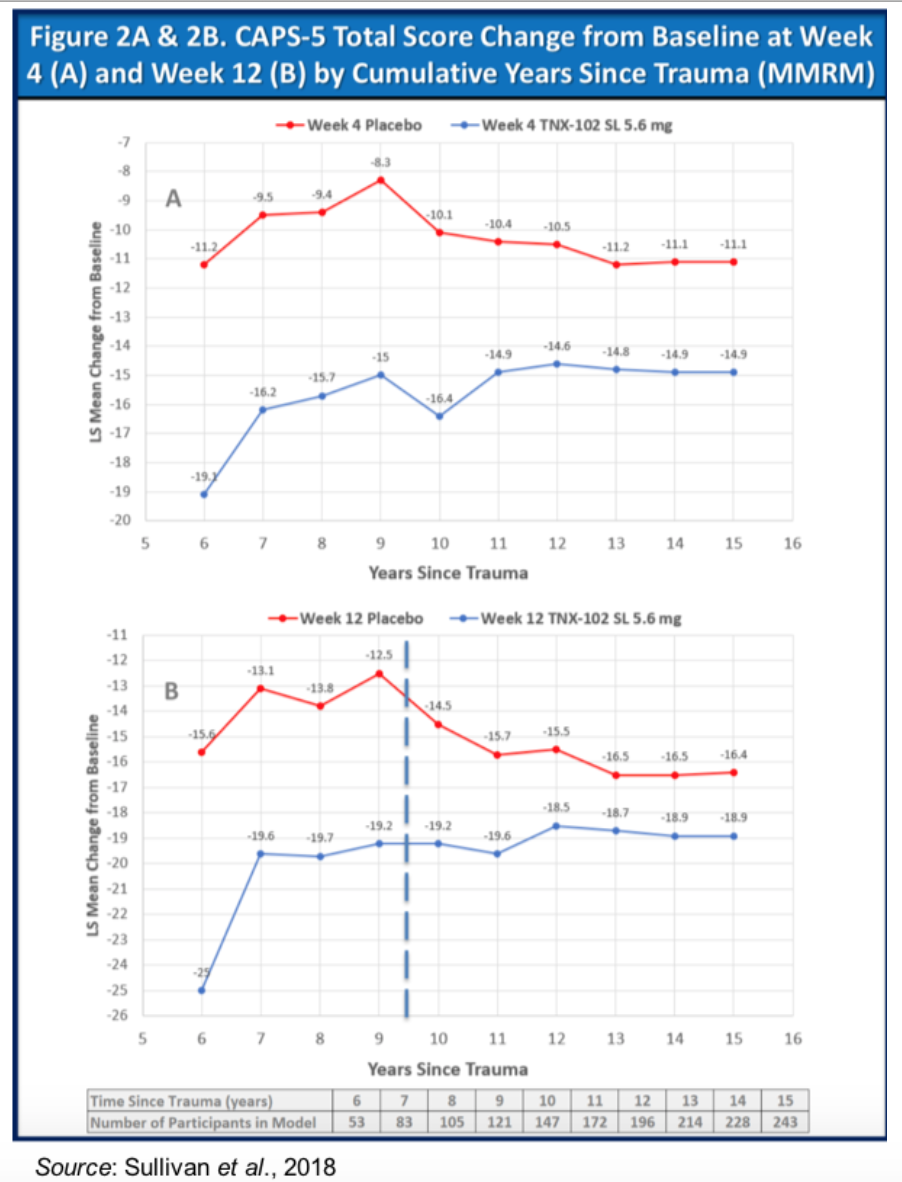
Tonix also presented the data as a function of cumulative years since trauma within each time range beginning with ≤6 years through ≤15 years. The following figures shows this for both Week 4 (top graph) and Week 12 (bottom graph). The table below the figures show the total number of cumulative participants for each TST. At Week 4 there was a very strong effect for TNX-102 SL for all subjects ≤6 years TST and with the addition of participants there remains a clear separation between placebo and TNX-102 SL treated subjects. In contrast, at Week 12 there is a clear separation between placebo and TNX-102 SL treated patients for those ≤9 years TST, however with the addition of participants >9 years TST there is an increasing response to placebo.
 View Exhibit IV
The company examined a number of secondary endpoints in the HONOR trial, which are shown in the following table. The data is presented for all participants as well as for those that were ≤9 years TST. For the TST ≤9 years subgroup, all of the secondary endpoints showed a P value <0.05 at Week 12.
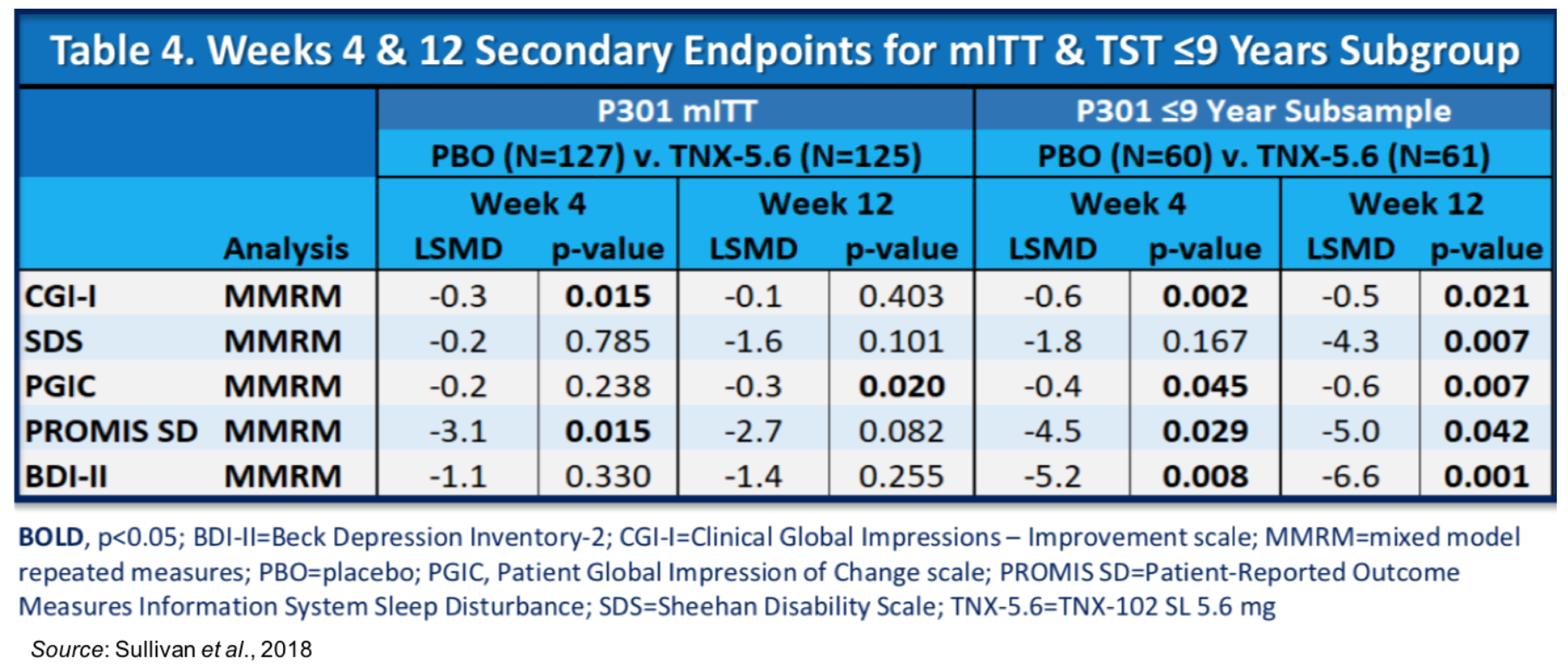 View Exhibit V
One of the more interesting findings among the secondary endpoints is for the Sheehan Disability Score (SDS) for subjects ≤9 years TST at Week 12 in which there was a 4.3 point difference between the TNX-102 SL and placebo treated groups. This is a very large difference, particularly when compared to what was seen in other PTSD clinical trials. For example, in a study of paroxetine in patients with chronic PTSD, there was a 2.5 point difference between the placebo and paroxetine groups (
Marshall et al., 2001), and in a study of venlafaxine ER in patients with PTSD there was a 2 point different between the placebo and venlafaxine ER groups (
Davidson et al., 2006). In light of those examples, the 4.3 point difference seen in the HONOR study is a very compelling finding.
Lastly, the company examined the treatment response for females and non-combat subgroups in the HONOR trial. The following table shows that for both females overall and for non-combat trauma experienced within 9 years of screening, there was a trend toward clinically-meaningful reductions in the CAPS-5 for TNX-102 SL treated subjects compared to those treated with placebo. The number of individuals in each of those subgroups was small, thus not amenable to statistical analysis, but the fact that there was a greater decrease in CAPS-5 for TNX-102 SL treated subjects in these subgroups is encouraging given that the next Phase 3 trial will include civilians with PTSD (a majority of which are expected to be female).
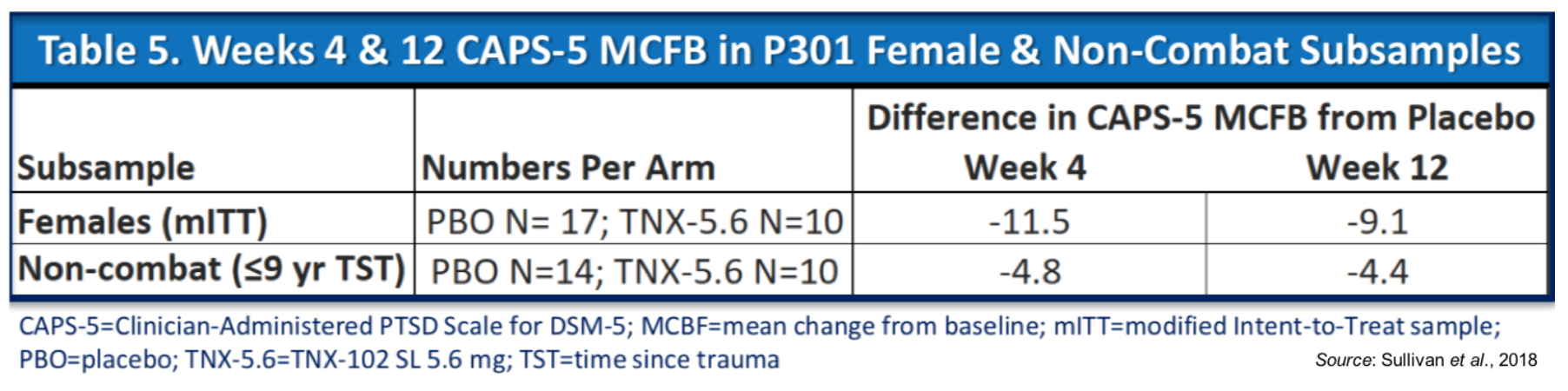 View Exhibit VIFinancial Update
On Nov. 9, 2018, Tonix announced financial results for the third quarter of 2018. As expected, the company did not report any revenues. Net loss for the third quarter of 2018 was $5.5 million, or $0.57 per share, compared to a net loss of $5.8 million, or $0.77 per share, for the third quarter of 2017. R&D expenses were $3.3 million for the third quarter of 2018 compared to $3.9 million for the third quarter of 2017. The decrease was primarily due to the termination of the HONOR study. G&A expenses were $2.3 million in the third quarter of 2018 compared to $1.9 million for the third quarter of 2017. The increase was primarily due to increased legal and investor expenses.
Tonix exited the third quarter of 2018 with approximately $14.7 million in cash and cash equivalents. Cash burn during the quarter was approximately $4.9 million. In October 2018, the company entered into a purchase agreement with Lincoln Park Capital Fund under which Tonix may sell up to $15 million of common stock to Lincoln Park from time to time. As of Nov. 8, 2018, Tonix had approximately 14.2 million shares of common stock outstanding.
Conclusion
The new Phase 3 trial for TNX-102 SL has a number of positive features in it that could lead to clinical success, particularly the fact that the primary endpoint will be at Week 4, as there was a clinically meaningful separation between TNX-102 SL and placebo treated patients in both the AtEase and HONOR trials at this time point. Now that the FDA has agreed to a Week 4 primary outcome, we have increased our chance for approval to 50%, which has increased our valuation to $3.50.
SUBSCRIBE TO ZACKS SMALL CAP RESEARCH to receive our articles and reports emailed directly to you each morning. Please visit our website for additional information on Zacks SCR.
DISCLOSURE: Zacks SCR has received compensation from the issuer directly or from an investor relations consulting firm, engaged by the issuer, for providing research coverage for a period of no less than one year. Research articles, as seen here, are part of the service Zacks provides and Zacks receives quarterly payments totaling a maximum fee of $30,000 annually for these services. Full Disclaimer HERE.