By
John Vandermosten, CFA
NASDAQ:TTNP
READ THE FULL TTNP RESEARCH REPORT
Third Quarter 2018 Financial and Operational Results
Titan Pharmaceuticals, Inc. (NASDAQ:TTNP) reported third quarter 2018 results on November 14th in a
press release and in a subsequently filed
10-Q. During the period, Titan recorded total revenues of $1.7 million compared to $40 thousand in 3Q:17. This 3Q:18 total consisted of $1.4 million of license revenue and $244,000 in product sales of Probuphine by Titan.
The $244,000 in Titan-generated Probuphine sales compares to 2Q:18’s $75,000, which was for a partial period. If the partial period rate was grossed up for the full quarter, pro forma second quarter sales would have been ~$190,000, representing a sequential increase in the sales rate.
Total expenses of $3.6 million include $178,000 in cost of goods sold, $1.9 million of R&D and $1.5 million of G&A. R&D costs fell 30% while G&A rose 8%. Lower R&D was attributable to decrease in external R&D efforts for ropinirole, while higher G&A stemmed from greater legal and professional fees.
Cash and equivalents as of September 30, 2018 were $8.4 million, compared to $7.5 million at the end of 2017. Debt was carried at $4.1 million. Subsequent to the end of the quarter, Titan raised an additional $4.5 million after the end of the quarter from the exercise of the overallotment option and the exercise of warrants. Cash burn was ($2.3) million in 3Q:18 compared to ($2.5) million in 3Q:17. The company anticipates sufficient cash to fund the company until the third quarter of 2019.
Addition of Chief Commercial Officer
Titan
announced on October 2 the addition of Dane D. Hallberg as Chief Commercial Officer (CCO) for Titan, who will be responsible for all of the company’s commercial activities. Mr. Hallberg had been working as a consultant with the company prior to his addition to the leadership team and has experience commercializing other implants, which includes Merck’s Implanon subdermal contraceptive. His background also includes leadership positions at Able Star, Sunovion Pharmaceuticals, Dendrite Japan and Tierra Incorporated. His experience will be critical as Titan launches Probuphine into its four identified market segments.
Public Offering
Titan has outlined a strategy to build a small sales and marketing team to commercialize Probuphine as a specialty product. This objective will require additional capital to hire, train and dispatch sales representatives into the targeted markets. To achieve this objective, Titan
raised $9.5 million from the issuance of 5.1 million shares of common stock, convertible preferred stock and warrants. The estimated proceeds from the issuance are expected to be sufficient to fund the internal commercialization efforts for Probuphine and the FDA-required Phase IV studies
1 through 2019.
Nevada Center for Behavioral Health
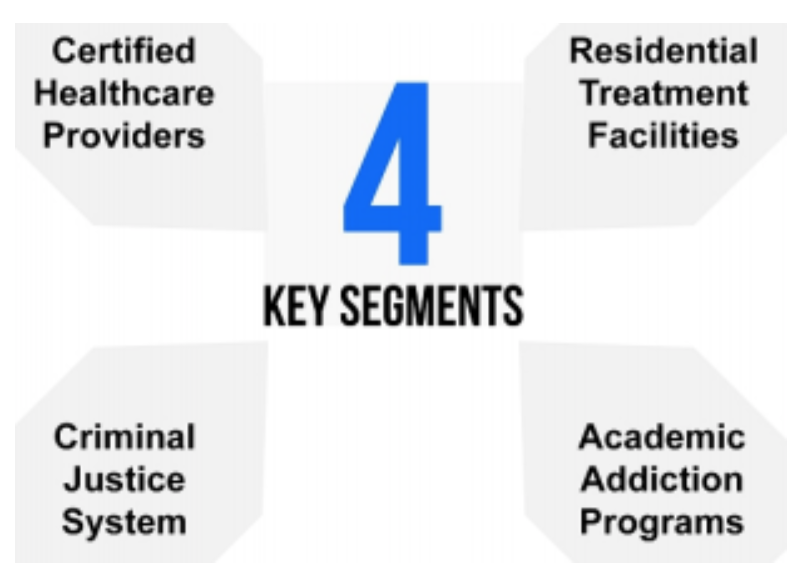 View Exhibit I
– Segmentation Strategy
Since the release of the quarterly report, Titan has updated shareholders on their commercialization initiatives with a
collaboration with the Nevada Center for Behavioral Health. This collaboration will evaluate the use of Probuphine to treat opioid use disorder (OUD) patients in the Nevada criminal justice system. It is a pilot program and includes the training and certification of seven health care providers regarding the Probuphine Risk Evaluation and Mitigation Strategy (REMS). A grant related to the 21st Century Cures Act was provided from state and federal authorities to fund the work. The incarcerated market for OUD in the United States is large. Titan statistics estimate that about a quarter of the 2.3 million confined persons in the U.S. suffer from OUD; however, less than 1% are given access to medications for it. The hesitation to use the opioid-based treatments is due to concerns over diversion, which does occur with sublingual formulations. Given Probuphine’s ability to avoid diversion, it is a particularly attractive alternative in this setting. The focus on this population is supported by a
study in Rhode Island that showed a 61% decrease in post-incarceration deaths and a 12% reduction in statewide overdose deaths a year following the implementation of a treatment program for incarcerated addicts. We expect that success in each of the targeted areas will lead to wider adoption over time.
Titan initiated the pilot program with the Nevada Center for Behavioral Health to use Probuphine to treat opioid use disorder in September. The goal of the program is to reduce recidivism for individuals in the criminal justice system. The program was put in place in order to establish treatment and design a broader effort intended for the incarcerated and paroled population. Titan’s experience here can be helpful for expanding their reach into other states. About 25% of individuals in the criminal justice system have opioid use disorder and it is largely untreated.
Phase IV Probuphine Studies
Titan will initiate two Phase IV post-marketing studies next year. The first will be a small study costing approximately $3 to $4 million and last for two to three years. A second, observational study is still in development, but is expected to last approximately four years and will and will cost approximately twice the initial study. Trial design is still in process.
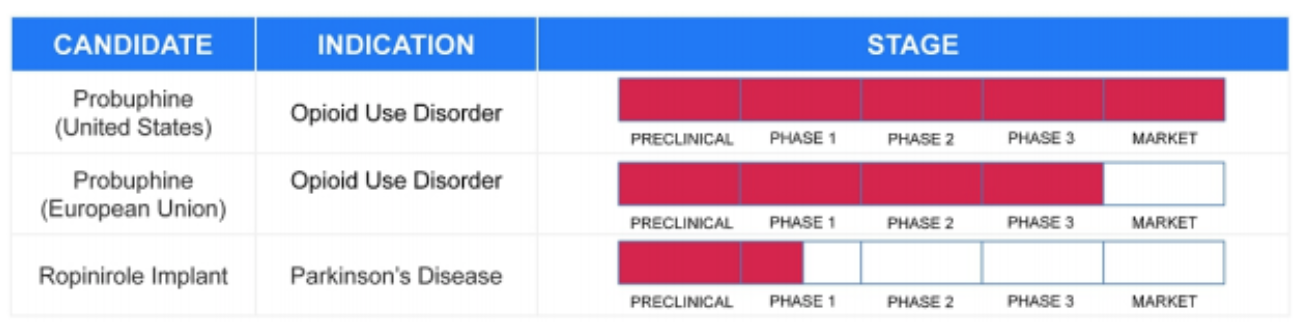 View Exhibit II
– Titan Pipeline
NASDAQ Notices
On April 9, 2018 the Nasdaq notified Titan that they were not in compliance with exchange listing requirements as they did not maintain minimum stockholders’ equity requirements. In response, the company submitted a plan of compliance and was granted an extension to October 8, 2018. On August 15, 2018, Titan received a notification that shares were not in compliance with minimum bid requirements and that they must regain compliance by February 11, 2019.
Knight Therapeutics
Knight launched Probuphine in the fourth quarter and is focused on commercializing the product in rural Canadian areas for patients without ready access to a physician. The company’s
press release in late October highlighted Health Canada’s approval of the implant earlier in the year, Knight’s exclusive right to distribute the drug and their launch of the product.
Capital Raise
In October the company sold 5.7 million shares at $0.24 per share which included attached warrants. The company also issued Class B units which were converted into 32.9 million shares of stock. The net impact of these issuances raised approximately $13 million and increased share count to 78.0 million shares as of November 9th from 21.2 million shares on August 10th 2018. 30.6 million warrants with an exercise price of $0.25 remain outstanding as of November 9th 2018.
Valuation
We update our valuation to reflect the new outstanding share count and the shift to internally generated sales in the Unites States, from the royalty arrangement that was negotiated with Braeburn. We also advance our discounted cash flow (DCF) model ahead by one year. The more focused end markets will reduce our anticipated revenues as compared to our prior estimates; however, Titan will maintain a higher percentage of sales generated. We anticipate contributions from both Canada and Europe and total product and royalty revenues of $2.1 million in 2019. The precipitous drop in our target price is entirely due to the substantial increase in shares from approximately 21 million to 78 million, which were a result of the capital raise and warrant issuance. Based on our cash flow estimates and discounted cash flow model our target price for Titan Pharmaceuticals is $3.00 per share.
Summary
Despite the dilution as a result of the September and October capital raise, operational momentum is improving for Titan. The rate of internal sales increased sequentially and new initiatives such as the Nevada correctional project are anticipated to drive continued sequential increases in revenues. Other contributions from Europe and Canada are expected in 2019. While cash flow breakeven remains several quarters into the future, we anticipate that when capital is available, other development programs will be advanced.
We are optimistic that early success with the Nevada Center for Behavioral Health is a prelude for additional collaborations. Titan’s strategy of hiring a small salesforce and targeting high impact channels appears to be capital efficient and also may ease some of the difficulties suffered by Braeburn, such as REMS compliance and reimbursement difficulties. While our enterprise valuation of the company actually increases due to the roll forward of our DCF model, our per share valuation declines due to the increase in share count resulting from the capital raise. As a result we reduce our valuation to $3.00 share.
SUBSCRIBE TO ZACKS SMALL CAP RESEARCH to receive our articles and reports emailed directly to you each morning. Please visit our website for additional information on Zacks SCR.
DISCLOSURE: Zacks SCR has received compensation from the issuer directly or from an investor relations consulting firm, engaged by the issuer, for providing research coverage for a period of no less than one year. Research articles, as seen here, are part of the service Zacks provides and Zacks receives quarterly payments totaling a maximum fee of $30,000 annually for these services. Full Disclaimer HERE._________________________________
1 As a condition of the marketing approval for Probuphine, the FDA required postapproval Phase IV clinical trials to assess potential safety risks associated with the insertion and removal of Probuphine, potential prolongation of the QT interval and to assess the potential for repeat administration of Probuphine into the same insertion site or insertion into an alternate site.