By
David Bautz, PhD
NASDAQ:VKTX
READ THE FULL VKTX RESEARCH REPORT
Business Update
Phase 2 Data for VK2809 Presented at AASLD
On November 12, 2018, Viking Therapeutics, Inc. (NASDAQ:VKTX)
presented results from the Phase 2 trial of VK2809, the company’s thyroid hormone receptor beta (TRβ) agonist, in patients with hypercholesterolemia and nonalcoholic fatty liver disease (NAFLD) at the 2018 meeting of the American Association for the Study of Liver Diseases (AASLD). The Phase 2 trial was a randomized, double blind, placebo controlled study where patients were treated once daily or every other day with 10 mg VK2809 or once daily with placebo for 12 weeks followed by four weeks off drug. While the primary endpoint of the study was change in LDL cholesterol, the most important endpoints were the secondary ones related to NAFLD and nonalcoholic steatohepatitis (NASH) that evaluated changes in liver fat content, inflammatory markers, and histological changes.
The company had previously
announced topline results that showed a robust and profound reduction in liver fat content as judged both by relative change in the percentage of liver fat by MRI-PDFF (a non-invasive imaging technique) and the percentage of patients that experienced a ≥ 30% reduction in liver fat. New data presented at AASLD included information on patients that experienced a ≥ 50% reduction in liver fat, which included approximately two-thirds of those administered VK2809.
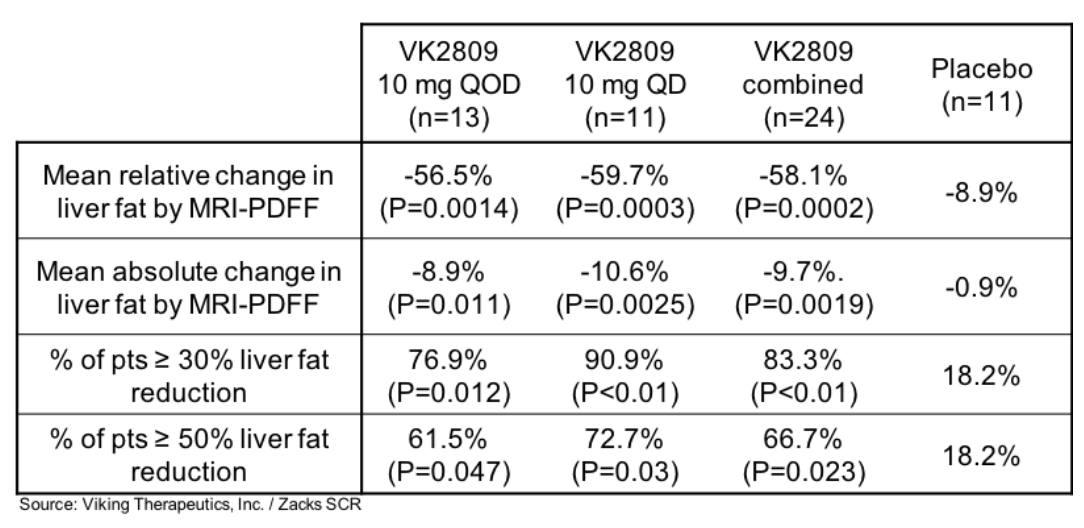 View Exhibit I
In addition to causing a substantial decrease in liver fat, treatment with VK2809 also resulted in a statistically significant reduction in low density lipoprotein cholesterol (LDL-C) as well as improvements in atherogenic proteins such as apolipoprotein B (ApoB) and lipoprotein (a) (Lp(a)). The most common cause of death for patients with NAFLD is cardiovascular disease (
Azzam et al., 2015), thus any NAFLD/NASH treatment that can also reduce cardiovascular risk factors is likely to be preferred by clinicians.
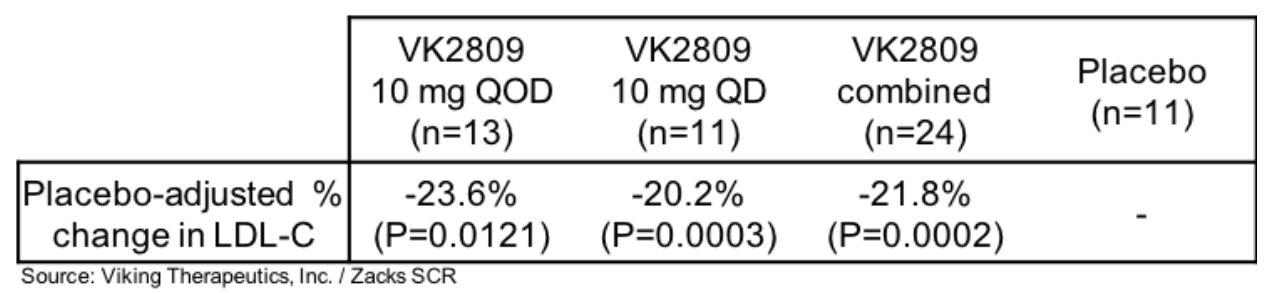 View Exhibit II
VK2809 was well tolerated in the Phase 2 study. There were no reports of serious adverse events (SAEs) among any of the patients in the study. Mean alanine aminotransferase (ALT) levels were reduced in patients taking VK2809 in comparison to those taking placebo at Week 12 and at Week 16 follow-up. For VK2809-treated patients with elevated ALT at baseline, mean ALT levels at Week 16 were reduced from baseline by 20.7 U/L (P=0.02).
In addition to showing the mean ALT levels at baseline, Week 12, and Week 16, the presentation at AASLD also included time course data for mean ALT levels for all patients. That data showed a mild rise in mean ALT at Week 1 before a steady decrease over the remainder of the study. We believe this initial mild rise in ALT is not a concern and is likely associated with the mechanism of action for VK2809. In support of this conclusion, a case study presented during a KOL event for Madrigal Pharmaceuticals (MDGL) on their lead drug MGL-3196 (a TRβ agonist like VK2809) reported a similar mild rise in ALT in the weeks following initiation of dosing of MGL-3196, which was then followed by a decrease in ALT through the rest of the study. In contrast to Viking, aside from the single example discussed by a KOL, Madrigal has not disclosed ALT levels from timepoints earlier than 12 weeks. However, given the same mechanism of action between the two drugs, it is reasonable to conclude that mean ALT levels among patients administered MGL-3196 would likely be similar to those disclosed for patients administered VK2809, with the one example disclosed during the KOL event supporting this conclusion. Thus, we think any initial mild rise in ALT is likely a feature of TRβ drugs and will not limit their development in NASH. In addition, this removes a substantial differentiating factor between VK2809 and MGL-3196 that is typically put forth by those who believe the two compounds have different hepatotoxicity profiles. The available data indicate this is not the case.
Other safety data showed there were no clinically or numerically meaningful differences in direct bilirubin, indirect bilirubin, alkaline phosphatase, and no changes to the thyroid hormone axis in patients administered VK2809 compared to placebo-treated patients. Lastly, there were no differences in GI-related AEs between those taking VK2809 and placebo.
Overall, we are very impressed with the data put forth by Viking as VK2809 appears to be the most robust liver fat reducer of oral agents currently in development for NASH. We also believe that any lingering potential concerns over safety have been alleviated. The company will next decide on whether to move into a Phase 2b or a Phase 2/3 adaptive clinical trial in patients with biopsy confirmed NASH. While no decision by management has been made yet, following our review of adaptive trial design in NASH (
Filozof et al., 2017) we view it as the riskier pathway, albeit with a potentially quicker path to an NDA submission. However, given the uncertainties surrounding how best to design an adaptive trial and the necessity for a very small alpha in such a trial (P value < 0.0001), we believe a Phase 2b trial with potentially 80-100 patients is the most likely next step.
Financial Update
For the third quarter of 2018, Viking reported a net loss of $6.6 million, or $0.11 per share, compared to a net loss of $6.1 million, or $0.22 per share, in the third quarter of 2017. R&D expenses in the third quarter of 2018 were $5.7 million compared to $3.5 million for the third quarter of 2017. The increase was primarily due to increased expenses in manufacturing, pre-clinical studies, consultants, and stock-based compensation. G&A expenses for the third quarter of 2018 were $1.7 million compared to $1.2 million for the third quarter of 2017. The increase was primarily due to increased expenses related to stock-based compensation, employee salaries and benefits, and professional services.
As of September 30, 2018, Viking had approximately $304.2 million in cash, cash equivalents, and short-term investments. This was due in part to a public offering in September 2018 that raised approximately $176 million in gross proceeds through the sale of 9.5 million shares of common stock at a price of $18.50 per share. As of October 31, 2018, the company had approximately 71.5 million shares of common stock outstanding and when factoring in stock options and warrants a fully diluted share count of 80.5 million.
Conclusion
There were no surprises in the Phase 2 data presentation of VK2809 at AASLD and we believe that any safety concerns surrounding the drug are no longer warranted. NASH is quickly becoming a very crowded field, and the robust decreases in LDL-C, ApoB, and Lp(a) are a nice differentiating factor for VK2809 that clinicians will view very favorably given the propensity for NASH patients to also suffer from cardiovascular disease. Combined with the robust decreases in liver fat, we believe VK2809 is setting up to potentially become a “best-in-class” treatment for NASH. Our current valuation is $28 and we would view any weakness in the stock as a buying opportunity as we consider Viking one of our top picks among small-cap biotech stocks.
SUBSCRIBE TO ZACKS SMALL CAP RESEARCH to receive our articles and reports emailed directly to you each morning. Please visit our website for additional information on Zacks SCR.
DISCLOSURE: Zacks SCR has received compensation from the issuer directly or from an investor relations consulting firm, engaged by the issuer, for providing research coverage for a period of no less than one year. Research articles, as seen here, are part of the service Zacks provides and Zacks receives quarterly payments totaling a maximum fee of $30,000 annually for these services. Full Disclaimer HERE.