By
David Bautz, PhD
NASDAQ:DFFN
READ THE FULL DFFN RESEARCH REPORT
Business Update
Positive Safety Data for Dose Escalation Run-in of Phase 3 GBM Trial
On July 23, 2019, Diffusion Pharmaceuticals, Inc. (NASDAQ:DFFN)
announced that the Data Safety Monitoring Board (DSMB) has unanimously recommended continuing the Phase 3
INvestigating
Tsc
Against
Cancerous
Tumors (INTACT) clinical trial following a dose escalation run-in phase with the company’s lead compound, trans sodium crocetinate (TSC). A total of 19 patients were treated with four doses of TSC: 0.25, 0.5, 1.0, and 1.5 mg/kg. Patients were treated with standard of care radiation therapy and temozolomide (TMZ) with intravenous TSC administered prior to those treatments. There were no safety signals seen and the DSMB recommended that the trial continue using the 1.5 mg/kg dose of TSC.
The Phase 3 INTACT trial is a follow up to a Phase 1/2 study of 59 GBM patients with newly diagnosed GBM (
Gainer et al., 2016). In the Phase I portion of the trial, TSC was initially administered three times per week at half-dose to three patients prior to radiation. Six additional patients received full dose TSC (0.25 mg/kg) for six weeks in combination with RT. No dose-limiting toxicities were identified in the nine patients during the Phase I portion of the trial. Fifty additional patients were enrolled in the Phase II trial at full dose TSC (0.25 mg/kg) in combination with TMZ and RT. Four weeks after completion of RT, all patients resumed TMZ for five days every four weeks, but no further TSC was administered.
The results of the study were presented in relation to a historical control group, which is from a 2005 study that showed the addition of TMZ to standard of care (surgery plus radiation) increased overall survival from 12.1 months to 14.6 months (
Stupp et al., 2005). Diffusion reported that:
• TSC plus radiation and TMZ increased the patients’ chance of survival at two years by 37%
compared to the historical control group. The overall survival at two years was 37% in the TSC group compared to 27% in the historical control group.
• In the subgroup of patients considered inoperable (biopsy only), the chance of survival at two years for those who received TSC was increased by 380%.
• 71 percent of people treated with TSC were alive at one year compared to 61 percent of people in the historical control group.
• Of the 37 patients with tumors able to be monitored, 27 experienced tumor regression, with 11 (30%) patients having complete tumor regression.
• No serious negative safety findings attributed to TSC were observed in the TSC study and adverse events were consistent with those seen in previous trials of GBM featuring radiation and TMZ.
It is important to point out that the results seen in the Phase 2 trial were with TSC administered at 0.25 mg/kg and only in combination with RT and TMZ; TSC was not administered following the end of RT. The Phase 3 INTACT trial will be testing TSC at 1.5 mg/kg during the entire treatment period, both during the six weeks of RT/TMZ as well as during the chemotherapy portion. Thus, we believe the potential exists for much greater efficacy in the INTACT trial.
As previously announced, the company is actively searching for a development partner before continuing on with the INTACT trial. We believe the compelling data from the Phase 2 trial combined with the increased dosing of TSC in the Phase 3 trial should help to facilitate such an arrangement.
Phase 2 Trial of TSC in Stroke to Initiate in 2019
Diffusion is currently planning to conduct the Pre-Hospital Ambulance Stroke Trial – TSC (PHAST-TSC), which will be a randomized, double blind, placebo controlled Phase 2 trial with an anticipated enrollment of 160 ambulance-transported patients (80 active/80 placebo) treated within two hours of the onset of a suspected stroke. The trial is novel in that patients will be treated in the ambulance on the way to the hospital. In addition, patients are eligible to receive tPA separately in-hospital if it is determined they are suffering from an ischemic stroke. In October 2018, Diffusion
received approval from the U.S. FDA to enroll patients in the study. We anticipate the trial initiating in the third quarter of 2019 and topline results could be available in two years following the start of the trial.
The primary endpoint of the study will be the extent of disability at 90 days using the utility-weighted modified Rankin Scale (UW-mRS) (
Chaisinanunkul et al., 2015). Secondary endpoints will examine functional independence, activities of daily living, and health-related quality of life.
Preclinical models show that TSC could be an effective treatment for both ischemic and hemorrhagic stroke (
Manabe et al., 2010;
Wang et al., 2014). The following figure shows a dose dependent reduction in infarct volume in a rat model of ischemia-reperfusion where TSC was administered 10 minutes following onset of ischemia.
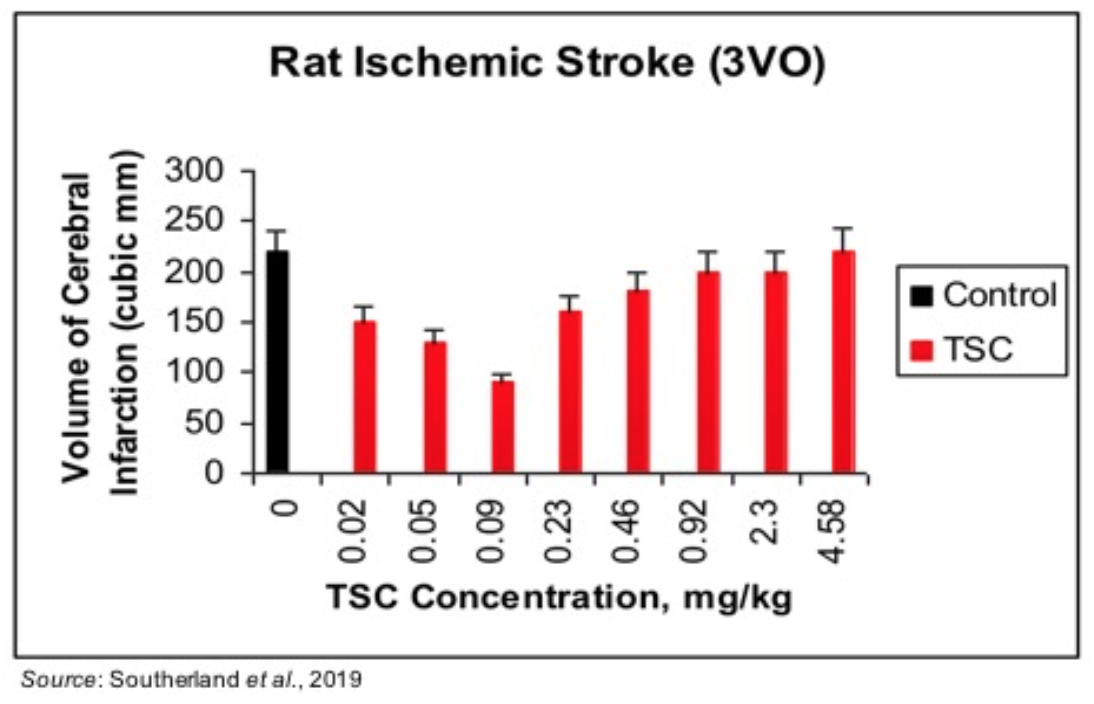 View Exhibit I
In another rat model of ischemia-reperfusion, which involved two hours of ischemia followed by 22 hours of reperfusion, treatment with TSC one and a half hours after onset of ischemia led to a significant reduction in infarct volume of 32%. In a third model of ischemia-reperfusion, which involved two hours of reperfusion followed by an additional four hours of one vessel occlusion, treatment with TSC significantly reduced infarct volume by 34%. Lastly, in an intracerebral hemorrhage model in which TSC was administered three hours after collagenase injection, there was a significant reduction in hemispheric swelling and hemorrhage volume in animals treated with TSC. It is important that TSC be effective, or at least not detrimental, regardless of the type of stroke. Otherwise, its use would be contraindicated prior to the diagnosis of the type of stroke and by that time it may be too late to be effective.
There are approximately 800,000 strokes every year in the U.S., and they are responsible for the deaths of approximately 140,000 individuals (CDC). Strokes cost the U.S. healthcare system an estimated $34 billion every year (
Benjamin et al., 2017).
Patent for Use of TSC in Combination with tPA in Europe
On May 23, 2019, Diffusion
announced that the receipt of a Notice of Intention to Grant a patent from the European Patent Office (EPO) in relation to the use of TSC in combination with tissue plasminogen activator (tPA) for the treatment of ischemic stroke. Two additional patents for TSC were also granted by the EPO; one that covers the use of TSC in treating acute lung injury, congestive heart failure, and pretreatment or treatment during surgery, the other that covers methods of synthesizing bipolar trans carotenoid salts, which includes TSC. The company has similar patents already granted in the U.S.
Financial Update
On August 8, 2019, Diffusion
announced financial results for the second quarter of 2019. As expected, the company did not report any revenues. R&D expenses in the second quarter of 2019 were $1.5 million compared to $1.4 million for the second quarter of 2018. The increase was mostly due to an increase in costs related to the Phase 2 stroke trial partially offset by a decrease in expenses related to the Phase 3 GBM trial. G&A expenses in the second quarter of 2019 were $1.1 million compared to $1.7 million for the second quarter of 2018. The decrease was due to lower salary and stock-based compensation expenses.
Diffusion exited the second quarter of 2019 with approximately $8.4 million in cash and cash equivalents. This was due in part to a $6.4 million private placement in May 2019 in which approximately 1.3 million shares of stock were sold at $4.77 per share. The company also issued 1.3 million warrants with an exercise price of $5.00 per share. We estimate the company has sufficient capital to fund operations into the first quarter of 2020. As of August 8, 2019, Diffusion had approximately 4.7 million shares outstanding and when factoring in warrants and stock options a fully diluted share count of approximately 8.5 million.
Valuation
We look forward to the initiation of the PHAST-TSC trial as we believe TSC offers a unique approach to treating stroke with plenty of preclinical data to support its use in that indication. With the Phase 2 trial initiating in 2019, we currently estimate for an NDA filing in 2024 and approval for treatment of stroke in 2025. We believe total peak sales for TSC of over a billion dollars are possible based on the compound’s unique mechanism of action and solid preclinical and clinical data seen to date. Our current valuation is $7.
SUBSCRIBE TO ZACKS SMALL CAP RESEARCH to receive our articles and reports emailed directly to you each morning. Please visit our website for additional information on Zacks SCR.
DISCLOSURE: Zacks SCR has received compensation from the issuer directly or from an investor relations consulting firm, engaged by the issuer, for providing research coverage for a period of no less than one year. Research articles, as seen here, are part of the service Zacks provides and Zacks receives quarterly payments totaling a maximum fee of $30,000 annually for these services. Full Disclaimer HERE.