By David Bautz, PhD
OTC:APLIF | TSX:APLI.V
READ THE FULL APLIF RESEARCH REPORT
Business Update
FDA Clears Expansion of Favipiravir Trial to Prevent COVID-19
On August 10, 2020, Appili Therapeutics Inc. (OTC:APLIF) (TSX:APLI.V) announced that the U.S. FDA has cleared the company to expand its Phase 2 clinical trial of favipiravir for the prevention of COVID-19 in long-term care facilities. Appili had previously received regulatory clearance from Health Canada in May 2020 to initiate the trial in Canada.
The ongoing coronavirus epidemic has hit the elderly the hardest, particularly those that reside in long-term care facilities. In Canada, approximately 80% of all COVID-19 deaths have occurred in long-term care facilities, while in the U.S. a number of states report that >50% of COVID-19 deaths occur in them. Thus, finding a means to prevent the spread of COVID-19 among this population could have a significant effect on mitigating the epidemic.
The cluster randomized, partially blinded, placebo controlled trial intends to enroll approximately 760 participants across 16 long term care facilities, with eight facilities administering favipiravir to its residents and the other eight administering placebo. Facilities are eligible to be enrolled in the trial after two or more residents test positive for SARS-CoV-2. Following enrollment of the facility, all residents will be administered either favipiravir or placebo with the primary outcome of the trial being outbreak control, defined as no new cases of COVID-19 in residents for 24 consecutive days up to Day 40 after the start of prophylactic treatment. Secondary objectives include safety, rates of infection, disease progression, and fatality rates. The company recently announced that site screening of long-term care facilities has initiated in Ontario. Residents at screened sites will then be eligible for enrollment and randomization into the trial upon confirmation of a COVID-19 outbreak.
Favipiravir
Favipiravir is a broad-spectrum antiviral compound that selectively inhibits the RNA-dependent RNA polymerase (RdRP) of influenza and many other RNA viruses (Shiraki et al., 2020). It was discovered by Toyoma Chemical Co., Ltd. through the screening of a large chemical library looking for compounds with anti-influenza activity. Favipiravir shows activity against influenza strains A, B, and C, which includes seasonal strains as well as pandemic strains (Fruruta et al., 2002).
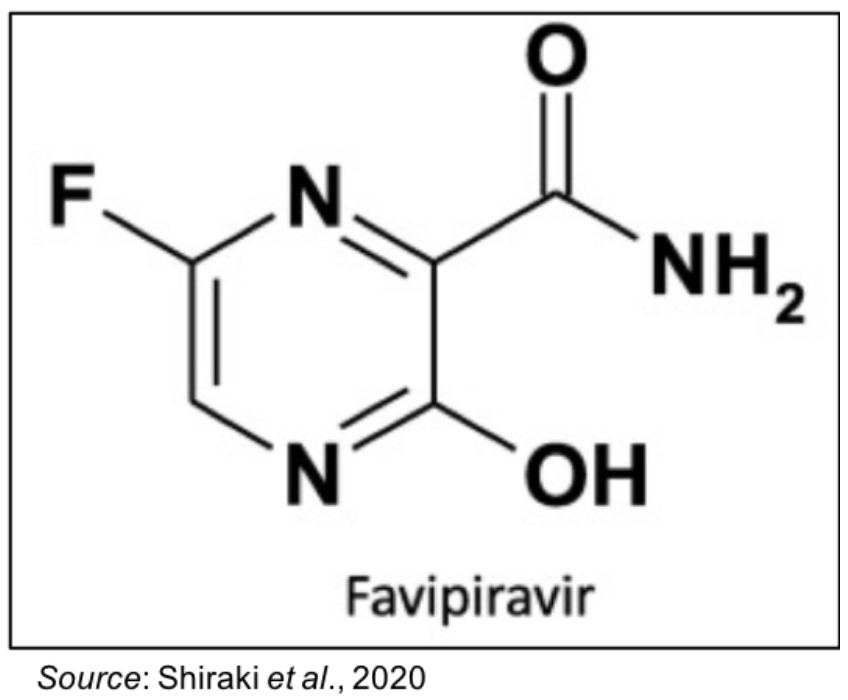
The drug interferes with viral replication through binding of RdRP and acting as a chain terminator at the site of incorporation (Jin et al., 2013). However, in comparison to other anti-viral compounds, it does not appear to generate resistant strains. For example, influenza virus strains that are resistant to oseltamivir (Tamiflu®) have emerged, however a favipiravir-resistant virus never appeared in Phase 3 clinical trials (Takashita et al., 2016). This is encouraging, as the use of favipiravir will likely not lead to a reduction in efficacy should the drug be utilized during the current coronavirus pandemic.
Favipiravir is currently approved for the treatment of pandemic influenza in Japan under the brand name Avigan®. However, it is contraindicated for use in pregnant women since it showed teratogenic and embryotoxic effects in animals. Other potential side effects include nausea, vomiting, diarrhea, and hepatic injury.
Favipiravir and COVID-19
There are a number of research groups around the world studying favipiravir for the treatment of COVID-19 as evidenced by the 14 clinical trials either ongoing or intending to start listed on clinicaltrials.gov. Thus far there have been two reports in the media about trials in China and Japan that tested favipiravir in patients with COVID-19, however it should be noted that those studies examined treatment with favipiravir after the patients had already been diagnosed with COVID-19.
Cai et al., 2020: This open label, non-randomized trial was performed in Shenzhen, China and compared favipiravir to lopinavir/ritonavir (control arm) for the treatment of COVID-19. Results showed that patients treated with favipiravir had a shorter viral clearance time compared to the control arm (4 days vs. 11 days; P<0.001) and showed significant improvement in chest imaging compared to the control arm (91.4% vs. 62.2%; P=0.004). In addition, fewer adverse reactions were seen in the favipiravir arm compared to the control arm.
Chen et al., 2020: This randomized, open label trial was performed in Wuhan, China and compared favipiravir to umifenovir (control arm) for the treatment of COVID-19. The primary endpoint was clinical recovery at Day 7, which did not significantly differ between the favipiravir (71/116, 61%) and control (62/120, 52%) group (P=0.1396). However, treatment with favipiravir led to shorter duration of fever (difference of 1.7 days; P<0.0001) and cough (difference of 1.75 days; P<0.0001).
These reports are encouraging and show that favipiravir has antiviral activity against SARS-CoV-2 along with a relatively benign side effect profile.
One Year Primate Data for ATI-1701 Expected Soon
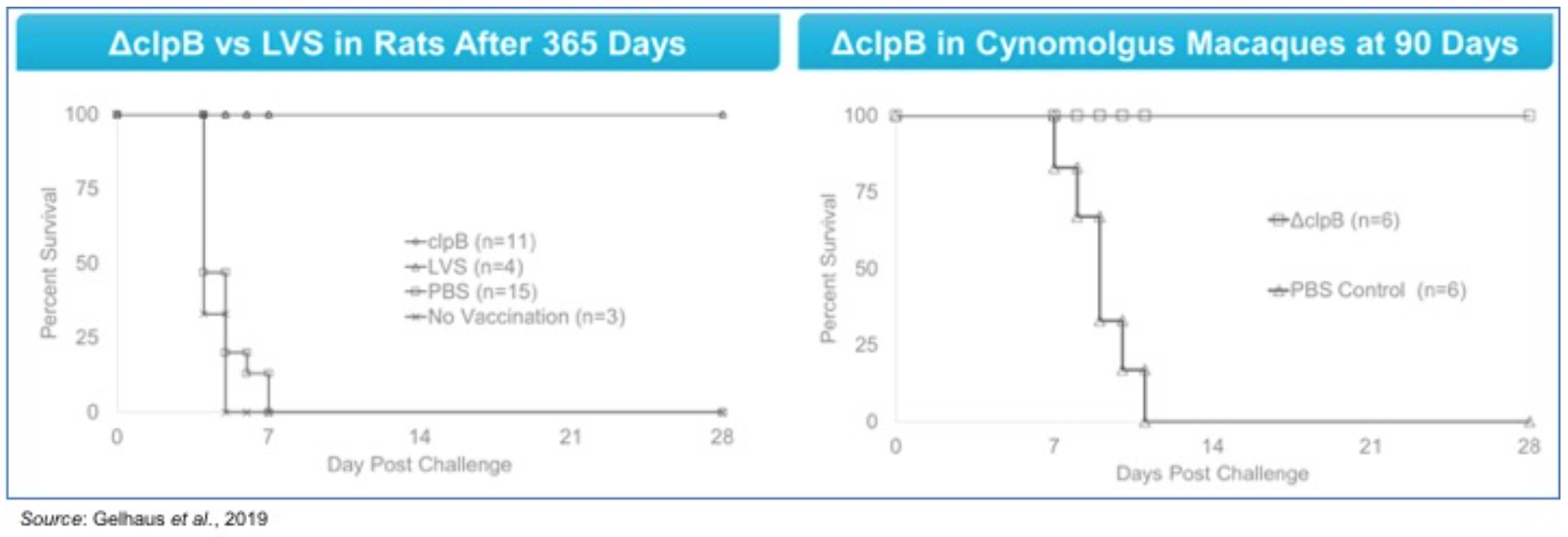
Earlier in 2020, Appili presented positive interim data for ATI-1701 at the 2020 ASM Biothreats conference hosted by the American Society for Microbiology. The company had previously presented similar results at the Chemical and Biological Defense Science & Technology Conference in Nov. 2019. The results presented in November 2019 showed that ATI-1701 (denoted clpB) protected rats for 365 days and cynomolgus macaques for 90 days following immunization, as shown in the following figures. This was tested by challenging vaccinated animals with aerosolized F. tularesnsis, which resulted in 100% fatality in non-vaccinated rats, rats immunized with the legacy F. tularensis vaccine (LVS), and non-vaccinated macaques.
In addition to showing that ATI-1701 offered a survival advantage to immunized animals, the following figure shows that immunized animals had strong immune responses as exhibited by significantly higher production of interferon-gamma (IFN-g), fractalkine (CX3CL1), tumor necrosis factor (TNF), and interleukin-2 (IL-2) compared to naïve animals.
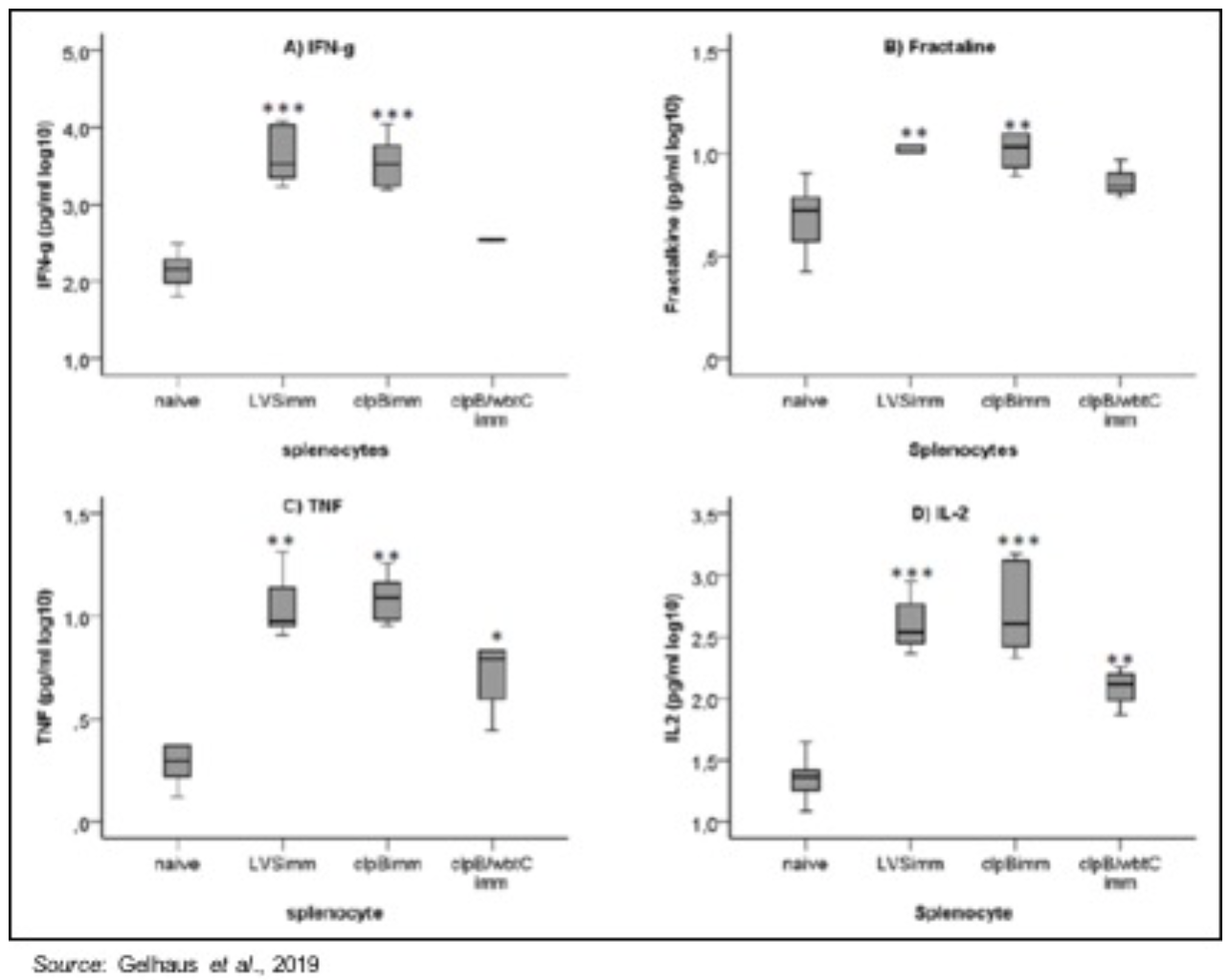
The conclusions from the study were that ATI-1701 can be manufactured in a stable form and it protects both rats and macaques for at least 365 and 90 days, respectively. We anticipate the company releasing data on the 365-day protection assays for macaques later this year.
ATI-2307 Update
In November 2019, Appili acquired ATI-2307 from FUJIFILM Toyama Chemical Co., LTD. It is a broad-spectrum, novel arylamidine antifungal agent that belongs to the same class of aromatic diamidines as pentamidine and furamidine (Mitsuyama et al., 2008). It has a highly differentiated novel mechanism of action that could potentially be used to treat infections caused by a number of clinically important and high priority pathogens, including Cryptococcus, Candida, and Aspergillus.

ATI-2307 has been successfully tested in multiple Phase 1 clinical trials, including a Phase 1 clinical trial in healthy volunteers in Japan that showed the drug was safe and well tolerated (NCT02289599). Appili is currently conducting proof of concept nonclinical studies to evaluate the therapeutic effect of ATI-2307 in rabbit and mouse intracranial Cryptococcus infection models along with evaluating the drugs activity in vitro against a panel of clinical isolates. We anticipate data from these studies to be reported in 2020.
Financial Update
On August 12, 2020, Appili announced financial results for the first quarter of fiscal year 2021, which ended June 30, 2020. Net loss for the first quarter of fiscal year 2021 was CAD $2.6 million, or CAD$0.05 per share, compared to a net loss of CAD$1.8 million, or CAD$0.06 per share, for the first quarter of fiscal year 2020. The increase was primarily due to increased R&D and G&A expenses.
R&D expenses for the first quarter of fiscal year 2021 were CAD$1.6 million, compared to CAD$0.6 million for the first quarter of fiscal year 2020. The increase was primarily due to increased spending for the favipiravir clinical trial and the ATI-2307 program. G&A expenses for the first quarter of fiscal year 2021 were CAD$1.0 million compared to CAD$0.9 million for the first quarter of fiscal year 2020. The increase was primiarly due to increased stock-based compensation.
As of June 30, 2020, Appili had approximately CAD$25.6 million in cash, cash equivalents, and short-term investments. In June 2020, the company completed a public offering of approximately 12.9 million units at a price of CAD$1.20 per unit for gross proceeds of approximately CAD$15.5 million. Each unit consisted of one share of common stock and one-half of one common share purchase warrant. Each warrant has an exercise price of CAD$1.50 and expires on June 10, 2023. Concurrently on June 10, 2020, the company closed a non-brokered private placement of 1.2 million units for gross proceeds of CAD$1.44 million.
As of June 30, 2020, Appili has approximately 61.6 million shares outstanding, 15.3 million warrants, and 4.0 million options for a fully diluted share count of approximately 81.0 million.
Conclusion
We look forward to updates regarding the Phase 2 trial of favipiravir and believe it could have an important impact on the coronavirus epidemic as the elderly are clearly the most vulnerable and treatments to prevent the spread of disease in that population are desperately needed. We also look forward to updates from the ATI-1701 and ATI-2307 programs over the next six months. With no changes to the model our valuation remains at $2.50.
SUBSCRIBE TO ZACKS SMALL CAP RESEARCH to receive our articles and reports emailed directly to you each morning. Please visit our website for additional information on Zacks SCR.
DISCLOSURE: Zacks SCR has received compensation from the issuer directly, from an investment manager, or from an investor relations consulting firm, engaged by the issuer, for providing research coverage for a period of no less than one year. Research articles, as seen here, are part of the service Zacks provides and Zacks receives quarterly payments totaling a maximum fee of $40,000 annually for these services. Full Disclaimer HERE.