By David Bautz, PhD
OTC:ATBPD | TSX:ATE.TO
READ THE FULL ATE.TO RESEARCH REPORT
Business Update
Update on Otenaproxesul
Antibe Therapeutics, Inc. (TSX:ATE.TO) (OTC:ATBPD) is preparing to move its lead development compound, otenaproxesul (the nonproprietary name for ATB-346), into a Phase 3 program. Otenaproxesul is being developed as a solution to the dose-related gastrointestinal (GI) side effects associated with nonsteroidal anti-inflammatory drugs (NSAIDs). It uses naproxen as a base molecule with a hydrogen sulfide moiety covalently attached. Hydrogen sulfide (H2S) is an important gasotransmitter, a gas that serves an important signaling molecule in the body.
In June 2020, Antibe announced positive topline results from the Phase 2b dose-ranging, efficacy trial of otenaproxesul. The randomized, double blind, placebo controlled trial enrolled 385 patients with osteoarthritis (OA) of the knee to once daily placebo or one of the three doses of otenaproxesul: 250 mg, 200 mg, and 150 mg. The primary endpoint of the trial was the change from baseline in the WOMAC pain subscale score following 14 days of treatment. Secondary efficacy endpoints included the WOMAC stiffness subscale score and the WOMAC difficulty performing daily activities (DPDA) subscale score.
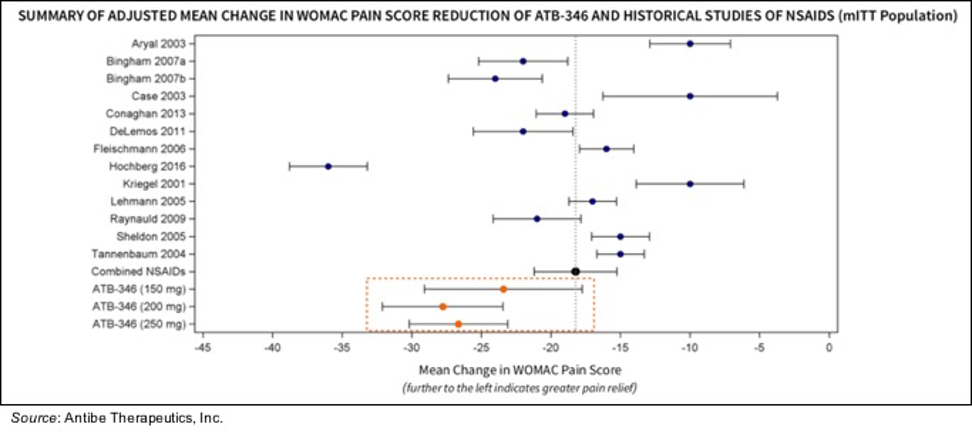
Patients administered otenaproxesul showed a statistically significantly greater decrease in the change in the WOMAC pain subscale score compared to those administered placebo at both 250 mg (P=0.01) and 200 mg (P=0.007). The 150 mg cohort was not powered for statistical significance, however that dose showed robust efficacy in the primary endpoint and likely would have been statistically significant if it had been adequately powered like the other treatment arms. The full results are discussed in detail in our previous report. The adverse event profile was similar between placebo and all three doses of ATB-346, and consisted of events typically seen with the use of NSAIDs (e.g., dyspepsia, acid reflux, and dizziness). The following image summarizes how the results seen for otenaproxesul compare to NSAIDs evaluated in other clinical trials, with further to the left indicating greater pain relief.
In 2018, Antibe announced positive topline results for the Phase 2 GI safety study of otenaproxesul. The double-blind, study enrolled 244 healthy volunteers, in which participants were administered either 250 mg otenaproxesul once daily or 500 mg naproxen twice daily. All subjects had an endoscopic examination of the upper GI tract prior to drug treatment and at the end of the 14-day study period.
The results showed that 42.1% (53/126) of naproxen-dosed subjects had GI ulceration compared to only 2.5% (3/118) of subjects treated with otenaproxesul, which was a statistically significant difference (P<0.001). Importantly, there were no safety signals and transient increases in liver enzymes were seen at levels comparable to what is seen with the most commonly prescribed NSAIDs.
The company has begun planning the Phase 3 development program for otenaproxesul. We anticipate an IND being filed in the next few months and an ‘End-of-Phase 2’ meeting occurring with the FDA (and the equivalent meeting with the EMA) within the next six months such that the first Phase 3 efficacy clinical trial can initiate by the end of the second quarter of 2021. While we await word on the specific details of the Phase 3 program, we believe it will involve:
• Two 12-week efficacy trials that will include lower doses of otenaproxesul than were seen in the Phase 2b dose-ranging efficacy trial (tested against placebo) such that the lowest effective dose can be determined. The first of those trials is likely to be a Phase 2/3 adaptive design trial, whereby an interim analysis is conducted following 50% enrollment to ensure that an adequate number of patients are enrolled to achieve statistical significance. The second efficacy trial will likely commence following the interim analysis of the first trial.
• One or two six-month GI-safety trials will be conducted so that the company can obtain a label for otenaproxesul that does not include the ‘black box’ warning regarding GI toxicity that is found on the labels for all NSAIDs.
• Safety data out to one year that will likely be collected from an open-label extension trial of the efficacy studies.
The company has initiated Phase 3-enabling animal toxicity and reproductive toxicity studies in rats, pigs, and rabbits. The short-range studies are expected to be completed by the first quarter of calendar 2021 such that the 12-week dosing portion of the Phase 3 trial can initiate while the long-range studies are expected to conclude in the third quarter of calendar 2021 such that the 24-week Phase 3 GI safety studies can commence.
We anticipate partnering discussions with potential global and regional partners to accelerate now that the Phase 2 trials are completed. Antibe will be actively advancing toward initiation of a Phase 3 trial while simultaneously engaging with potential partners. While we continue to believe a partnership with a major, global pharmaceutical company is likely, we are unsure of the timing for such an agreement knowing that these arrangements can take a considerable amount of time to pull together.
Financial Update
On November 13, 2020, Antibe announced financial results for the second quarter of fiscal year 2021 that ended September 30, 2020. The company reported revenues of CAD$2.9 million for the three months ending Septeber 30, 2020 compared to revenues of CAD$2.2 million for the three months ending September 30, 2019.
General and administrative, selling and marketing, research and development, stock-based compensation, and amortization and depreciation totaled CAD$8.8 million for the second quarter of fiscal year 2021 compared to CAD$3.1 million for the first quarter of fiscal year 2020. The increase was primarily related to the following:
• G&A expenses were CAD$2.5 million in 2QFY21 compared to CAD$1.2 million in 2QFY20. The increase was primarily due to higher salaries and wages, professional and consulting fees, and office expenses.
• Selling and marketing costs were CAD$0.6 million in 2QFY21 compared to CAD$0.8 million in 2QFY20. The decrease was due to lower salaries and wages, commissions, travel, and entertainment costs.
• R&D expenses were CAD$4.8 million in 2QFY21 compared to CAD$2.4 million in 2QFY20. The increase was primarily due to higher development costs for otenaproxesul, pill manufacturing costs, and salaries and wages.
• Stock-based compensation in 2QFY21 was CAD$0.8 million compared to CAD$1.0 million in 2QFY20 due to expensing of previously granted RSUs.
• Amortization and depreciation was CAD$0.1 million in both 2QFY21 and 2QFY20.
As of September 30, 2020, Antibe reported cash and cash equivalents of approximately CAD$22.4 million. The company recently began trading on the Toronto Stock Exchange (TSX) and also conducted a 1:10 share consolidation in preparation for an eventual uplisting to the Nasdaq. There are approximately 38.8 million shares outstanding and, when factoring in stock options and warrants, the fully diluted count is approximately 46.4 million. Lastly, the company will be expanding its investor outreach in the coming months to include institutional investors in an effort to expand its shareholder base.
Conclusion
Antibe continues to execute on its strategy as it moves otenaproxesul toward initiation of a global Phase 3 program. We anticipate an IND filing and an ‘End of Phase 2’ meeting to occur during the first half of 2021 such that the first Phase 3 clinical trial can initiate by the end of the second quarter of 2021, with subsequent trials initiating over the subsequent months. We are looking forward to continued updates as the company meets with regulatory authorities in preparation for the Phase 3 program. We have adjusted our model to account for the recent 1:10 share consolidation and our valuation is CAD$28.00 per share.
SUBSCRIBE TO ZACKS SMALL CAP RESEARCH to receive our articles and reports emailed directly to you each morning. Please visit our website for additional information on Zacks SCR.
DISCLOSURE: Zacks SCR has received compensation from the issuer directly, from an investment manager, or from an investor relations consulting firm, engaged by the issuer, for providing research coverage for a period of no less than one year. Research articles, as seen here, are part of the service Zacks provides and Zacks receives quarterly payments totaling a maximum fee of $40,000 annually for these services. Full Disclaimer HERE.