By David Bautz, PhD
TSX:ATE.V | OTC:ATBPF
READ THE FULL ATE.V RESEARCH REPORT
Business Update
Advancing Toward Phase 3 Program for ATB-346 (Otenaproxesul)
Antibe Therapeutics, Inc. (TSX:ATE.V) (OTC:ATBPF) is preparing to move its lead development compound, otenaproxesul (the nonproprietary name for ATB-346), into a Phase 3 program. Otenaproxesul is being developed as a solution to the dose-related gastrointestinal (GI) side effects associated with nonsteroidal anti-inflammatory drugs (NSAIDs). It uses naproxen as a base molecule with a hydrogen sulfide moiety covalently attached. Hydrogen sulfide (H2S) is an important gasotransmitter, a gas that serves an important signaling molecule in the body.
In 2018, Antibe announced positive topline results for the Phase 2 GI safety study of otenaproxesul. The double-blind, study enrolled 244 healthy volunteers, in which participants were administered either 250 mg otenaproxesul once daily or 500 mg naproxen twice daily. All subjects had an endoscopic examination of the upper GI tract prior to drug treatment and at the end of the 14-day study period.
The results showed that 42.1% (53/126) of naproxen-dosed subjects had GI ulceration compared to only 2.5% (3/118) of subjects treated with otenaproxesul, which was a statistically significant difference (P<0.001). Importantly, there were no safety signals and transient increases in liver enzymes were seen at levels comparable to what is seen with the most commonly prescribed NSAIDs.
In June 2020, Antibe announced positive topline results from the Phase 2b dose-ranging, efficacy trial of otenaproxesul. The randomized, double blind, placebo controlled trial enrolled 385 patients with osteoarthritis (OA) of the knee to once daily placebo or one of the three doses of otenaproxesul: 250 mg, 200 mg, and 150 mg. The primary endpoint of the trial was the change from baseline in the WOMAC pain subscale score following 14 days of treatment. Secondary efficacy endpoints included the WOMAC stiffness subscale score and the WOMAC difficulty performing daily activities (DPDA) subscale score.
Patients administered otenaproxesul showed a statistically significantly greater decrease in the change in the WOMAC pain subscale score compared to those administered placebo at both 250 mg (P=0.01) and 200 mg (P=0.007). The 150 mg cohort was not powered for statistical significance, however that dose showed robust efficacy in the primary endpoint and likely would have been statistically significant if it had been adequately powered like the other treatment arms. The full results are discussed in detail in our previous report. The adverse event profile was similar between placebo and all three doses of ATB-346, and consisted of events typically seen with the use of NSAIDs (e.g., dyspepsia, acid reflux, and dizziness).
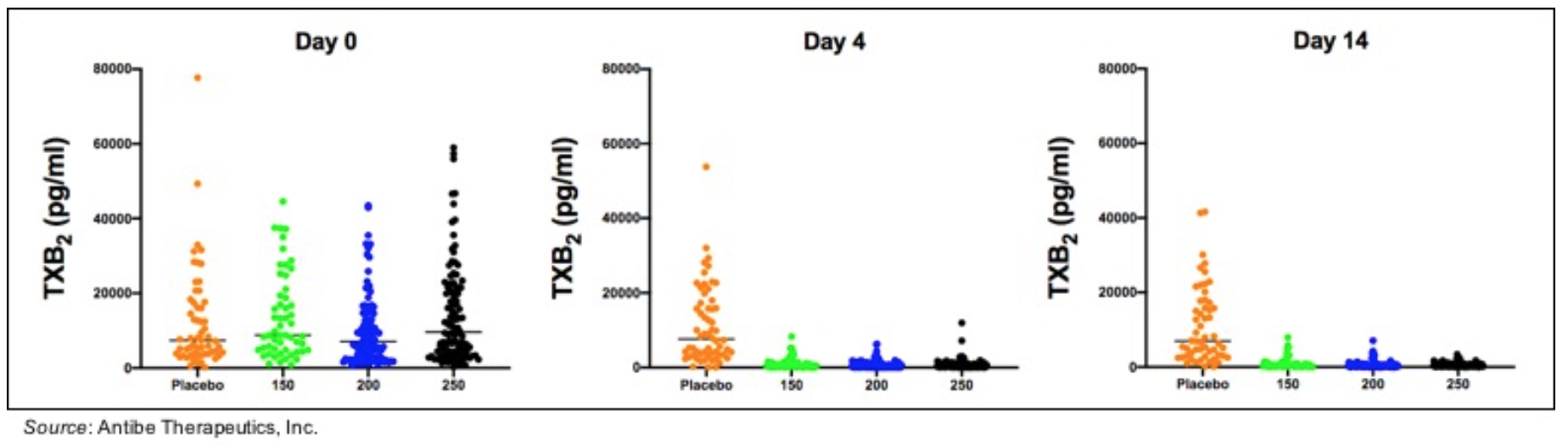
In addition to the WOMAC results, the company also recently reported that otenaproxesul treatment resulted in a marked inhibition of cyclo-oxygenase enzymes (TXB2 is a product of COX enzyme activity). The following figure shows that all three doses of otenaproxesul resulted in a profound inhibition by Day 4 and this continued through Day 14. In addition, there was little difference between the three doses, and likely indicates that the company will be able to decrease the dose before seeing any decrease in efficacy.
Now that the efficacy and GI safety data for otenaproxesul is in hand, the company has begun planning the Phase 3 development program. We anticipate an IND being filed before the end of 2020 and an ‘End-of-Phase 2’ meeting occurring with the FDA (and the equivalent meeting with the EMA) on a similar timeframe. While we await word on the specific details of the Phase 3 program, we believe it will involve:
• Two 12-week efficacy trials that will include lower doses of otenaproxesul than were seen in the Phase 2b dose-ranging efficacy trial (tested against placebo) such that the lowest effective dose can be determined. The first of those trials is likely to be a Phase 2/3 adaptive design trial, whereby an interim analysis is conducted following 50% enrollment to ensure that an adequate number of patients are enrolled to achieve statistical significance. The second efficacy trial will likely commence following the interim analysis of the first trial.
• Two six-month GI-safety trials will be conducted so that the company can obtain a label for otenaproxesul that does not include the ‘black box’ warning regarding GI toxicity that is found on the labels for all NSAIDs.
• Safety data out to one year that will likely be collected from an open-label extension trial of the efficacy studies.
We anticipate partnering discussions with potential global and regional partners to accelerate now that the Phase 2 trials are completed. Antibe will be actively advancing toward initiation of a Phase 3 trial while simultaneously engaging with potential partners. While we continue to believe a partnership with a major, global pharmaceutical company is likely, we are unsure of the timing for such an agreement knowing that these arrangements can take a considerable amount of time to pull together.
Market Analysis Points to Blockbuster Potential for Otenaproxesul
Antibe recently reported on two commercial studies for otenaproxesul that examined its potential in the largest global markets (e.g., the U.S., the ‘E.U. 5’, and Japan). The studies were conducted by Shift Health (for the U.S. and E.U.) and LEK (for Japan). Following interviews with clinicians, payors, and pharmacy benefit managers, the analysis indicated that peak sales of up to CAD$5.3 billion are possible for otenaproxesul in OA. This forecast was based on a daily price of US$6 per day in the U.S., which is similar to branded NSAIDs (e.g., Celebrex®).
Financial Update
Raises CAD$28.75 Million in Bought Deal Public Offering
On June 30, 2020, Antibe announced it closed a bought deal public offering of 62.5 million units at a price of CAD$0.40 per unit. Each unit consisted of one share of common stock and one-third of one common share purchase warrant, with each full warrant exercisable at a price of CAD$0.60 prior to June 30, 2022. The underwriter’s fully exercised their over-allotment option of 9.375 million units, thus the aggregate gross proceeds from the offering were CAD$28.75 million.
FY20 Financial Results
On July 24, 2020, Antibe announced financial results for fiscal year 2020 that ended Mar. 31, 2020. The company reported revenues of CAD$10.0 million in fiscal year 2020 compared to revenues of CAD$9.5 million for fiscal year 2019.
General and administrative, selling and marketing, research and development, stock-based compensation, and amortization and depreciation totaled CAD$21.5 million for fiscal year 2020 compared to CAD$15.7 million in fiscal year 2019. The increase was primarily related to the following:
• G&A expenses were CAD$5.7 million in fiscal year 2020 compared to CAD$4.9 million in fiscal year 2019. The increase was primarily due to higher salaries and professional and consulting fees.
• Selling and marketing costs were CAD$3.8 million in fiscal year 2020 compared to CAD$3.5 million in fiscal year 2019. The increase was due to higher salaries, commissions, travel, and entertainment costs.
• R&D expenses were CAD$8.1 million in fiscal year 2020 compared to CAD$3.9 million in fiscal year 2019. The increase was primarily due to higher development costs for ATB-346 partially offset by lower salary and professional costs.
• Stock-based compensation in fiscal year 2020 was CAD$3.4 million compared to CAD$3.0 million in fiscal year 2019 due to expensing of previously granted RSUs.
• Amortization and depreciation was CAD$0.6 million in fiscal year 2020 compared to CAD$0.4 million in fiscal year 2019.
As of March 31, 2020, Antibe reported cash and cash equivalents of approximately CAD$6.2 million. From April 1, 2020 through July 24, 2020, the company raised approximately CAD$1.2 million from exercised stock options and CAD$3.3 million from exercised warrants. When including the June 2020 financing we estimate that the company currently has approximately CAD$34 million.
We estimate that the company currently has approximately 385.3 million shares outstanding and, when considering stock options and warrants, a fully diluted share count of approximately 451 million shares. Antibe is preparing for the optimal time to uplist the company’s shares to a senior exchange, most likely either the Nasdaq and/or the Toronto Stock Exchange. In addition, the company will be expanding its investor outreach in the coming months to include institutional investors in an effort to expand its shareholder base.
Conclusion
Antibe has a plan in place to get otenaproxesul into a global Phase 3 program, with the first Phase 3 clinical trial likely to start in the Spring of 2021, and subsequent trials initiating over the subsequent months. The market analyses are very encouraging and show that an effective NSAID without GI side effects would be a welcome addition to the treatment options for those suffering from OA. We are looking forward to continued updates as the company meets with regulatory authorities in the second half of 2020 in preparation for the Phase 3 program. Our model had accounted for additional financings, thus even after the recent offering our valuation remains at US$2.25 (CAD$3.00) per share.
SUBSCRIBE TO ZACKS SMALL CAP RESEARCH to receive our articles and reports emailed directly to you each morning. Please visit our website for additional information on Zacks SCR.
DISCLOSURE: Zacks SCR has received compensation from the issuer directly, from an investment manager, or from an investor relations consulting firm, engaged by the issuer, for providing research coverage for a period of no less than one year. Research articles, as seen here, are part of the service Zacks provides and Zacks receives quarterly payments totaling a maximum fee of $40,000 annually for these services. Full Disclaimer HERE.