By David Bautz, PhD
NASDAQ:BTAI
READ THE FULL BTAI RESEARCH REPORT
Business Update
IND for Opioid Withdrawal Cleared by FDA
On February 6, 2020, BioXcel (NASDAQ:BTAI) announced that the FDA has cleared the company’s IND for BXCL501 for the treatment of opioid withdrawal symptoms. The company will soon be initiating the Phase 1b/2 RELEASE trial, which will be a multicenter, randomized, double blind, placebo controlled study in patients with opioid use disorder who are physically dependent on opioids and experiencing symptoms of opioid withdrawal. Multiple dose cohorts of BXCL501 or placebo will be administered twice daily for five days. Patients will be assessed using both the Clinical Opiate Withdrawal Scale (COWS), an 11-item scale that measures a range of withdrawal symptoms experienced after quitting opioids (Wesson et al., 2003). and Short Opiate Withdrawal Scale (Gossop, 1990) over a 10-day period.
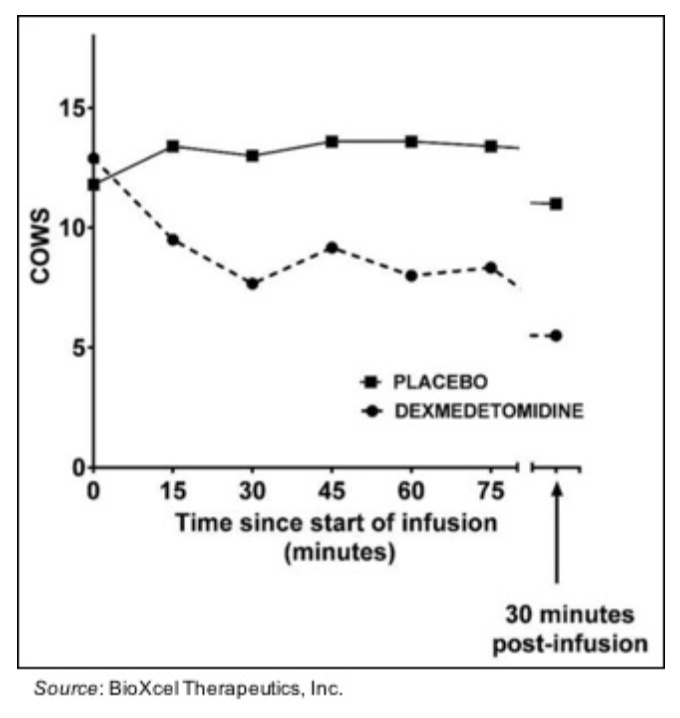
The company had previously tested intravenous (IV) dexmedetomidine in patients suffering from opioid withdrawal symptoms and announced results in February 2019. A total of 15 patients (10 treated with dexmedetomidine and five administered placebo) with opioid dependence were enrolled and opioid withdrawal symptoms evaluated using the COWS. All 10 patients treated with dexmedetomidine responded to treatment, with the following graph showing the average decrease for treated patients, while no patients treated with placebo responded.
Phase 3 Trials in Schizophrenia and Bipolar Disorder Underway
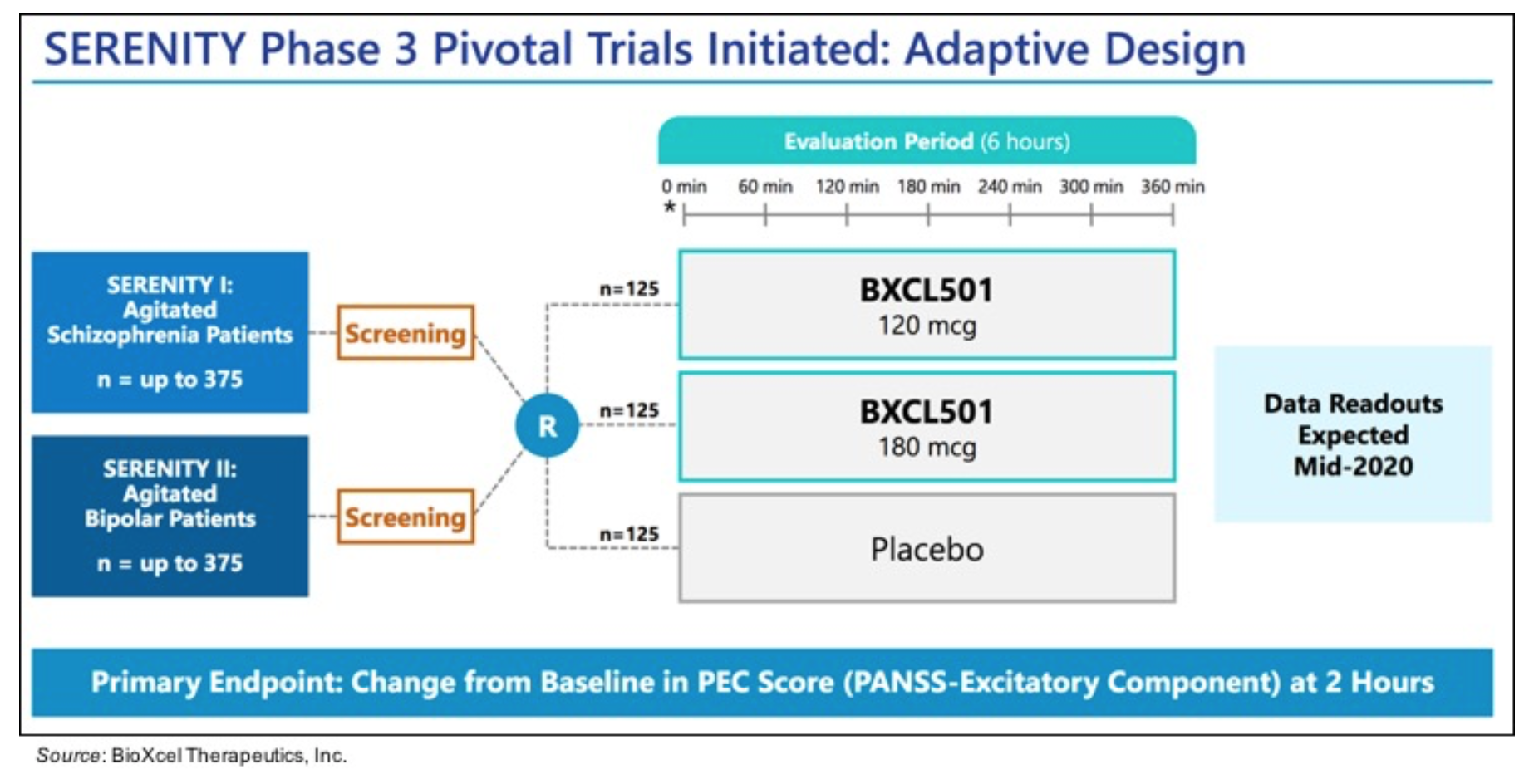
The company recently initiated the pivotal Phase 3 SERENITY (Sub-Lingual DExmedetomidine in Agitation Associated With SchizophRENIa and Bipolar Disorder STudY) trials of BXCL501 for acute treatment of agitation in patients with schizophrenia and bipolar disorder. The primary endpoint of both trials will be a reduction of symptoms of acute agitation using the Positive and Negative Syndrome Scale – Excitatory Component (PEC), a validated regulatory endpoint for quantifying agitation comprised of five elements associated with agitation scored from 1 (minimum) to 7 (maximum) (Montoya et al., 2011), as measured from baseline compared to placebo. A key secondary endpoint will be determining the earliest time where an effect on agitation is apparent by measuring the change in PEC score from baseline. An outline of the SERENITY program is shown below.
Phase 1b/2 Trial in Dementia Initiated
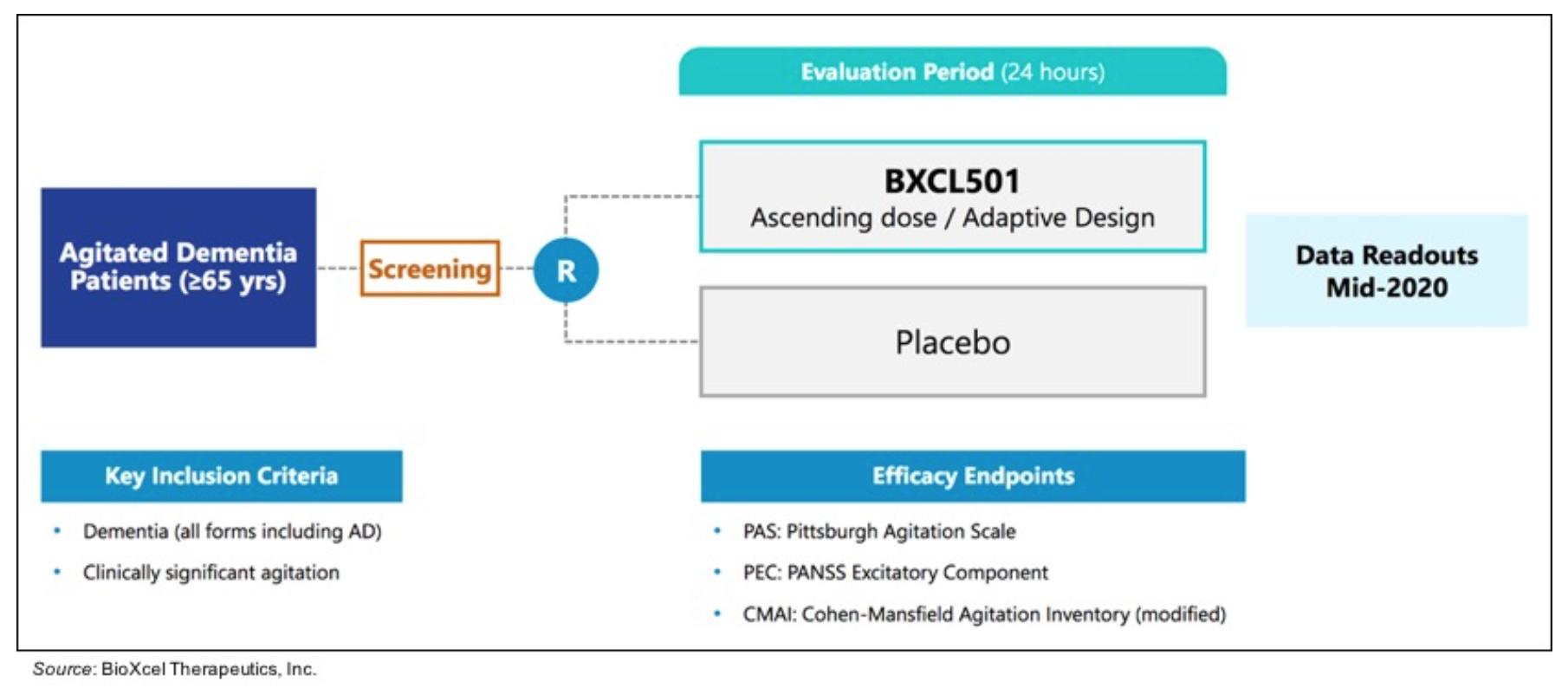
The company recently announced the initiation of a Phase 1b/2 clinical trial of BXCL501 for the acute treatment of agitation in patients with dementia, including Alzheimer’s disease (AD). The multicenter, randomized, double blind, placebo controlled, ascending dose trial is designed to evaluate the safety, efficacy, tolerability, and pharmacokinetics of BXCL501 in patients age 65 and older who exhibit acute agitation associated with all forms of dementia. It is an adaptive trial design and will evaluate multiple doses of BXCL501 or matching placebos. Following the completion of each dosing cohort, a safety and tolerability review will be conducted to determine the next tested dose. An outline of the trial is below.
Agitated behaviors (e.g., irritability, restlessness, aggression) are a significant issue in patients with dementia. Reports indicate that agitation occurs in up to 70% of AD patients and is a leading cause of institutionalization (Cohen et al., 1997). These behavioral disturbances have been linked with both cognitive decline (Teri et al., 1990) as well as increased caregiver burden, thus decreasing or eliminating them could be beneficial for both the patients and those taking care of them.
Agitation among dementia patients typically occurs in the late afternoon or evening and thus additional terms used to describe the condition include “sundown syndrome”, “sundowning”, and “nocturnal delirium”. The terms all collectively refer to a set of neuropsychiatric symptoms that occur in elderly patients with dementia near sunset. The International Psychogeriatric Association defines agitation in those with dementia as excessive motor activity such as pacing and restlessness, verbal aggression such as screaming and shouting, or physical aggression such as grabbing, pushing, and hitting that 1) is frequently recurrent for at least two weeks and 2) results in excess disability (e.g., impairment in interpersonal relationships). Due to the lack of a clear definition until recently, some prior studies referring to “sundown syndrome” included behaviors only in late afternoon while some included behaviors occurring throughout the night, thus making it difficult to draw comparisons across different studies.
The symptoms of agitation are generally seen in alterations of three main areas: mood, anxiety, and psychosis.
‣ Mood refers to emotional states such as sadness, happiness, irritability, and lability. In dementia patients, mood is typically dysregulated and in addition to agitation this can also lead to depression.
‣ Anxiety is driven by an overactive “fight or flight” response, which is analogous to what is seen in patients with posttraumatic stress disorder (PTSD), particularly hyperarousal and hypervigilance.
‣ Psychosis, which results in disturbed perceptions, delusions, and disorganized thought processes, occurs in many dementia patients due to paranoid ideation.
There is no agreed upon theory as to the cause of agitation in AD, although there are a number of hypotheses, including:
◦ Unmet physical or psychological needs as a result of isolation at night (Cohen-Mansfield et al., 1990), fatigue (Cohen-Mansfield et al., 1995), or some other nonspecific unmet need (Evans, 1987).
◦ Disordered circadian rhythm manifested as increased nocturnal activity, later peak of daytime activity, and less correlation in body temperature with a 24-hour cycle (Volicer et al., 2001).
◦ Sleep disorders caused by the degradation of neuronal pathways that initiate and regulate sleep (Bliwise et al., 2004). Staedt et al. provide a comprehensive overview of the biological causes of sleep disruption in AD patients (Staedt et al., 2005). An additional factor affecting sleep may be restless leg syndrome, which was found to correlate with agitation in patients with AD (Rose et al., 2011).
Currently there are no FDA approved therapies for agitation in dementia and the treatments that are used are either not effective, have a number of potential serious side effects, or both. Treatment typically involves changes in the patient’s environment and/or the off-label use of pharmaceutical agents.
For alterations in mood, mood stabilizers (valproic acid or carbamazepine) or antidepressants (typically selective serotonin reuptake inhibitors, SSRIs) are most commonly used. The FDA has not approved any drugs from either class for the treatment of agitation in dementia. There is evidence for efficacy of antidepressants, however their use is also associated with adverse side effects (Porsteinsson et al., 2014).
Anxiety is typically treated with benzodiazepines (e.g., lorazepam). While effective at calming patients, they have serious tolerability issues and can have a negative impact on memory, cognition, balance (potentially leading to falls), and potentially increase the risk of death (Saarelainen et al., 2017).
Antipsychotics are the most common medications prescribed to treat psychosis. While some atypical antipsychotics have shown superiority over placebo in treating agitation in AD (Ballard et al., 2009), in 2005 the FDA published a document regarding deaths related to the use of antipsychotics in elderly patients with behavioral disturbances (FDA, 2005) that led to a “black box” warning for this class of drugs in 2008.
Biomarker Study Initiated in Schizophrenia Patients
On February 18, 2020, BioXcel announced the initiation of a Phase 2 study at Yale University that is examining biomarkers associated with agitation in schizophrenia patients and the response to treatment with BXCL501 (NCT03708315). The company hopes to utilize various biomarkers (change in heart rate, electrodermal activity, electroencephalogram [EEG]) that may help it to identify other indications that show the same physiological signs of hyperarousal. The hope is that some or all of these bodily signals could be utilized to indicate an agitated state prior to visible symptoms becoming apparent. This may allow doctors to intervene before an agitated person becomes a danger to themselves or others. We anticipate data from this study in the second quarter of 2020.
Financial Update
On February 20, 2020, BioXcel Therapeutics, Inc. announced the pricing of a public offering in which the company sold two million shares of common stock at an offering price of $32 per share for gross proceeds of approximately $64 million. The company also granted the underwriters a 30-day option to purchase up to an additional 300,000 shares at the offering price. We estimate that following the closing of the offering the company will have approximately $90 million in cash and cash equivalents.
We have recently taken a fresh look at our DCF model and incorporated a number of changes as we believe we may have been too conservative in our estimates for BXCL501. The changes we have made include the following:
• We have raised our estimated wholesale acquisition cost (WAC) for a dose of BXCL501 to $175 from $135 with 2% yearly increases. Our research showed that Adasuve® had a WAC of $174 (Valdes et al., 2014), and since BXCL501 has numerous superior attributes we believe that a list price in line with Adasuve® is justified. In addition, Lucemyra® (lofexidine), an FDA approved treatment for opioid withdrawal, costs ~$2000 for a ten-day supply (GoodRx.com), thus we believe that is another good comparator for BXCL501. We have also decreased the discount rate to 13% and use an 85% gross to net adjustment to account for rebates and discounts.
• We have increased potential peak sales in schizophrenia and bipolar disorder to $750 million. We continue to estimate that approximately 25% of the approximately eight million patients in the U.S. with schizophrenia and bipolar disorder suffer from agitation that requires treatment. We estimate that patients will average approximately one episode per month and that BioXcel can capture 15% of the market.
• For agitation in dementia we have increased our potential peak sales to $1.2 billion. Our estimates include 20% of the approximately five million individuals in the U.S. will suffer from agitation and that patients will suffer an average of 18 episodes per year that will require the use of medication. We believe that BioXcel can potentially capture 25% of this market.
• For opioid withdrawal, have increased our potential peak sales to approximately $800 million. We estimate there are currently approximately 1.2 million individuals addicted to opioids that seek treatment each year and that 50% of these patients will require medication to deal with opioid withdrawal. Our model calls for peak market share of 30%, that patients will be treated for opioid addiction twice per year, and will receive ten doses of BXCL501 during a treatment cycle.
• While still in the planning stages, we include treatment of agitation in delirium in our model with potential peak sales of approximately $350 million. There are approximately two million individuals in the U.S. who suffer from delirium and we estimate that 20% of those will experience agitation with an average of 15 episodes per year.
• After accounting for cost of goods (7% average over the next decade), operating costs (70% operating margin), a tax rate of 21%, and using probability adjusted revenues for schizophrenia/bipolar (80% probability), dementia (70% probability), opioid withdrawal (70% probability), and delirium (50% probability) gives an NPV of approximately $1.9 billion for BXCL501.
• After combining the NPV for BXCL701 ($150 million), including the estimated cash balance, and dividing by the current fully diluted share count leads to a valuation of approximately $92 per share.
Conclusion
We look forward to what is shaping up to be a transformative year for BioXcel with a number of data readouts and catalysts to come this year, including:
• Phase 3 data for BXCL501 in treating agitation in schizophrenia and bipolar disorder in mid-2020
• Phase 1b/2 data for BXCL501 in treating agitation in dementia in mid-2020
• Phase 1b/2 data for BXCL501 in treating opioid withdrawal in 2H20
• NDA filing for BXCL501 in treating agitation in schizophrenia and bipolar disorder in 2H20
• Phase 1b data for BXCL701 in combination with pembrolizumab in patients with neuroendocrine prostate cancer in 2H20
• Initial data from investigator-initiated Phase 2 trial of BXCL701 in combination with pembrolizumab in multiple solid tumors in 2H20
• Initiation of a Phase 1 trial of BXCL701 in combination with bempegaldesleukin and avelumab in pancreatic cancer in 2H20
BioXcel’s stock has risen >600% since we initiated in November 2019 however we believe there is plenty of upside available, particularly with positive data from the above-mentioned trials. Our current valuation is now $92 per share.
SUBSCRIBE TO ZACKS SMALL CAP RESEARCH to receive our articles and reports emailed directly to you each morning. Please visit our website for additional information on Zacks SCR.
DISCLOSURE: Zacks SCR has received compensation from the issuer directly, from an investment manager, or from an investor relations consulting firm, engaged by the issuer, for providing research coverage for a period of no less than one year. Research articles, as seen here, are part of the service Zacks provides and Zacks receives quarterly payments totaling a maximum fee of $30,000 annually for these services. Full Disclaimer HERE.