By David Bautz, PhD
NASDAQ:CERC
READ THE FULL CERC RESEARCH REPORT
Business Update
Examining LIGHT as Potential Biomarker for ARDS
In March 2020, Cerecor, Inc. (NASDAQ:CERC) announced it will examine the role of LIGHT (Lymphotoxin-like, exhibits Inducible expression, and competes with HSV Glycoprotein D for HVEM, a receptor expressed by T lymphocytes [part of the Tumor Necrosis Super Family 14]), an inflammatory cytokine, in patients with acute respiratory distress syndrome (ARDS) caused by COVID-19. The company will be evaluating LIGHT as well as other inflammatory markers, including IL-18 and IFN-γ in patients with mild/moderate ARDS compared to those with severe ARDS.
ARDS results in the small blood vessels of the lung leaking fluid that fills up the alveoli, thus preventing proper oxygen exchange (Stevens et al., 2018). It is caused by a number of different conditions, including infections (e.g., pneumonia), severe burns, pancreatitis, inhalation of smoke or chemicals, or other serious illnesses. An excessive inflammatory response appears to be involved in the pathogenesis of ARDS (Li et al., 2019). Current treatment options involve supportive care while the lungs heal, which involves oxygen therapy supplied through a ventilator. There are no pharmacological treatments specifically for ARDS and approximately 40% of hospitalized patients die from it (Siegel et al., 2020).
LIGHT is induced by viral infection (Mehta et al., 2018) and can drive the formation of pulmonary fibrosis (Herro et al., 2015) as well as driving the release of additional pro-inflammatory cytokines. Thus, neutralization of LIGHT, potentially with CERC-002 (anti-LIGHT monoclonal antibody), may be beneficial to patients suffering from ARDS caused by COVID-19.
Acquisition of Aevi Genomic Medicine Expands Pipeline
In February 2020, Cerecor announced the completion of the merger with Aevi Genomic Medicine (GNMX) in an all-stock transaction valued at approximately $16.1 million plus contingent value rights (CVRs) for up to an additional $6.5 million based on subsequent clinical or regulatory milestones. The company is continuing to explore strategic alternatives for CERC-301 and Millipred, which was not included in the sale of the company’s Pediatric Portfolio.
The rationale behind the acquisition of Aevi centered on Cerecor’s desire to expand its rare disease pipeline, which now includes three clinical-stage programs from Aevi in addition to the 800-series programs. In addition, the CEO and CMO from Aevi, Mike Cola and Dr. Garry Neil, joined Cerecor as the company did not have anyone in either position prior to the acquisition.
The three programs that Cerecor acquired from Aevi are:
CERC-007: This is an anti-interleukin (IL)-18 fully human monoclonal antibody that will developed for the treatment of Adult Onset Stills Disease (AOSD) and multiple myeloma (MM). We anticipate proof-of-concept clinical trials initiating in 2020.
‣ AOSD is an inflammatory disease in which patients suffer from high fevers, sore throat, joint pain, swollen lymph nodes, and weight loss. The cause is unknown and no risk factors have been identified. Approximately 1 in 100,000 people develop AOSD each year and it becomes a chronic condition in approximately 1/3rd of those affected (Medlineplus). We estimate there are approximately 4,000 patients in the U.S. with AOSD.
‣ MM is a cancer of monoclonal plasma cells that derive from post-germinal-center B cells. The disease is characterized by an infiltration of these cells into the bone marrow causing anemia, lytic bone disease, hypercalcemia, and kidney damage from the accumulation of monoclonal immunoglobulins (Kumar et al., 2017). The disease is most common in the elderly, with a median age of onset of 69 years (NCI SEER). Elevated IL-18 serum levels are associated with poor overall survival in MM patients (Alexandrakis et al., 2004) and IL-18 drives the generation of myeloid-derived suppressor cells (MDSCs) that accelerate disease progression (Nakamura et al., 2018).
CERC-006: This is a small molecule inhibitor of the mTORC1/2 complexes that is being developed for the treatment of complex lymphatic malformation (LM). LMs are rare, non-malignant masses composed of fluid-filled channels or spaces caused by the improper formation of the lymphatic system. The abnormal lymphatic vessels cause the slow transfer of lymphatic fluid back into the venous system, thus excessive fluid accumulates and dilates the lymphatic channels. LMs form prior to birth and are typically identified within the first two years of life. They most commonly affect the head and neck area but can occur anywhere in the body. They affect approximately 50,000 individuals in the U.S.
The cellular receptor TIE2 plays a key role in vascular maturation through the PI3K/AKT/mTOR signaling pathway, and up to 60% of venous malformations are caused by mutations in TIE2 (Hammer et al., 2018) while another 20% are due to mutations in PIK3CA, which encodes the catalytic subunit of PI3K (Limaye et al., 2015).
Sirolimus is an allosteric inhibitor of mTOR, the catalytic subunit of two distinct complexes: mTORC1 and mTORC2. It inhibits mTORC1 (Tsang et al., 2007) but only inhibits mTORC2 in certain cell types after prolonged exposure (Sarbassov et al., 2006).
A systematic review identified twenty studies that included 71 patients with vascular malformations (45 patients with LM) treated with sirolimus (Wiegand et al., 2018). Despite dosing and duration of treatment differences, 60 patients experienced a partial remission of disease. Thus, we believe these data provide compelling justification for testing an mTORC1/2 inhibitor for the treatment of LM. We anticipate data from a Phase 1b proof-of-concept trial within the first half of 2021.
CERC-002: This is a fully human monoclonal antibody targeting LIGHT (Lymphotoxin-like, exhibits Inducible expression, and competes with HSV Glycoprotein D for HVEM, a receptor expressed by T lymphocytes [part of the Tumor Necrosis Super Family 14]). The compound is currently in a Phase 1 clinical trial in adult patients with Crohn’s disease (CD), and the company is planning to initiate a clinical trial for pediatric Crohn’s disease.
Crohn’s disease is chronic type of inflammatory bowel disease of the digestive tract in which patients experience diarrhea, cramping and pain in the abdomen, and weight loss (NIDDK). The cause of CD is unknown but is thought to be an interplay between various genetic and environmental factors. Current treatment options work to decrease the inflammation and to prevent its recurrence, however there is no cure for the disease. Corticosteroids, immunomodulators, and biologic therapies that targets tumor necrosis factor-alpha, IL-12, or IL-23 are examples of currently available treatments.
Previous preclinical research showed that LIGHT expression caused similar pathological features and cytokine characterization that is observed in CD (Wang et al., 2005), which forms the basis for potentially treating Crohn’s patients with an anti-LIGHT antibody. The company has developed a validated assay to quantify the levels of LIGHT in patients, thus making patient selection and monitoring more efficient. Aevi previously initiated a clinical trial of AEVI-002 in adult Crohn’s disease patients (NCT03169894) and we anticipate initial data from this study in the first quarter of 2021 before Cerecor can initiate a trial in pediatric Crohn’s patients later in 2021.
CERC-800 Series Update
Cerecor is developing CERC-801 (D-galactose), CERC-802 (D-mannose), and CERC-803 (L-fucose) for the treatment of the congenital disorder of glycosylation (CDG) diseases phosphoglucomutase 1 (PGM1) deficiency, mannose-phosphate isomerase (MPI) deficiency, and leukocyte adhesion deficiency type II (LADII) or SLC35C1-CDG, respectively.
In July 2019, the company announced the first patient was enrolled in the CDG FIRST (Congenital Disorders of Glycosylation Formative Retrospective Study) trial. The purpose of the CDG FIRST trial is to collect natural history data from patients diagnosed with CDGs along with any treatment-related data whether or not they had been treated with D-galactose, D-mannose, or L-fucose. Earlier in 2019, the FDA issued draft guidance on the use of natural history studies for drug development in rare diseases. Since the natural history, or the course a disease would take with no intervention, is typically limited for rare diseases, these types of studies are important to help understand the most useful types of outcomes to monitor.
We believe the company is hoping to collect data from approximately 10 patients each for CERC-801 and CERC-802 while for CERC-803 only a few patients will likely be needed given that it is incredibly rare. We anticipate initial data from this study in the first half of 2020. We don’t believe any prospective study required by the FDA will be onerous and will likely only require up to 10 patients each for CERC-801 and CERC-802 and potentially only a couple of patients for CERC-803. Precedent for a very small prospective trial is provided by Xuriden® (uridine triacetate), which was approved by the FDA in 2015 following an open-label study in four patients with hereditary orotic aciduria. Three of the four patients had previously been treated with uridine before being switched to Xuriden®.
The first NDA filing should occur in 2021 with an expected approval in 2022. Which compound the first NDA is filed for will be determined by the rate at which the prospective studies occur. However, since all of the CERC-800 compounds qualify for a priority review voucher (discussed below), it doesn’t make a difference which compound is approved first.
Potential for Priority Review Voucher
Given that the number of patients for each of the CERC-800 products is very small, the most important aspect for those products is likely the fact that they are eligible for a priority review voucher (PRV) upon approval. A PRV allows the holder of the voucher to receive an expedited six-month review from the FDA for an NDA or biologics license application (BLA) instead of the usual ten-month review. The Food and Drug Administration Safety and Innovation Act (FDASIA) created the rare pediatric voucher in 2012 to specifically target the need for additional therapies for rare pediatric subsets of diseases (affect fewer than 200,000 individuals in the U.S.). Priority review vouchers are also awarded for the development of treatments for certain tropical diseases and medical countermeasures.
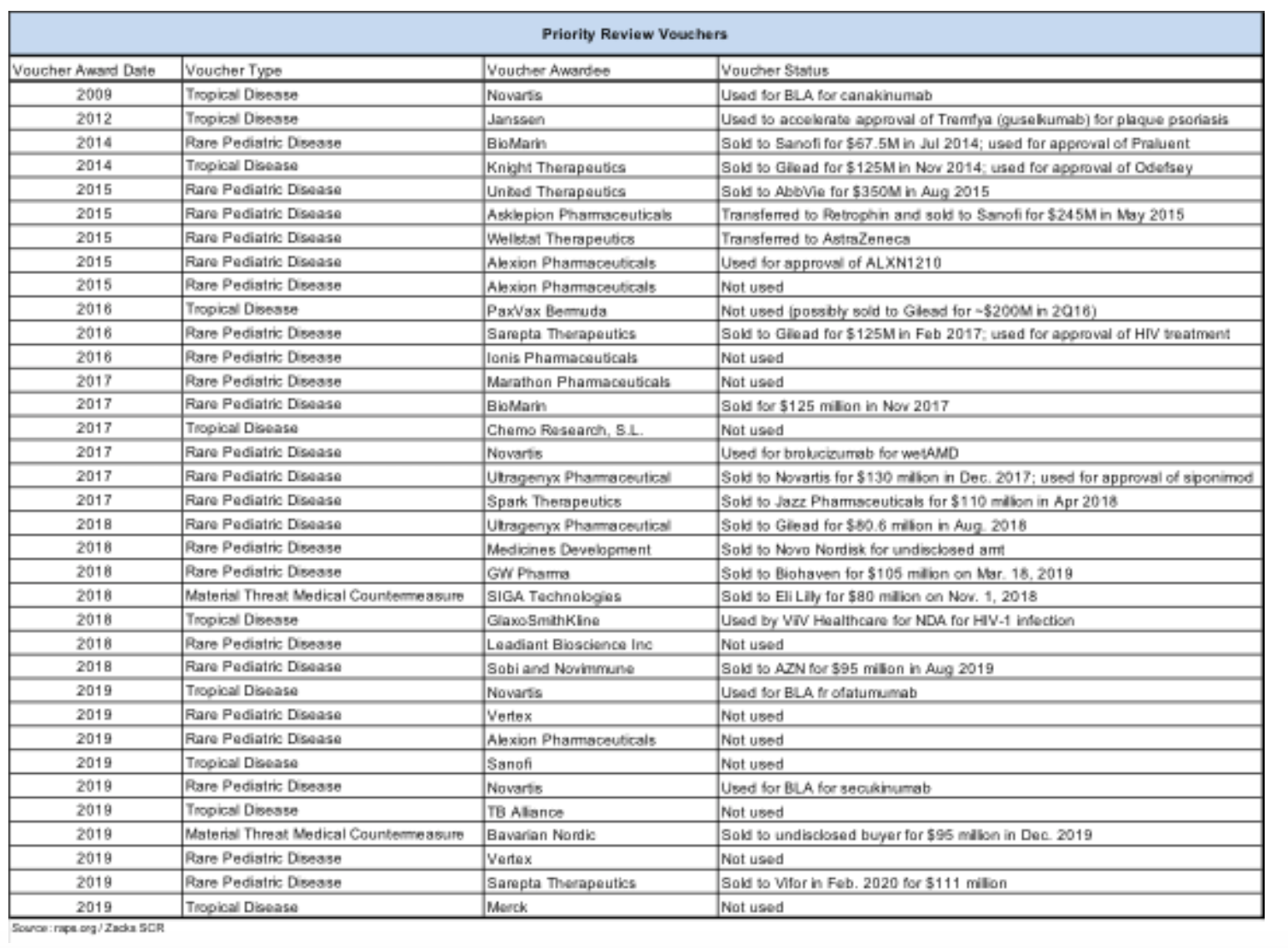
Priority review vouchers are fully transferrable, and a number of companies that have been issued the vouchers in the past have sold them, including one that was sold to AbbVie (ABBV) in Aug. 2015 for $350 million. The four most recent purchases are by Biohaven Pharmaceutical Holding Company for $105 million in Mar. 2019, AstraZeneca (AZN) for $95 million in Aug. 2019, an undisclosed buy for $95 million in Dec. 2019, and Vifor for $111 million in Feb. 2020. While prices for PRVs have come down since AbbVie purchased one for $350 million in 2015, the price for them appears to have settled to approximately $100 million. The following table shows how many PRVs have been issued along with the current status of the voucher, if known.
Changes to Board of Directors
On April 24, 2020, Cerecor announced the appointment of Dr. Sol Barer as Chairman of the Board with Dr. Simon Pedder stepping down as Executive Chairman. In addition, Dr. Suzanne Bruhn and Mr. Joseph Miller were appointed as Director’s to the company’s Board. Dr. Barer was the founder, CEO, and Chairman of Celgene Corporation and is now on the Board of Teva Pharmaceuticals, Centrexion Therapeutics Corporation, and NexImmune along with being the Lead Director of ContraFect. Dr. Bruhn is currently the President, CEO, and Director of Tiaki Therapeutics and was previously the President, CEO, and Director of Proclara Biosciences. Mr. Miller recently resigned from Cerecor where he had served as Chief Financial Officer, Principle Executive Officer, and Corporate Secretary.
Financial Update
On May 7, 2020, Cerecor announced financial results for the first quarter of 2020. The company reported net revenues of $2.8 million, which were derived from the sale of Millipred®, the company’s only remaining commercial product. These revenues were consistent with net product revenues for the first quarter of 2019 of $2.6 million. R&D expenses were $4.8 million in the first quarter of 2020 compared to $3.4 million in the first quarter of 2019. The increase was primarily due to expansion of the pipeline as a result of the Aevi merger. The company acquired $25.5 million of in-process R&D (IPR&D) for the assets acquired from the Aevi merger, while there was no IPR&D for the first quarter of 2019. G&A expenses for the first quarter of 2020 were $2.7 million, which was the same as for the first quarter of 2019.
Cerecor exited the first quarter of 2020 with approximately $5.7 million in cash and cash equivalents, which was due in part to a direct offering in February 2020 and a private placement with Armistice Capital in March 2020. Subsequent to the end of the quarter, the company converted the 9,805,845 shares of convertible preferred stock in Aytu Biosciences into shares of common stock and then sold those shares for approximately $12.8 million. In addition, the company got an income tax receivable from the Coronavirus Aid, Relief, and Economic Security (CARES) Act of approximately $2.2 million. Thus, we estimate the company will exit the second quarter of 2020 with approximately $15 million in cash and cash equivalents. As a reminder, Cerecor is still interested in selling Millipred®, which we estimate could be sold for approximately $15-$20 million. The goal is to use the aforementioned to finance the company until the approval of the first CERC-800 series product, which will come with a priority review voucher (PRV). PRV’s are currently being sold for approximately $100 million.
As of May 4, 2020, Cerecor had approximately 59.6 million shares outstanding and when factoring in options and warrants a fully diluted share count of approximately 71.9 million.
Conclusion and Valuation
Following the acquisition of Aevi and the sale of the Pediatric Portfolio, Cerecor is now fully focused on a diverse pipeline of assets targeting rare and orphan diseases. The company now has a significantly improved balance sheet along with no debt along to get the company to an expected PRV in 2022, with three other PRV’s possible over the following few years.
For the CERC-800 series, the majority of the valuation comes from the potential PRVs to be issued upon approval of each of the compounds. However, the company will be commercializing the products as well and we estimate that the CERC-800 series compounds could generate peak sales of $100 million. We model for three PRVs to be issued in 2022 and 2023 and currently use an 80% probability of approval. We also model for each PRV to be sold within a year of being issued. Using a 13.5% discount rate leads to a net present value for the CERC-800 series of $215 million.
For the assets acquired from Aevi, we currently estimate that Cerecor will commercialize each of the assets in the U.S., although if CERC-007 is advanced in MM, we believe that will be done through a partnership. For sales outside the U.S., we estimate that each compound will be partnered and the company will receive a 15% royalty on net sales.
For CERC-007 in AOSD, we estimate there are approximately 4,000 individuals in the U.S. and approximately 6,000 in the rest of the world with the condition. Based on the literature, approximately 30% of patients are refractory to front-line methotrexate therapy and thus would be the target population for treatment with CERC-007. Based on approval in 2025, a $250,000 yearly cost, peak sales of $250 million in the U.S. and $150 million in the rest of the world, and using a 13.5% discount rate and a 20% probability of approval leads to a net present value for CERC-007 in AOSD of approximately $16 million.
For CERC-007 in MM, we estimate there are approximately 30,000 and 39,000 individuals with the disease in the U.S. and E.U., respectively. We estimate for approval in 2027, peak sales of $700 million in the U.S. and $400 million in the E.U., and using a 13.5% discount rate and a 20% probability of approval leads to a net present value for CERC-007 in MM of approximately $35 million.
For CERC-006 in LM, we estimate there are approximately 50,000 and 60,000 individuals with the condition in the U.S. and E.U., respectively. We estimate for approval in 2024 in the U.S. and 2025 in the E.U., peak sales of $600 million in the U.S. and $700 million in the E.U., and using a 13.5% discount rate and a 20% probability of approval leads to a net present value for CERC-006 in LM of approximately $68 million.
For CERC-002 for pediatric Crohn’s, we estimate there are approximately 50,000 and 75,000 individuals with the condition in the U.S. and E.U., respectively. We estimate for approval in 2026 in the U.S. and 2027 in the E.U., peak sales of $400 million in both the U.S. and E.U., and using a 13.5% discount rate and a 20% probability of approval leads to a net present value for CERC-002 in pediatric Crohn’s of approximately $26 million.
Combining the net present value for the CERC-800 series, the other pipeline assets, a $15 million valuation for Millipred®, a $20 million valuation for the legacy neurology assets, and the company’s current cash total and dividing by the current share count of approximately 59.6 million shares leads to a valuation for Cerecor of approximately $7 per share.
SUBSCRIBE TO ZACKS SMALL CAP RESEARCH to receive our articles and reports emailed directly to you each morning. Please visit our website for additional information on Zacks SCR.
DISCLOSURE: Zacks SCR has received compensation from the issuer directly, from an investment manager, or from an investor relations consulting firm, engaged by the issuer, for providing research coverage for a period of no less than one year. Research articles, as seen here, are part of the service Zacks provides and Zacks receives quarterly payments totaling a maximum fee of $30,000 annually for these services. Full Disclaimer HERE.