By David Bautz, PhD
NASDAQ:DFFN
READ THE FULL DFFN RESEARCH REPORT
Business Update
ARDS Trial to Initiate Soon
On July 27, 2020, Diffusion Pharmaceuticals, Inc. (NASDAQ:DFFN) announced receipt of guidance from the U.S. FDA on the IND application to test trans sodium crocetinate (TSC) in COVID-19 patients suffering from acute respiratory distress syndrome (ARDS). The guidance suggested certain study design changes regarding endpoints and statistical considerations that should improve the chance for approval upon favorable clinical results. The company is planning to initiate a global development program that will encompass a two-part clinical trial:
• A Phase 1b lead-in trial is set to get underway in Romania. A total of 24 COVID-19 patients with ARDS are planned to be enrolled. The primary outcome of the trial is safety, with additional data on increased oxygenation being collected to help determine optimal dosing for future studies. We anticipate topline data in the fourth quarter of 2020.
• Assuming positive results in the lead-in trial, a larger clinical trial is planned for the U.S. and Europe. A total of approximately 400 patients will be enrolled to examine the safety and efficacy of TSC compared to placebo in COVID-19 patients with ARDS.
ARDS and TSC
The current coronavirus epidemic is resulting in severe disease for a small percentage of patients, many of which end up on a ventilator as a result of ARDS, which is a condition where the small blood vessels of the lung leak fluid that fills up the alveoli, thus preventing proper oxygen exchange (Stevens et al., 2018). This can lead to a hypoxic environment in the patient signified by a low blood oxygen level and subsequent lack of oxygen in vital organs, thus a treatment that can increase oxygenation should help to alleviate these symptoms.
There are many causes of ARDS, including infections (e.g., pneumonia), severe burns, pancreatitis, inhalation of smoke or chemicals, or other serious illnesses. An excessive inflammatory response appears to be involved in the pathogenesis of ARDS (Li et al., 2019). Current treatment options involve supportive care while the lungs heal, which involves oxygen therapy supplied through a ventilator. There are no pharmacological treatments specifically for ARDS and approximately 40% of hospitalized patients die from it (Siegel et al., 2020).
In a model of acute lung injury that mimics ARDS, TSC was shown to increase arterial PO2 immediately after administration without affecting the lungs (Gainer et al., 2005). This is in addition to multiple other examples of TSC increasing oxygenation in animal models, including in hemorrhagic shock (Giassi et al., 2002) and in a 10% oxygen environment (Singer et al., 2000). Thus, we believe there is ample support for testing TSC in the treatment of ARDS.
Update on Phase 2 Stroke Trial
Diffusion is currently conducting the Phase 2 on-ambulance trial of the company’s lead asset, trans sodium crocetinate (TSC), for the treatment of stroke. The Pre-Hospital Administration of Stroke Therapy-TSC (PHAST-TSC) trial is expected to enroll 160 patients who will be treated in the ambulance (80 active/80 placebo) within two hours of a suspected stroke on the way to the hospital regardless of whether they are suffering from an ischemic or hemorrhagic stroke. In addition, patients are eligible to receive tissue plasminogen activator (tPA) separately in-hospital if it is determined they are suffering from an ischemic stroke. A total of 23 hospitals, working in conjunction with 150 emergency medical transport groups, are expected to participate in the trial across central Virginia and in Los Angeles County. Enrollment has initiated in both locations, however due to the ongoing coronavirus epidemic the company expects delays in enrollment until the epidemic is over.
The primary endpoint of the study will be the extent of disability at 90 days using the utility-weighted modified Rankin Scale (UW-mRS) (Chaisinanunkul et al., 2015). Secondary endpoints will examine functional independence, activities of daily living, and health-related quality of life.
Preclinical models show that TSC could be an effective treatment for both ischemic and hemorrhagic stroke (Manabe et al., 2010; Wang et al., 2014). The following figure, shown at the 2019 International Stroke Conference, shows a dose dependent reduction in infarct volume in a rat model of ischemia-reperfusion where TSC was administered 10 minutes following onset of ischemia.
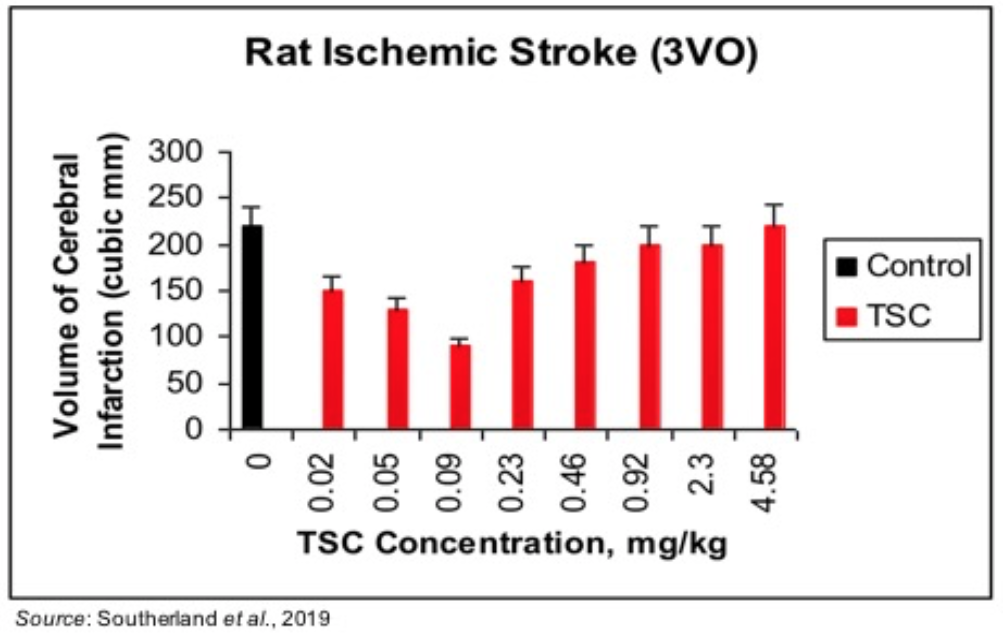
In another rat model of ischemia-reperfusion, which involved two hours of ischemia followed by 22 hours of reperfusion, treatment with TSC one and a half hours after onset of ischemia led to a significant reduction in infarct volume of 32%. In a third model of ischemia-reperfusion, which involved two hours of reperfusion followed by an additional four hours of one vessel occlusion, treatment with TSC significantly reduced infarct volume by 34%. Lastly, in an intracerebral hemorrhage model in which TSC was administered three hours after collagenase injection, there was a significant reduction in hemispheric swelling and hemorrhage volume in animals treated with TSC. It is important that TSC be effective, or at least not detrimental, regardless of the type of stroke. Otherwise, its use would be contraindicated prior to the diagnosis of the type of stroke and by that time it may be too late to be effective.
There are approximately 800,000 strokes every year in the U.S., and they are responsible for the deaths of approximately 140,000 individuals (CDC). Strokes cost the U.S. healthcare system an estimated $34 billion every year (Benjamin et al., 2017).
Financial Update
On August 10, 2020, Diffusion announced financial results for the second quarter of 2020. As expected, the company did not report any revenues. R&D expenses were $2.2 million for the second quarter of 2020 compared to $1.5 million during the second quarter of 2019. The increase was due to follow on work for the run-in portion of the Phase 3 GBM trial, expenses related to the lead-in trial for TSC in COVID-19 patients, and increased manufacturing costs. G&A expenses were $1.5 million for the second quarter of 2020 compared to $1.1 million for the second quarter of 2019. The increase was primarily due to increased professional expenses and salaries.
As of June 30, 2020, Diffusion had approximately $25.6 million in cash and cash equivalents. In May 2020 the company completed an offering of 11.4 million shares for net proceeds of $10.3 million. The company also received proceeds of $7.6 million from the exercise of 13 million warrants and the exchange and exercise of an additional 5 million warrants. We estimate the company has sufficient capital to fund operations into the fourth quarter of 2021.
As of August 5, 2020, Diffusion had approximately 64 million shares outstanding and, when factoring in stock options and warrants, a fully diluted share count of approximately 74.0 million shares.
Conclusion
We believe there is plenty of data to support the use of TSC as a treatment for ARDS and we look forward to the company initiating the clinical trial in ARDS patients soon and potentially reporting preliminary data from the lead-in trial in the fourth quarter of 2020. We have incorporated the recent financing and warrant exercises into our model and decreased the estimated future dilution, which has caused our valuation to increase slightly to $2.00 per share.
SUBSCRIBE TO ZACKS SMALL CAP RESEARCH to receive our articles and reports emailed directly to you each morning. Please visit our website for additional information on Zacks SCR.
DISCLOSURE: Zacks SCR has received compensation from the issuer directly, from an investment manager, or from an investor relations consulting firm, engaged by the issuer, for providing research coverage for a period of no less than one year. Research articles, as seen here, are part of the service Zacks provides and Zacks receives quarterly payments totaling a maximum fee of $40,000 annually for these services. Full Disclaimer HERE.