By Steven Ralston, CFA
OTC:DYLLF | ASX:DYL.AX
READ THE FULL DYLLF RESEARCH REPORT
Deep Yellow Ltd. (OTC:DYLLF) (ASX:DYL.AX) is being developed to become a tier-one uranium producer of uranium ahead of the anticipated up-cycle. Ongoing annual supply deficits and the rationalization of capacity by the major producers, along with production cutbacks due to the pandemic, are hastening the inflection point in uranium’s commodity cycle. Management is developing its Namibian uranium projects, one of which (the Reptile Project) has advanced to the PFS stage. Management is also seeking M&A opportunities to increase the company’s reserves and to broaden Deep Yellow’s geographic diversification in terms of mining jurisdictions. Management is focused on becoming a tier-one uranium producer by becoming a secure and reliable supplier of uranium.
The uranium industry is setting up for an anticipated accelerated rise in uranium prices.
• Supply/demand imbalances in the past have created three distinct commodity cycles in the uranium industry. Each cycle has begun with an increase in the price(s) of uranium and of uranium equities (both major established producers and junior mining companies), which has culminated in a rapid, exponential 1-2 year rally in uranium stocks.
• Over the last five years (2015-2019), demand has been growing steadily. Over the next five years, global nuclear reactor uranium requirements are expected to grow in the 0.5%-to-2.5% range.
• The majority of uranium is supplied to nuclear power plants through long-term contracts which are priced at a premium to spot market. Though currently these long-term contracts allow certain uranium producers to continue selling some of their uranium production profitably, about half of the uranium producers have operating costs that are above the current spot price.
• Prior to the pandemic-related shut downs, over 53 million lbs. U308 of capacity have been mothballed since 2013 through the shutdowns of unprofitable mines or by the intentional capacity rationalization by major producers (Kazatomprom and Cameco).
The uranium industry is composed of many companies, from major established producers to more speculative junior exploration companies. Though larger producers tend to have greater resources to navigate periods of depressed market conditions, junior companies provide greater leverage to the rise in uranium prices.
Almost all uranium stocks should benefit from the anticipated growth of much needed primary supply driven by the expected upcoming fundamental supply deficit; however, certain groups of uranium stocks benefit differently from each stage of the up-cycle. Historically (observing the 2001-2007 up-cycle), current producers reacted well to the initial rise in prices (since their current production could immediately benefit from the increase in the price of uranium), and they significantly outperformed the price of the commodity, itself. However, extreme out-sized returns were enjoyed by junior mining companies that traded below $0.25 per share at the bottom.
Then, there was a mid-phase when the rate of increase of the spot price of uranium moderated to a single-digit rate. In this period, junior mining companies corrected about 50%, while producers corrected about half that amount (around 25%). During the latter phase, when the uranium spot price surged irrationally, junior mining companies that have become producers (and the commodity) exhibited solid triple-digit returns from the consolidation low that had occurred in the mid-phase. Surprisingly, in this late phase, out-sized returns were achieved by junior mining companies which announced, at that instant, they were entering the uranium space; on the other hand, these same junior companies later experienced greater that 95% declines as the cycle eventually unwound.
Deep Yellow Ltd. is unique among junior mining companies and is being positioned to provide a leveraged opportunity to participate in all phases of the expected upswing in uranium prices under a Dual Pillar strategy. The company’s CEO, John Borshoff, achieved the same accomplishment as Founder and CEO of Paladin Energy by acquiring, developing and advancing both the Langer Heinrich mine into production within four years and, three years later, the Kayelekera mine in Malawi during the last uranium up cycle. Furthermore, Deep Yellow’s current flagship project, the Reptile Project, is in the exact same jurisdiction and shares the same palaeochannel network as Langer Heinrich mine. To be sure, Deep Yellow has uranium assets and management experience to walk the same path again during the next up cycle.
In October 2016, John Borshoff was appointed CEO and Managing Director of Deep Yellow, and the company’s focus shifted from not only expanding the resource base through exploration, but also pursuing multiple projects in order to create a multi-jurisdictional uranium platform.
Deep Yellow was formed in 2005 with Paladin Energy later becoming a major shareholder from 2005 to 2017. Initially, the company focused on several Australian projects, but in October 2006, Deep Yellow merged with Raptor Partners Limited, a BVI registered company, in order to secure prospective uranium prospects in Namibia (EPL 3496, EPL 3497 and EPL 3498 and one other EPL application at the time, which was later disposed).
The Reptile Project consists of EPL 3496 and EPL 3497, which encompass 959.4 square kilometers. The advanced project contains both palaeochannel-calcrete and basement/alaskite uranium deposits with JORC-compliant resource estimates. Combined, these deposits represent approximately 71.0 million lbs. U308 of Measured and Indicated Mineral Resources and 88.3 million lbs. U308 of Inferred Mineral Resources. A Scoping Study (SS) has been completed on the Tumas deposits (which represent 37.2 million lbs. U308 of Measured and Indicated Mineral Resources), and a Pre-Feasibility Study (PFS) was commissioned in January 2020. Management expects the PFS to be completed in December 2020.
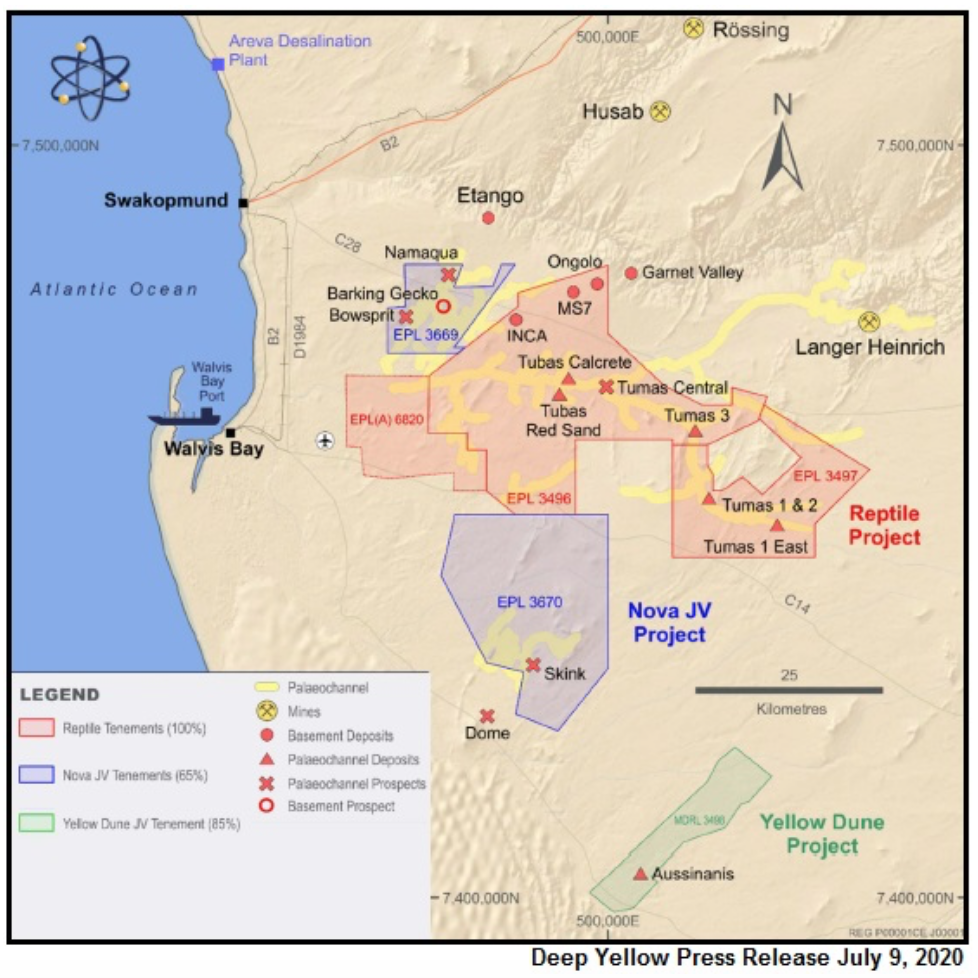
Also within six months of John Borshoff being appointed CEO, in late-March 2017, Deep Yellow entered into a joint venture agreement with JOGMEC (Japan Oil, Gas and Metal National Corporation) regarding the NOVA Joint Venture (or NOVA JV). JOGMEC could earn a 39.5% interest in the project for AUD$4.5 million in exploration and development expenditures over a period of four years. The earn-in process has been completed with the latest of many exploration campaigns funded by JOGMEC. The NOVA JV consists of EPL 3669 and EPL 3670, which encompass 556.8 square kilometers. Deep Yellow continues to be the manager of the NOVA JV holding 65% interest in the project, which will be reduced to 39.5% on confirmation of the JOGMEC earn-in.
Namibia
Namibia is a mining-friendly jurisdiction and has become the world’s fourth largest producer of uranium. The government has effectively developed, supported and regulated the uranium mining industry. Namibia is a proven mining jurisdiction with well-developed infrastructure, including highways, formed roads, power grid and a deep water port (Walvis Bay).
The cost of exploration in Namibia is low. The shallow depth of Namibia’s palaeochannel calcrete-hosted uranium deposits is conducive to low-cost RC drilling. Metallurgical test work was anticipated to require diamond core sample material; however, comparative test work between RC and diamond drilling samples showed future work could be carried out using RC samples only, a significant cost savings. In addition, the location is primarily desert terrain, allowing for drilling large areas easily and rapidly.
Corporate Strategy
Confident in the impending up-cycle in uranium, management embarked on a Dual Pillar growth strategy consisting of both organic and inorganic growth initiatives. Organically, management is focused on exploring and developing Deep Yellow’s existing portfolio of Namibian projects (Reptile, Nova JV and Yellow Dune) from exploration to production. The company’s primary focus in on advancing the Reptile Project through continued exploration with the resource having been increased and/or upgraded three times within the last few years. The latest drilling program at the Nova JV (Barking Gecko on EPL 3669) intersected very promising uranium mineralization in a large (4km long and 1km wide) anomalous zone, which wraps around a prominent domal feature. The best intersection was a 24-meter zone averaged 297ppm eU308 and a maximum grade of 736ppm was obtained over 1 meter.
The second pillar of management’s growth plan is to diversify the company’s uranium portfolio by pursuing acquisitions/mergers in order to create a multi-jurisdictional portfolio of low-cost uranium projects. When utilities look to enter into an off-take primary supply contract with a producer, one of the many aspects considered is to ensure a secure and reliable supply of uranium is the ability to fulfill the contract. In the eyes of utility buyers, being a multi-jurisdictional uranium producer mitigates operational, geographic and political risks.
Through organic and inorganic growth initiatives, management’s goal is to build a multi-project, low cost, Tier 1 uranium producer with the capacity to deliver 5-10 million lbs. of uranium annually.
Management
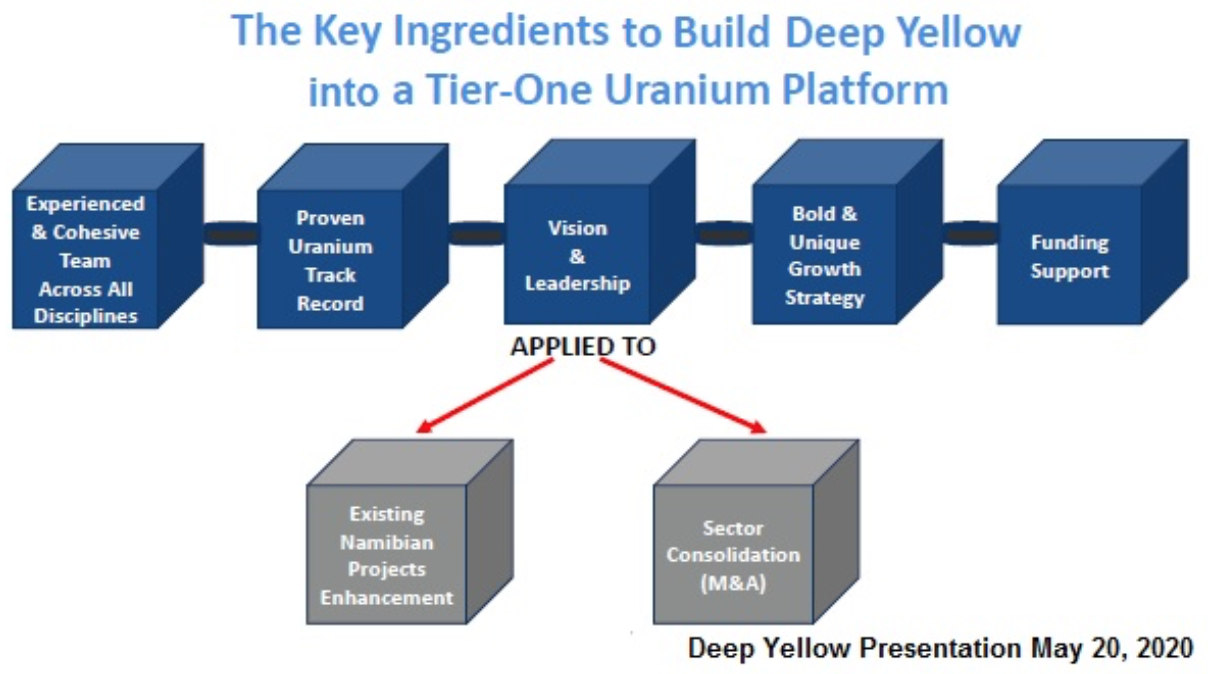
Utility buyers (and investors) look for assurance that management can effectively execute its strategy. Deep Yellow has a leadership team with a proven track record that has delivered in the past. Most significantly, under CEO John Borshoff, Paladin Energy acquired the Langer Heinrich Project from Aztec Resources in 2002 and within four years, commenced uranium mining operations in 2006. Paladin also acquired Kayelekera in Malawi (initially through a joint venture and later purchasing the entire project outright) and brought this mine into production in 2010. Moreover, most of Deep Yellow’s management team worked together at Paladin. Uranium mining projects face a multifaceted array of economic, environmental, regulatory, technical and geopolitical issues. In order to be successful, the management team of a junior uranium mining company needs the technical, regulatory, financing and geopolitical experience to navigate the necessary steps of exploration, environmental studies, metallurgical process design, mining lease application, permitting, mine construction and final fine-tuning of the process.
Reptile Project
Located in the Erongo Region of western of Namibia, Deep Yellow’s Reptile Project is held by Deep Yellow’s wholly owned subsidiary Reptile Uranium Namibia (Pty) Ltd (RUN). The Reptile Project consists of two EPLs (3496 and 3497), which encompass approximately 959.4 square kilometers.
In a little over three years, management has delivered a remarkable increase in the project’s estimated resources through aggressive drilling campaigns targeting six palaeochannel-calcrete deposit areas: Tumas 1, Tumas 1 East, Tumas 2, Tumas 3, Tubas and Tubas Red Sands, of which Tumas 3 is currently the most significant. The most recent total Measured and Indicated Resources at the Tumas 1, 2 and 3 deposits are 37.2 million lbs. at 324ppm (0.0324%) eU308. These three deposits were the subjects of the Scoping Study completed in December 2019 and are the topic of the ongoing Pre-Feasibility Study, which is expected to be completed by December 2020.
In addition, at a later date, the company intends to pursue a second type of uranium mineralization at the Reptile Project described as basement/alaskite. Usually referred to as uraniferous leucogranites, alaskite (a local term) dyke-like formations were formed by molten granite intruding into sedimentary rock. It is postulated elevated uranium grades occur when high-grade metamorphism causes a partial melting of basement rocks, which enhances the transportation and enrichment of uranium ore, such as at Rössing South.
Alaskite Alley, a north-south trending zone of occurrences of uraniferous leucogranite, currently supports two mines (Rössing and Husab), where the primary mineralization of the ore bodies is usually found in sheets of uranium-rich, granite-hosted alaskite (pegmatitic alkali-leucogranite). Rössing and Husab are almost due north of the Reptile Project, and Alaskite Alley appears to cut through the western part of Deep Yellow’s EPL 3496 tenement, in which Deep Yellow has discovered three small uranium deposits (Ongolo, MS7 and INCA). This prospective area has been relatively unexplored and currently is not a priority undertaking; however, it does represent a potentially substantial opportunity to discover additional uranium resources within EPL3496.
Valuation
Broadly speaking, the public uranium companies can be grouped into three segments: producers, development companies and exploration companies. Producers are actively mining and generating revenues. Exploration companies are prospecting and/or drilling to establish mineral resources. In between these two segments are the development companies that already have established resources and are advancing through the process to bring a mine in operation, generally from the point of initiating a Pre-Feasibility Study to the actual construction of a mine. The comparable companies to Deep Yellow fall into this category.
Further, the comparable companies have been narrowed through quantitative factors, particularly those with a market capitalization over $30 million and trading above $0.10 per share. This process captures a range of well-funded junior uranium development companies. Currently, the P/B valuation range of these comparable companies is between 0.61 and 6.05. With the expectation that DYLLF will attain a second quartile P/B ratio of 4.2, our comparable analysis valuation price target is US$0.68.
SUBSCRIBE TO ZACKS SMALL CAP RESEARCH to receive our articles and reports emailed directly to you each morning. Please visit our website for additional information on Zacks SCR.
DISCLOSURE: Zacks SCR has received compensation from the issuer directly, from an investment manager, or from an investor relations consulting firm, engaged by the issuer, for providing research coverage for a period of no less than one year. Research articles, as seen here, are part of the service Zacks provides and Zacks receives quarterly payments totaling a maximum fee of $40,000 annually for these services. Full Disclaimer HERE.