By John Vandermosten
NASDAQ:LPCN
READ THE FULL LPCN RESEARCH REPORT
Third Quarter 2020 Operational and Financial Results
On November 10, 2020 Lipocine (NASDAQ:LPCN) filed its third quarter 2020 10-Q and posted its earnings release for the three month period ending September 30, 2020. The company reported zero revenues and a net loss per share of ($0.07) compared to prior year third quarter revenues of $0.2 million and loss of ($0.12) per share. Attention since the second quarter report has been dominated by the target action date delay imposed by the FDA on Tlando. The FDA is now expected to provide its response to Lipocine’s new drug application around the week of November 30. The company accomplished several commitments since the middle of the year including enrollment completion and journal publication of the LPCN 1144 Liver Fat Study results and presentation of materials at scientific and investor conferences. The company’s shares exceeded $1.00 in June, and have remained above this level, allowing Lipocine to regain compliance with NASDAQ minimum bid requirements in July.
We expect to hear a response from the FDA on Tlando before year end. Assuming approval, Lipocine will likely find a partner to commercialize Tlando and use associated upfront and milestone payments to further develop the existing pipeline. Potential licensees will presumably wait until approval is granted before performing their due diligence. This suggests that a deal would take some time to be constructed and an announcement would come in the months following a positive answer from the FDA.
Operational expenses for 3Q:20 were $4.4 million, up 39% from the prior year period and net loss totaled ($4.3) million or ($0.07) per share. Research and development expenses totaled $2.5 million. The 45% rise in R&D over prior year amounts reflects increased costs related to the LiFT study and greater manufacturing costs related to Tlando and higher personnel expenditures. General and administrative costs rose 32% over last year’s third quarter levels to $1.9 million on an expansion in legal expenditures related to the Clarus dispute and an increase in personnel costs related to stock compensation, partially offset by lower marketing expenses and administrative travel. A decline in the share price since the prior quarter end reduced the warrant liability and required the recognition of a small gain, while net interest expense was lower due to lower interest rates.
Cash and marketable securities balance was $18.8 million as of September 30, 2020. There is another $5 million of restricted (1) cash which will remain on hold until Tlando is approved. Current and non-current debt is carried on the balance sheet at $6.4 million. Cash burn for 3Q:20 was approximately ($4.2) million and net cash provided by financing was $4.7 million representing funds raised through the at-the-market facility and the exercise of warrants.
Tlando
On November 11 of last year, Lipocine announced that it had received a complete response letter (CRL) for Tlando. The CRL identified one deficiency stating that the trial did not meet one of the three secondary endpoints for maximal testosterone concentrations (Cmax). No deficiencies related to chemistry, manufacturing and controls were noted. FDA guidelines call for 85% of subjects to achieve a Cmax below 1500 ng/dL and no more than 5% of subjects presenting a Cmax between 1800 ng/dL and 2500 ng/dL and 0% above 2500 ng/dL. In the most recent dosing validation (DV) study, 85% of subjects were below 1500 ng/dL and 7% were between 1800 ng/dL and 2500 ng/dL. Although there were small variations from the FDA guidelines in the original SOAR study for subjects above 2500 ng/dL, the FDA did not identify these as a deficiency during the original New Drug Application (NDA) submission.
Following the Post Action meeting with the FDA, Lipocine was advised to address the outstanding deficiencies with a reanalysis of existing data. This recommendation relieved Lipocine of the time and cost of an additional trial and also allowed the resubmission of the Tlando NDA in February. A target action date of August 28th was provided but has subsequently been extended. A company press release provided FDA estimates of an approximately three month delay (around November 30) in the Prescription Drug User Fee Act (PDUFA) date. Tlando has faced significant hurdles gaining the favor of the FDA, but we are hopeful for a favorable result in the next few weeks. We published a note on February 25th that discussed details regarding the resubmission.
LPCN 1144
Lipocine announced in August 2018 the pursuit of a new indication in nonalcoholic steatohepatitis (NASH). We discuss the indication and Lipocine’s efforts in an earlier piece that can be accessed here. Full enrollment of 36 subjects was achieved in November 2018.
In January 2019, Lipocine announced meaningful liver fat reduction in patients participating in its Liver Fat Study and informed investors that the company had filed an investigational new drug (IND) application to begin a Phase II study for NASH. Since LPCN 1144 is the same molecule as TLANDO, for which there were numerous safety studies completed, Lipocine was allowed to perform a proof of concept (POC) clinical study under the original IND to assess liver fat changes. This 36-person study was conducted in hypogonadal men at risk of developing non-alcoholic steatohepatitis (NASH) and results were measured using the magnetic resonance imaging proton density fat fraction (MRI-PDFF) technique. Topline results were announced in 1Q:19 demonstrating a 4.0% to 8.2% percentage point reduction in liver fat depending on baseline liver fat category. We discussed the results in further detail in our NASH Topline article.
Lipocine launched its Phase II clinical study for LPCN 1144 and dosed its first patient last September. Prior to the start of the trial, Lipocine announced that the FDA would allow the Phase II LiFT trial to enroll eugonadal patients in addition to the NASH patients that were initially targeted. This expansion was based on research that we discussed in a July 29th note. The study enrolled its last patient in September 2020 and is expected to report topline in January 2021 and 36 biopsy and MRI-PDFF data in mid-2021.
LiFT, an acronym of Liver Fat intervention with oral Testosterone, is a paired biopsy Phase II study in NASH subjects. The study design will employ a three-arm, double-blind, placebo-controlled structure and enroll approximately 75 biopsy-confirmed male NASH subjects with a NAS (2) score of greater or equal to four. The primary endpoint for the study is 12-week MRI-PDFF liver fat reduction and the first patient was enrolled in 3Q:19. As for the anticipated timeline, Lipocine expects top line liver fat reduction data in 4Q:20 as measured by MRI-PDFF at 12 weeks. Biopsy data at 36 weeks is expected to be available in the second quarter of 2021.

Exhibit I – LiFT Study Timeline (3)
NASH Environment
A lot has happened in the NASH space in 2020. Genfit (GNFT) announced that it will halt development of elafibranor after it failed to distinguish itself compared to placebo earlier this year. CymaBay (CBAY) announced that the FDA had lifted the hold on seladelpar’s Phase II study last month. No evidence was found for liver injury for the drug and the trial is expected to resume. Intercept’s (ICPT) OCA received a complete response letter from the FDA in late June noting that the agency remains uncertain that the benefits of the drug outweigh the risks. Viking (VKTX) is conducting the Phase IIb VOYAGE trial for VK2809, which is still ongoing. A bright spot in the space has been results from Akero’s (AKRO) Phase IIb trial for efruxifermin in NASH which were announced June 30. The study found that 48% of patients had fibrosis improvement of at least one stage with a 62% response rate. Fibrosis improved by at least two stages for 28% of the group with a 38% response rate and 48% experienced NASH resolution without worsening of fibrosis across all dose groups.
LPCN 1148
Lipocine is preparing to develop its testosterone molecule to treat NASH cirrhosis patients. While the target market is smaller than that of pre-cirrhotic NASH, there are no other FDA approved products available. The inverse relationship between testosterone and sarcopenia and the increased risks of advancing NASH cirrhosis validates this pursuit. Pending funding, Lipocine plans to initiate a proof of concept trial to evaluate the potential of this candidate. The company’s Investigational New Drug (IND) application was cleared by the FDA in May 2020. We anticipate Lipocine will launch the Phase II trial after the start of commercialization of Tlando and upon availability of sufficient capital to fund it.
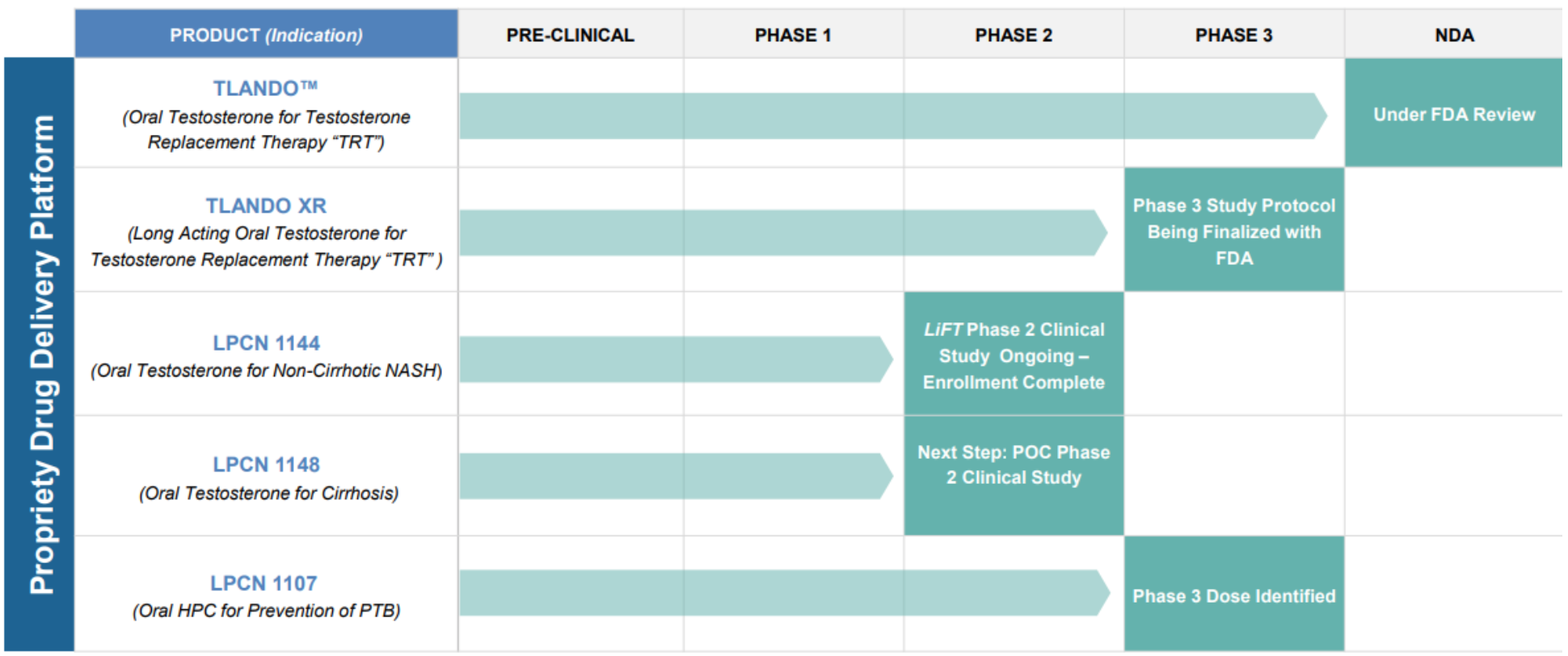
Exhibit II – Lipocine Pipeline (4)
Milestones
‣ Tlando CRL – November 9, 2019
‣ Tlando FDA post action meeting – January 2020
‣ Resubmission of Tlando NDA – February 2020
‣ Investigational New Drug (IND) clearance for LPCN 1148 – May 2020
‣ Wajda v. Patel shareholder suit dismissed – July 2020
‣ Tlando target action date – Expected week of November 30, 2020
‣ Primary endpoint results for LiFT (LPCN 1144) – January 2020
‣ Patent Infringement trial – February 2021
‣ Complete Phase II LiFT (LPCN 1144) – 2Q:21
‣ 36-week biopsy data in mid-2021 (LPCN 1144)
Summary
Since our previous update, the FDA has extended its deadline to provide a response for the Tlando new drug application by at least three months. Since then, Lipocine has participated in several conferences, including the HC Wainwright investment conference and the Sexual Medicine Society of North American and Liver Meeting scientific conferences. Assuming a favorable outcome for the application, Lipocine will seek a commercialization partner and should receive upfront and milestone proceeds in conjunction with a deal. The Phase II LiFT trial continues to be a bright spot for the company and is potentially able to address a large unmet need in NASH patients in contrast to competing programs which have met with difficulty. Management has guided towards a January 2021 readout of LiFT trial results. Lipocine is also developing LPCN 1148 for cirrhosis patients which was recently given clearance to begin a Phase II study. While we do not see this program entering the clinic until sufficient capital is available, we do think it will advance if Phase II data for LPCN 1144 are positive.
SUBSCRIBE TO ZACKS SMALL CAP RESEARCH to receive our articles and reports emailed directly to you each morning. Please visit our website for additional information on Zacks SCR.
DISCLOSURE: Zacks SCR has received compensation from the issuer directly, from an investment manager, or from an investor relations consulting firm, engaged by the issuer, for providing research coverage for a period of no less than one year. Research articles, as seen here, are part of the service Zacks provides and Zacks receives quarterly payments totaling a maximum fee of $40,000 annually for these services. Full Disclaimer HERE.
________________________
1. Tlando was not approved by the FDA by May 31, 2018, and therefore Lipocine is required to maintain $5.0 million of cash collateral at Silicon Valley Bank (the lender) until such time as it is approved by the FDA.
2. NAS: NAFLD (Non-alcoholic fatty liver disease) Activity Score. Discussion of the metric can be found here.
3. Source: Lipocine Corporate Presentation May 2020.
4. Source: Lipocine Corporate Presentation September 2020.