By John Vandermosten, CFA
NASDAQ:LTRN
READ THE FULL LTRN RESEARCH REPORT
What’s New?
On October 29th, 2020, Lantern Pharma Inc. (NASDAQ:LTRN) published its third quarter 2020 earnings release and filed its 10-Q with the SEC for the three month period ending September 30, 2020. Third quarter and year to date highlights include surpassing one billion curated data points for the RADR platform, advancing LP-184 in collaborations with Fox Chase Cancer Center and Georgetown University and execution of a contract to produce clinical trial quantities of cGMP-quality LP-300 drug substance.
No revenues were reported during the third quarter. Operating expenses for the three month period ending September 30, 2020 were $1.7 million, up $660,000 compared to prior year levels. General and administrative expenses were $1.1 million, rising 150% from increases in expenses related to labor, business development, and corporate insurance partially offset by lower travel and relocation expenses. Research and development spend expanded 160% to $600,000. The change was attributed to increased research study expenses, expanded product candidate manufacturing related expenses and higher research and development employee costs.
Cash on the balance sheet was $20.8 million and liabilities included an immaterial amount of borrowing related to the paycheck protection plan (PPP) as of September 30, 2020. Cash burn for the three month period was ($2.9) million which compares with ($556,000) for the same quarter last year. A small amount of cash from financing was used to repay a loan.
1.1 Billion Data Points
Soon after going public, Lantern announced that it had surpassed 450 million data points for its RADR AI platform and by late July, exceeded 500 million curated oncology data points. As of the end of October, over 1.1 billion data points were curated, providing a trove of information that can reduce the development risk of existing assets and help identify new ones. As more data are accumulated, it becomes easier to generate a precision signature and understand the mechanism of action of a drug on a specific tumor. Being able to identify the best match between drug and tumor type can accelerate clinical trials, reduce the cost of drug development and identify patient types most amenable to targeted oncology therapies.
Lantern is gathering many types of information for its platform. This includes DNA, RNA and transcriptome sequences as well as enzyme, antibody and antigen data. These data expand the AI system’s ability to generate actionable output as more information is accumulated. For new drug prospects, additional information points can help describe a tumor’s reaction to different drug classes and help match existing therapeutics with specific, biomarker or genomically defined tumor types.
Additional data increases the value of the platform with collaborators seeking an advantage in their pipelines and candidates. As the RADR platform continues to evolve, Lantern has indicated that it will refine the use of meta tags to improve the types of questions asked and allow the process to be further automated to address larger data sets.
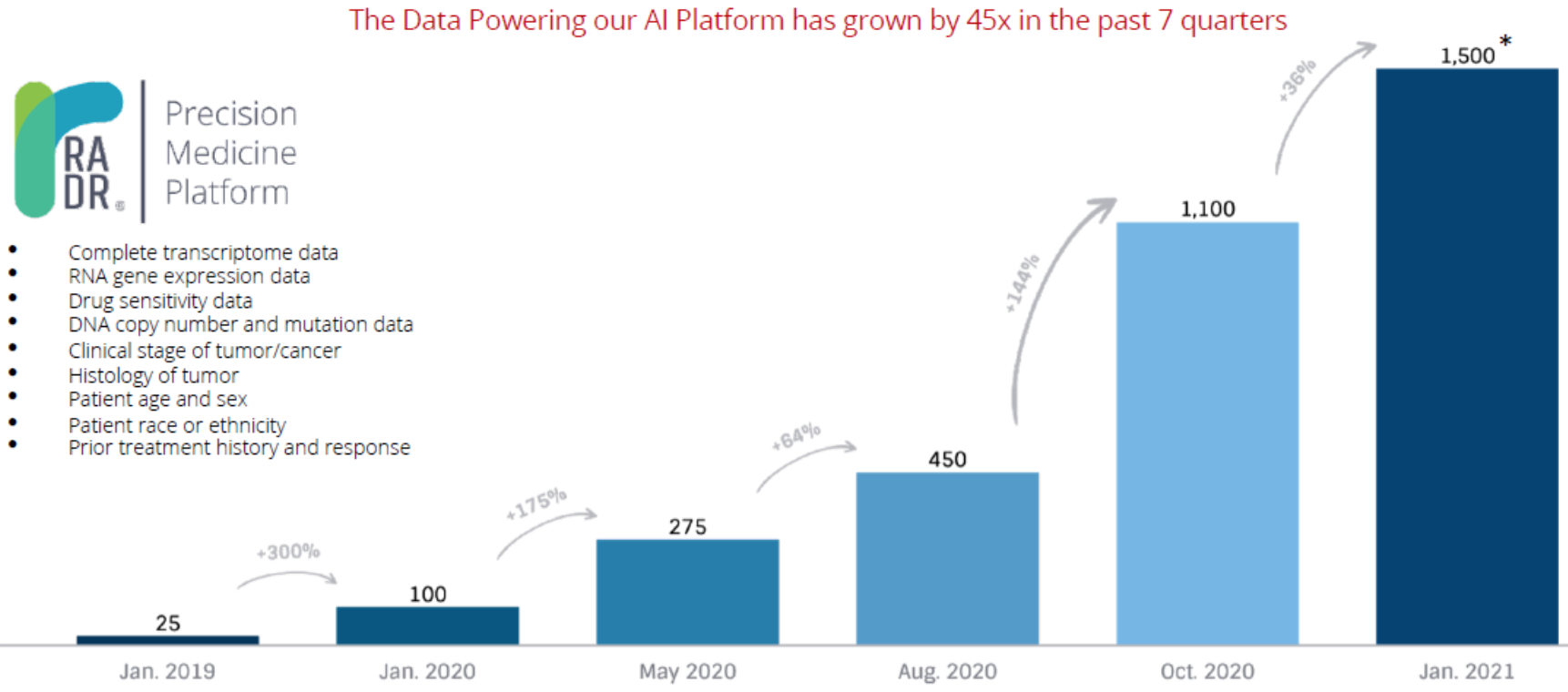
Progression of Data Points (1)
Academic Collaborations
On September 27, Lantern announced a collaboration and research agreement with Fox Chase Cancer Center in Philadelphia, Pennsylvania. The cooperation will advance efforts with Lantern’s LP-184 in pancreatic cancer to develop a more biologically relevant and robust gene signature for future clinical trials and improve the precision of cancer treatment. The work on LP-184 at Fox Chase, led by Igor Astsaturov, MD, Ph.D., will identify the opportunities for the candidate in pancreatic cancers. The effort employed 3D organoids and patient derived xenograft (PDx) models to identify the biomarker signatures necessary to characterize the mechanisms behind LP-184. Lantern had previously announced that it was engaged in discussions with Fox Chase to advance LP-184, to evaluate prostaglandin reductase 1 (PTGR1) status effect on drug sensitivity using cell lines and PDx models in various cancer types. Lantern expects to move next into animal models, building upon in silico and in vitro work completed. Eventually, LP-184 may be used in glioblastoma setting where temozolomide has not worked well, such as in the O6-methylguanine DNA methyltransferase (MGMT) unmethylated population.
Georgetown University and Lantern announced a continuation in their agreement on October 5th related to advancing LP-184 in genomically defined solid tumors, including prostate and pancreatic cancers. Lantern has been collaborating with Georgetown since 2019 to determine the efficacy of LP-184 in a panel of prostate cancer organoid models and engineered pancreatic cancer cell lines. The studies will gather data on LP-184 responses and drug sensitivity in prostate and pancreatic cancers. This first stage of work demonstrated that LP-184 had nanomolar potency across a wide variety of prostate cancer cell lines, had the ability to kill PTGR1 expressing cancer cells and exhibited dose dependent cancer cell death in 3D organoid cultures. The efforts are generating genomic, transcriptomic and drug sensitivity data that will refine the response signature and identify the DNA repair deficiencies that are most likely to respond to LP-184. So far the studies have suggested that LP-184’s mechanism of action damages and blocks a critical pathway for cancer cell proliferation and is particularly amenable to combination therapies in a number of tumor types. The next stage of the Georgetown collaboration will focus on a larger set of PDx models and attempt to confirm the role of PTGR1 and the genetic mutations driving the DNA damage repair pathways that make the drug potent in the identified cancers. In preparation for clinical trials, these efforts will develop a more biologically relevant and robust gene signature that is more personalized and effective for specific patients with prostate cancer.
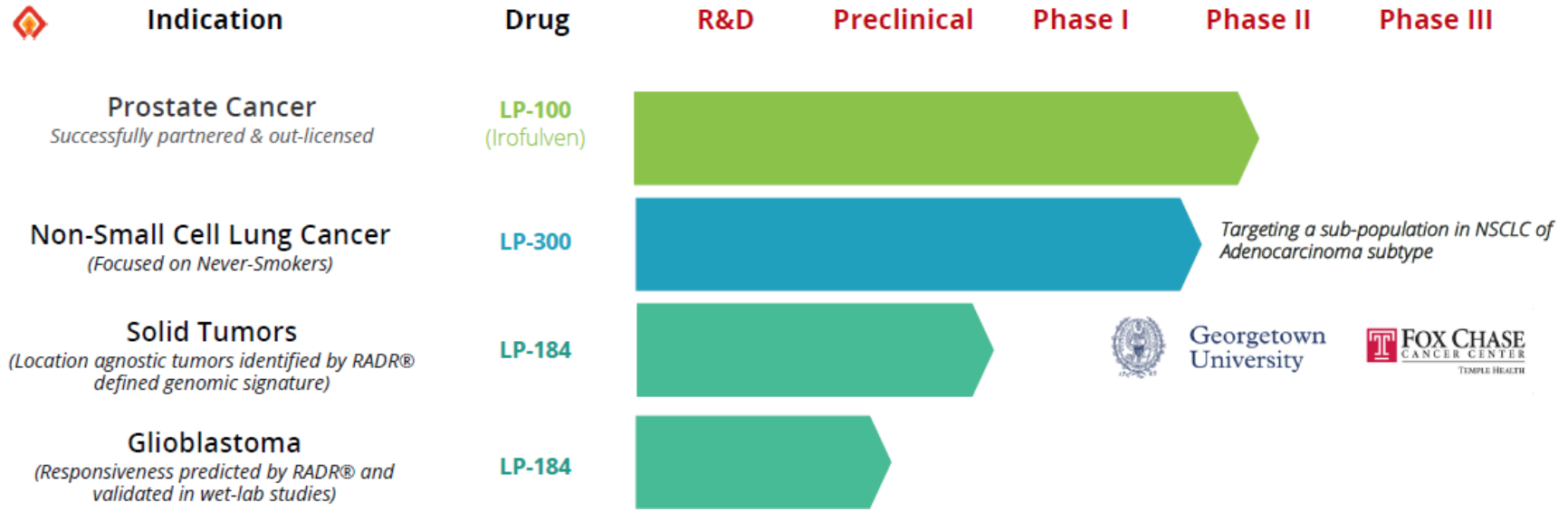
Lantern Pharma Pipeline (2)
Historical and Forward Looking Milestones
‣ First patient dosed with LP-100 - 4Q:18
‣ NCI collaboration to identify response-predictive gene signatures - October 2019
‣ IPO and initiation of trading on the NASDAQ – June 10, 2020
‣ LP-300 cGMP contract – July 2020
‣ Regulatory interaction for Phase II trial design, LP-300 – 2H:20
‣ Exceed 1.1 billion RADR data points – October 2020
‣ Joint update meeting with Allarity Therapeutics (LP-100) – 4Q:20
‣ Analyst day update call – 4Q:20
‣ Phase II of LP-100 in mCRPC readout – 1H:21
‣ Phase II launch of LP-300 – mid-2021
‣ Phase I launch of LP-184 – 4Q:21 to 1Q:22
Investment Thesis
‣ Proprietary RADR AI-driven algorithm for detecting genetic/biomarker signatures
‣ Opportunities to salvage failed drugs with clinically validated safety history
‣ Declining returns and smaller end markets can benefit from improved drug development approaches that leverage AI
◦ Build from existing preclinical and clinical work
◦ Pursue orphan indications and personalized medicine
◦ Generate pivotal data with less expensive, targeted trials
◦ Use modeling and complex algorithms to reduce failure risk
‣ Two years of financial runway
Summary
Lantern has recognized the opportunity that AI and ML present and is leveraging its RADR platform to identify promising candidates in oncology. RADR can identify genomic biomarkers that identify a responsive population by using data generated from genetic sequencing, drug sensitivity, trial data and patient data among other information sets. By pursuing candidates that have already generated substantial pre-clinical and clinical data, much of the work to demonstrate safety and characterize mechanism of action has been completed. With the ability to target a small population based on biomarkers and genomic data, Lantern can identify patients that will respond to a specific drug therapy. This allows for smaller, accelerated and less expensive trials to obtain approval in underserved indications.
SUBSCRIBE TO ZACKS SMALL CAP RESEARCH to receive our articles and reports emailed directly to you each morning. Please visit our website for additional information on Zacks SCR.
DISCLOSURE: Zacks SCR has received compensation from the issuer directly, from an investment manager, or from an investor relations consulting firm, engaged by the issuer, for providing research coverage for a period of no less than one year. Research articles, as seen here, are part of the service Zacks provides and Zacks receives quarterly payments totaling a maximum fee of $40,000 annually for these services. Full Disclaimer HERE.
________________________
1. Source: 3Q:20 Earnings Call Corporate Presentation
2. Source: 3Q:20 Earnings Call Corporate Presentation