By David Bautz, PhD
NASDAQ:VKTX
READ THE FULL VKTX RESEARCH REPORT
Business Update
VK0214 IND Filed
Viking Therapeutics, Inc. (NASDAQ:VKTX) recently announced that the IND for VK0214 has been filed and a Phase 1 trial will commence upon clearance of the IND. The details of the Phase 1 trial will be announced upon study initiation, however we believe the trial will start with a single-ascending dose portion in healthy volunteers and, if there is no safety signal, a multiple-ascending dose portion of the trial in healthy volunteers will begin. Based upon those data, a starting dose will be selected for a study in X-ALD patients in which levels of VLCFAs will be examined following 28 days of treatment.
VK0214 is being developed for the treatment of X-linked adrenoleukodystrophy (X-ALD), an orphan neurodegenerative disease that affects approximately 8,000 individuals in the U.S. and 12,000 in Europe. In contrast to VK2809, VK0214 is a TRβ agonist that is activated by carboxyesterases that are ubiquitously expressed in the body. The drug also has a different pharmacokinetic and pharmacodynamic profile than VK2809, thus potentially making the drug more suitable for a disease such as X-ALD, which is more diffuse than NASH.
X-ALD is caused by a mutation(s) in the ABCD1 gene, which encodes the adrenoleukodystrophy protein (ALDP). ALDP is responsible for transporting very long chain fatty acids (VLCFAs) into peroxisomes for degradation, thus without proper ALDP function the VLCFAs accumulate to toxic levels. The theory behind using VK0214 to treat X-ALD is that it increases the expression of ALDR (encoded by the ABCD2 gene), which is also a VLCFA transporter, thus compensating for the loss of ALDP. Please refer to our previous report discussing the use of VK0214 in a mouse model of X-ALD, which can be found here.
Additional support for the use of a compound that can augment expression of the ABCD2 gene in patients with X-ALD comes from a study of vorinostat (Zolinza®), a histone deacetylase inhibitor that is approved for the treatment of cutaneous manifestations in patients with cutaneous T cell lymphoma (CTCL) (Zierfuss et al., 2020). Researchers discovered that expression of ABCD2 in macrophages is controlled through histone modifications in the ABCD2 promoter region, specifically a high level of histone 3 lysine 27 acetylation (H3K27ac). Thus, macrophages from X-ALD patients were treated in vitro with vorinostat, and as shown in the following figure there was a dose dependent increase in ABCD2 expression (lower left), which led to a subsequent increase in the β-oxidation of C26:0 (a type of VLCFA, lower right).
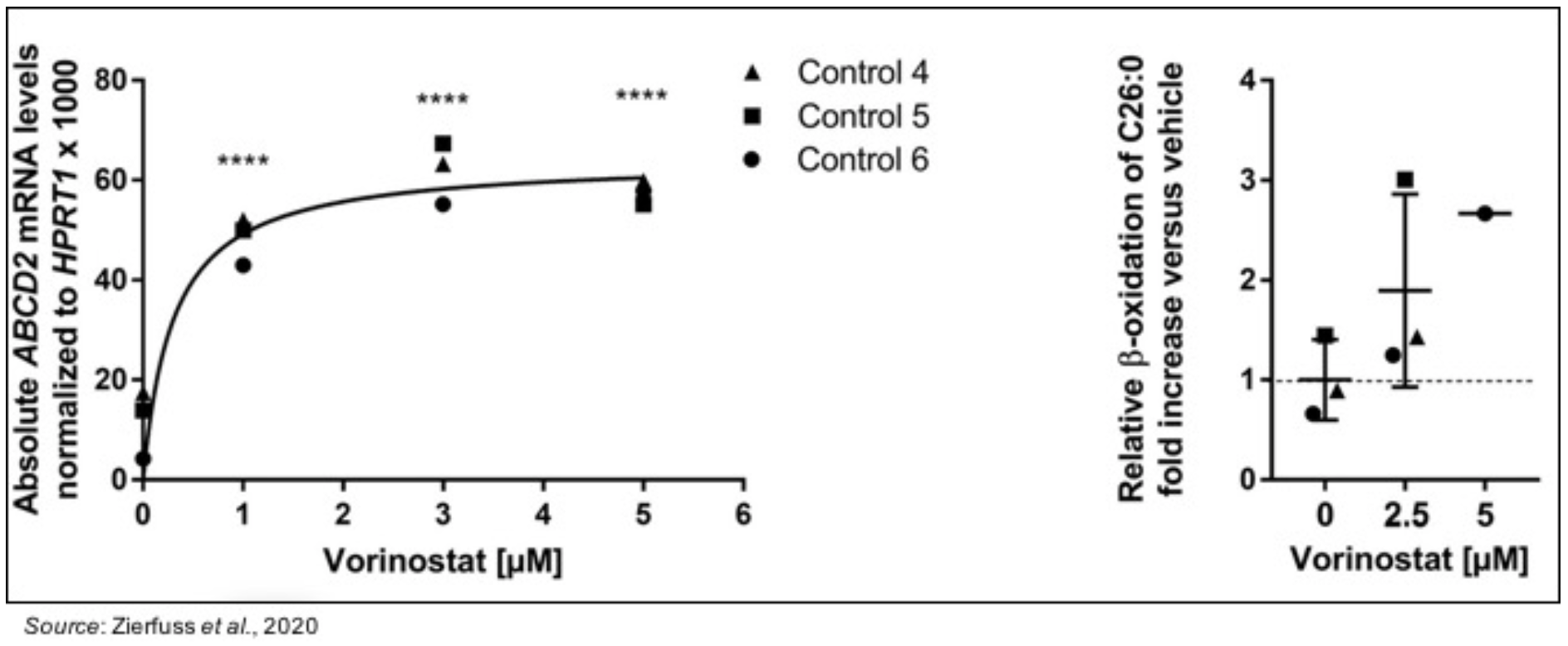
While VK0214 and vorinostat are not in the same class of drugs, we feel that the data above shows a compound that is able to induce expression of the ABCD2 gene (which both VK0214 and vorinostat are able to do) can lead to the desired phenotype, namely an increase in the β-oxidation of VLCFAs. Zierfuss et al. attempted treatment of advanced cerebral adrenoleukodystrophy (CALD) patients with vorinostat but were unsuccessful in halting progression of the disease, however they did note decreases in the plasma levels of C26:0 and improvements in other inflammatory markers. We are encouraged by the clinical application of a compound that increases ABCD2 expression in X-ALD patients and believe this further supports testing VK0214 in this population.
Update on VOYAGE Trial
Viking is currently conducting the Phase 2b VOYAGE trial of VK2809 in patients with biopsy-confirmed nonalcoholic steatohepatitis (NASH). The randomized, double blind, placebo-controlled trial is expected to enroll approximately 340 patients with fibrosis ranging from stages F1 to F3 across five treatment groups: 1 mg VK2809 daily, 2.5 mg VK2809 daily, 5 mg VK2809 every other day, 10 mg VK2809 every other day, or placebo. We expect approximately 75 patients per arm for the 2.5 mg, 5 mg, 10 mg, and placebo groups and approximately 40 patients in the 1 mg arm. There will be a total of approximately 70 centers enrolling patients in the US and we expect approximately 10-15 ex-U.S. centers opening beginning in the third quarter of 2020. An overview of the trial is given below.
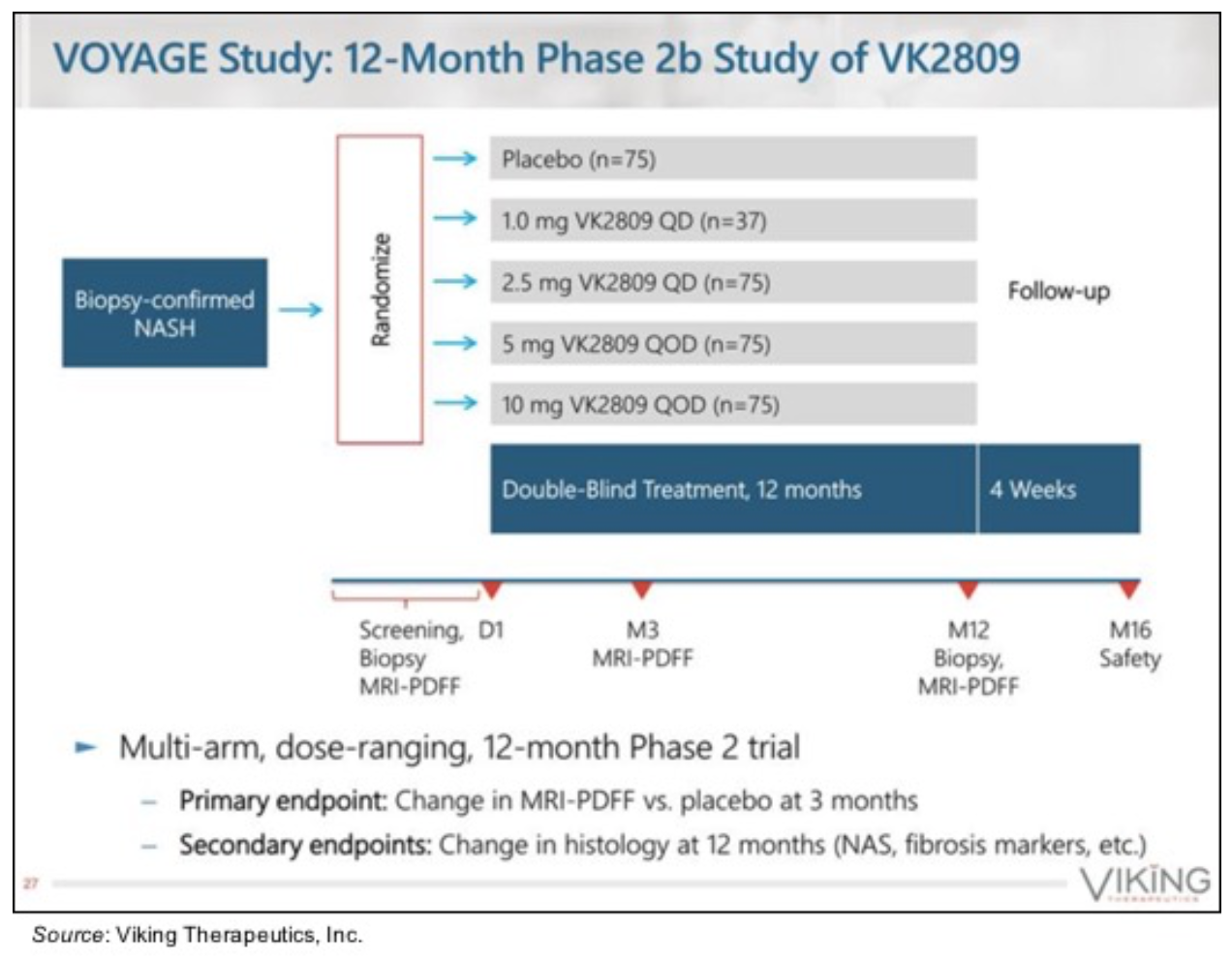
The primary endpoint of the trial is the 12-week change in liver fat content assessed by magnetic resonance imaging proton density fat fraction (MRI-PDFF) for those treated with VK2809 compared to placebo. A key secondary outcome measure is histological changes assessed by liver biopsy following 52 weeks of dosing.
During the second quarter conference call update, management reiterated that the ongoing coronavirus pandemic never resulted in a pause in enrollment and since the last update sites have continued to loosen restrictions that were implemented at the beginning of the pandemic. The company continues to open additional sites and we anticipate sites in the E.U. opening in the third quarter of 2020, with a target of over 80 sites globally (approximately 10-15 in the E.U.). We continue to anticipate enrollment completing during the first half of 2021.
The company also reported that dosing for the first patients enrolled has now exceeded six months. As a reminder, 6-month toxicology data had originally been submitted with the IND and the FDA had requested the 12-month toxicology data when it became available. The trial was allowed to commence with six months of dosing when the IND was approved. The company subsequently submitted the requested 12-month toxicology data several months ago, as indicated on the first quarter 2020 update call. There isn’t a formal mechanism in place for the company to hear back from the FDA regarding the 12-month toxicology data, and since “no news is good news” in this situation it means there were no issues with the 12-month toxicology data and dosing can continue as planned up to 52 weeks.
Presentation at EASL
In February 2020, Viking announced that an abstract describing additional data from the Phase 2 trial of VK2809 in patients with non-alcoholic fatty liver disease (NAFLD) and hypercholesterolemia was selected for an oral presentation at the 2020 International Liver Congress, which is hosted by the European Association for the Study of the Liver (EASL). The presentation will take place on August 28, 2020. Full details of the abstract have not been disclosed, however the company did say that it will include data for patients that had a liver MRI performed at week 16 of the trial (4 weeks after dosing stopped) along with an examination of various subsets and patient characteristics.
Financial Update
On July 29, 2020, Viking announced financial results for the second quarter of 2020. As expected, the company did not report any revenues in the second quarter of 2020. Viking reported a net loss of $9.6 million, or $0.13 per share, in the second quarter of 2020 compared to a net loss of $7.7 million, or $0.11 per share, for the second quarter of 2019. R&D expenses in the second quarter of 2020 were $7.8 million, compared to $7.3 million for the second quarter of 2019. The increase was primarily due to increased expenses related to clinical trials, manufacturing, salaries and benefits, and stock-based compensation. G&A expenses for the second quarter of 2020 were $2.8 million, compared to $2.2 million for the second quarter of 2019. The increase was primarily due to increased stock-based compensation, legal expenses, and insurance expenses.
Viking exited the second quarter of 2020 with approximately $263 million in cash, cash equivalents, and short-term investments and we believe the company is continuing to be fiscally prudent with its resources. As of July 15, 2020, Viking had approximately 72.8 million shares outstanding and, when factoring in stock options and warrants, a fully diluted share count of approximately 82.8 million.
Conclusion
The IND filing for VK0214 is an important milestone for the company and we look forward to additional details of the Phase 1 trial when it gets underway. With the ongoing pandemic it is very difficult to gauge when we might see the first patient data, however we are hopeful that initial data on VLCFA levels in X-ALD patients could be reported in the first half of 2021.
We were glad to hear that enrollment in the VOYAGE trial is continuing as well as possible given the current circumstances, and as additional clinical sites come on board we are confident the company can complete enrollment during the first half of 2021.
With no changes to our model our valuation remains at $22 per share.
SUBSCRIBE TO ZACKS SMALL CAP RESEARCH to receive our articles and reports emailed directly to you each morning. Please visit our website for additional information on Zacks SCR.
DISCLOSURE: Zacks SCR has received compensation from the issuer directly, from an investment manager, or from an investor relations consulting firm, engaged by the issuer, for providing research coverage for a period of no less than one year. Research articles, as seen here, are part of the service Zacks provides and Zacks receives quarterly payments totaling a maximum fee of $40,000 annually for these services. Full Disclaimer HERE.