By John Vandermosten, CFA
EPA:ALQGC
READ THE FULL ALQGC RESEARCH REPORT
First Half 2021 Results
Quantum Genomics S.A. (EPA:ALQGC) updated investors regarding first half 2021 financial and operational results in a press release and submission of its semi-annual financial report.
Highlights for the first half ended June 30th 2021 and to-date include:
➢ Launch of Phase III REFRESH trial - January 2021
➢ Orient EuroPharma acquires stake in Quantum - February 2021
➢ Termination of collaboration with Qilu Pharma - April 2021
➢ Secured €3 million in non-dilutive financing - April 2021
➢ Publication in Biomedecine et Pharmacotherapy - May 2021
➢ First patient enrolled in REFRESH - July 2021
➢ Presentation at ESC Annual Congress - August 2021
➢ Presentation of QUORUM results at ESC1 Meeting - August 2021
➢ REFRESH study regulatory clearance in South Korea & Taiwan – October 2021
Financial Results
Quantum generated revenues of €2.7 million in first half 2021 and incurred operational expenses of (€9.9) million yielding net income of (€6.2) million or (€0.23) per share.2
For the first half ending June 30, 2021 and versus the same period ending June 30, 2020:
➢ Revenue was €2.7 million, up 619% from €0.4 million, mainly composed of upfronts from South Korea, Greece and Canada;
➢ Personnel costs were (€1.1) million, comparable with (€1.1) million;
➢ Other operating costs were (€8.8) million vs (€5.2) million, driven by progress in clinical studies;
➢ Research tax credits were €1.2 million, up 36% from €0.9 million;
➢ Net loss was (€6.2) million versus (€5.1) million, or (€0.23) and (€0.25),3 respectively.
As of June 30, 2021, cash and equivalents totaled €24.9 million. Cash burn for the first half was (€5.8) million. Financial debts stand at €3.0 million related to the PGE state guaranteed loan and the R&D innovation loan.
Development Advances in Asia
Following the first half 2021 report announcement, Quantum updated its regulatory status in Asia announcing the clearance of the Phase III REFRESH study by regulatory authorities and ethics committees in South Korea and Taiwan. This is an important milestone as centers in these two countries are expected to contribute 20% of the global study population. DongWha, which is the sponsor for the South Korean trials and Orient EuroPharma, which is the sponsor for the Taiwanese ones are expected to recruit the first patients in the coming weeks. Each of the partners is also expected to make milestone payments to Quantum before year end.
QUORUM Study Results Announcement
Quantum reported topline results for the QUORUM study which were presented at the European Society of Cardiology (ESC) Congress and announced in a press release on August 27, 2021. Professor Gilles Montalescot of Pitié-Salpêtrière University Hospital, Paris, France delivered the results during the conference’s scientific sessions.
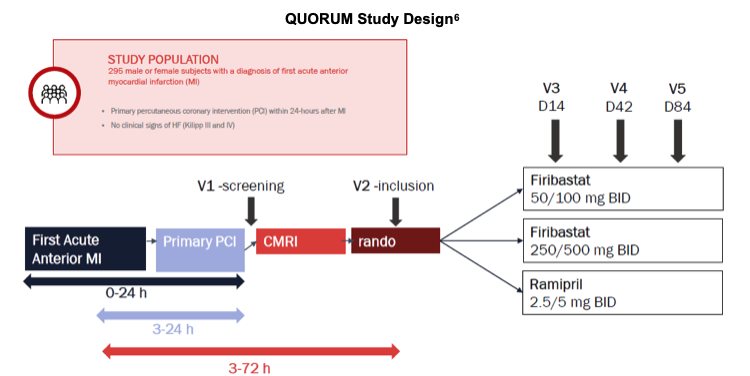
QUORUM (NCT03715998) is a 295-patient multi-center, multinational, randomized, double-blind, active-controlled trial designed to assess the efficacy and the safety of twice-daily firibastat compared to ramipril in the prevention of left ventricular dysfunction after acute myocardial infarction (MI). Patients were recruited within 24 hours of their first MI. These patients were randomized into three groups with varying firibastat dosing schemes.
QUORUM dosing groups:
➢ 100 mg firibastat twice daily after two weeks at 50 mg twice daily;
➢ 500 mg firibastat twice daily after two weeks at 250 mg twice daily;
➢ Ramipril 5 mg twice daily after two weeks at 2.5 mg twice daily (standard treatment).
The primary outcome measure was change from baseline in left ventricular ejection fraction (LVEF) assessed by cardiac MRI. Secondary endpoints include changes in other MRI parameters, cardiovascular events, biomarkers and clinical and laboratory tolerance. The trial was powered to show a minimum difference of 5% between the groups on the overall population in the primary endpoint.
Topline results highlights include:
➢ Firibastat efficacy comparable with ramipril in preventing degradation of LVEF after MI in total study population;
➢ Firibastat outperformed ramipril in severe patients with low ejection fraction;
➢ Firibastat improved blood pressure profile in study population; and
➢ Good safety profile was observed from both doses of firibastat.
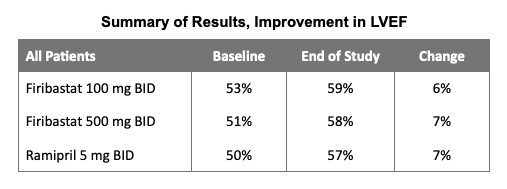
After 12 weeks of treatment, left ventricular ejection fraction evaluated by cardiac MRI increased from 53% to 59% in the firibastat 100 mg group, from 51% to 58% in the firibastat 500 mg group and 50% to 57% in the ramipril group. Firibastat efficacy was not statistically differentiable from ramipril.
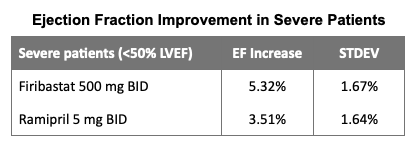
In the subgroup of severe patients with ejection fraction less than 50% (n=126), ejection fraction increased by 5.32 (+/- 1.67%) and 3.51 (+/- 1.64%) from baseline for firibastat and ramipril, respectively, which was directionally favorable but did not meet statistical significance. This group of patients comprised 43% of the enrolled population.
Firibastat dosing was not limited by excessive changes in blood pressure. Heart failure patients may suffer from hypotension and ACE inhibitors can exacerbate this, limiting maximum dosing. Ramipril was dose limited, with 32.5% of patients failing to reach the target dose while only 20% of patients were dose limited in the firibastat arms. Firibastat was safe and well tolerated with the most common side effects being skin reactions, which are also common with ramipril. Renal adverse events were not reported in the firibastat 100 mg arm, but were reported in both the 500 mg arm and the ramipril 5 mg arm, with fewer renal adverse events in the firibastat 500 mg arm. Common side effects for ramipril include hypotension, adverse renal function and hyperkalemia.
While firibastat did not demonstrate superior efficacy compared to gold-standard ramipril, patients on ramipril can become dose-limited due to impacts on blood pressure. In a study conducted by Mouhat et al., patients with systolic blood pressure below 125 mmHg were twice as likely to suffer cardiovascular death in the first year compared with those with systolic blood pressure above 125 mmHg4 highlighting the importance of regimens that can avoid reducing blood pressure. Low blood pressure or hypotension is common in patients with heart failure which can lead to dizziness, fatigue and inadequate blood flow. ACE inhibitors are associated with hypotension in heart failure patients and alternatives are preferred in those that have systolic blood pressure below 110 mmHg.5
Quantum’s goal is to target all patients in the post-MI HF group that have an ejection fraction below 50% and are unlikely to be up-titrated to ramipril due to blood pressure. The goal with a successful trial in this group is to replace other ACE inhibitors in this group of patients who are now largely maintained on low doses of ramipril without any proven efficacy of the dose and at higher risk of negative outcomes.
Phase III REFRESH Launched
On January 18, 2021, Quantum announced the launch of REFRESH, a Phase III pivotal trial of once daily firibastat in difficult-to-treat7 hypertension and resistant8 hypertension, a key milestone in the pursuit of global commercialization for Quantum’s lead candidate. The study is part of an overall Phase III evaluation of firibastat. If successful, the once-daily administration will provide additional convenience and compliance compared to the twice-daily regimen being investigated in the FRESH trials. The goal of REFRESH is to assess both long-term safety and three-month efficacy in the once-daily dose. The launch of the trial will not impact the anticipated timeline for the filing of firibastat which is expected in 2023.
Dosing for REFRESH will be 1000 mg firibastat, administered once per day to individuals with treatment-resistant hypertension. For the first three months of treatment, patients in REFRESH will receive 1000 mg firibastat once-daily in addition to their current regimen. The primary endpoint is reduction in systolic automated office blood pressure from baseline. Following the three-month efficacy evaluation, treatment will continue with follow-up for six months. 100 patients will receive follow up exams at 12 months to assess long-term safety. As hypertension often requires chronic use of medication, the long-term safety data generated in REFRESH is necessary for submission of a New Drug Application (NDA).
REFRESH First Patient Enrolled
Quantum announced on July 8, 2021 that the first patient had been enrolled in its pivotal Phase III REFRESH trial of once-daily firibastat in difficult-to-treat and resistant hypertension. REFRESH is the last step in an FDA-endorsed development plan needed before submission for market authorization anticipated in 2H:23. The study is being conducted with partners DongWha for the South Korean market and Orient Europharma for Southeast Asia, Australia and New Zealand. The multicenter, multinational study is targeting total enrollment of 750 patients with difficult to treat or resistant hypertension, defined by persistent hypertension despite administration of two antihypertensive drugs at maximum tolerated doses and three antihypertensive drugs including a diuretic at maximum tolerated doses, respectively. Quantum anticipates participation of 96 study sites across Europe, Canada, US, Taiwan and South Korea. Efficacy results and six-month safety results are expected in mid-2023. In an October 7th update, Quantum disclosed that REFRESH had been approved by regulatory authorities in South Korea and Taiwan. These territories are expected to recruit 20% of the patients in Quantum’s ongoing REFRESH trial.
Other Events
Quantum has provided several updates related to partners, financing, publications and anticipated conference presentations in addition to advancing the REFRESH trial. In April, the company announced the end of its collaboration with Qilu in China. The two companies were not able to reconcile the objectives for firibastat development in the Chinese market and aborted their agreement to commercialize the region. Quantum has recovered development rights and is now opening discussions with other potential collaborators. No risk of litigation or penalties were identified by Quantum Genomics.
Last September, Quantum signed a collaboration agreement with Orient EuroPharma that provided an exclusive license to develop and commercialize firibastat in Southeast Asia, Australia and New Zealand in return for upfronts, milestones and double digit royalties. This February, Orient announced an equity interest in Quantum totaling approximately €870,000. The shares are subject to a three year lock-up period. In addition to providing Quantum additional capital to advance the clinical programs, it also gives Orient an increased interest in the global success of firibastat.
In late April, Quantum secured €3 million in non-dilutive financing from government-backed, low interest loans. Half comes from BNP at a 0.25% interest rate and half from a research and development loan from BPIfrance at a 0.72% rate. The first loan comes due in one year and the second has a seven-year maturity. The loans should extend the funding of operations by about a quarter at a very favorable cost of capital. As of June 30, 2021, Quantum held €24.9 million in cash on the balance sheet and is expected to burn about €1.5 million per month.
In May, Quantum reported the publication of a scientific article in Biomedicine & Pharmacotherapy entitled "Effects of firibastat in combination with enalapril and hydrochlorothiazide on blood pressure and vasopressin release in hypertensive DOCA-salt rats." The paper examined oral administration of firibastat in hypertensive rats. Firibastat efficacy was evaluated in combination with enalapril and hydrochlorothiazide. Administration of oral firibastat in triple combination produced a significant decrease in blood pressure whereas enalapril and hydrochlorothiazide alone had minimal impact. The triple combination also performed better than using firibastat alone. The animal study was supportive of firibastat being used in combination therapy for blood pressure control in difficult to treat or resistant patient populations.
On August 28th, Dr. Catherine Llorens-Cortes, one of the innovators of BAPAI, presented the details of a preclinical study of QGC606 in heart failure after MI. The title of the presentation is Comparison of QGC606, a novel orally active brain-penetrating aminopeptidase A inhibitor prodrug with firibastat and ramipril for treating heart failure following myocardial infarction, which was given at the Late Breaking Basic & Translational Science session.
Pipeline
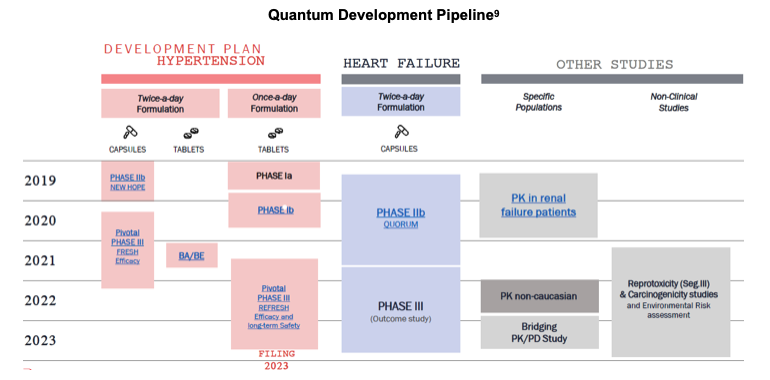
Quantum’s pipeline consists of one drug, firibastat, with various formulations pursuing multiple indications. It is being investigated in difficult-to-treat and resistant hypertension, heart failure, renal failure also in once per day formulations. The candidate is currently in one Phase III trial for hypertension, Phase I trials for QD formulation hypertension and renal failure, and has completed a Phase II trial for heart failure.
Milestones
➢ FRESH first patient enrolled – July 2020
➢ €20 million private placement – December 2020
➢ Launch REFRESH study – January 2021
➢ Orient EuroPharma Equity Stake – February 2021
➢ First patient enrolled in REFRESH study – July 2021
➢ QUORUM Phase II topline results, presented at ESC – August 2021
➢ FRESH trial topline – 2Q:22
➢ With supportive data, launch Ph3 outcome study in HF – 2022
➢ Interim results for REFRESH study – Mid-year 2023
➢ FDA submission of firibastat – 3Q:23
➢ Firibastat approval and commercialization – 2024
Summary
Quantum had an eventful first half of 2021 with progress made in the clinic, including results from QUORUM, and the launch and beginning of enrollment for REFRESH. Quantum presented data from its QUORUM trial at European Society of Cardiology that demonstrated a benefit in a subpopulation of the post-MI HF population. REFRESH was approved by regulatory authorities and ethics committees in South Korea and Taiwan, and pre-marketing activities have intensified with partners OEP and DongWha. In the financial sphere, Quantum’s revenues were €2.7 million, driven primarily by upfronts from South Korean, Greek and Canadian partners.
Quantum is building a global market for firibastat with development and commercialization partnerships around the world. Additional opportunity remains for deals in countries such as Japan, India, North America, China and unpenetrated areas in Europe. New sources of capital and cash reserves of almost €29 million suggest a runway beyond 2022. We expect additional milestone funds in future quarters which will further support development programs and perhaps eliminate the need for further capital raises.
SUBSCRIBE TO ZACKS SMALL CAP RESEARCH to receive our articles and reports emailed directly to you each morning. Please visit our website for additional information on Zacks SCR.
DISCLOSURE: Zacks SCR has received compensation from the issuer directly, from an investment manager, or from an investor relations consulting firm, engaged by the issuer, for providing research coverage for a period of no less than one year. Research articles, as seen here, are part of the service Zacks SCR provides and Zacks SCR receives quarterly payments totaling a maximum fee of up to $40,000 annually for these services provided to or regarding the issuer. Full Disclaimer HERE.
________________________
1. European Society of Cardiology
2. Using share count as of September 1, 2021 as proxy for 1H:21: 26,892,613
3. Using June 30, 2020 share count as proxy for 1H:20: 20,298,464
4. Mouhat, B. et al. Low Systolic Blood Pressure and Mortality in Elderly Patients After Acute Myocardial Infarction. 26 Feb 2020https://doi.org/10.1161/JAHA.119.013030Journal of the American Heart Association. 2020;9:e013030
5. Cautela, J. et al. Management of low blood pressure in ambulatory heart failure with reduced ejection fraction patients. 30 April 2020 https://doi.org/10.1002/ejhf.1835
6. Source: June 2021 Quantum Genomics Corporate Presentation
7. Hypertension that is not controlled despite two antihypertensive classes, including a diuretic, at maximum tolerated doses.
8. Hypertension that is not controlled despite treatment with at least three antihypertensive classes, including a diuretic, at maximum tolerated doses.
9. Source: Quantum Genomics June 2021 Corporate Presentation