By David Bautz, PhD
NASDAQ:BTAI
READ THE FULL BTAI RESEARCH REPORT
Business Update
NDA Submitted for BXCL501 for Schizophrenia and Bipolar Related Agitation
On March 11, 2021, BioXcel Therapeutics, Inc. (NASDAQ:BTAI) announced that it has completed the submission of the New Drug Application for BXCL501 for the treatment of schizophrenia and bipolar disorder related agitation. The FDA now has 60 days to decide whether to accept the NDA, and following acceptance of the NDA the review time is 10 months (or 6 months if the application is granted priority review). BioXcel was able to go from first-in-human studies to an NDA submission in just over two years, which is a remarkable achievement.
The NDA filing for BXCL501 is based in part on the positive results from the Phase 3 SERENITY I and SERENITY II clinical trials, which the company disclosed in July 2020. The SERENITY I trial was a randomized, double blind, placebo controlled parallel group adaptive trial in patients with schizophrenia or schizoaffective disorder (n=381) that were randomized to receive 120 μg BXCL501, 180 μg BXCL501, or placebo. The SERENITY II trial was a randomized, double blind, placebo controlled parallel group adaptive trial in patients with bipolar disorders (n=378) that were randomized to receive 120 μg BXCL501, 180 μg BXCL501, or placebo.
SERENITY I
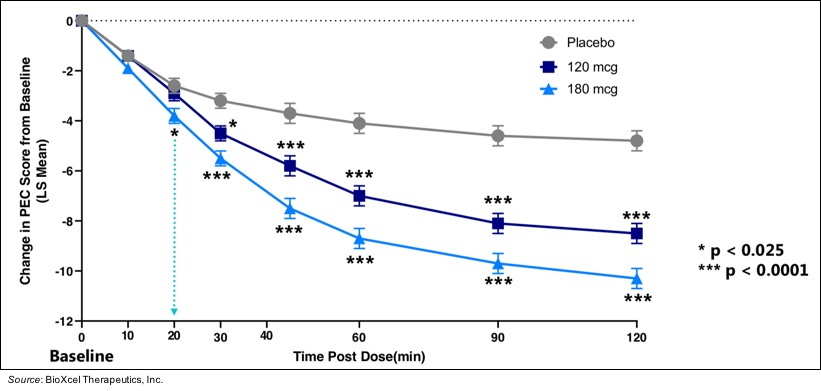
The following graph shows the robust response seen in decreasing PEC scores in schizophrenia patients treated with BXCL501 compared to placebo. The results for the 180 μg arm became significant starting at 20 minutes after dosing and the separation from placebo continued to increase out to 120 minutes.
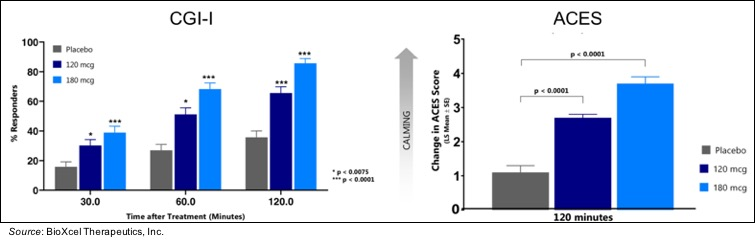
Clinically meaningful responses were also seen in the clinical global impression improvement scale (CGI-I) and the agitation and calmness evaluation scale (ACES), as shown in the following figures. The results from these secondary endpoints lend further support to the clinically meaningful effect that BXCL501 has on agitated patients.
SERENITY II
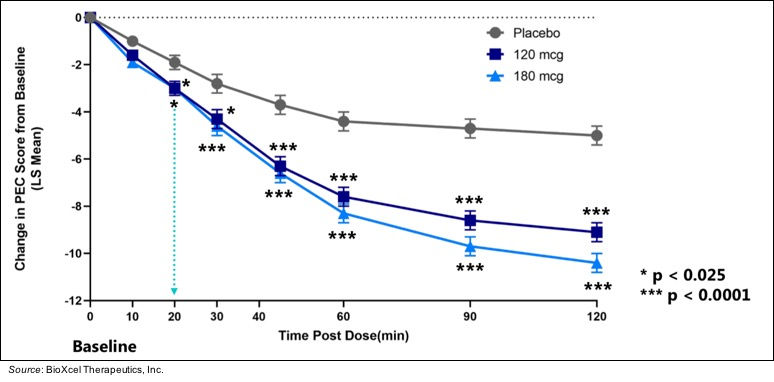
Very similar results were seen in SERENITY II, with patients administered BXCL501 experiencing a robust and highly statistically significant decrease in PEC compared to placebo. Similar to SERENITY I, the difference from placebo became statistically significant at the 20-minute mark.
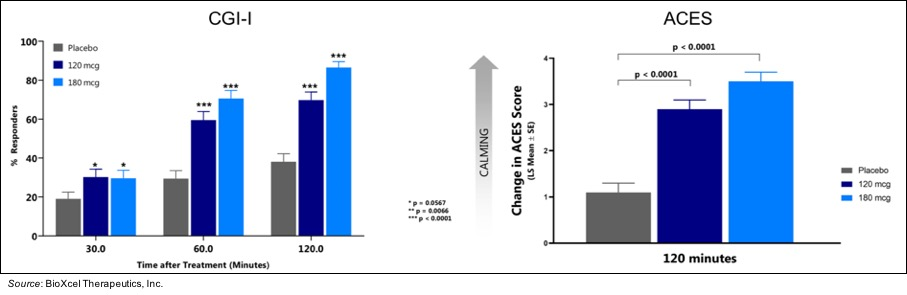
Just as in SERENITY I, results from SERENITY II showed clinically meaningful responses in the CGI-I and the ACES, as shown in the following figures.
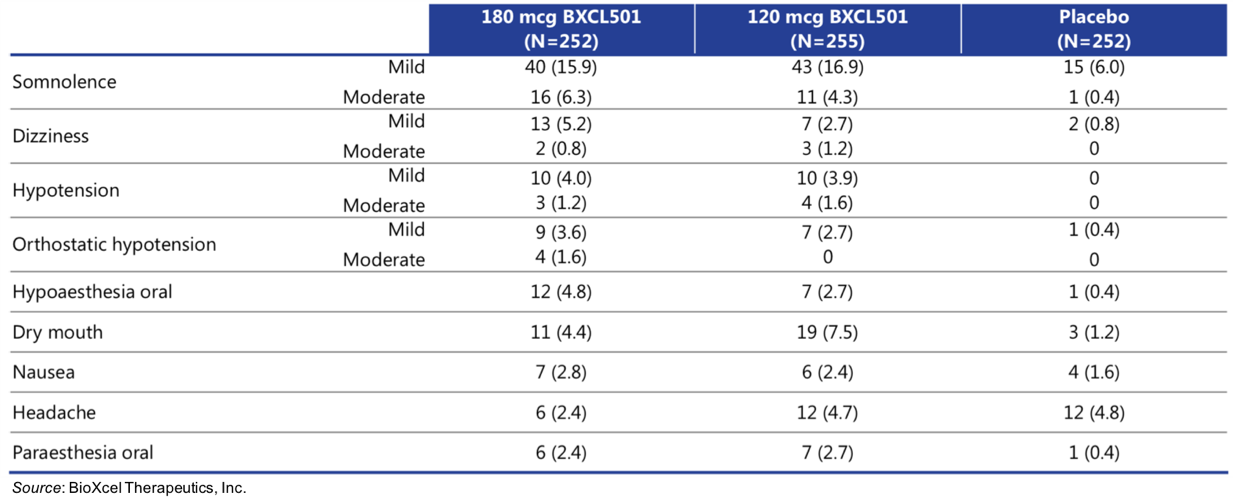
Importantly, there were no serious adverse events reported and the tolerability was comparable in both of the SERENITY trials. In addition, all patients were able to self-administer the treatments.
KOL Event Highlights Need for BXCL501
In February 2021, BioXcel hosted a Key Opinion Leader (KOL) virtual symposium that focused on BXCL501. A full summary of the event can be found in our previous report here and we invite interested investors to familiarize themselves with the issues discussed during the symposium.
One of the overarching themes of the event was that currently available therapeutics for the indications the company is targeting with BXCL501 all have various shortcomings. For example, Dr. Scott Zeller highlighted the fact that many of the agents used to treat agitation in schizophrenia and bipolar disorder patients come with a number of side effects, including the risk of oversedation. There are a number of complications that come with oversedation, including an inability for the medical examiner to do a full evaluation, the patient is unable to answer questions or take care of themselves, a psychiatric consult will not evaluate the patient until they are fully awake, most receiving hospitals are unwilling to consider a patient transfer until they are alert, and an unconscious patient not receiving treatment is taking up valuable room in the emergency department. In contrast, in the SERENITY I and SERENITY II trials, BXCL501 was reported to cause somnolence in less than 20% of patients tested and otherwise had a very favorable tolerability profile.
Dr. Zeller concluded his remarks with a ‘wish list’ of attributes that physicians would like to see in an ‘idea’ agitation treatment. We believe that BXCL501 possesses many of these attributes and would be a welcome addition to a doctor’s armamentarium for treating agitation in schizophrenia and bipolar disorder.

BXCL501 Granted Breakthrough Therapy Designation for Treatment of Dementia Related Agitation
On March 15, 2021, BioXcel announced that the FDA has granted Breakthrough Therapy designation to BXCL501 for the treatment of agitation in dementia patients. Breakthrough Therapy designation allows for additional guidance from the FDA on drug development, the involvement of senior FDA managers, and a rolling review of the NDA.
In January 2021, BioXcel announced positive topline results for the Phase 1b/2 TRANQUILITY trial of BXCL501 for the acute treatment of agitation in dementia patients, including those with Alzheimer’s disease. Treatment with BXCL501 resulted in a rapid, dose dependent decrease in PEC score from baseline that separated from placebo numerically by 30 minutes post-treatment and was statistically significantly different by 60 minutes. A full recap of the results can be found in our previous report.
Subsequent to the data announcement, the company initiated a supplemental dosing cohort investigating a 40 mg dose of BXCL501 in 46 patients (randomized 1:1) to help build a comprehensive clinical development strategy with the long-term goal of targeting dementia care from long-term care centers to at-home care. We anticipate a data readout before the end of 2021, but we don’t expect it to delay the initiation of the Phase 3 program in dementia related agitation.
The company will be meeting with the FDA for an ‘End-of-Phase 2’ meeting in the first half of 2021 to receive feedback on the dose, trial design, and primary endpoint. We anticipate the Phase 3 program in dementia related agitation initiating in the second half of 2021.
Phase 1b/2 trial of BXCL501 in Opioid Withdrawal Results Expected Soon
BioXcel is currently conducting the Phase 1b/2 RELEASE trial, which is a multicenter, randomized, double blind, placebo controlled study of BXCL501 in patients with opioid use disorder who are physically dependent on opioids and experiencing symptoms of opioid withdrawal. Multiple dose cohorts of BXCL501 or placebo are being administered twice daily for seven days and patients are assessed using both the Clinical Opiate Withdrawal Scale (COWS), an 11-item scale that measures a range of withdrawal symptoms experienced after quitting opioids (Wesson et al., 2003), and Short Opiate Withdrawal Scale (Gossop, 1990). We anticipate results from the study being released before the end of the first quarter of 2021.
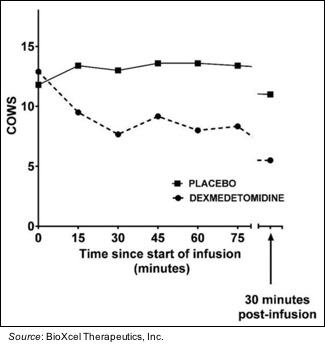
The company had previously tested intravenous (IV) dexmedetomidine in patients suffering from opioid withdrawal symptoms and announced results in February 2019. A total of 15 patients (10 treated with dexmedetomidine and five administered placebo) with opioid dependence were enrolled and opioid withdrawal symptoms evaluated using the COWS. All 10 patients treated with dexmedetomidine responded to treatment, with the following graph showing the average decrease for treated patients, while no patients treated with placebo responded.
Phase 2 Trial in Delirium Underway
BioXcel has initiated the Phase 2 PLACIDITY clinical trial of BXCL501 in patients with delirium related agitation. The trial will include patients who experience agitation in the intensive care unit (ICU) associated with and without COVID-19. In July 2020, the company announced the initiation of a compassionate use program for BXCL501 to investigate its use in treating delirium in patients suffering from COVID-19 in the ICU. There have been numerous reports in the media about COVID-19 patients suffering from delirium and agitation after having been admitted to the ICU, particularly in patients that were put on ventilators (see here and here). Treating delirium represents another large potential market opportunity and we anticipate topline results from the PLACIDITY trial in the first quarter of 2022.
Financial Update
On March 11, 2021, BioXcel announced financial results for the fourth quarter and full year 2020. As expected, the company did not report any revenues in 2020. Net loss in the fourth quarter of 2020 was $21.1 million, compared to a net loss of $8.3 million in the fourth quarter of 2019. R&D expenses in the fourth quarter of 2020 were $11.4 million, compared to $6.5 million for the fourth quarter of 2019. The increase was primarily due to increased personnel, clinical trial, and professional research costs. G&A expenses in the fourth quarter of 2020 were $9.7 million, compared to $1.9 million for the fourth quarter of 2019. The increase was primarily due to an increase in compensation costs and professional fees.
For 2020, BioXcel reported a net loss of $82.2 million, compared to a net loss of $33.0 million in 2019. R&D expenses in 2020 were $58.0 million, compared to $25.8 million in 2019. The increase was primarily due to increased clinical trial costs, compensation costs, and professional research costs. G&A expenses in 2020 were $24.3 million, compared to $7.8 million in 2019. The increase was primarily due to increased professional and consulting fees along with the growth of BioXcel’s operations.
As of December 31, 2020, BioXcel had approximately $213.1 million in cash and cash equivalents. As of March 1, 2021, the company had approximately 24.6 million shares outstanding and when factoring in stock options a fully diluted share count of approximately 28.4 million.
Conclusion
We congratulate BioXcel on filing an NDA for BXCL501 for the treatment of schizophrenia and bipolar disorder related agitation just a little over two years after initiating first-in-human trials. With a standard review time we anticipate that the company could launch the product in the first half of 2022. In preparation for that, BioXcel has begun building the infrastructure needed to support commercialization including the design of the sales force (estimated 75-100 sales reps). The company will be launching an education campaign on schizophrenia and bipolar related agitation in May 2021, which is Mental Health Awareness Month. The Medical Science Liaison and Medical Manage Care teams will be deployed later this month following completion of their training to initiate interactions with healthcare professionals and payers, respectively. We believe BioXcel is laying the groundwork for a successful launch of BXCL501 in the first half of 2022 and we look forward to updates regarding the NDA and commercialization plans as the year progresses. With no changes to our model our valuation remains at $145.
SUBSCRIBE TO ZACKS SMALL CAP RESEARCH to receive our articles and reports emailed directly to you each morning. Please visit our website for additional information on Zacks SCR.
DISCLOSURE: Zacks SCR has received compensation from the issuer directly, from an investment manager, or from an investor relations consulting firm, engaged by the issuer, for providing research coverage for a period of no less than one year. Research articles, as seen here, are part of the service Zacks provides and Zacks receives quarterly payments totaling a maximum fee of $40,000 annually for these services. Full Disclaimer HERE.