By Steven Ralston, CFA
OTC:DYLLF | ASX:DYL.AX
READ THE FULL DYLLF RESEARCH REPORT
Deep Yellow (OTC:DYLLF) (ASX:DYL.AX) has achieved several highly significant milestones over the last few weeks concerning the company’s advancement toward becoming a Tier I multi-jurisdictional uranium producer during the current uranium up cycle.
1) A positive Pre-Feasibility Study (PFS) on the Tumas Project aka the Reptile Project, including a Maiden Reserve for the Project
2) The completion of a AUD$ 40.8 million private placement to help fund management’s dual-pillar growth strategy, namely advancing the Tumas Project to production and becoming a multi-jurisdictional producer
a. The net proceeds plus cash on hand will be utilized
i. to complete the DFS on the Tumas Project
ii. to fund drilling programs to upgrade and expand the Resources at Tumas and
iii. to pursue acquisitions/ mergers
3) Having reviewed the PFS, the Board approved the immediate pursuit of a Definitive Feasibility Study (DFS). Work of the DFS commenced in February 2021 with an expected completion date by the end of calendar 2022
4) The immediate initiation of a 15,000-meter RC infill drilling program at Tumas 3 and Tumas 1 East to support the DFS
5) In addition, drilling results were released from 2 drill holes in the 3,200-meter drilling campaign at the Barking Gecko Project
As noted before, the management team created a producing uranium mining operation (Paladin Energy) in the last uranium cycle, and now has a singular focus to do so again. As important, management is executing on a clear objective of becoming a Tier I uranium producer, defined as a multi-project producer of uranium with the capacity to deliver 5-10 million lbs. of uranium annually. In other words, we expect management to remain focused on pursuing only one or two acquisitions in order to achieve the company’s stated objective and to execute the development of the projects on a rigorous timetable.
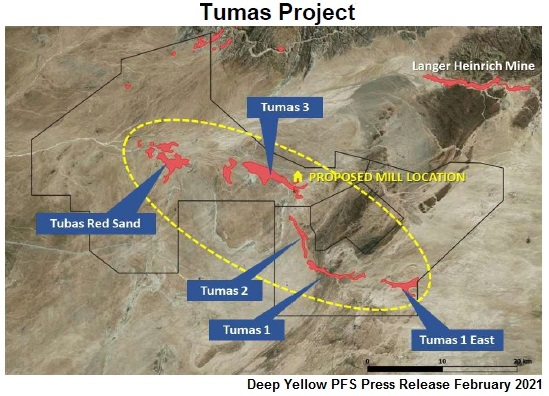
The Langer Heinrich uranium mine is situated 30km northeast of the Tumas Project. Deep Yellow’s executive team acquired, defined, funded, developed, optimized and operated Langer Heinrich from 2002 to 2017. The geology and type of deposit mineralization in these palaeo-channel systems at Langer Heinrich and Tumas are quite similar, and the mining jurisdiction is one in the same. Management is well-prepared to fast-track Tumas to production during this uranium up-cycle.
Pre-Feasibility Study (PFS) on Tumas Project
On February 10, 2021, Deep Yellow released the details of the PFS on the Tumas Project. After evaluating the potential of only the Measured and Indicated Resources available on calcrete-associated uranium deposits of the Tumas palaeo-channel system, the PFS determined that open pit mining of four Tumas deposits (Tumas 1, Tumas 1 East, Tumas 2 and Tumas 3) with a centrally located processing facility is feasible at a uranium price of $65 per pound.
The key outcomes of PFS is that that the Tumas Project is technically and economically viable based on an open pit mining operation similar to the Langer Heinrich mine, which is around 30km to the northeast of Tumas, and which was developed from greenfield-to-production (from resource delineation to processing design, from operations to product marketing) by the current Deep Yellow management team in the mid-2000’s.
Based on utilizing a 3 million lb. U308 per annum processing facility and a fixed uranium price of US$65 per pound, the Project has an estimated NPV of US$207 million (AUD$276 million) and a post-tax of IRR 21.1%. With an average production rate of 2.5 million pounds U308 annually over a Life-Of-Mine (LOM) of 11.5 years, the Project is forecasted to generate mine revenue of US$1.89 billion and undiscounted after-tax cash flow of US$447.4 million over the life of the mine.
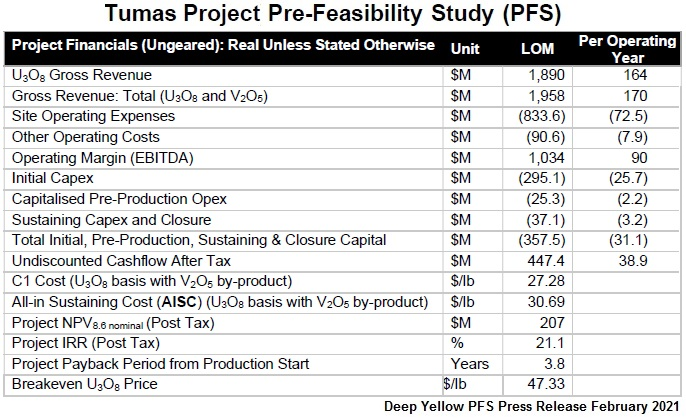
The PFS utilizes a price of $65 per pound U308, which represents the consensus price expected for negotiated multi-year (term) sales agreements multi-year sales in order to incentivize uranium miners to bring capacity on-line to fulfill the demand from nuclear electric utilities by the mid-to-late 2020s. The US$65 price is also consistent with TradeTech’s forecast.
In addition to the press release concerning the PFS, the company posted an updated Corporate Presentation to its website that highlights the Tumas PFS.
Maiden Reserve
The PFS included an estimated Maiden Reserve of 40.9 million tonnes of ore with an average grade of 344ppm U308 that contains a Probable Reserve of 31.0 million pounds U308.
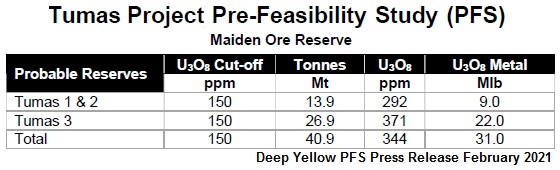
Infill drilling undertaken for the PFS converted 63% of the Indicated Mineral Resource into Probable Reserves for the Maiden Reserve. In addition, 95% of the Inferred Mineral Resource was upgraded to the Indicated Mineral Resource category. With addition exploration work, management believes that there is a reasonable expectation that total Reserves will ultimately exceed 75 million pounds U308 at a 100 ppm cut off.
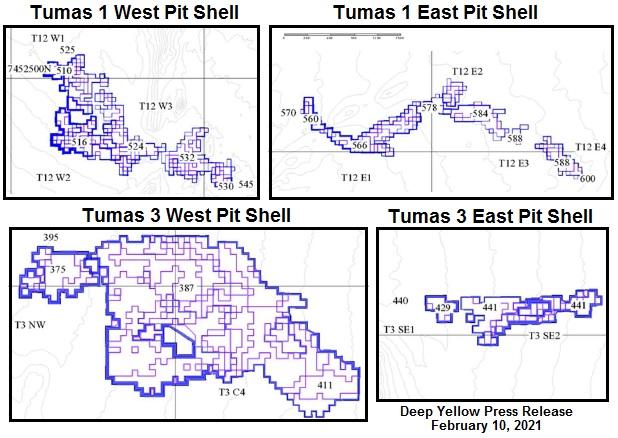
Cube Consulting completed the mining engineering work for the Tumas PFS, including open-pit optimization studies and designs, culminating in the geometry of the final pit designs (see images below).
Management’s Objectives
Management’s goal is to advance a Namibian uranium project into production with no less than a 20-year LOM and IRR of at least 20% with annual uranium oxide production in the 2-to-3 million pound range with operating costs in the area of US$30 per pound. In order to extend the LOM from 11 ½ to 20+ years, management is focusing on enhancing and further optimizing the PFS’s Tumas development plan by increasing the available ore reserves through a 15,000-meter RC infill drilling program designed to upgrade already existing Inferred Resources. In addition, certain facets of the mine plan will undergo an optimization process, including mine scheduling and the ore treatment process. These enhancements will be incorporated into the DFS.
The PFS considered the latest drilling results and metallurgical test work in laying out the developmental processes of permitting, processing facility construction, open pit design and initiating mining and processing operations. Highly relevant assumptions from the Langer Heinrich uranium deposit were also incorporated into the PFS.
Having reviewed the Tumas PFS, the Board of Directors approved to proceed directly to a DFS that expands the project’s target in order to achieve the stated goal of at least a 20-year LOM operation.
Definitive Feasibility Study (DFS) on Tumas Project
Along with confirming the technical and potential economic viability of Tumas Project, the activities supporting the DFS have the objective of achieving a +20-year LOM operation, up from the 11 ½ years in the PFS. The key undertakings include upgrading the existing Inferred Resources through a 15,000-meter drilling program (see detail in a section below) and optimizing the development plan.
Optimization studies will be conducted on several recommendations detailed in the PFS, including a pit optimization process and metallurgical optimization test work. The metallurgical optimization test work will begin immediately utilizing the 1,000kg of samples that were received at Perth in January 2021.
Deep Yellow is expanding its in-house technical team to support these activities. There are also trade-off studies being considered. One mining schedule optimization process already incorporated into the PFS is to stockpile lower grade (100-150 ppm) material for potential processing, but only if a sufficiently higher uranium price allows it to be economically processed.
If the development process advances smoothly, management anticipates that the Tumas Project will enter production phase in two or three years, which dovetails with the beginning of the expected uranium shortage to become ominous with a blatant supply/demand imbalance in the 2023/24 timeframe with price of uranium increasing the US$60-to-US$70 per lb. range.
DFS-related 15,000-meter Drilling Program
In early February 2021, a 4-month, 15,000-meter infill drilling program commenced to support the DFS. The infill drilling program will better define and in all probability upgrade the current Inferred Mineral Resource, which was delineated by former wider-spaced drilling. All drill holes will be surveyed with down-hole radiometric gamma logging.
The objective of the drilling program is to upgrade the existing Inferred Mineral Resources at Tumas 3 (West & East) and Tumas 1 East to a higher category with a goal of converting 95% of the currently defined Inferred Resources (51.2 million pounds at 249ppm U308) to Indicated status, similar to the 2020 infill drilling in 2020 at Tumas 3 that upgraded 95% of the then existing Inferred Mineral Resource to the Indicated category.
The host rock, type and grade of mineralization, along with the palaeo-channel shape are quite consistent at Tumas. Furthermore, on 100-meter/kilometer scale, the calcrete-type mineralization is relatively persistent both along the channel and laterally, though over shorter distances (meters), the mineralization can vary considerably. Therefore, management reasonably assumes that 95% benchmark for upgrading Inferred Resources to the Indicated category can be achieved through infill drilling.
The initial focus is on Tumas 3 West, then moving to Tumas 3 East and concluding at Tumas 1 East on the following schedule.
February — Tumas 3 West — 300 to 350 holes (totaling 4,500 to 6,000 meters)
March — Tumas 3 East — 250 to 300 holes (totaling 2,500 to 3,500 meters)
April – May — Tumas 1 East — 400 to 500 holes (4,500 to 6,500 meters)
The infill drilling program is targeting the lateral extensions of the Tumas 3 deposit and the shallow tributaries of Tumas 1 East. Ultimately, the upgraded Resources are expected to contribute significantly to an updated Reserve under the DFS.
Environmental Impact Assessment
Work on the Environmental Impact Assessment (EIA) continues. Baseline studies have commenced on groundwater, radiological, air quality, flora and fauna conditions. 14 water bores have been completed to support the baseline studies. The submission (and approval) of an EIA is required before the Environmental Commissioner can issue an Environmental Clearance Certificate (ECC), which is a requirement for a Mining License.
Mining License
Management anticipates submitting an application for a Mining Lease for the Tumas Project area in the quarter ending June 30th. The application may cover as much as 60 kilometers of Tumas palaeo-channel system.
Project and M&A Funding
Announced on February 18, 2021, an AUD$40.8 million private placement was completed on February 24, 2021. The private placement consisted of the issuance of 62,768,803 ordinary shares at AUD$0.65 per share. In addition, as of December 31, 2020, the company had a cash position of AUD$9.7 million and was debt-free.
The net proceeds and cash are targeted to fund management’s strategic initiatives, namely
1) the completion of a DFS, including the ongoing drilling programs to expand and upgrade the resource at the Reptile Project,
2) the advancement of the Nova JV’s exploration campaigns and
3) the pursuit of the strategic goal of establishing a multi-jurisdictional uranium company through a selective acquisition and/or merger while the uranium industry is still in a generally low uranium price environment.
Management continues assess and evaluate advanced M&A opportunities.
Barking Gecko - NOVA JV (EPL 3669 & EPL 3670)
On February 12, 2021, Deep Yellow announced drilling results of the first two drill holes of Phase 2 at the Barking Gecko Prospect on EPL 3669. The 3,200-meter RC drilling program had commenced on November 23, 2020, with the operations being suspended during the Namibian festive season in December. The drill holes were in the vicinity of the positive holes drilled in the April - July 2020 RC drilling program. Both gamma down-hole logging and optical borehole imagery are being undertaken. The latter helps determine the structural orientation of the uranium mineralization.
The best intersections of the two holes were 27 meters at 291ppm U308 (TN245RC) and 6 meters at 228ppm U308 & 11 meters at 214ppm U308 (TN246RC). These initial results confirm the potential that the previously identified thick uranium intersections extend in this dome-related geological setting.
This drilling program at Barking Gecko is being conducted after the JOGMEC earn-in; therefore, all parties in the NOVA JV have agreed to a budget of AUD$570,000 through March 31, 2021. Phase 2 began in February 2021 and is expected to be completed during March.
Barking Gecko Background: The April - July 2020 RC drilling program at Barking Gecko intersected very promising uranium mineralization in a large (4km long and 1km wide) anomalous geological zone, which wraps around a prominent domal feature. The best intersection was a 24-meter zone averaged 297ppm eU308 and a maximum grade of 736ppm was obtained over 1 meter.
Phase 1 of this drilling program was completed in early December 2020. The two holes (totaling 502 meters) did not intersect up-dip and down-dip extensions of previously identified thick mineralization, rather only areas of narrow mineralization. Therefore, the geology of the area was re-evaluated utilizing results of the OPTV down-hole logging. It has been determined that the mineralization at Barking Gecko has a NNE orientation instead of the previously expected WSW. The drilling program was revised accordingly.
OTCQX Best 50
On January 29, 2021, OTC Markets Group announced the annual OTCQX Best 50 ranking, which is formulated by being among the 50 best performing stocks out of the 462 companies traded on OTCQX Best Market, along with such quality standards as complying with financial standards and exhibiting average daily dollar volume growth. For its performance in calendar 2020, Deep Yellow achieved the recognition of being ranked in the OTCQX Best 50.
Valuation
Broadly speaking, the public uranium companies can be grouped into three segments: producers, development companies and exploration companies. Producers are actively mining and generating revenues. Exploration companies are prospecting and/or drilling to establish mineral resources. In between these two segments are the development companies that already have established resources and are advancing through the process to bring a mine in operation, generally from the point of initiating a Pre-Feasibility Study to the actual construction of a mine. The comparable companies to Deep Yellow fall into this category.
Further, the comparable companies have been narrowed through quantitative factors, particularly those with a market capitalization over $50 million and trading above $0.20 per share. This process captures a range of well-funded junior uranium development companies. Currently, the P/B valuation range of these comparable companies is between 0.85 and 12.19. With the expectation that DYLLF will attain an industry average P/B ratio of 4.87, our comparable analysis valuation price target is US$1.14.
SUBSCRIBE TO ZACKS SMALL CAP RESEARCH to receive our articles and reports emailed directly to you each morning. Please visit our website for additional information on Zacks SCR.
DISCLOSURE: Zacks SCR has received compensation from the issuer directly, from an investment manager, or from an investor relations consulting firm, engaged by the issuer, for providing research coverage for a period of no less than one year. Research articles, as seen here, are part of the service Zacks provides and Zacks receives quarterly payments totaling a maximum fee of $40,000 annually for these services. Full Disclaimer HERE.