By John Vandermosten, CFA
NASDAQ:LPCN
READ THE FULL LPCN RESEARCH REPORT
First Quarter 2021 Financial and Operational Results
On May 6, 2021 Lipocine (NASDAQ:LPCN) filed its Form 10-Q and posted its earnings release for the three month period ending March 31, 2021.
Highlights for the first quarter 2021 and to-date include:
➢ Positive topline results for Phase II LiFT - January 2021
➢ USPTO declaration of interference - January 2021
➢ Closing of $25 million public offering - January 2021
➢ Presentations at ENDO 2021 Conference - March 2021
➢ Publication for LPCN1144 in NASH and hepatic fibrosis - March 2021
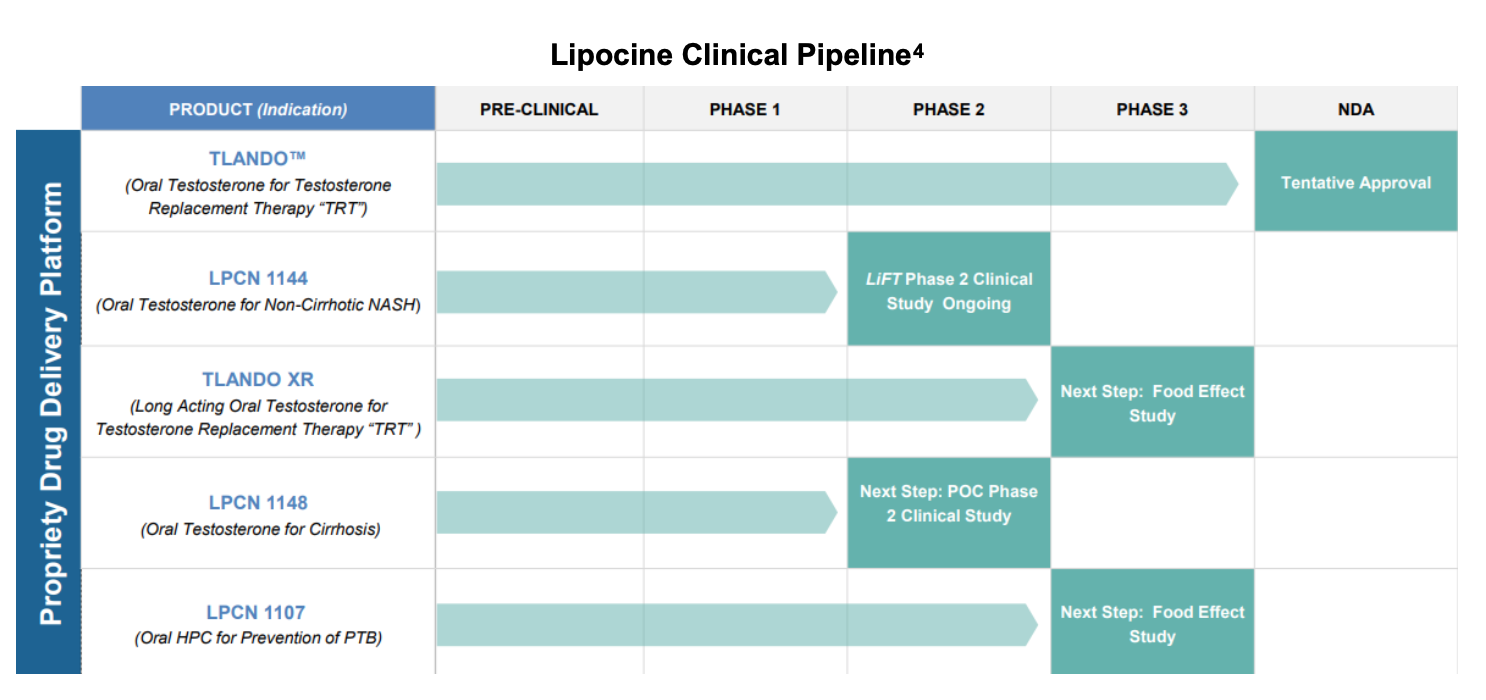
Lipocine continued advancing the ongoing Phase II LiFT study, with 36-week biopsy data expected August 2021, and further enrollment into LiFT’s open-label extension. The company is also in the process of evaluating commercial options for TLANDO.
Lipocine generated no revenue from its products in 1Q:21 or 1Q:20. It reported net loss of $3.4 million, or ($0.04) per diluted share for the first quarter 2021 compared with net loss of ($5.8) million, or ($0.14) per diluted share for the prior year period.
For the first quarter ending March 31, 2021 and versus the first quarter ending March 31, 2020:
➢ Research & development expense totaled $1.58 million, down 37% from $2.51 million driven primarily by reduction in external service provider costs for LPCN 1144 and TLANDO XR, partially offset by increases in internal personnel costs and other R&D expenses;
➢ General & administrative expenses fell 26% to $1.53 million from $2.08 million, primarily due to a decrease in legal costs related to patent litigation with Clarus Therapeutics;
➢ Net loss was $3.4 million or ($0.04) per diluted share compared with net loss of ($5.8) million or ($0.14) per diluted share;
As of March 31, 2021, marketable securities, cash and equivalents totaled $45.3 million, compared to $15.6 million a year before. Through a February 2021 amendment of the Loan and Security Agreement between Lipocine and Silicon Valley Bank, the $5 million minimum cash provision is no longer required. In January 2021, Lipocine raised gross proceeds of $28.7 million through a public offering.
FDA Grants Tentative Approval to Tlando
After multiple extensions from the August 2020 target action date, the FDA granted tentative approval of Lipocine’s Tlando on December 8th. Tlando met all required quality, safety and efficacy standards necessary for approval; however, marketing of Tlando will not be allowed until the expiration of the exclusivity period for Clarus’ Jatenzo. Jatenzo, also an oral form of testosterone undecanoate, was granted a three year period of exclusivity as of March 27, 2019.
Upon full approval, on Tlando’s behalf, Lipocine must assess the safety and effectiveness of the product in pediatric patients and conduct post-marketing studies. One of the studies requires that the label is designed appropriately so that patients understand the risk disclosures and the other requires a one-year trial to assess adrenal insufficiency with chronic Tlando therapy. We discuss the tentative approval of Tlando and its implications for future commercialization in our previous report.
Lipocine is in the process of identifying possible partners for commercialization of Tlando and is considering two approaches. The first is to outlicense commercialization of the drug where Lipocine would not participate in the marketing effort. The second is to enter into a risk sharing agreement where profits are shared after costs are covered by the collaborative entity. Lipocine is in discussions with multiple prospects and we anticipate further information will be provided when the path forward is clarified.
Positive Topline Phase II Results from Ongoing LiFT Study
Lipocine announced positive topline data from LiFT, a Phase II study of its candidate LPCN 1144 in biopsy-confirmed, non-cirrhotic male NASH patients with F1-F3 fibrosis, a patient population with outstanding clinical need. Results are positive and show statistical significance in the primary endpoint of change in hepatic fat fraction, quantified via MRI-PDFF1 at week 12. The results succeed a string of failed NASH treatment attempts by other companies, including Gilead, whose anti-fibrosis drug selonsertib failed in Phase III, Ionis, with its delayed result release for their antisense gene therapy, and Intercept, whose Ocaliva failed to achieve statistical significance in the clinic. In contrast, Lipocine’s LPCN 1144, an oral pro-drug of endogenous testosterone, has shown robust, statistically significant efficacy in not only its primary endpoint of reduction of hepatic fat fraction, but secondary endpoints as well, some of which were published in an update on January 12, 2021.
LiFT Study Design
LiFT (Liver Fat intervention with oral Testosterone) is a Phase II trial designed to evaluate LPCN 1144 oral testosterone in males with biopsy-confirmed NASH. It enrolled 56 men with confirmed NASH, randomized 1:1:1 in three arms. The arms included Treatment A, 142 mg testosterone equivalent twice daily, Treatment B, which was the same as Treatment A but with the addition of 217 mg of d-alpha tocopherol equivalent twice daily, and a placebo arm with twice-daily administration. Excluding the open label extension, LiFT has a duration of 36 weeks.
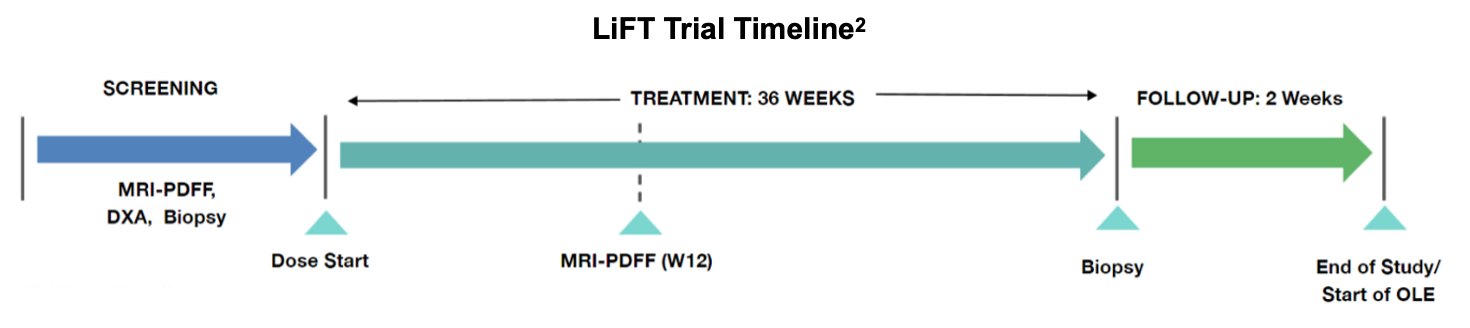
Primary endpoint for LiFT was change in hepatic fat fraction, evaluated using MRI-PDFF at week 12, topline results for which were released recently. Secondary endpoints included change in NASH activity and fibrosis via liver biopsy scoring at week 36, change in hepatic fat fraction via MRI-PDFF at week 36, change in liver injury markers, anthropomorphic measurements, lipids, insulin resistance and inflammatory/fibrosis markers, and Patient Reported Outcomes (PROs) including quality of life and global impression scores (PGI). In the same release, Lipocine included preliminary data regarding liver biomarkers as well.
Patients will have access to LPCN 1144 through an open label extension study, announced December 30, 2020. This option for patients will enable the collection of additional data for up to 72 weeks total. The open label extension is underway and enrolling.
Topline Results
Baseline characteristics were presented that recounted the participants, completion, age, BMI, diabetes and hypertension, as well as baseline measurements of endpoint factors.
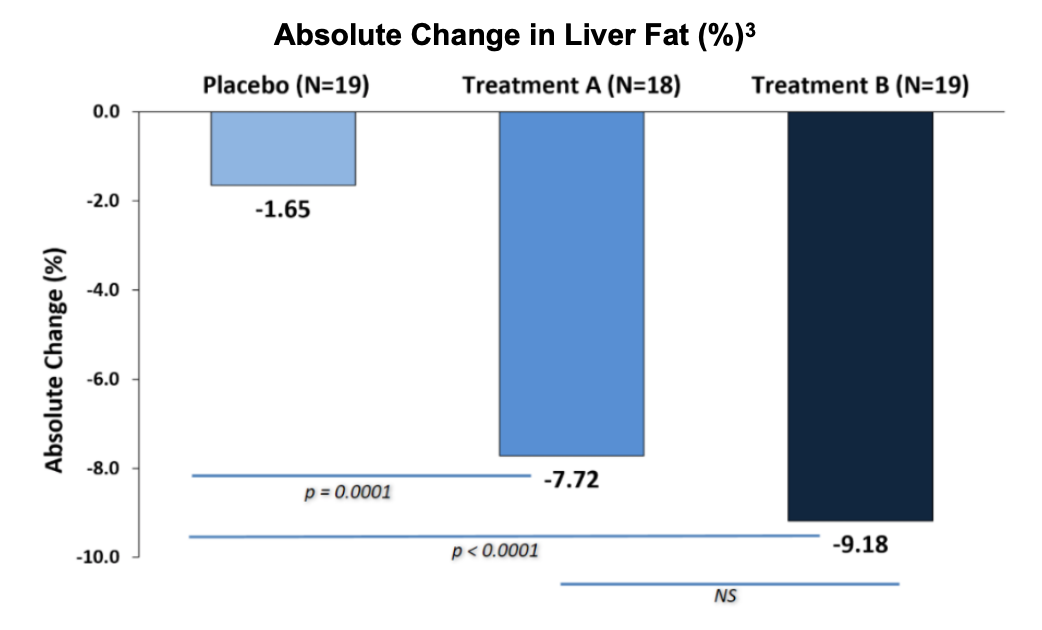
The primary endpoint for LiFT was change in hepatic fat fraction. As reported, there was a statistically significant decrease in hepatic fat, significant at the 0.01% level (p < 1%) for both Treatment A and Treatment B arms. The percentage of subjects with greater than 30% reduction in liver fat was statistically significant in excess of 1% in both arms vs placebo. Absolute and relative change in liver fat percentage in subjects with baseline liver fat in excess of 5% was statistically significant at 0.01% for both arms vs placebo. Although the data failed to power a statistical difference between Treatment A and Treatment B in the aforementioned results, directionally, it appeared that the addition of d-alpha tocopherol potentiated LPCN 1144’s action.
In evaluation of liver injury markers, d-alpha tocopherol’s potentiation of LPCN 1144 was quantifiably apparent. With respect to alanine aminotransferase (ALT), both treatment arms were statistically differentiable from placebo at 1.6% and 0.01% for A and B arms, respectively. Here, Treatment B was statistically distinguishable from Treatment A arm at the 0.5% level. Evaluation of change in aspartate aminotransferase (AST) was again statistically significant for both arms at 2% and 0.01% levels for A and B arms, respectively, but here A and B arms were not statistically different, although directionally consistent. ALT and AST reduction in absolute terms were up to 22.4 U/L and 10.4 U/L, respectively. Results including d-alpha tocopherol generated substantially reduced liver injury markers ALT and AST compared with LPCN 1144 alone. The difference between the two arms was less dramatic in other measures such as hepatic fat fraction reduction. Lipocine proposed antioxidant activity of d-alpha tocopherol as a possible mechanism that impacted ALT and AST, although the exact mechanism was not understood.
Finally, longitudinal analysis of changes in the two liver injury markers showed that as early as week four, for AST, and week eight for both ALT and AST, combination LPCN 1144 and d-alpha tocopherol showed statistically significant changes. The treatment was not only successful where other NASH therapies have struggled, but also conveniently orally administered and timely in its efficacy.
Adverse events were comparable to the placebo arm with no observed tolerability issues. Three subjects in the placebo group and one in a treatment arm discontinued study due to treatment emergent adverse events (TEAE).
36-week biopsy data from LiFT are expected in July or August of 2021. Enrollment for the open label extension to the LiFT study has begun, which will allow the collection of additional data for up to 72 weeks of therapy.
Capital Raise
On January 28, 2021, Lipocine announced that it had closed a $28.7 million public offering. The offer issued 16,428,571 common shares at $1.75 per share to the public, which included full exercise of underwriter purchase options for 2,142,857 shares at the offer price. Raymond James & Associates, Inc. acted as sole book-running manager and Ladenburg Thalmann & Co. Inc. acted as co-manager for the public offering.
LPCN 1148 IND Acceptance
On May 5, 2020, Lipocine announced that the FDA had accepted its Investigational New Drug (IND) application to initiate a Phase II proof-of-concept study of LPCN 1148 in adult male liver cirrhosis. The Phase II trial is planned as a prospective, multi-center, randomized, placebo-controlled study with a duration of 52 weeks in male cirrhotic patients who are on the liver transplant list. Initiation of the study is expected in 2H:21 which will target sites at academic institutions.
Milestones
➢ NDA filed for Tlando – February 2020
➢ IND clearance for Phase II study of LPCN 1148 – May 2020
➢ Tentative approval of Tlando – December 2020
➢ LiFT Study
◦ Primary endpoint – January 2021
◦ Last patient, last visit for biopsy data – June 2021
◦ Presentation of biopsy data – August 2021
➢ Abstract presentation at EASL – June 2021
➢ Male cirrhosis trial launch for LPCN 1148 – 2H:21
➢ Tlando eligible for final approval – 2Q:22
Summary
Highlights for Lipocine in 2021 include several milestones related to LPCN 1144, including presentation of final data which is expected later this year. Now in the background, but the primary valuation driver for the company is Tlando, which must wait for full approval and first sales until the expiration of a competitor’s exclusivity. In the interim between now and anticipated full approval, Lipocine will be meeting with prospects to identify a path forward for commercialization. New efforts are advancing following the capital raise in the first quarter including LPCN 1148 in male cirrhosis which is expected to enroll first patients in 2H:21.
SUBSCRIBE TO ZACKS SMALL CAP RESEARCH to receive our articles and reports emailed directly to you each morning. Please visit our website for additional information on Zacks SCR.
DISCLOSURE: Zacks SCR has received compensation from the issuer directly, from an investment manager, or from an investor relations consulting firm, engaged by the issuer, for providing research coverage for a period of no less than one year. Research articles, as seen here, are part of the service Zacks provides and Zacks receives quarterly payments totaling a maximum fee of $40,000 annually for these services. Full Disclaimer HERE.
________________________
1. Magnetic Resonance Imaging Proton Density Fat Fraction
2. Lipocine LPCN 1144 presentation January 12, 2021
3. Lipocine March 2021 corporate presentation
4. Lipocine March 2021 Corporate Presentation