By John Vandermosten, CFA
NASDAQ:LPCN
READ THE FULL LPCN RESEARCH REPORT
Full Year 2020 Financial and Operational Results
On March 11, 2021 Lipocine (NASDAQ:LPCN) filed its 2020 Form 10-K and posted its earnings release for the twelve month period ending December 31, 2020. The company reported zero revenues and a net loss per share of ($0.38) compared to 2019 revenues of $0.2 million and loss of ($0.50) per share. After a multi-year effort and several submissions, Tlando was finally approved by the FDA on December 8, 2020. The approval was tentative and requires the expiry of marketing exclusivity for competing oral testosterone product Jatenzo or successful legal action by Lipocine prior to Tlando being cleared for marketing. Lipocine is now considering its options on how to proceed with commercialization of Tlando. Other important accomplishments include results from the LiFT study for NASH which demonstrated LPCN 1144’s ability to reduce liver fat and improve liver injury markers. Lipocine also experienced several favorable outcomes in the legal wrangling with Clarus and raised additional capital to support its ongoing development programs.
Lipocine did not generate any revenues in 2020 compared with revenues of $165,000 in 2019 related to royalty payments received from Spriaso. For the fiscal year ending December 31, 2020 and versus the fiscal year ending December 31, 2019:
➢ Research & development expense was $9.7 million, up 31% from $7.5 million primarily due to increase in contract research organization (CRO) and outside consulting and manufacturing costs for Phase II LiFT, and increases in manufacturing costs for Tlando, personnel expense and other R&D programs and expenses, partially offset by a decrease in CRO expenses for Tlando;
➢ General & administrative expenses rose 47% to $8.2 million from $5.6 million driven by increases in legal costs, personnel costs, and other G&A expenses, offset by decrease in travel and marketing expense;
➢ Other expense was ($3.0) million, with the vast majority of the amount attributable to the unrealized loss on the warrant liability related to an increase in the company’s share price over the reporting period;
➢ Net loss was ($21.0) million or ($0.38) per diluted share compared to ($13.0) million or ($0.50) per diluted share;
As of December 31, 2020, cash and equivalents were $19.7 million, excluding $5 million in restricted cash, compared to $14.1 million a year before. Through a February 2021 amendment of the Loan and Security Agreement between Lipocine and Silicon Valley Bank, the $5 million minimum cash provision is no longer required. Following the end of the reporting period, Lipocine raised gross proceeds of $28.7 million through a public offering.
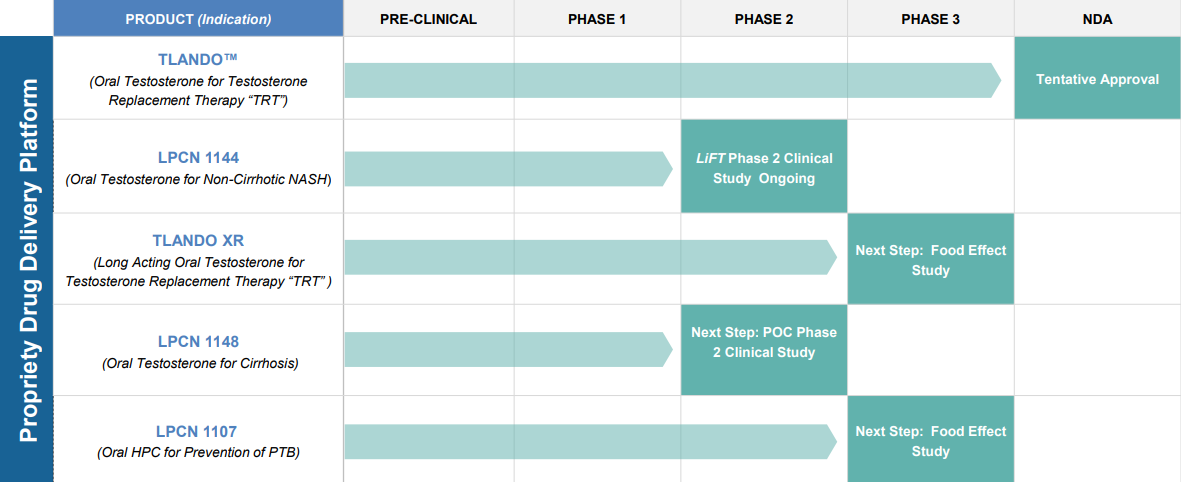
Lipocine Clinical Pipeline (1)
FDA Grants Tentative Approval to Tlando
After multiple extensions from the August 2020 target action date, the FDA granted tentative approval of Lipocine’s Tlando on December 8th. Tlando met all required quality, safety and efficacy standards necessary for approval; however, marketing of Tlando will not be allowed until the expiration of the exclusivity period for Clarus’ Jatenzo. Jatenzo, also an oral form of testosterone undecanoate, was granted a three year period of exclusivity as of March 27, 2019.
Prior to the clarification provided by the FDA in conjunction with the tentative approval, it had been unclear if the exclusivity granted to Jatenzo would extend to Tlando. There had been other testosterone replacement therapies and multiple formulations, including an oral methyltestosterone; however, the FDA considers Jatenzo to be the first oral testosterone undecanoate and its exclusivity prevents Tlando from being commercialized in the United States until March 2022.
Lipocine has several alternatives that may allow for earlier marketing of Tlando prior to Jatenzo’s 2022 exclusivity expiration; however, none of them are certain and delays in the jury trial and possibly other proceedings may severely limit outcomes. Lipocine may appeal the FDA’s exclusivity decision through the court system. This could take several months. Another approach may involve a settlement related to the patent infringement lawsuit that is underway where Lipocine appears to have the advantage (2). The two parties may come together and decide that in return for Lipocine dropping the infringement case, Clarus could waive its exclusivity with respect to Tlando among other adjustments. While a settlement is possible, they are usually driven by a near term court-decision. Due to COVID-related delays, the jury trial originally scheduled for February 2021 has been delayed indefinitely, possibly pushing the incentive to settle beyond the expiration of Jatenzo’s exclusivity. Lipocine could also progress forward with the patent infringement lawsuit and prevail, which would allow them to begin marketing and sue for damages.
In parallel with efforts to advance the allowed marketing approval date, we believe that Lipocine will begin to look for a commercialization partner. In the following months, both Lipocine and a prospective partner will have time to determine a valuation, quantify upfronts, milestones and royalties and identify a commercial manufacturer among other prerequisites prior to launch. We had originally anticipated this effort would take several months as negotiation and due diligence takes place.
Upon full approval, on Tlando’s behalf, Lipocine must assess the safety and effectiveness of the product in pediatric patients and conduct post-marketing studies. One of the studies requires that the label is designed appropriately so that patients understand the risk disclosures and the other requires a one-year trial to assess adrenal insufficiency with chronic Tlando therapy.
Positive Topline Phase II Results from Ongoing LiFT Study
Lipocine announced positive topline data from its ongoing LiFT study, a Phase II study of its candidate LPCN 1144, an oral pro-drug of endogenous testosterone, in biopsy-confirmed, non-cirrhotic male NASH patients with F1-F3 fibrosis, a patient population with outstanding clinical need. Results were positive, as partway through the study, results already show statistical significance in its primary endpoint of change in hepatic fat fraction, quantified via MRI-PDFF (3) at week 12. The results succeed a string of failed NASH treatment attempts by other companies, including Gilead, whose anti-fibrosis drug selonsertib failed in Phase III, Ionis, with its delayed result release for their antisense gene therapy, and Intercept’s Ocaliva that failed to achieve statistical significance in the clinic. In contrast, Lipocine’s LPCN 1144 has shown robust, statistically significant efficacy in not only its primary endpoint of reduction of hepatic fat fraction, but secondary endpoints as well, some of which were publicized in an update on January 12, 2021.
LiFT Study Design
LiFT (Liver Fat intervention with oral Testosterone) is a Phase II trial designed to evaluate LPCN 1144 oral testosterone in men with biopsy-confirmed NASH. It enrolled 56 men with confirmed NASH, randomized 1:1:1 in three arms. The arms included Treatment A, 142 mg testosterone equivalent twice daily, Treatment B, which was the same as Treatment A but with the addition of 217 mg of d-alpha tocopherol equivalent twice daily and a placebo arm with twice-daily administration. Excluding the open label extension, LiFT has a duration of 36 weeks.

LiFT Trial Timeline (4)
Primary endpoint for LiFT was change in hepatic fat fraction, evaluated using MRI-PDFF at week 12, topline results for which were released most recently. Secondary endpoints included change in NASH activity and fibrosis via liver biopsy scoring at week 36, change in hepatic fat fraction via MRI-PDFF at week 36, change in liver injury markers, anthropomorphic measurements, lipids, insulin resistance and inflammatory/fibrosis markers, and Patient Reported Outcomes (PROs) including quality of life and global impression scores (PGI). In the latest update, Lipocine included preliminary data regarding liver biomarkers as well.
Patients will have access to LPCN 1144 through an open label extension study, announced December 30, 2020. This option for patients will enable the collection of additional data for up to 72 weeks total. The open label extension has begun enrollment.
Topline Results
Baseline characteristics were presented that recounted the participants, completion, age, BMI, diabetes and hypertension, as well as baseline measurements of endpoint factors.

Absolute Change in Liver Fat (%) (5)
The primary endpoint for LiFT was change in hepatic fat fraction. As reported, there was a statistically significant decrease in hepatic fat, significant at the 0.01% level (p < 1%) for both Treatment A and Treatment B arms. The percentage of subjects with greater than 30% reduction in liver fat was statistically significant in excess of 1% in both arms vs placebo. Absolute and relative change in liver fat percentage in subjects with baseline liver fat in excess of 5% was statistically significant at 0.01% for both arms vs placebo. Although the data failed to power a statistical difference between Treatment A and Treatment B in the aforementioned results, directionally, it appeared that the addition of d-alpha tocopherol potentiated LPCN 1144’s action.
In evaluation of liver injury markers, d-alpha tocopherol’s potentiation of LPCN 1144 was quantifiably apparent. With respect to alanine aminotransferase (ALT), both treatment arms were statistically differentiable from placebo at 1.6% and 0.01% for A and B arms, respectively. Here, Treatment B was statistically distinguishable from Treatment A arm at the 0.5% level. Evaluation of change in aspartate aminotransferase (AST) was again statistically significant for both arms at 2% and 0.01% levels for A and B arms, respectively, but here A and B arms were not statistically different, although directionally consistent. ALT and AST reduction in absolute terms were up to 22.4 U/L and 10.4 U/L, respectively. Results including d-alpha tocopherol generated substantially reduced liver injury markers ALT and AST compared with LPCN 1144 alone. The difference between the two arms was less dramatic in other measures such as hepatic fat fraction reduction. Lipocine proposed antioxidant activity of d-alpha tocopherol as a possible mechanism that impacted ALT and AST, although the exact mechanism was not understood.
Finally, longitudinal analysis of changes in the two liver injury markers showed that as early as week four, for AST, and week eight for both ALT and AST, combination LPCN 1144 and d-alpha tocopherol showed statistically significant changes. The treatment was not only successful where other NASH therapies have struggled, but also conveniently orally administered and timely in its efficacy.
Adverse events were comparable to the placebo arm with no observed tolerability issues. Three subjects in the placebo group and one in a treatment arm discontinued study due to treatment emergent adverse events (TEAE).
36-week biopsy data from LiFT are expected in July or August of 2021. Enrollment for the open label extension to the LiFT study has begun, which will allow the collection of additional data for up to 72 weeks of therapy.
Capital Raises
Lipocine announced the closing of $6 million direct offering of common stock and warrants on February 27, 2020. The offer comprised 10,084,034 Class A Units, each comprising one share of common stock and one half of a common warrant to purchase one common share at $0.595. Gross proceeds were $6 million and proceeds were put toward working capital and general corporate purposes. Roth Capital Partners acted as sole agent for the offering.
On January 28, 2021, Lipocine announced that it had closed a $28.7 million public offering. The offer issued 16,428,571 common shares at $1.75 per share to the public, which included full exercise of underwriter purchase options for 2,142,857 shares at the offer price. Raymond James & Associates, Inc. acted as sole book-running manager and Ladenburg Thalmann & Co. Inc. acted as co-manager for the public offering.
LPCN 1148 IND Acceptance
On May 5, 2020, Lipocine announced that the FDA had accepted its Investigational New Drug (IND) application to initiate a Phase II proof-of-concept study of LPCN 1148 in adult male liver cirrhosis. The Phase II trial is planned as a prospective, multi-center, randomized, placebo-controlled study with a duration of 52 weeks in male cirrhotic patients who are on the liver transplant list. Initiation of the study is pending availability of funding.
Milestones
➢ NDA filed for Tlando – February 2020
➢ IND clearance for Phase II study of LPCN 1148 – May 2020
➢ Tentative approval of Tlando – December 2020
➢ LiFT 36-week biopsy data – 3Q:21
➢ Tlando eligible for final approval – 2Q:22
Summary
Highlights for Lipocine’s FY:20 included the FDA’s grant of tentative approval to Tlando, with full approval expected in March 2022, presentation of data for LPCN 1144 from the LiFT Phase II study and the raise of additional capital to advance development programs. After several FDA-issued complete response letters since 2016 and two delays to the latest target action date, the agency has extended a tentative approval to Tlando. While at first glance the 15-month delay appears to be a disappointment, it extends our previous expectations by about a year for marketing launch and allows Lipocine to carefully consider suitors if they choose to work with a partner. There are also several alternate routes which may allow for earlier sales that involve success in the courts or negotiation with Clarus.
SUBSCRIBE TO ZACKS SMALL CAP RESEARCH to receive our articles and reports emailed directly to you each morning. Please visit our website for additional information on Zacks SCR.
DISCLOSURE: Zacks SCR has received compensation from the issuer directly, from an investment manager, or from an investor relations consulting firm, engaged by the issuer, for providing research coverage for a period of no less than one year. Research articles, as seen here, are part of the service Zacks provides and Zacks receives quarterly payments totaling a maximum fee of $40,000 annually for these services. Full Disclaimer HERE.
________________________
1. Lipocine March 2021 Corporate Presentation
2. See our May 28, 2020 article under the heading: Markman Hearing.
3. Magnetic Resonance imaging Proton Density Fat Fraction
4. Lipocine LPCN 1144 presentation January 12, 2021
5. Lipocine March 2021 corporate presentation