By David Bautz, PhD
NASDAQ:MDNA
READ THE FULL MDNA RESEARCH REPORT
Business Update
Phase 1/2 ABILITY Trial Underway; Initial Safety and Biomarker Data by Year-End 2021
Medicenna Therapeutics Corp. (NASDAQ:MDNA) recently initiated the Phase 1/2 ABILITY Study (A Beta-only IL-2 ImmunoTherapY Study) of MDNA11 in patients with advanced solid tumors. It is designed to assess the safety, pharmacokinetics (PK)/pharmacodynamics (PD), and effect on various biomarkers of MDNA11 as both a monotherapy as well as in combination with a checkpoint inhibitor. The trial is initiating in Australia with a plan to have 4-6 sites and the company recently received IND clearance with the U.S. FDA with a plan for 8-10 sites in the U.S. We anticipate the trial eventually expanding to clinical sites in the U.K. and Canada, with submissions to their regulatory agencies expected by the end of calendar 2021.
The first data reported from the trial will include preliminary safety, PK, PD, and biomarker data from the initial dose escalation cohorts, which are expected by end of this calendar year. In regards to PK, the company is hoping to see albumin-mediated half-life extension that would support dosing once every two to three weeks. In regards to PD and biomarker data, the company will be evaluating various biomarkers in peripheral blood as well as any available paired tumor biopsies to look for anti-cancer immune cell activation and a lack of regulatory T cell activation. Subsequent data including efficacy data readouts will continue throughout 2022 for both monotherapy and combination treatment.
Additional MDNA11 Preclinical Data Presented at AACR-NCI-EORTC
On October 7, 2021, Medicenna announced the presentation of new preclinical data from the MDNA11 program at the AACR-NCI-EORTC Virtual International Conference on Molecular Targets and Cancer Therapeutics. A copy of the presentation can be found here. The data were from mouse and non-human primate (NHP) IND-enabling studies. Mouse studies evaluated MDNA11 as a monotherapy as well as in combination with an anti-PD1 checkpoint inhibitor. NHP studies evaluated the safety and PK/PD of three repeat doses of 0.15 mg/kg, 0.3 mg/kg, or 0.6 mg/kg MDNA11.
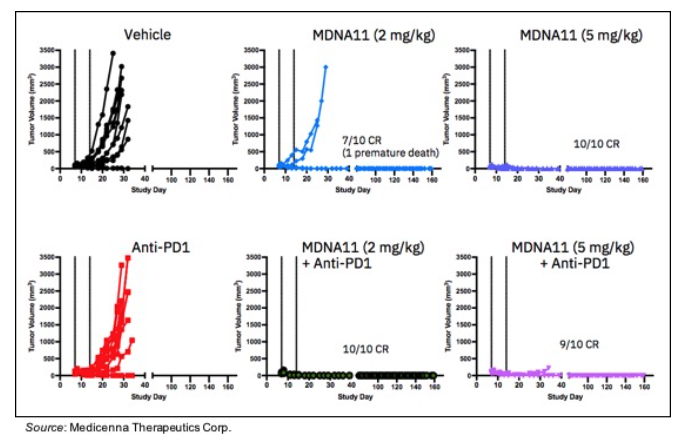
The following graphs show the anti-tumor effect of MDNA11 at two different doses as a monotherapy and in combination with an anti-PD1 antibody in the MC38 mouse model. MDNA11 monotherapy at 5 mg/kg and at 2 mg/kg in combination with an anti-PD1 antibody resulted in complete tumor elimination. The anti-PD1 antibody as a monotherapy was not effective in this model.
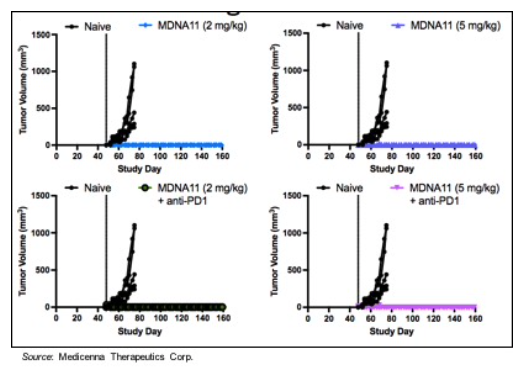
When mice that showed complete tumor regression were re-challenged with tumors, there was no tumor growth seen, as shown in the following figure. This effect was exhibited in mice that had been treated with both MDNA11 monotherapy and in combination with an anti-PD1 antibody and was mediated through the induction of long-term, antigen-specific CD8+ T cells.
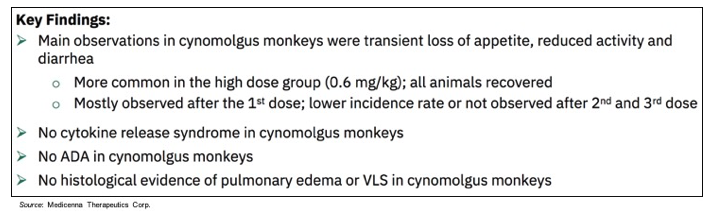
In regards to the NHP study, the following is a summary of key findings, which importantly included no evidence for cytokine release syndrome, no anti-drug antibodies (ADA), no evidence for edema or vascular leak syndrome (VLS), which was been an issue with other IL-2 therapies:
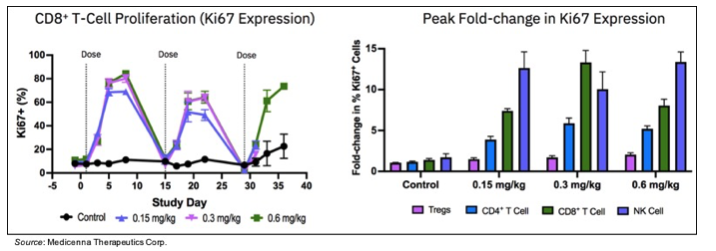
The following graphs show that MDNA11 is able to induce CD8+ T cell proliferation (as shown by Ki67 expression) that peaked approximately 7 days following dosing and returned to base line by Day 15 (lower left) and the peak fold-change in Ki67 expression was much higher in CD8+ T cells and natural killer (NK) cells compared to regulatory T cells (Treg) and CD4+ T cells (lower right). PK data showed that MDNA11 was below the lower limit of quantitation by Day 4-5 following the first dose, however increased Ki67 expression was seen past that, indicating an extended PD effect for MDNA11.
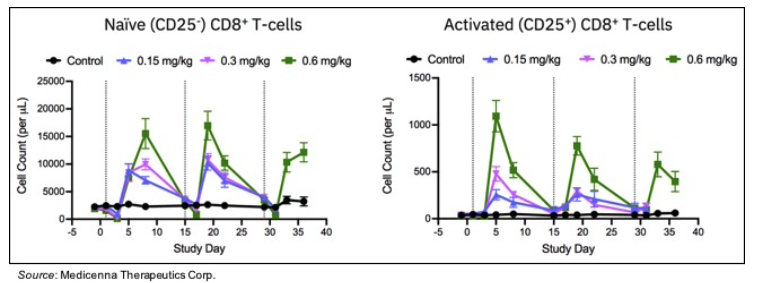
Lastly, as shown in the following graphs, MDNA11 is able to induce the proliferation of both naïve (CD25-) and activated (CD25+) CD8+ T cells, thus allowing for the use of the entire repertoire of CD8+ T cells and potentially leading to a more robust immune response.
Financial Update
On November 12, 2021, Medicenna announced financial results for the second quarter of fiscal year 2022 that ended September 30, 2021. The company reported a net loss for the second quarter of fiscal year 2022 of CAD$8.2 million, or CAD$0.15 per share, compared to a net loss of CAD$3.8 million, or CAD$0.08 per share, for the three months ending September 30, 2020. R&D expenses for the second quarter of fiscal year 2022 were CAD$6.3 million compared to CAD$2.2 million for the second quarter of fiscal year 2021. The increase in expenses was primarily due to increased higher CMC costs, increased preclinical costs due to IND-enabling studies, discovery work on the BiSKITs platform, and higher salary and benefits costs. G&A expenses for the second quarter of fiscal year 2022 were CAD$2.0 million compared to CAD$1.7 million for the three months ending September 30, 2020. The increase was primarily due to increased directors and officer’s liability insurance premiums, increased stock-based compensation, and increased salaries and benefits.
As of September 30, 2021, Medicenna had approximately CAD$26.7 million in cash, cash equivalents, and marketable securities. We estimate Medicenna has sufficient capital to fund operations through the end of calendar 2022. As of November 12, 2021, Medicenna had approximately 54.0 million shares outstanding and, when factoring in options and warrants, a fully diluted share count of approximately 62.4 million.
Conclusion
We are glad to see the ABILITY trial is underway and the first patients have been dosed at clinical sites in Australia. Now that the IND has cleared in the U.S. we anticipate sites opening up there in the first quarter of calendar 2022. We are really looking forward to seeing ‘first-in-human’ data for MDNA11 before the end of calendar 2021 that should include information on safety, PK/PD, and biomarker analysis. Our valuation remains at $12 per share, and with the stock continuing to underperform despite multiple upcoming catalysts investors have a nice opportunity to initiate or add to a position prior to the first data readouts from the ABILITY trial.
SUBSCRIBE TO ZACKS SMALL CAP RESEARCH to receive our articles and reports emailed directly to you each morning. Please visit our website for additional information on Zacks SCR.
DISCLOSURE: Zacks SCR has received compensation from the issuer directly, from an investment manager, or from an investor relations consulting firm, engaged by the issuer, for providing research coverage for a period of no less than one year. Research articles, as seen here, are part of the service Zacks SCR provides and Zacks SCR receives quarterly payments totaling a maximum fee of up to $40,000 annually for these services provided to or regarding the issuer. Full Disclaimer HERE.