By David Bautz, PhD
NASDAQ:VIRI
READ THE FULL VIRI RESEARCH REPORT
Business Update
Update on Phase 2b FORTRESS Trial
Virios Therapeutics, Inc. (NASDAQ:VIRI) is currently conducting the Phase 2b FORTRESS (Fibromyalgia Outcome Research Trial Evaluating Synergistic Suppression of HSV-1) trial of IMC-1 in patients with fibromyalgia (FM). It is a randomized, double blind, placebo controlled, multi-center trial with a primary endpoint of reduction in pain and secondary endpoints including change in fatigue, sleep disturbance, global health status, and patient functionality (NCT04748705). Approximately 460 females between the ages of 18-65 will be enrolled with a study duration of 16 weeks. An outline of the trial is shown below.
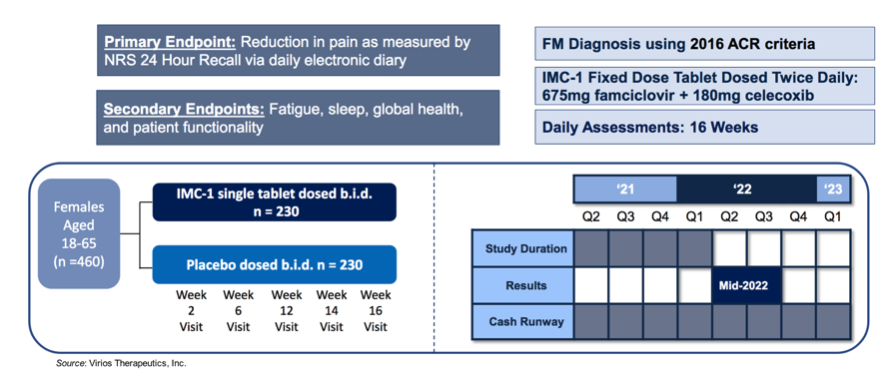
During the third quarter conference call update, management indicated that over 200 patients have been randomized into the trial thus far. In addition, as of now there has been no effect on enrollment due to the ongoing COVID-19 pandemic in the U.S. and based on prior experience Virios does not forecast there being major changes to the rate of enrollment due to COVID-19. We anticipate topline results from the trial in the third quarter of 2022.
IMC-1 to be Tested as Treatment for IBS
During the third quarter conference call, Virios management announced that the company has filed an investigational new drug (IND) application with the FDA in order to test IMC-1 as a treatment for irritable bowel syndrome (IBS).
IBS is a chronic functional bowel disorder that is characterized by recurrent abdominal pain, often accompanied by bloating, related to defecation or in association with a change in stool frequency or form (Mearin et al., 2016). The condition negatively affects the quality of life, with one survey showing that patients would gladly trade 10-15 years of life expectancy for instant release from the disease (Canavan et al., 2014). More women than men are affected by IBS and the population prevalence ranges from 7-16% in the U.S. (Lovell et al., 2012). It is estimated that IBS has direct costs of >$1 billion in the U.S., thus finding effective treatments is important for decreasing the societal and economic impacts of the disease.
Various treatment approaches exist for IBS, including dietary changes, antispasmodic agents, antibiotics, probiotics, anti-inflammatory drugs, and antidepressants. Different prescription options include:
• Viberzi (eluxadoline), which was approved 2015 for IBS with diarrhea and had 2020 revenues of $184 million (EvaluatePharma).
• Xifaxan 550 (rifaximin), which was approved in 2015 for IBS with diarrhea and had 2020 revenues of $767 million (EvalutePharma).
• Linzess (linaclotide), which was approved in 2012 for IBS with constipation and had 2020 revenues of $444 million (EvaluatePharma).
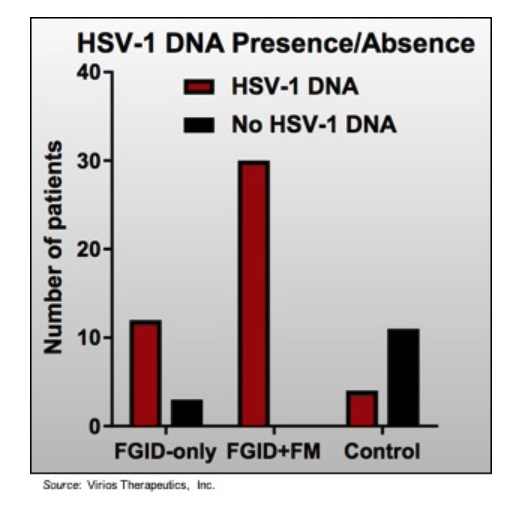
None of the treatments listed above impacts the root cause of the disease, which Virios believes may be due to reactivated HSV-1 and the company has preliminary evidence to support this hypothesis. As shown in the following figure, a study at the University of Alabama showed that the majority of a population of patients with functional gastrointestinal disorders (FGID), which includes IBS, tested positive for HSV-1 DNA, suggesting it may play a role in the disease.
Data from the company’s Phase 2a clinical trial of IMC-1 in FM showed that the drug significantly reduced FM-related pain, which serves as an excellent proof-of-concept for the potential utility of using IMC-1 to treat IBS pain.
The company anticipates feedback on the IND for IBS before the end of 2021 or early in 2022, which could lead to a clinical trial getting underway in mid-2022. The trial will likely be similar in size to the Phase 2a trial of IMC-1 in fibromyalgia, which had approximately 140 patients. Data from the trial could be available in the first half of 2023.
Financial Update
On November 11, 2021, Virios announced financial results for the third quarter of 2021. As expected, the company did not report any revenues for the third quarter of 2021. R&D expenses for the three months ending September 30, 2021 were $3.0 million compared to $0.1 million for the third quarter of 2020. The increase was primarily due to increased expenses for clinical trials, toxicology studiesand drug development and manufacturing. G&A expenses increased were $1.1 million for the third quarter of 2021 compared to $2.5 million for the third quarter of 2020. The decrease was primarily due to compensation expense recognized in 2020 for the issuance of membership interests to Virios’ founder offset by increased costs associated with being a public company.
As of September 30, 2021, Virios had approximately $19.2 million in cash and cash equivalents. We estimate the company has sufficient capital to fund operations through the end of 2022. As of November 11, 2021, Virios had approximately 8.3 million common shares outstanding and, when factoring in stock options and warrants, a fully diluted share count of approximately 9.5 million.
Conclusion
Everything seems to be going according to plan thus far for the Phase 2b FORTRESS trial and we estimate that topline results will be available in the third quarter of 2022. With approximately $19 million in cash and cash equivalents the company is sufficiently capitalized to the end of 2022, and importantly through the data readout for the FORTRESS trial.
We like the decision by management to expand the potential market opportunity for IMC-1 into IBS, particularly given the data showing that HSV-1 activation is seen in those patients. Patients suffering from IBS need additional effective treatment options and we look forward to the initiation of the clinical trial in 2022. We had previously included additional indications for IMC-1 in our model, thus our valuation remains at $22.
SUBSCRIBE TO ZACKS SMALL CAP RESEARCH to receive our articles and reports emailed directly to you each morning. Please visit our website for additional information on Zacks SCR.
DISCLOSURE: Zacks SCR has received compensation from the issuer directly, from an investment manager, or from an investor relations consulting firm, engaged by the issuer, for providing research coverage for a period of no less than one year. Research articles, as seen here, are part of the service Zacks SCR provides and Zacks SCR receives quarterly payments totaling a maximum fee of up to $40,000 annually for these services provided to or regarding the issuer. Full Disclaimer HERE.