By John Vandermosten, CFA
NASDAQ:BCTX
READ THE FULL BCTX RESEARCH REPORT
Bria-IMT Breast Cancer Efficacy Data
BriaCell (NASDAQ:BCTX) attended the Society for Immunotherapy of Cancer (SITC) 37th Annual Meeting and presented data from its Phase I/IIa clinical study of Bria-IMT and described the process for developing its next generation of cellular immunotherapy. The title of the poster is “An off the shelf personalized cellular approach to immunotherapy for the treatment of advanced solid tumors.” The related study generating the data shared in the poster is evaluating the safety and efficacy of the treatment in patients with metastatic or locally recurrent breast cancer. Bria-IMT is being administered in combination with PD-1 inhibitor retifanlimab and has demonstrated favorable results. The poster reviews the clinical performance of Bria-IMT, explains the process for producing the next generation of cellular immunotherapy and discusses its dual mechanism of action.
We discuss this poster in a video interview with CEO Dr. Williams: SITC Poster Presentation
The clinical trial for Bria-IMT, also designated SV-BR-1-GM, has enrolled 33 subjects in monotherapy study and 21 subjects in combination therapy with a PD-1 inhibitor. Patients that responded best in terms of disease control to both the monotherapy and combination therapy shared human leukocyte antigen (HLA) allele matches with the cell line used. For most subjects, the drug regimen effectively reduced tumor size. In the following exhibit, we show change in tumor size for patients in the combination study with both pembrolizumab (in blue) and with retifanlimab (orange).

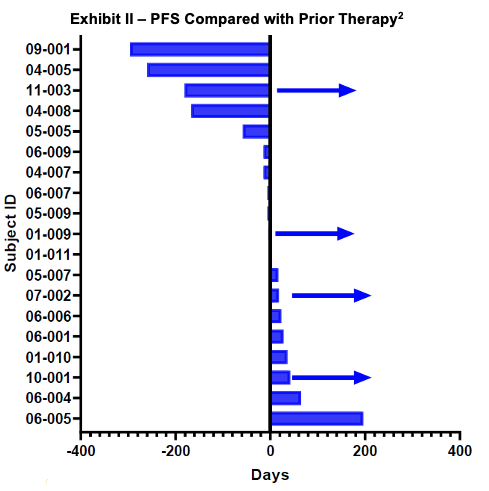
For later line patients that have failed other lines of therapy, it is difficult to determine the effectiveness of a new approach. To partially address this shortcoming, BriaCell compared the length of time on the Bria-IMT combination with the length of time on their prior regimen. Generally, time on therapy becomes shorter and shorter as the patient declines; however, many patients demonstrated longer progression free survival with Bria-IMT and a PD-1 inhibitor as compared to their prior regimen.
The poster provides background information on BriaCell’s next generation cellular immunotherapy which offers two complimentary mechanisms of action: cross-presentation of cancer cell antigens and direct T cell activation. To prepare the therapy, the research group collected cancer cell lines in breast, prostate, melanoma and lung tissue and modified them to provide enhanced immunogenicity. Two primary genetic modifications were made:
➢ Expression of costimulatory molecules (CD80, CD86, 4-1BB-L) and immunomodulatory cytokines (GM-CSF, IFNa, IL-12 and IL-7).
o The purpose of this modification is to enhance the cell's antigen presentation properties.
➢ Expression of an extended repertoire of HLA alleles to generate semi-allogeneic cell lines that will match the whole population at least at one HLA allele.
o The purpose of this approach is to force the host immune response to recognize tumor-associated antigens in the context of allogeneic MHC-I or II molecules or in proximity of strong non-self antigens.
The modifications are expected to enable a set of cell lines that will match over 99% of the patient population for at least one HLA allele. Lentiviral vectors are used to deliver two different genes from independent promoters that will produce the Bria-OTS products. This product will express multiple cytokines and co-stimulatory molecules that can heat up the tumor environment and activate the body’s immune system.

The following exhibit shows the process of developing BriaCell’s next generation of cellular immunotherapy. Gene editing is used to knock out unwanted genes, then a lentiviral vector is used to insert the gene sequence for desired cytokines and co-stimulatory molecules. The result of the modifications is Bria-OTS, a cellular immunotherapy that can match with almost all cancer patients’ HLA types.

BriaCell’s next generation of cellular immunotherapy is expected to address a broader population that should include near 99% of HLA phenotypes. Bria-OTS can be administered after HLA genotypying and does not require additional personalization. With the high degree of matching, Bria-OTS can be an off-the-shelf product that provides a dual mechanism of action with features of both cancer cells and dendritic cells that are expected to enhance the immune response in cancer patients. Bria-OTS can further be a precision therapy with improved safety relative to existing chemotherapy and hormone-based products.
See our interviews with CEO Dr. Bill Williams:
➢ Introduction to Bria-IMT
➢ SITC Poster Presentation Summary
Summary
BriaCell’s poster at SITC updates stakeholders on the most recent performance of the Phase II clinical trial in metastatic or locally recurrent breast cancer. We are also introduced to the process used for the next generation of cellular immunotherapy that provides a dual mechanism of action employing co-stimulatory molecules and expression of additional alleles that allow for a broader population to be addressed.
SUBSCRIBE TO ZACKS SMALL CAP RESEARCH to receive our articles and reports emailed directly to you each morning. Please visit our website for additional information on Zacks SCR.
DISCLOSURE: Zacks SCR has received compensation from the issuer directly, from an investment manager, or from an investor relations consulting firm, engaged by the issuer, for providing research coverage for a period of no less than one year. Research articles, as seen here, are part of the service Zacks SCR provides and Zacks SCR receives quarterly payments totaling a maximum fee of up to $40,000 annually for these services provided to or regarding the issuer. Full Disclaimer HERE.
________________________
1. Lopez-Lago, M., et al. An off-the-shelf personalized cellular approach to immunotherapy for the treatment of advanced
solid tumors. BriaCell SITC annual meeting, Boston. November 8-12, 2022.
2. Lopez-Lago, M., et al. An off-the-shelf personalized cellular approach to immunotherapy for the treatment of advanced
solid tumors. BriaCell SITC annual meeting, Boston. November 8-12, 2022.
3. Lopez-Lago, M., et al. An off-the-shelf personalized cellular approach to immunotherapy for the treatment of advanced
solid tumors. BriaCell SITC annual meeting, Boston. November 8-12, 2022.
4. Lopez-Lago, M., et al. An off-the-shelf personalized cellular approach to immunotherapy for the treatment of advanced
solid tumors. BriaCell SITC annual meeting, Boston. November 8-12, 2022.