By John Vandermosten, CFA
NASDAQ:BLRX
READ THE FULL BLRX RESEARCH REPORT
Commercialization Plans for Motixafortide (APHEXDA®)
BioLineRx Ltd. (NASDAQ:BLRX) submitted its New Drug Application (NDA) to the FDA on September 9, 2022 for Motixafortide (now branded Aphexda) in stem cell mobilization for multiple myeloma patients undergoing autologous bone marrow transplantation. Since then, BioLineRx has undertaken significant pre-commercialization activities and presented a plan to advance commercialization of Aphexda in the United States. On September 27, BioLineRx held a webinar to explain Aphexda’s position in stem cell mobilization, shared details of the apheresis process with a specialized nurse and a patient/caregiver who underwent the procedure and provided a review of the anticipated commercialization plan for Aphexda.
The webinar began with an introduction by CEO Phil Serlin who introduced the participants including the KOL, Dr. John DiPersio. He is Chief of the Division of Oncology, Washington University School of Medicine, St. Louis and was the principal investigator for the GENESIS trial. Dr. DiPersio began his presentation with an explanation of hematopoietic stem cell (HSC) transplantation. HSC transplantation requires stem cell mobilization from the bone marrow into the blood circulation where the stem cells can be collected and set aside for use after treatment for blood cancer in a process called apheresis. Following chemotherapy treatment, the stem cells are returned to the bloodstream where they home into the bone marrow and repopulate, providing the basis for the patient’s post-treatment immune system. One of the difficulties of this procedure is that five to eight days are required to collect sufficient stem cells using the standard agent, granulocyte colony stimulating factor (G-CSF). Other shortcomings related to G-CSF include bone pain and inability to use in all disease types.
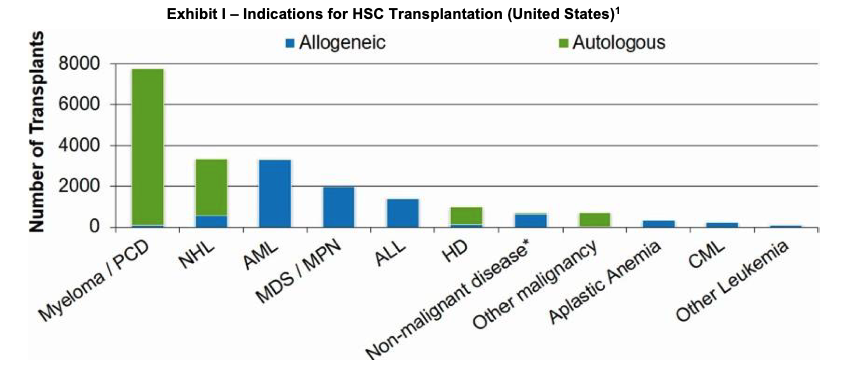
Dr. DiPersio continued his presentation and quantified the number of HSC transplantations conducted per year, which exceeded 14,000 autologous and reached almost 10,000 allogeneic transplants in the United States for 2020. There are other opportunities to use SCM, including those in gene therapy that may increase demand to an even greater extent. The leading indications for HSC transplantation include multiple myeloma, non-Hodgkin’s lymphoma and acute myeloid leukemia among others.
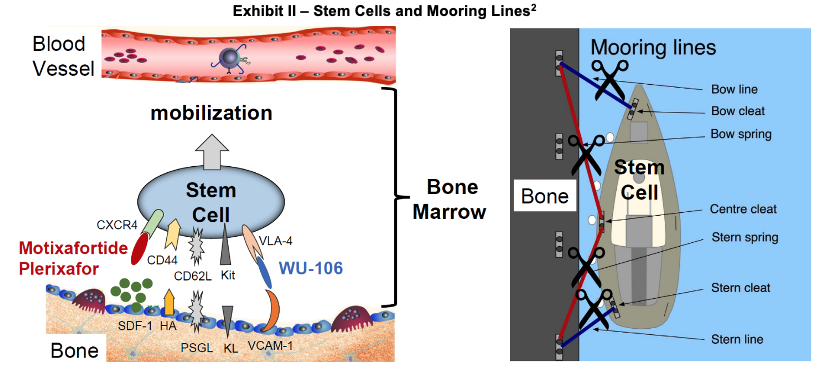
The most engaging part of Dr. DiPersio’s presentation was his explanation of the mechanism of action for stem cell mobilization agents. There are numerous ligand-receptor interactions between stem cells and the perivascular niche which hold stem cells in place. For the stem cell to be mobilized into the bloodstream, the connection between the two must be broken. Several of these ligand-receptor pairs are illustrated in the following illustration. They are similar to mooring lines used to secure a boat to the pier, which must be released before the vessel can depart. Motixafortide is able to break the bonds or mooring lines, allowing the stem cells to drift away from the bone marrow and into circulation, where they later can be collected via apheresis.
Commercialization Plans
With the approval of Motixafortide (now branded Aphexda) on the horizon, BioLineRx is undergoing a significant effort to prepare for commercialization. BioLineRx had initially considered two commercialization models: out-license to a commercial partner and self-commercialization. In many cases when a large salesforce is needed for a non-differentiated product, using a partner is an attractive route. However, for Aphexda, which is substantially more effective than existing standard of care and targets a limited number of transplant centers that will be the predominant users of the product, self-commercialization has many elements in its favor. BioLineRx will be able to maintain a higher percentage of the profits, maintain control over market development, field a small and effective sales team and make a compelling economic case to physicians and health systems for the product. Other favorable factors include the established manufacturing and distribution partners that will support the commercialization effort.
Holly May, President and Chief Commercial Officer, highlighted several of the activities that are already underway in preparation for first sales. Efforts that require a long lead time including manufacturing, distribution, licensing, pricing and stakeholder relationships are being developed. Presence of BioLineRx USA in the Boston area provides access to a talent pool for managing the sales process and finding medical affairs specialists.
At this point it is unknown if the FDA will consider Aphexda’s New Drug Application (NDA) under Priority Review or a standard review. A Priority designation is associated with a six month rather than a ten-month review and if granted would produce a target action date that is expected to be in 2Q:23.
BioLineRx is putting all of its efforts forward to be able to launch within a couple weeks of an FDA approval. In preparation for this, there are relationship building programs which include a medical affairs scientific exchange, preparation for journal publication and medical service liaison (MSL) engagement.
Management is relying on the strong efficacy and economic case for Aphexda. Using the product can improve efficiencies for apheresis unit scheduling and increase throughput. This is in addition to the quality-of-life benefit for a patient who will likely be able to complete their procedure in one day rather than three or four. The obstacles faced by multiple myeloma patients were made clear in the webinar segment that interviewed patient and caregiver Mary and Albert Quarterman where transportation, lodging, separation from family and additional responsibilities make each successive day incrementally harder. Aphexda’s ability to obtain sufficient cells in one day for 90% of patients can dramatically reduce the burden on all stakeholders.
Over the long term there are opportunities to expand into peripheral indications such as autologous stem cell-based gene therapies, allogeneic transplants and other blood cancers and conditions. BioLineRx will not initially pursue these indications; however, physicians may elect to use the product anyway.
SUBSCRIBE TO ZACKS SMALL CAP RESEARCH to receive our articles and reports emailed directly to you each morning. Please visit our website for additional information on Zacks SCR.
DISCLOSURE: Zacks SCR has received compensation from the issuer directly, from an investment manager, or from an investor relations consulting firm, engaged by the issuer, for providing research coverage for a period of no less than one year. Research articles, as seen here, are part of the service Zacks SCR provides and Zacks SCR receives quarterly payments totaling a maximum fee of up to $40,000 annually for these services provided to or regarding the issuer. Full Disclaimer HERE.
________________________
1. Source: BioLineRx Corporate Presentation, September 2022 KOL Event.
2. Source: BioLineRx Corporate Presentation, September 2022 KOL Event.