By John Vandermosten, CFA
NASDAQ:BLRX
READ THE FULL BLRX RESEARCH REPORT
Third Quarter 2022 Operational and Financial Results
On November 15, 2022, BioLineRx Ltd. (NASDAQ:BLRX) reported 3Q:22 operational and financial results in a press release concurrent with the filing of Form 6-K. A conference call and webcast were hosted later that morning. Key highlights since the previous earnings update in August include a comprehensive analyst day event which detailed BioLineRx’ lead candidate motixafortide, the burdens a multiple myeloma patient and the company’s commercialization efforts. A new drug application (NDA) for Motixafortide in stem cell mobilization (SCM) was submitted and given a Prescription Drug User Fee Act (PDUFA) target action date of September 9, 2023. Additional capital of $55 million was raised using both debt and equity to support Aphexda commercialization efforts and new executive Holly May was promoted to President of BioLineRx USA.
Milestones include:
➢ BL-8040 NDA submission for stem cell mobilization (SCM) – September 2022
➢ NDA acceptance and PDUFA date assignment – November 2022
Below we summarize financial results for the period ended September 30, 2022, compared to the same period ending a year prior:
➢ Research and development expenses totaled $4.4 million, down 11% from $4.9 million, on account of lower expenses related to motixafortide NDA-supporting activities and decreased expenses associated with the completed motixafortide GENESIS clinical trial, offset by an increase in payroll and related expenses;
➢ Sales and marketing expenses were $1.3 million, up 430% from $0.2 million on account of initiation of pre-commercialization activities related to motixafortide and an increase in market research;
➢ General and administrative (G&A) expenses were $1.4 million, up 33% from $1.0 million due to a rise in share-based compensation and small increases across several G&A expense categories;
➢ Non-operating income was $0.4 million reflecting changes in fair-value adjustments of warrant liabilities on the balance sheet, offset by warrant offering expenses;
➢ Net financial expenses amounted to $0.2 million which was impacted by interest paid on loans, interest received from cash balances and strengthening of the US dollar;
➢ Net loss was ($6.8) million compared with ($5.7) million, or ($0.01) and ($0.01) per share respectively.
Cash, equivalents and short-term bank deposits as of September 30, 2022 totaled $57.3 million, close to the year end 2021 balance of $57.1 million. BioLineRx raised a gross $55 million from debt and equity issuances in September increasing cash levels. Cash burn during 3Q:22 amounted to ($8.7) million which was offset by a net $22.7 million contribution from financing cash flows.
Commercialization Plans for Motixafortide (APHEXDA®)
BioLineRx submitted its New Drug Application (NDA) to the FDA on September 9, 2022 for Motixafortide (now branded Aphexda) in stem cell mobilization for multiple myeloma patients undergoing autologous bone marrow transplantation. Since then, BioLineRx has undertaken significant pre-commercialization activities and presented a plan to advance commercialization of Aphexda in the United States. On September 27, BioLineRx held a webinar to explain Aphexda’s position in stem cell mobilization, shared details of the apheresis process with a specialized nurse and a patient/caregiver who underwent the procedure and provided a review of the anticipated commercialization plan for Aphexda.
The webinar began with an introduction by CEO Phil Serlin who introduced the participants including the key opinion leader (KOL), Dr. John DiPersio. He is Chief of the Division of Oncology, Washington University School of Medicine, St. Louis and was the principal investigator for the GENESIS trial. Dr. DiPersio began his presentation with an explanation of hematopoietic stem cell (HSC) transplantation. HSC transplantation requires stem cell mobilization from the bone marrow into the blood circulation where the stem cells can be collected and set aside for use after treatment for blood cancer in a process called apheresis. Following chemotherapy treatment, the stem cells are returned to the bloodstream where they home in to the bone marrow and repopulate, providing the basis for the patient’s post-treatment immune system. One of the difficulties of this procedure is that five to eight days are required to collect sufficient stem cells using the standard agent, granulocyte colony stimulating factor (G-CSF). Other shortcomings related to G-CSF include bone pain and inability to address all disease types.
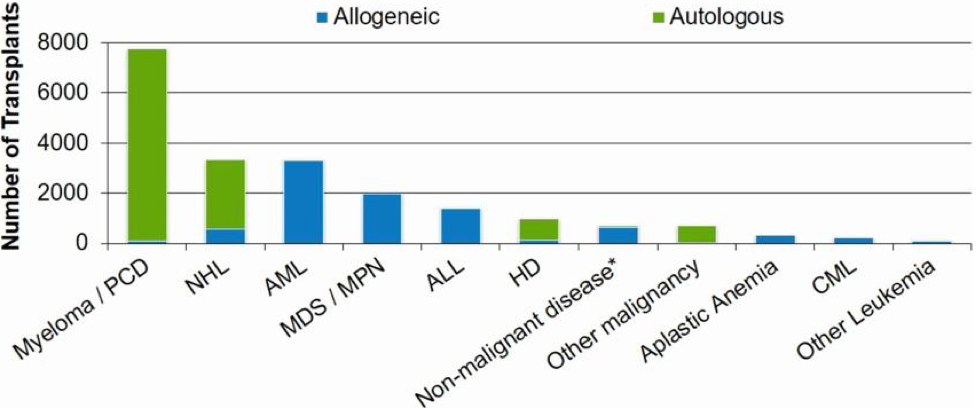
Dr. DiPersio continued his presentation and quantified the number of HSC transplantations conducted per year, which exceeded 14,000 autologous and reached almost 10,000 allogeneic transplants in the United States for 2020. There are other opportunities to use SCM, including those in gene therapy that may increase demand to an even greater extent. The leading indications for HSC transplantation include multiple myeloma, non-Hodgkin’s lymphoma and acute myeloid leukemia among others.
Exhibit I – Indications for HSC Transplantation (United States) 1
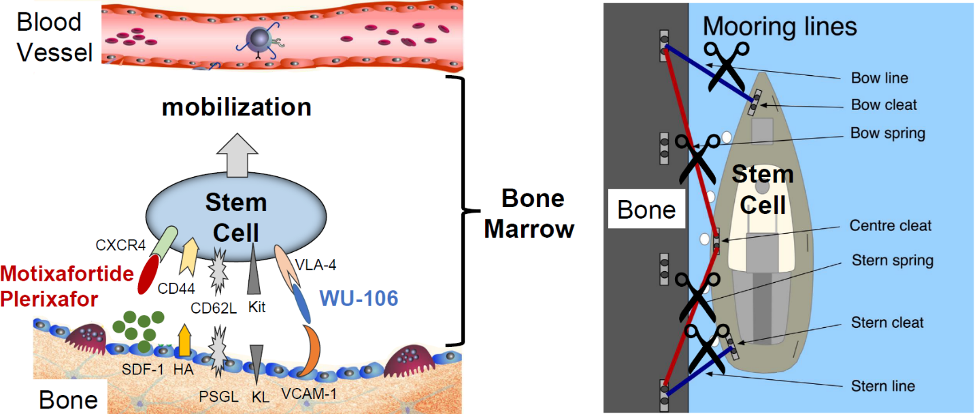
The most engaging part of Dr. DiPersio’s presentation was his explanation of the mechanism of action for stem cell mobilization agents. There are numerous ligand-receptor interactions between stem cells and the perivascular niche which hold stem cells in place. For the stem cell to be mobilized into the bloodstream, the connection between the two must be broken. Several of these ligand-receptor pairs are illustrated in the following illustration. They are similar to mooring lines used to secure a boat to the pier, which must be released before the vessel can depart. Motixafortide is able to break the bonds or mooring lines, allowing the stem cells to drift away from the bone marrow and into circulation, where they later can be collected via apheresis.
Exhibit II – Stem Cells and Mooring Lines 2
Commercialization Plans
With the approval of Motixafortide (now branded Aphexda) on the horizon, BioLineRx is undergoing a significant effort to prepare for commercialization. BioLineRx had initially considered two commercialization models: out-license to a commercial partner and self-commercialization. In many cases when a large salesforce is needed for a non-differentiated product, using a partner is an attractive route. However, for Aphexda, which is substantially more effective than existing standard of care and which targets a limited number of transplant centers that will be the predominant users of the product, self-commercialization has many elements in its favor. BioLineRx will be able to maintain a higher percentage of the profits, maintain control over market development, field a small and effective sales team and make a compelling economic case to physicians and health systems for the product. Other favorable factors include the established manufacturing and distribution partners that will support the commercialization effort.
Holly May, President and Chief Commercial Officer, highlighted several of the activities that are already underway in preparation for first sales. Efforts that require a long lead time including manufacturing, distribution, licensing, pricing and stakeholder relationships are being developed. Presence of BioLineRx USA in the Boston area provides access to a talent pool for managing the sales process and finding medical affairs specialists.
BioLineRx is preparing to be able to launch Aphexda within a couple weeks of an FDA approval. Efforts in support of this goal include relationship building programs which include a medical affairs scientific exchange, development of journal articles for publication and engagement with stakeholders by medical service liaisons (MSL).
Management is relying on the strong efficacy and economic case for Aphexda. Using the product can improve efficiencies for apheresis unit scheduling and increase throughput. This is addition to the quality-of-life benefit for a patient who will likely be able to complete their procedure in one day rather than three or four. The obstacles faced by multiple myeloma patients were made clear in the webinar segment that interviewed patient and caregiver Mary and Albert Quarterman where transportation, lodging, separation from family and additional responsibilities make each successive day incrementally harder. Aphexda’s ability to obtain sufficient cells in one day for 90% of patients can dramatically reduce the burden on all stakeholders.
Over the long term there are opportunities to expand into peripheral indications such as autologous stem cell-based gene therapies, allogeneic transplants and other blood cancers and conditions. BioLineRx will not initially pursue these indications; however, physicians may elect to use the product anyway.
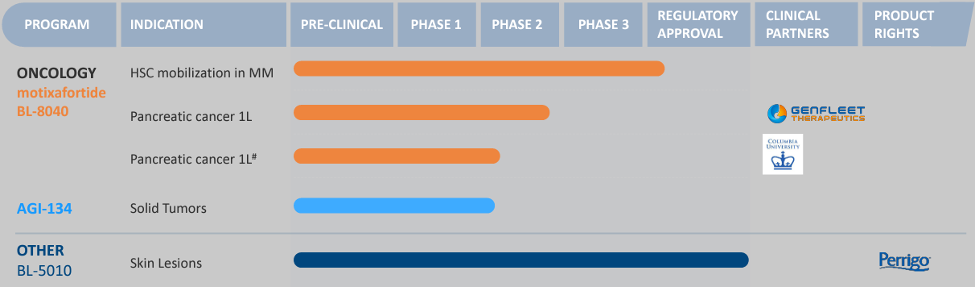
Exhibit III – BioLineRx Pipeline 3
Upcoming Milestones
➢ BL-8040 NDA submission for stem cell mobilization (SCM) – September 2022
➢ Acceptance of NDA by FDA – November 2022
➢ AGI-134 Phase I/IIa initial results – 4Q:22
➢ Presentation of GENESIS data at medical meetings & conferences – 2022/2023
➢ Phase II combination study of motixafortide to initiate with GenFleet – 2023
➢ Data published for Phase II PDAC trial - 2023
➢ Motixafortide in SCM target action (PDUFA) date – September 2023
➢ US launch of motixafortide in SCM – 3Q:23
➢ Potential initiation of randomized Phase 2 study of AGI-134 – 2023
Valuation Update
We update our valuation to reflect BioLineRx’ internal commercialization of motixafortide (Aphexda) for stem cell mobilization in multiple myeloma. Rather than negotiate a royalty from an established partner, BioLineRx’ internal sales force will commercialize the product in a targeted number of centers in the United States. Note that the change from licensing Aphexda to commercializing it in house shifts royalty revenues to product sales revenues and therefore includes cost of goods sold, additional sales and marketing costs and a small increase in general and administrative expenses on the income statement. We forecast research and development expenditures to decline in successive years. General and administrative expenses are also forecasted to rise given the expansion of overall activities at BioLineRx. The shift in our valuation model from having a partner commercialize Aphexda and paying BioLineRx royalty revenues to conducting this work internally results in a reduction in product revenues reflecting a smaller sales force as compared to a big pharma partner, but an increase in the amount of profit BioLineRx will keep from the venture.
Summary
On November 15, 2022, BioLineRx reported third quarter 2022 financial and operational results. Highlights for the quarter and to date include submission and acceptance of the motixafortide BLA and preparations for immediate commercialization if the candidate is approved. A PDUFA data was assigned for September 2023. BioLineRx will continue to work on the other programs in its portfolio and with its partners including GenFleet Therapeutics and Columbia University for the advancement in its oncology programs. We also expect to hear initial results from the AGI-134 trial shortly.
The market for motixafortide is sizable with approximately 23,000 stem cell transplants taking place per year in the United States. About 59% of these are autologous and 90% are in multiple myeloma (MM) and lymphomas with about 65% of the autologous MM and lymphoma patients appropriate for the therapy. BioLineRx’ second indication for motixafortide is in pancreatic cancer which is being developed in Phase II trials. Our timeline anticipates that a Phase II/III or Phase III trial will be launched in the next year producing top-line in 2026, followed by submission to regulatory agencies in the US, Europe and China. We also model development and eventual commercialization of AGI-134 in the United States.
SUBSCRIBE TO ZACKS SMALL CAP RESEARCH to receive our articles and reports emailed directly to you each morning. Please visit our website for additional information on Zacks SCR.
DISCLOSURE: Zacks SCR has received compensation from the issuer directly, from an investment manager, or from an investor relations consulting firm, engaged by the issuer, for providing research coverage for a period of no less than one year. Research articles, as seen here, are part of the service Zacks SCR provides and Zacks SCR receives quarterly payments totaling a maximum fee of up to $40,000 annually for these services provided to or regarding the issuer. Full Disclaimer HERE.
________________________
1. Source: BioLineRx Corporate Presentation, September 2022 KOL Event.
2. Source: BioLineRx Corporate Presentation, September 2022 KOL Event.
3. BioLineRx November 2022 Corporate Presentation